


Let's cut through the noise.

David van der Merwe
新興市場トレーダー ·  South Africa
☕ 9 分で読める
学べること:
- 1What Demo Apps Actually Are (And Aren't)
- 2The 3 Demo Mistakes That Are Killing Your Progress
- 3How to Set Up a Proper Demo Environment
- 4The Bridge: Moving from Demo to Live Without Blowing Up
- 5Beyond the Basics: Advanced Uses for Experienced Traders
- 6Choosing a Demo App: What Matters for South Africans
- 7The Final Lesson: Knowing When to Ditch the Demo

Let's cut through the noise. Every new trader in South Africa gets the same advice: 'Start with a demo account.' It's presented as the golden ticket, a risk-free playground where you can make millions in virtual Rand before touching the real market. I'm here to tell you that's a myth, and a dangerous one. Most people use demo apps completely wrong, building habits that guarantee they'll blow their first live account. I've seen it a hundred times. This guide isn't about praising demo apps; it's about showing you how to use them properly, so you don't become another statistic.
First, let's get our definitions straight. A forex trading demo app is a simulation platform offered by a broker, like Exness or IC Markets, that gives you virtual money to trade with real-time market prices. That's it. It's not a trading course, a strategy validator, or a crystal ball. Its sole purpose is to familiarize you with a broker's specific trading terminal - MT4, MT5, or their own platform - and the basic mechanics of placing an order.
What it isn't is a realistic trading environment. The psychology is completely absent. Losing R10,000 of pretend money feels nothing like watching your hard-earned salary evaporate on a bad EUR/USD trade. The slippage, requotes, and occasional platform freezes you'll face with real money? Often smoothed over in the demo. You're trading in a frictionless fantasy world, and if you don't know that, you're being set up.

Warning: The biggest lie of demo trading is that it proves a strategy works. It doesn't. It only proves you can click buttons. Real validation requires live market conditions and, crucially, your emotional response to them.
“A demo account's sole purpose is to familiarize you with a broker's terminal, not to make you a profitable trader.”
I've reviewed hundreds of demo accounts from my students. These three errors are almost universal.
Mistake 1: Trading with Monopoly Money
You get R1,000,000 in demo capital. So what's your first move? You open a massive 10-lot position on USD/ZAR because, hey, it's not real. This teaches you nothing about proper position size calculation. When you switch to a live account with R20,000, your sense of scale is utterly broken. You'll risk 50% of your account on a single trade because that's what felt 'normal' in the demo.
Mistake 2: The Scattergun Approach
With no consequence, you jump from a scalping strategy to swing trading in the same hour. You test ten indicators at once. You have no process. The demo becomes a video game, not a training ground. Consistency, the bedrock of real trading, is never developed.
Mistake 3: Ignoring the Logistical Reality
You're in Cape Town with a 100mbps line. Demo execution is instant. But what happens when you're trading from a guesthouse in Plettenberg Bay on shaky Wi-Fi during a major news event? The delay and potential margin call won't be part of your demo experience. You also likely ignore the spread costs, which eat directly into your profits, especially on exotic pairs like USD/ZAR.
I made Mistake #1 myself early on. My demo was up 300% in a month trading huge sizes. I felt like a genius. I funded a live account, used the same reckless sizing, and lost 40% of it in two days. The virtual profits had taught me arrogance, not skill.

💡 ウィンストンのヒント
Your first demo goal isn't profit. It's to make 100 trades where you follow your position sizing rules to the letter, without a single exception. Boring discipline beats exciting genius every time.
“If you can't stick to a plan with fake money, you have zero chance with real money.”
To make a demo useful, you have to force reality upon it. Here’s how.
1. Mirror Your Real Capital: If you plan to start live with R15,000, fund your demo with R15,000. Not a ZAR more. This forces you to think about capital preservation from day one.
2. Implement Realistic Position Sizing: Use a position size calculator for every single trade. Decide your risk per trade (e.g., 1% of your demo capital) and stick to it religiously. If your demo is R15,000, you risk R150 per trade. This habit must be automatic.
3. Choose the Right Broker Demo: Don't just download any app. Use the demo of the broker you actually intend to use, like Pepperstone or XM. Get familiar with their spreads, execution speed, and platform quirks. If you plan to trade USD/ZAR, check the average spread on that pair during your trading hours (SA evening often has wider spreads).
4. Trade Your Plan, Not the Market: Write down a simple trading plan before you open the demo. It should include: what pairs you'll trade (stick to majors like EUR/USD to start), your strategy rules, your daily loss limit. Then follow it. The goal is not to make fake money, but to build discipline.

Pro Tip: Set a weekly 'salary' for yourself from the demo profits. If you make R2,000 in week one, 'transfer' it out. Start week two with your original R15,000 again. This simulates the reality of withdrawing profits and prevents you from letting a lucky streak inflate your trading size.
“If you can't stick to a plan with fake money, you have zero chance with real money.”
This is the moment where most fail. The transition is a chasm, not a step. Your demo success means nothing if you can't handle the psychological shift.
First, acknowledge you will be scared. Your hands will sweat. That's normal. The trick is to make your first live trades so small that the fear is manageable. I tell my students to risk 0.5% of their account or less on their first 10-20 live trades. Yes, the potential profit is tiny. But the goal isn't profit; it's acclimatization. You're paying a small tuition fee to learn how your mind reacts to real pips of gain and loss.
Second, keep your demo account open. Use it to test new ideas or practice adjustments to your strategy. But never use it to 'revenge trade' after a live loss. That just reinforces bad habits.
Finally, understand that live markets behave differently. I learned this trading Gold (XAU/USD). On demo, my stops were always filled neatly at my price. On my first live trade during a volatile period, I got slipped 3 dollars worse on my stop-loss. That R400 extra loss felt like a punch in the gut. It was a cheap lesson in market liquidity that my demo app had completely hidden from me.
💡 ウィンストンのヒント
If your demo account isn't boring you, you're probably doing it wrong. The thrill should come from executing a plan perfectly, not from watching fake numbers go up.

“The virtual profits had taught me arrogance, not skill.”
Demo apps aren't just for newbies. Even after 12 years, I still use them. Here's how.
Strategy Backtesting: Got a new idea based on the MACD indicator divergence? Don't code a complex backtester. Manually walk through the charts on your demo platform. Go back in time and paper-trade the setup 20-30 times. Keep a log. It's tedious, but it gives you a 'feel' for the strategy that automated backtesting can't.
Broker Comparison: Considering a new broker? Don't just read reviews. Open their demo and the demo of your current broker side-by-side. Execute the same trade on both during a news event. Which one gives you a better price? Which one has less slippage? This is due diligence with data you can trust.
Platform Feature Testing: New tools come out all the time. Maybe you want to practice using a trailing stop or a multi-level entry grid. Screwing it up in demo is free. For instance, mastering a tool that lets you set multiple take-profit levels is a skill. Doing it wrong can turn a winning trade into a loser. A demo lets you make that mistake cost-free.

Example: I once tested a grid trading strategy on a XM demo. I set 10 buy orders at intervals below price. It worked beautifully in a ranging market. I went live. The market trended strongly down instead. I didn't have a firm stop-loss for the entire grid, and the demo hadn't punished me for that oversight. Live account drawdown: 12%. The demo had shown me the mechanics but hidden the critical risk.
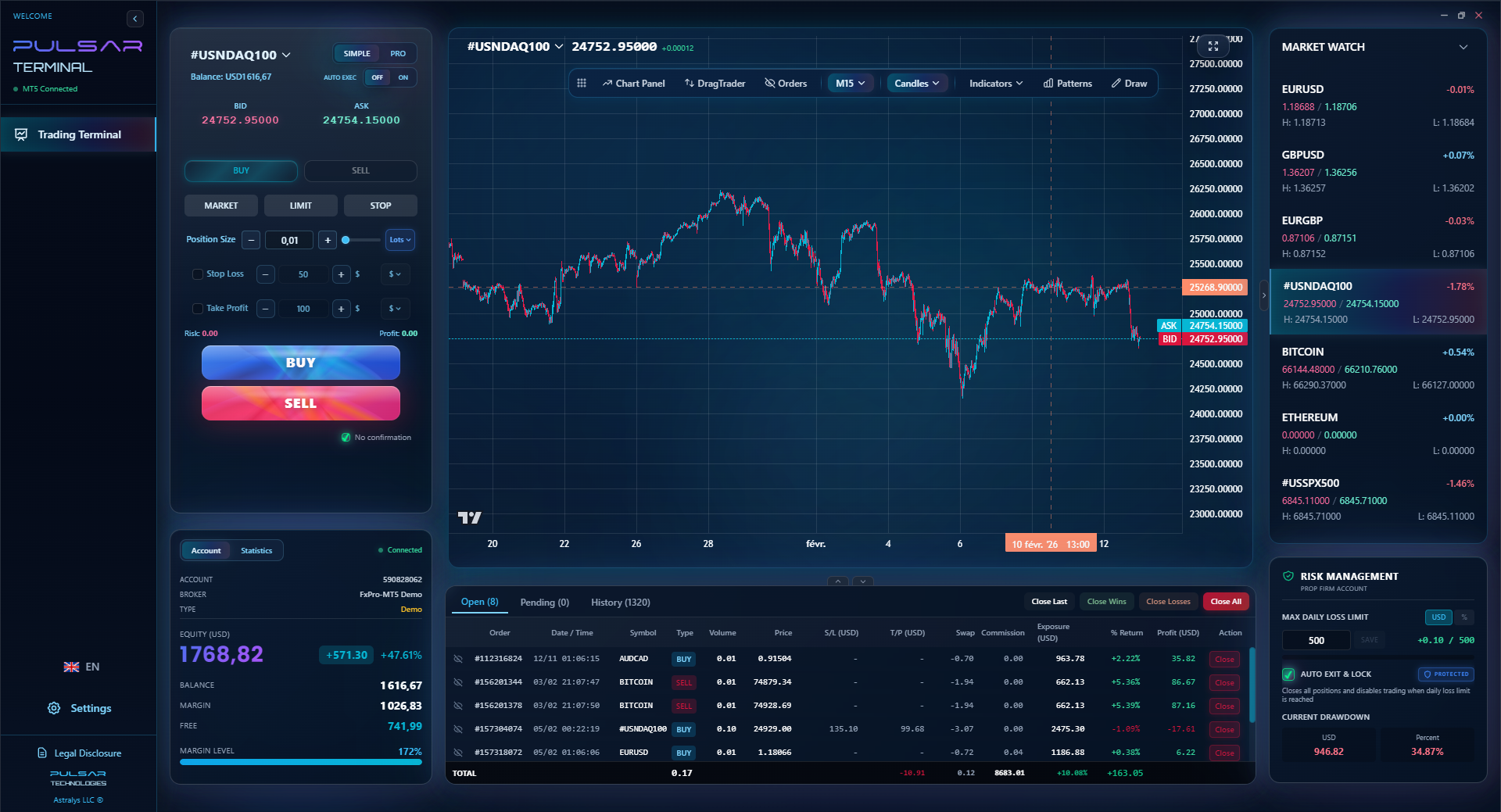
When testing complex order types like grids or multi-level take-profits on demo, a tool like Pulsar Terminal lets you practice setting them up efficiently on MT5 before you ever risk real money.
Pulsar Terminal
MT5オールインワンツール:ドラッグ&ドロップ注文、マルチTP/SL、トレーリングストップ、グリッドトレード、出来高プロファイル、プロップファーム保護。毎日1,000人以上のトレーダーが利用。
“The virtual profits had taught me arrogance, not skill.”
Not all demo apps are created equal, especially from our perspective. Here’s what to look for.
| Feature | Why It Matters for South Africans |
|---|---|
| Local Deposit/Withdrawal Sim | Does the demo let you simulate funding in ZAR? This helps you understand the conversion costs and process. |
| USD/ZAR & Other Relevant Pairs | Can you trade USD/ZAR, EUR/ZAR, GBP/ZAR? If you want to trade these, the demo must offer them with realistic spreads. |
| No Expiry Date | Some demos expire after 30 days. Avoid them. You need an unlimited demo to properly test long-term consistency. |
| MT4/MT5 Demo | These are the global standards. If you learn on a broker's proprietary app, you limit your future options. Stick to MT4/MT5 demos. |
Our Local Reality: Your internet isn't as stable as in London or New York. A good demo will sometimes lag or disconnect, giving you a taste of that reality. A 'perfect' demo that never fails is actually a worse training tool for us.
Focus on brokers with a strong local presence and reliable platforms. The demo is your test drive of their entire service. If their demo is clunky, slow, or lacks ZAR pairs, their live service likely won't be any better.
💡 ウィンストンのヒント
The moment you feel contempt for the 'play money' in your demo, it's time to fund a small live account. That contempt is the psychological edge you need to start respecting real risk.
“Your first live goal is survival, then consistency, then profitability.”
The demo account has a shelf life. If you use it too long, it becomes a crutch that stunts your growth. Here are the signs it's time to go live with a tiny account:
- You've Been Consistently 'Profitable' for 3 Months: Not just up overall, but with consistent weekly results, following your rules, using proper position sizing. Three months of simulated discipline is a decent baseline.
- The Excitement is Gone: Trading on demo feels boring. You're following your checklist mechanically. This is good. It means the process is becoming habitual, which is what you need.
- You're Starting to Get Careless: This is the counter-intuitive one. If you find yourself breaking rules on demo because 'it doesn't matter,' you need the psychological sting of real money to re-establish discipline. A small live account can provide that.
Don't expect the live results to match your demo. They won't. Your first live goal is survival, then consistency, then profitability. The forex trading demo apps got you to the starting line. The real race, with all its bumps and potholes, starts now.
FAQ
Q1How much virtual money should I start with in a forex demo app?
Start with the exact amount of real money you plan to deposit. If it's R10,000, use R10,000. This trains your brain for realistic capital management from day one. Starting with R1,000,000 is a fantasy that builds terrible habits.
Q2Can I really learn to trade just using a demo app?
You can learn the mechanics, like placing orders and reading charts. But you cannot learn the psychological discipline required for real trading. That only comes from risking your own money. A demo teaches you how to drive a car in an empty parking lot. Live trading is driving in Johannesburg rush-hour traffic.
Q3My demo trading is profitable, but I lose money live. Why?
This is the most common story. It's almost always down to psychology and unrealistic demo conditions. On demo, you patiently wait for perfect setups. On live, fear and greed make you jump into mediocre trades. Also, live execution has slippage and wider spreads that your demo likely smoothed over.
Q4Are there any demo apps that simulate emotions?
No, and anyone who claims otherwise is selling something. True trading psychology comes from the real consequence of loss. Some apps might have quizzes or scenarios, but the gut-churning feeling of a losing trade can't be simulated. You have to experience it with small, affordable amounts of real capital.
Q5How long should I use a demo account before trading live?
There's no set time. It's based on performance, not days. I'd say a minimum of 2-3 months of consistent, rule-based, disciplined trading on demo where you treat the virtual money as real. If you can't stick to a plan with fake money, you have zero chance with real money.
Q6Is it bad to use a demo account after I start live trading?
Not at all. It's smart. Use your live account for your proven, main strategy. Use the demo to test new ideas, indicators, or timeframes. It keeps your live account safe while allowing for experimentation. Just keep the two activities completely separate in your mind.
ウィンストン教授のレッスン
重要ポイント:
- ✓Fund your demo with your intended real capital amount, not a fantasy million.
- ✓Risk a fixed percentage (like 1%) on every demo trade to build the habit.
- ✓Demo execution hides slippage; expect worse fills with real money.
- ✓Transition live by risking 0.5% or less to acclimate your psychology.
- ✓Use demo indefinitely for testing, but know when to leave it for your main strategy.
この記事はどれくらい役に立ちましたか?
星をクリックして評価
週刊トレーディングインサイト
無料の週刊分析&戦略。スパムなし。
著者について
David van der Merwe
新興市場トレーダー
ヨハネスブルグ拠点で新興市場通貨11年のトレーダー。ZARペア、FSCA規制下の取引、南アフリカ市場分析を専門とする。
コメント
リスク警告
金融商品の取引には大きなリスクが伴い、すべての投資家に適しているわけではありません。過去の実績は将来の結果を保証するものではありません。本コンテンツは教育目的のみであり、投資助言として解釈すべきではありません。取引前に必ずご自身で調査を行ってください。
こちらもおすすめ

Cara Trading Forex Sukses: 7 Prinsip dari Trader Profesional
Cara trading forex sukses dengan 7 prinsip trader pro: manajemen modal, disiplin, journal trading, backtest. Data nyata, bukan janji profit palsu.
Jam Trading Forex Terbaik untuk Trader Indonesia: Panduan Lengkap dengan Tabel Waktu
Panduan jam trading forex untuk trader Indonesia. Tabel 4 sesi dunia, jam emas 20:00-00:00, sesi mana yang harus dihindari. Data akurat + tips dari trader berpengalaman.
Top 5 Sàn Forex Uy Tín Nhất 2026: Review Jujur dari Trader Indonesia
Top 5 sàn forex uy tín 2026 untuk trader Indonesia. Review jujur: spread, deposit, withdraw, dukungan lokal. Exness, XM, IC Markets & lebih.
