


Let's be brutally honest: most South Africans who try forex trading lose all their money within six months.

David van der Merwe
新興市場トレーダー ·  South Africa
☕ 11 分で読める
学べること:
- 1Why Most South African Traders Fail (The Real Reasons)
- 2South African Regulations You Can't Ignore
- 3The Real Costs of Trading in South Africa
- 4Choosing a Broker as a South African Beginner
- 5Building Your First South African Trading Plan
- 6Common Pitfalls (And How to Avoid Them)
- 7From Demo to Live: The Dangerous Transition
Let's be brutally honest: most South Africans who try forex trading lose all their money within six months. It's not because they're stupid or lazy. It's because they're sold a dream by slick marketing and have no idea how the game is actually played. I've been trading for over 12 years, and I've seen this story repeat itself a thousand times. This guide isn't about getting rich quick. It's about understanding the real rules, the real costs, and the real psychology you need to survive. If you're a beginner in South Africa, this is the unvarnished truth you need before you deposit a single rand.
The failure rate isn't a mystery. It's a predictable outcome of specific, avoidable mistakes. The first killer is use. Since 2021, the FSCA has capped retail use at 30:1. That's still insane for a beginner. On a R10,000 account, that's R300,000 of market exposure. A 3% move against you wipes you out. Beginners see this as 'more buying power.' Professionals see it as a guaranteed margin call waiting to happen.
The second killer is trading the ZAR pairs emotionally. USD/ZAR, EUR/ZAR – we watch these every day in the news. We have opinions. Trading your opinion is a surefire way to lose money. I learned this the hard way in 2016. I was convinced the Rand would strengthen after a political event. I went heavy on USD/ZAR shorts. The pair ripped 500 pips against me in two days. I lost 40% of my account because I traded a headline, not a chart.
Finally, there's the 'side hustle' mentality. You can't treat this like a weekend hobby. The market doesn't care if you have a day job. If you're not treating it with the same rigor as a second business, you're just gambling. The brokers and signal sellers love this mentality. You won't.

💡 ウィンストンのヒント
The market's job is to make you feel stupid and emotional. Your job is to follow your plan anyway. The moment you start arguing with the price, you've already lost.
“The 30:1 use cap isn't a restriction; it's a life jacket for beginners who don't know they're drowning.”
This is the most important section for any beginner. Getting this wrong can mean losing all your money with zero recourse.
The FSCA is Your First Line of Defence
The Financial Sector Conduct Authority (FSCA) is the only regulator that matters for you. If your broker isn't licensed by them, walk away. It's that simple. You can check any broker's FSP number on the FSCA's public register. This isn't bureaucracy; it's your protection. FSCA-regulated brokers must segregate client funds. This means your money is held separately from the broker's operating money. If the broker goes bust (it happens), your funds should be safe.
The use Cap is a Blessing
That 30:1 use cap for retail clients? Thank the FSCA for it. Offshore brokers will dangle 500:1 or even 2000:1 in front of you. It's poison. The cap forces you to use less use, which is the single best thing for a beginner's survival. I recommend you use far less than the maximum. Start with 5:1 or 10:1 while you learn.
The Tax Reality
Yes, your profits are taxable. You must declare them to SARS. Keep a detailed trade journal. Every profit, every loss. When you start making consistent money, get a good accountant who understands trading income. Trying to hide it isn't worth the hassle.

Warning: The FSCA issued over a hundred public warnings in early 2025, mostly about fake 'signal sellers' on social media and cloned broker websites. If someone on WhatsApp or Telegram is promising guaranteed returns, they are guaranteed to be a scam. Only use licensed providers.
Moving Money Offshore
You have two main allowances:
- Single Discretionary Allowance (SDA): R1 million per year. No tax clearance needed.
- Foreign Investment Allowance (FIA): R10 million per year. You'll need a Tax Compliance Status (TCS) pin from SARS.
If you use an FSCA-licensed broker with a local entity, you can often deposit in ZAR directly, simplifying this process. Brokers like IG and AvaTrade have strong local presence.
“Your trading plan is useless if you abandon it the first time a trade goes against you.”
Brokers advertise 'zero commission' or 'tight spreads.' Here's what they're not telling you, and how it eats your account alive.
The Spread is Your First Loss. On EUR/USD, a 'tight' spread might be 0.9 pips. On a standard lot (100,000 units), that's a $9 cost to open the trade. You're down $9 before the market even moves. On ZAR pairs like USD/ZAR, spreads can be 50-100 pips or more. That's a massive hurdle to overcome just to break even. Always check the typical spread on the pairs you want to trade.
Commissions Add Up Fast. Some brokers, especially those with ECN-style accounts like FP Markets or IC Markets, charge a commission per lot. Say it's $7 per lot, round turn (open and close). On a 1-lot trade, that's $14 gone. If you're a scalping strategy trader making 10 trades a day, that's $140 in commissions daily. Your strategy must overcome that.
The Silent Killers: Swaps and Inactivity Fees. Holding a position overnight incurs a swap fee, based on interest rate differentials. It can be positive or negative. If you're swing trading and holding for weeks, these fees matter. Check your broker's swap rates.
Inactivity fees are a joke, but they're real. Some brokers charge $10 or more per month if you don't trade. Read the fine print.

Example: Let's say you trade 1 mini lot (10,000 units) of EUR/USD. Spread is 1.2 pips ($1.20). Commission is $3.50 per side ($7 total). Your total cost to enter and exit is $8.20. The market needs to move 8.2 pips in your favor just for you to break even. This is why overtrading destroys accounts.
“Your trading plan is useless if you abandon it the first time a trade goes against you.”
Your broker is your gateway to the market. Choose wrong, and you're fighting an uphill battle from day one.
Non-Negotiables:
- FSCA Regulation: Already covered. Non-negotiable.
- ZAR Account & Local Support: Can you deposit in Rands? Do they have a South African phone number or support team? This solves a lot of payment and communication headaches.
- A Proper Demo Account: Not a 7-day trial. A full-featured, unlimited demo account where you can practice for months. Exness and XM are known for good demo access.
What to Compare:
| Feature | What to Look For | Why It Matters |
|---|---|---|
| Minimum Deposit | As low as possible. $5-$100 is common. | You should risk practice money first, not your rent. |
| Trading Platform | MetaTrader 4 (MT4) or MetaTrader 5 (MT5). | The industry standard. All tutorials and tools are built for them. |
| Spreads on YOUR Pairs | Check EUR/USD AND USD/ZAR during SA market hours. | Low spreads on majors don't mean low spreads on ZAR pairs. |
| Withdrawal Process | How long? Any fees? In ZAR? | Getting your money out should be easy and cheap. |
A Word on Prop Firms: They're popular now. You pass a challenge to trade a firm's capital. They sound great, but their rules are brutal - strict daily loss limits, time constraints. If you're a beginner, master a real position size calculator on a demo account long before you touch a prop firm challenge. The risk of blowing the challenge fee is high.
💡 ウィンストンのヒント
If you can't articulate the exact reason for your trade in one sentence before you click 'buy,' you're guessing. Guessing is expensive.
“The spread isn't a fee; it's the house edge. And the house always gets paid first.”
A trading plan isn't a vague idea. It's a written rulebook you follow, especially when you're scared or greedy.
Step 1: Define Your Instrument
Don't trade everything. Pick one or two pairs to master. For a South African, understanding USD/ZAR is useful, but its volatility is extreme. I often suggest beginners start with a major pair like EUR/USD because it has tighter spreads and more predictable liquidity. Once you're consistently profitable there, you can consider ZAR pairs.
Step 2: Risk Management is NOT Optional
This is the core of survival. Before you think about profit, you must define your loss.
- Risk Per Trade: Never risk more than 1-2% of your account balance on a single trade. On a R10,000 account, that's R100-R200 max.
- Stop-Loss Every Time: Every. Single. Trade. If you don't know where you're wrong, you have no business being in the trade. Use the position size calculator to work out your lot size based on your stop-loss distance.
- Daily Loss Limit: When you lose R500 in a day, you stop. Turn off the computer. This prevents a bad day from becoming a catastrophic week.
Step 3: Find a Simple Strategy and Test It
Forget complicated indicators. Start with price action and one or two tools. A simple strategy like using the RSI indicator to spot overbought/oversold conditions on a higher time frame (like the 4-hour chart), combined with support/resistance levels, is a solid foundation. Backtest it on your demo account for at least 50 trades. Write down every result.
Step 4: The Psychology Rule
Your plan must include what to do when you're emotional. My rule: After two consecutive losses, I walk away for the day. No exceptions. It stops revenge trading. Your biggest enemy will be the person in the mirror.
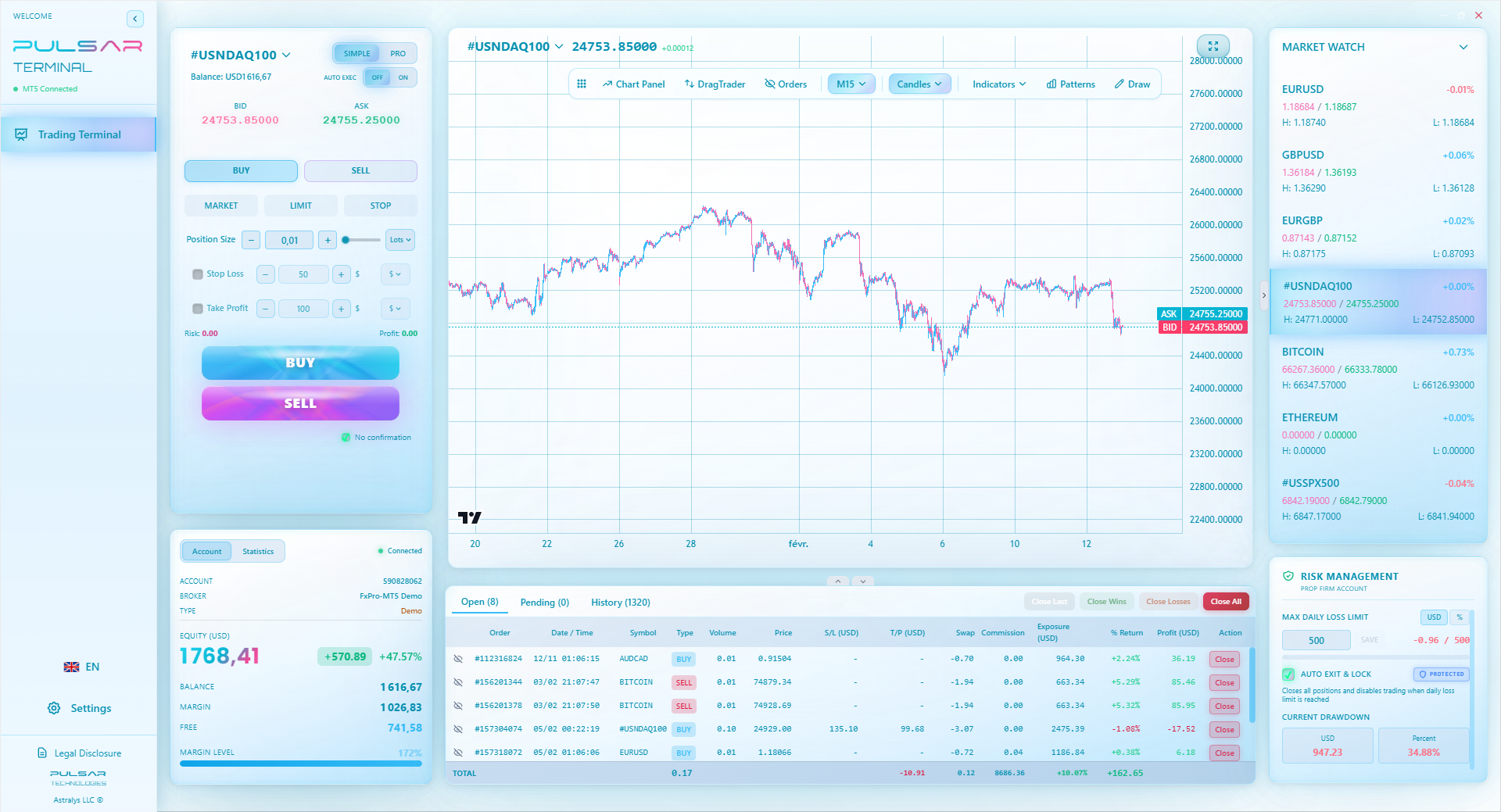
Sticking to a daily loss limit is a core survival rule, and Pulsar Terminal's prop firm daily loss protection feature automates this, cutting all trades if your loss hits a preset threshold.
Pulsar Terminal
MT5オールインワンツール:ドラッグ&ドロップ注文、マルチTP/SL、トレーリングストップ、グリッドトレード、出来高プロファイル、プロップファーム保護。毎日1,000人以上のトレーダーが利用。
“The spread isn't a fee; it's the house edge. And the house always gets paid first.”
Here's where beginners trip, every single time.
Pitfall 1: Chasing the 'Holy Grail' Indicator. You buy a fancy indicator or a robot that promises 90% wins. It doesn't exist. I wasted over R15,000 on various 'systems' in my first three years. The only edge is your discipline. Learn the basics of the MACD indicator or support/resistance instead of chasing magic.
Pitfall 2: Not Understanding a Pip's Value. A move in USD/ZAR is not the same as a move in EUR/USD. The pip definition and its value change per pair and lot size. If you don't calculate this before you trade, you have no idea how much you're really risking.
Pitfall 3: Ignoring the Economic Calendar. South African data (CPI, SARB interest rate decisions, mining production) moves the Rand. US data (Non-Farm Payrolls, Fed decisions) moves everything. Trading right before a major news release is like gambling. Know when news is due.
Pitfall 4: Underestimating the Time Commitment. This isn't a few minutes a day. It's hours of analysis, review, and education. If you can't dedicate at least 5-10 hours a week to studying charts and reviewing your trades, stick to unit trusts.

Pro Tip: Keep a trading journal. Not just 'bought here, sold there.' Write your reasoning for the trade, your emotion entering, and your emotion exiting. After 100 trades, you'll see your psychological patterns clearer than any chart pattern. It's the cheapest and most effective tool you have.
“Demo trading teaches you the rules. Live trading teaches you why you need them.”
This is the moment where 90% of beginners fail. You've been killing it on demo for three months. You feel ready. You go live, and suddenly nothing works.
Why? Because demo money isn't real. There's no fear, no greed, no sweaty palms when a trade goes R500 against you. On demo, you'd hold your stop. On live, you'll be tempted to move it, 'just this once.'
How to make the transition successfully:
- Start Microscopically. Fund your live account with the absolute minimum deposit. Trade the smallest possible lot size (0.01 lots, a micro lot). Your goal for the first month is not profit. Your goal is to execute your plan perfectly with real money on the line. The financial amount should be so small that a loss is meaningless, but the psychological impact is real.
- Replicate Your Demo Exactly. Use the same strategy, the same risk per trade (1%), the same timeframes. The only variable that should change is the balance in the corner of your screen.
- Expect to Suck. You will make stupid mistakes you never made on demo. You'll hesitate on entries. You'll close winners too early. This is normal. It's part of the training. The key is to not blow up your account during this learning phase.
- Gradually Scale Up. Only after you have three consecutive months of following your plan perfectly (not necessarily profitable, but disciplined) should you consider adding more capital. And when you do, increase your position sizes slowly. Don't go from 0.01 lots to 1.0 lot because you have more money. That's a recipe for a single trade to cripple you.
I made the mistake of going from a R50,000 demo to a R20,000 live account and immediately used the same position sizes. A string of losses wiped out 30% in two weeks because the psychological pressure made me abandon all my rules. Start small. Your future self will thank you.
💡 ウィンストンのヒント
Your first R10,000 in the market is tuition, not capital. Expect to pay it to learn. The goal is to learn as much as possible before it's gone.
FAQ
Q1Is forex trading legal in South Africa?
Yes, it is completely legal, but you must use a broker licensed by the Financial Sector Conduct Authority (FSCA). Trading with an unregulated offshore broker puts all your capital at risk with no legal protection.
Q2How much money do I need to start forex trading in South Africa?
You can start with as little as R500-R1000 with some brokers, but I strongly advise against it with such a small amount. The minimum to practically apply proper risk management is closer to R10,000. This allows you to risk R100-R200 per trade (1-2%) without being forced to use dangerous use or tiny positions that get eaten by spreads. Always start with a demo account first, regardless.
Q3What is the best forex broker for beginners in South Africa?
There's no single 'best' broker. The right broker for a beginner is one that is FSCA-regulated, offers a strong demo account, has low minimum deposits, and provides good local support. Brokers like IG, AvaTrade, and XM have strong local operations. Your priority should be safety and education, not the lowest spreads.
Q4How are forex trading profits taxed in South Africa?
Profits from trading are considered income by SARS and are taxable. You must declare them in your annual tax return. It's crucial to keep detailed records of all your trades, including profits and losses, as you can offset losses against profits. Consult with a tax professional familiar with trading income.
Q5Why is the 30:1 use limit a good thing?
It forces discipline. Beginners see high use as a way to make huge profits from small moves. In reality, it's the fastest way to get a margin call and lose everything. The 30:1 cap, imposed by the FSCA, protects you from yourself by limiting how much you can amplify your losses. Experienced traders often use far less use than the maximum allowed.
Q6Can I use international brokers like Pepperstone or Exness as a South African?
Yes, many international brokers like Pepperstone and Exness also hold FSCA licenses specifically for their South African clients. This is ideal because you get the broker's global infrastructure combined with local regulatory protection. Always ensure you are opening an account under their FSCA-regulated entity, not their offshore one.
Q7What's the biggest mistake South African forex beginners make?
Trading the South African Rand (ZAR) pairs based on emotion and news headlines. They see the Rand is 'weak' on the news and want to sell it, without any technical plan or risk management. The volatility of USD/ZAR can destroy an account in hours. It's far better to learn the basics on a more stable major pair first.
ウィンストン教授のレッスン
重要ポイント:
- ✓FSCA regulation is non-negotiable for capital protection.
- ✓Never risk more than 2% of your account on a single trade.
- ✓Master one simple strategy on demo before going live.
- ✓Start live trading with the smallest possible position size.
- ✓A trading journal is more valuable than any indicator.
この記事はどれくらい役に立ちましたか?
星をクリックして評価
週刊トレーディングインサイト
無料の週刊分析&戦略。スパムなし。
著者について
David van der Merwe
新興市場トレーダー
ヨハネスブルグ拠点で新興市場通貨11年のトレーダー。ZARペア、FSCA規制下の取引、南アフリカ市場分析を専門とする。
コメント
リスク警告
金融商品の取引には大きなリスクが伴い、すべての投資家に適しているわけではありません。過去の実績は将来の結果を保証するものではありません。本コンテンツは教育目的のみであり、投資助言として解釈すべきではありません。取引前に必ずご自身で調査を行ってください。
こちらもおすすめ

Cara Trading Forex Sukses: 7 Prinsip dari Trader Profesional
Cara trading forex sukses dengan 7 prinsip trader pro: manajemen modal, disiplin, journal trading, backtest. Data nyata, bukan janji profit palsu.
Jam Trading Forex Terbaik untuk Trader Indonesia: Panduan Lengkap dengan Tabel Waktu
Panduan jam trading forex untuk trader Indonesia. Tabel 4 sesi dunia, jam emas 20:00-00:00, sesi mana yang harus dihindari. Data akurat + tips dari trader berpengalaman.
Top 5 Sàn Forex Uy Tín Nhất 2026: Review Jujur dari Trader Indonesia
Top 5 sàn forex uy tín 2026 untuk trader Indonesia. Review jujur: spread, deposit, withdraw, dukungan lokal. Exness, XM, IC Markets & lebih.
