


Let me be brutally honest: 90% of the so-called 'forex trading institutes' in Delhi are preparing you for a date with the Enforcement Directorate, not a trading career.
Rajesh Sharma
シニアFXアナリスト ·  India
India
☕ 10 分で読める
学べること:
- 1The Legal Reality in Delhi: You Can't Trade What They're Teaching
- 2Red Flags: How to Spot a Scam Institute in Delhi
- 3What Real Forex Education Looks Like (The Legal Way)
- 4The Brokers & Platforms You Can Actually Use
- 5A Self-Education Roadmap (Skip the Expensive Institute)
- 6The Future: Stricter Rules, Not Looser Ones
- 7Final Verdict: How to Find a Real Forex Trading Institute in Delhi
Let me be brutally honest: 90% of the so-called 'forex trading institutes' in Delhi are preparing you for a date with the Enforcement Directorate, not a trading career. They're selling you a dream of trading EUR/USD on slick offshore platforms, which is flat-out illegal for a resident Indian. I've seen too many students lose money to brokers who then vanish, only to have their bank accounts frozen by the RBI. This guide will cut through the nonsense. I'll show you what legal forex trading in India actually looks like, how to spot a scam institute, and where to get real education that won't land you in legal trouble.
Here's the cold, hard truth that most institutes in Delhi won't tell you upfront. Under the Foreign Exchange Management Act (FEMA), you, as a resident Indian, are prohibited from trading forex on international spot markets. That means all those fancy charts of EUR/USD, GBP/JPY, or XAU/USD you see in their presentations? Off-limits. Trading those pairs through an unregulated offshore broker like Exness or IC Markets from India is a violation of FEMA. The RBI maintains an 'Alert List' of unauthorized entities, and getting caught can mean heavy fines, frozen accounts, and even prosecution.
What IS legal is trading currency derivatives on Indian exchanges. We're talking about the USD-INR, EUR-INR, GBP-INR, and JPY-INR futures and options contracts on the NSE or BSE. That's it. The entire environment is different: regulated Indian brokers, INR-only accounts, and specific exchange-traded products. If an institute's curriculum is centered on MetaTrader 4/5 with non-INR pairs, they are, intentionally or not, guiding you toward an illegal activity. I made this mistake early on, funding an offshore account with $500. I made a quick 15% profit, but the stress of knowing it was against RBI rules made it impossible to trade properly. I withdrew the money and never looked back.

Warning: The Liberalized Remittance Scheme (LRS) allows you to send up to $250,000 abroad per year. This does NOT cover speculative forex trading. Using LRS funds for an offshore trading account is a direct violation and a surefire way to attract regulatory scrutiny.
“90% of the so-called 'forex trading institutes' in Delhi are preparing you for a date with the Enforcement Directorate.”
Walk into any of these places in Karol Bagh, Lajpat Nagar, or online. Listen carefully. If you hear any of the following, turn around and walk out.
They Promise Easy Money with High use They'll flash screenshots of 1:500 use on EUR/USD trades. In India's legal market, use is tightly controlled. In GIFT City (the special economic zone), retail traders might get 1:50, and that's the highest permissible environment. Anyone offering more through an 'international partner' is peddling an illegal service.
Their 'Certification' is from an Unknown Offshore Entity You'll get a fancy certificate from some 'International Federation of Forex Traders' based in Cyprus or Saint Vincent. It's worthless. In India, the only credentials that carry weight in the regulated space are from the NSE's certification in financial markets (NCFM) or similar SEBI-recognized programs.
They Push a Specific Offshore Broker This is the biggest giveaway. They'll have a 'tie-up' with a broker, often offering you a 'special link' for sign-up. They're getting a kickback (an affiliate commission) for every student they send, regardless of whether that student loses their shirt or gets into legal trouble. A legitimate educator focuses on the knowledge, not the broker.
They're Vague on FEMA, RBI, and SEBI Rules Ask them directly: 'Can you explain the FEMA restrictions on currency pairs?' If they dance around the question or say 'don't worry, everyone does it,' they are negligent. A proper educator makes the legal framework the first lesson.
I visited one such institute in South Delhi years ago. The salesperson spent an hour showing me Lamborghini photos and talking about 'funded accounts.' When I asked about the RBI's stance, he said, 'Sir, RBI cannot track small traders.' That was all I needed to hear. A good position size calculator is more valuable than their entire course.

💡 ウィンストンのヒント
If an educator's screen isn't showing a USD-INR chart from NSE, they're not teaching you how to trade legally in India. They're teaching you how to break the law.
“Trading EUR/USD from Delhi isn't a strategy; it's a violation of FEMA.”
So, where do you actually learn? Real education for the Indian trader is less glamorous but infinitely more solid. It focuses on the instruments you can actually use.
A Curriculum Based on USD-INR, Not EUR/USD
A proper course will teach you how the USD-INR futures contract works on the NSE. That means understanding the contract size (usually $1000), expiry cycles (near-month, next-month), and how the price is quoted (in INR per USD). It's a different beast than the spot forex you see on YouTube. You'll learn about the factors that move the rupee: RBI interventions, crude oil prices, FDI/FII flows, and the dollar index.
Technical Analysis is Universal, But Context is King
Yes, you can use the RSI indicator or MACD indicator on a USD-INR chart. The principles of support/resistance and trendlines apply. But a good educator will show you how these tools behave on exchange-traded derivatives, which can have different liquidity patterns than the global spot market. They'll integrate fundamental analysis specific to the Indian economy.
Risk Management with Indian use
Forget 1:500. You'll learn to structure trades with the 1:10 or 1:20 use typical with Indian brokers. This forces better discipline. You'll focus on proper position size calculator use relative to your capital, understanding that a 50-pip move in USD-INR (which is roughly 0.6%) has a different monetary impact than in other pairs. They'll drill into you how to avoid a margin call in this environment.

Pro Tip: The best 'institute' might not be a physical classroom in Delhi. Look for online mentors or courses created by traders who explicitly trade NSE currency derivatives and can show a verifiable track record (not just screenshots). The NSE itself has extensive educational resources on its website.
“Trading EUR/USD from Delhi isn't a strategy; it's a violation of FEMA.”
Your broker choice in India is simple: they must be SEBI-registered and a member of the NSE/BSE. Full stop. You're not comparing Exness review to IC Markets review. You're comparing traditional Indian stockbrokers like Zerodha, Upstox, Angel One, or Kotak Securities.
These brokers provide their own trading platforms or offer access through platforms like NOW or NEST. The experience is different from MT4. Order types, charts, and analysis tools are built for the Indian market. Your money stays in INR in your trading account, which is linked to your Indian bank account. Deposits and withdrawals are straightforward bank transfers.
Here’s a quick comparison of what you’re evaluating:
| Feature | Legal Indian Broker (e.g., Zerodha) | Illegal Offshore Broker (e.g., promoted by many institutes) |
|---|---|---|
| Regulation | SEBI & RBI | Offshore (FSA, CySEC, etc.) - irrelevant in India |
| Legal Status | Fully compliant with FEMA | Operating in violation of FEMA for Indian residents |
| Currency Pairs | Only INR pairs (USD-INR, EUR-INR) | All major/minor pairs (EUR/USD, GBP/JPY, etc.) |
| Account Currency | INR only | USD, EUR, GBP |
| Deposit/Withdrawal | Seamless via Indian bank | Difficult, often via crypto or shady payment gateways |
| Risk | Market risk only | Market risk + Regulatory/legal risk + fund seizure risk |
The spread definition still applies, but it's determined by the exchange liquidity. Your costs are brokerage, STT, GST, and exchange charges. It's transparent.
I use a major Indian broker. My first big trade was a short on USD-INR futures at 83.25, expecting RBI intervention to strengthen the rupee. I set a tight stop at 83.40. The trade went my way, and I closed half at 82.90, letting the rest run. This kind of trade, with defined risk on a legal platform, is what you should be learning.
💡 ウィンストンのヒント
Your first 20 trades should be on a demo account with a SEBI broker's platform. Your goal isn't profit. It's to understand how a single USD-INR futures contract moves with the news.
“Your edge in India comes from understanding RBI policy, not Fibonacci retracements.”
You don't need to pay ₹50,000 to a Delhi institute. Here’s a step-by-step, legal, and far cheaper path.
Phase 1: Learn the Rules & Instruments
- Read the RBI's FAQs on forex. Read SEBI's guidelines for investors.
- Go to the NSE website. Download the contract specifications for USD-INR futures. Understand every single term.
- Open a demo account with a SEBI-registered broker. Not MT4, their actual platform. Practice trading USD-INR for a month.
Phase 2: Develop a Strategy for INR Pairs
- Study how the rupee moves. It's not like the euro. It's heavily managed by the RBI. Learn what 'non-deliverable forward' means (and why the RBI is banning them by 2026).
- Adapt a simple strategy. Maybe a swing trading approach based on RBI policy and dollar index levels. Scalping strategy is harder due to lower liquidity vs. global majors.
- Paper trade this strategy rigorously. Keep a journal. Note if support/resistance levels on USD-INR hold as cleanly as they do on EUR/USD (often, they don't).
Phase 3: Risk Management & Execution
- Start small with real money. Your goal for the first six months is to not lose money, not to make a fortune.
- Use a position size calculator religiously. With lower use, position sizing is your primary risk tool.
- Analyze every trade. Why did it work? Why did it fail? Was it your analysis, or an unexpected RBI statement?

Example: You have ₹100,000 capital. With a broker offering 1:10 use on futures, your buying power is ~₹1,000,000. For a USD-INR trade, you decide to risk only 0.5% of capital, or ₹500. You calculate your position size based on your stop-loss distance in pips. This discipline is non-negotiable.
This self-directed path builds real competence, not dependency on a guru. It connects you directly to the market you're allowed to trade.
“Your edge in India comes from understanding RBI policy, not Fibonacci retracements.”
If you're hoping regulations will loosen, think again. The trend is toward more control. The RBI's recent moves are clear signals.
By April 2026, banks are prohibited from offering offshore NDF contracts linked to the rupee. They also have to cap their net open rupee positions. This is the RBI squeezing speculative activity from all angles to stabilize the currency. For you, the retail trader, it means the legal, on-exchange derivative market is your only sandbox, and it will be heavily influenced by these institutional flows.
The mandatory Legal Entity Identifier (LEI) for all market participants further increases transparency. It's part of a global push, but in India, it's another layer ensuring everyone is who they say they are.
What does this mean for you? Your edge will come from understanding these macro shifts and their impact on USD-INR volatility, not from trying to outsmart the system. The profitable traders in the future will be those who treat it as a serious, regulated financial market, not a casino. They'll use tools that help them manage this complexity within the legal framework.
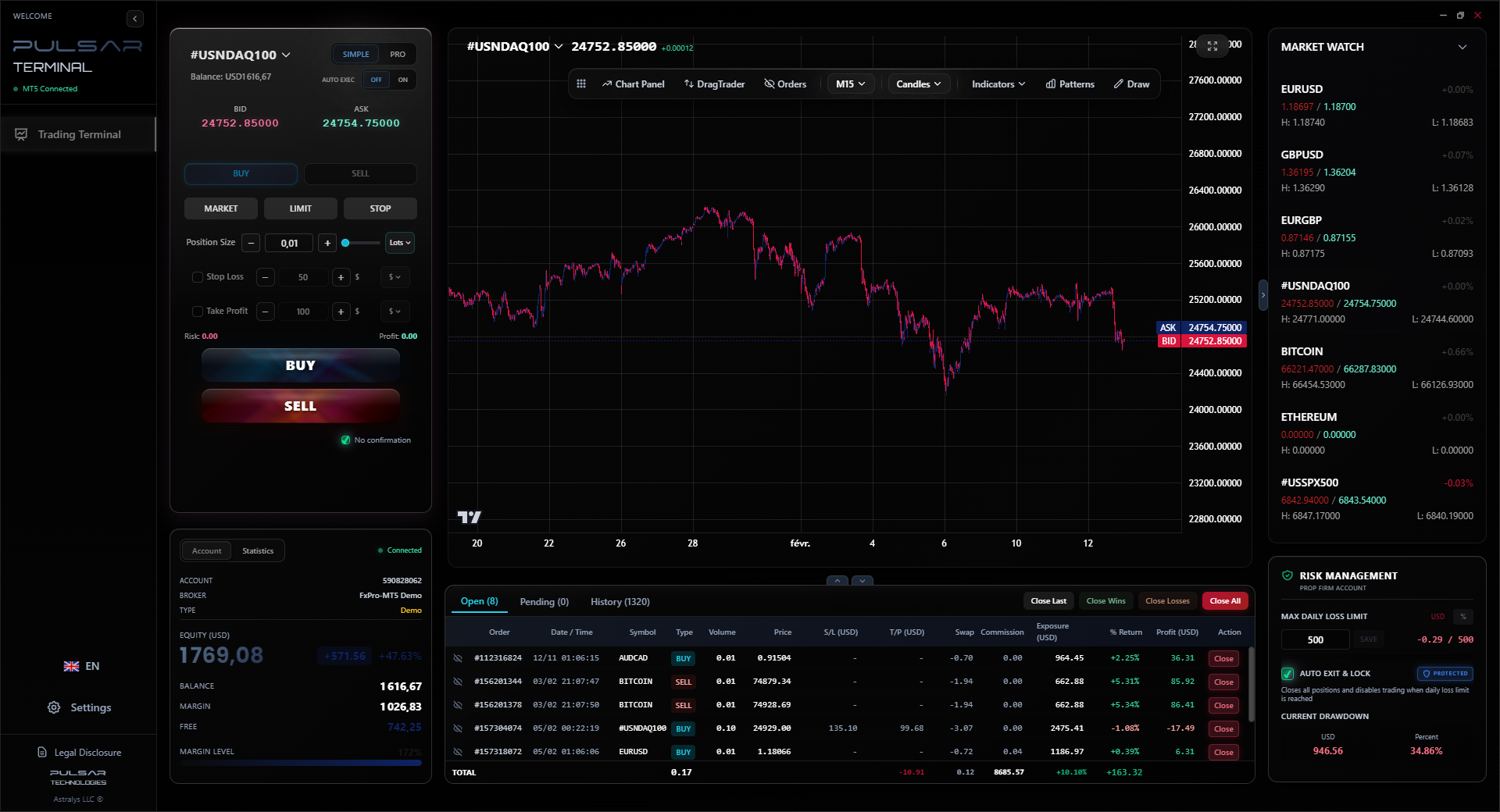
Managing trades on an Indian broker's platform can be clunky. Setting multiple take-profits or a trailing stop is often a manual headache. This is where a tool that integrates properly becomes useful.
💡 ウィンストンのヒント
The RBI's next policy statement will move the USD-INR more than any technical pattern you learn. Fundamentals rule here. Always know the date of the next MPC meeting.
Executing precise multi-level strategies on clunky broker platforms is a pain; Pulsar Terminal's drag-and-drop order system and automated trailing stops work directly on MT5 to handle that.
Pulsar Terminal
MT5オールインワンツール:ドラッグ&ドロップ注文、マルチTP/SL、トレーリングストップ、グリッドトレード、出来高プロファイル、プロップファーム保護。毎日1,000人以上のトレーダーが利用。
“The profitable traders will be those who treat it as a serious, regulated market, not a casino.”
So, is there such a thing as a legitimate forex trading institute in Delhi? Yes, but it's rare. It won't be the one with the flashy ads. Here’s your checklist:
- Their first module is on FEMA, RBI, and SEBI regulations. They stress the legality of INR pairs only.
- They teach using NSE/BSE data and Indian broker platforms. Their charts are of USD-INR futures, not EUR/USD.
- They have no 'preferred' offshore broker. They might discuss the pros and cons of different SEBI-registered brokers.
- The instructor can show a long-term track record of trading NSE currency derivatives. Ask for it.
- The cost is reasonable for education, not a 'get-rich-quick' scheme. You're paying for knowledge, not promises.
, the best institute might be your own computer. Combine the free resources from the NSE, a demo account with a regulated Indian broker, and disciplined self-study. Save the ₹50,000-₹1,00,000 institute fee. That's your first trading capital. Lose it in the market learning real lessons, not in a classroom learning illegal tricks. The path is narrower in India, but it's the only one that doesn't end in a dead end.
FAQ
Q1Is forex trading legal in Delhi, India?
Yes, but in a very specific way. Trading currency derivatives (futures & options) involving the Indian Rupee (like USD-INR, EUR-INR) on Indian exchanges like the NSE is legal. Trading international forex pairs like EUR/USD through offshore platforms is illegal for resident Indians under FEMA rules.
Q2What should I look for in a forex trading institute in Delhi?
Look for an institute that starts its curriculum with Indian regulations (FEMA, RBI). They must teach trading only in INR-based pairs (USD-INR) using SEBI-registered brokers and NSE/BSE platforms. Run if they focus on EUR/USD, promote offshore brokers, or are vague about the law.
Q3Can I use MetaTrader 4 (MT4) in India legally?
It's complicated. Using MT4 with an unregulated offshore broker to trade non-INR pairs is illegal. Some Indian brokers may offer MT4/MT5 access to trade the permitted INR derivatives, but the platform's legality is tied to the broker's regulation. The platform itself isn't the issue; what and who you trade with is.
Q4What are the penalties for illegal forex trading in India?
Penalties under FEMA are severe. They can include heavy financial penalties (multiples of the traded amount), seizure of funds in your bank accounts, and legal prosecution. The RBI actively issues warnings and has an 'Alert List' of unauthorized entities.
Q5How much use can I get in legal forex trading in India?
use is restricted. For retail traders on main Indian exchanges, it's typically low (e.g., 1:10 or 1:20 on futures margins). In the GIFT City IFSC, retail use may go up to 1:50. Any institute promising 1:100, 1:500, etc., is referring to illegal offshore trading.
Q6Are there any good online alternatives to a Delhi institute?
Absolutely. The best start is the free education section on the NSE website. Many reputable financial educators in India offer online courses specifically on trading NSE derivatives. Focus on those who trade what they teach and are transparent about the legal framework.
Q7What is the minimum capital required to start legal forex trading in India?
It varies by broker, but you can start with as little as ₹5,000-₹10,000. However, with low use, you need to manage your position size carefully. A more practical starting capital for meaningful, well-risk-managed trading is closer to ₹50,000-₹100,000.
ウィンストン教授のレッスン
重要ポイント:
- ✓Legal trading is ONLY INR pairs (USD-INR) on NSE/BSE.
- ✓Any institute teaching EUR/USD is guiding you to break the law.
- ✓Use SEBI brokers only; offshore brokers mean legal risk.
- ✓Maximum legal retail use is ~1:50 (in GIFT City).
- ✓RBI policy is your #1 fundamental indicator.
この記事はどれくらい役に立ちましたか?
星をクリックして評価
週刊トレーディングインサイト
無料の週刊分析&戦略。スパムなし。
著者について
Rajesh Sharma
シニアFXアナリスト
インド・南アジア市場で10年以上のトレード経験。NSEの通貨デリバティブからキャリアをスタートし、国際FXへ転向。USD/INRと新興国通貨ペアを専門とする。
コメント
リスク警告
金融商品の取引には大きなリスクが伴い、すべての投資家に適しているわけではありません。過去の実績は将来の結果を保証するものではありません。本コンテンツは教育目的のみであり、投資助言として解釈すべきではありません。取引前に必ずご自身で調査を行ってください。
こちらもおすすめ

Cara Trading Forex Sukses: 7 Prinsip dari Trader Profesional
Cara trading forex sukses dengan 7 prinsip trader pro: manajemen modal, disiplin, journal trading, backtest. Data nyata, bukan janji profit palsu.
Jam Trading Forex Terbaik untuk Trader Indonesia: Panduan Lengkap dengan Tabel Waktu
Panduan jam trading forex untuk trader Indonesia. Tabel 4 sesi dunia, jam emas 20:00-00:00, sesi mana yang harus dihindari. Data akurat + tips dari trader berpengalaman.
Top 5 Sàn Forex Uy Tín Nhất 2026: Review Jujur dari Trader Indonesia
Top 5 sàn forex uy tín 2026 untuk trader Indonesia. Review jujur: spread, deposit, withdraw, dukungan lokal. Exness, XM, IC Markets & lebih.
