


Here's a number that should wake you up: the turnover in Nigeria's FX market jumped over 56% to $8.6 billion in 2025.

Olumide Adeyemi
西アフリカ・トレーディングの先駆者 ·  Nigeria
☕ 10 分で読める
学べること:
- 1What Exactly is a 'Forex Wolf' in Nigeria?
- 2The Rules of the Jungle: Nigerian Forex Regulations
- 3Wolf-Pack Strategies: Trading Nigeria's Volatility
- 4The Psychology of a Survivor, Not a Gambler
- 5Your Den: Tools, Brokers, and Execution
- 6Traps for Young Wolves: What to Avoid
- 7Building Your First Hunting Plan
Here's a number that should wake you up: the turnover in Nigeria's FX market jumped over 56% to $8.6 billion in 2025. That's not just noise, it's opportunity screaming your name. In this chaos, a new breed of trader has emerged - the 'forex wolf.' Forget the lone wolf stereotype. A real forex wolf isn't just aggressive; they're smart, patient, and know exactly when to strike. This isn't about getting rich quick. It's about understanding a market where the rules change weekly and your biggest enemy is often the guy in the mirror. I've traded through multiple CBN policy shifts and watched more 'wolves' get sheared than I can count. Let's talk about how to actually be one.
In Lagos, Abuja, or Port Harcourt, when someone calls you a forex wolf, it's a compliment with an edge. It means you've got a nose for opportunity and the guts to take it. But let's clear something up right now. The Instagram 'gurus' posing with rented Lamborghinis? They're not wolves. They're hyenas, scavenging on the dreams of newcomers.
A true forex wolf in this market operates on three principles. First, they understand local liquidity. They know when the banks are active and when the parallel market (yes, we have to talk about it) moves the needle. Second, they're regulatory-aware. They don't just trade EUR/USD; they watch CBN circulars like hawks. A policy shift can be a bigger money-maker than any technical pattern. Third, they're ruthlessly pragmatic. Sentiment doesn't pay the bills. I learned this the hard way in 2021, holding a long Naira position based on 'hope' against the USD. I ignored the fundamentals and bled over 15% of my account before I cut the loss. That experience taught me more than any winning streak ever did.

Warning: The 'wolf' label is dangerous if it makes you overconfident. The market doesn't care about your ego. I've seen traders take wild, oversized risks just to live up to the persona. It's a fast track to a margin call.

💡 ウィンストンのヒント
The market's greatest trick is making you feel smart when you're lucky. Your trading plan is the only thing that separates skill from chance. Write it down and follow it like your life depends on it.
“A true forex wolf isn't just aggressive; they're smart, patient, and know exactly when to strike.”
You can't hunt if you don't know the territory. Nigeria's regulatory scene is, let's say, dynamic. It's not for the faint-hearted.
The Key Players: CBN vs. SEC
The Central Bank of Nigeria (CBN) controls the flow of foreign currency. Their main concern is monetary stability. The Securities and Exchange Commission (SEC) oversees capital markets and considers forex trading a securities activity. Here’s the practical breakdown for you, the trader:
| Aspect | CBN Focus | SEC Focus | What It Means For You |
|---|---|---|---|
| Broker Access | Historically restricted Naira funding to int'l brokers. | Requires brokers physically in Nigeria to be licensed. | Funding your account is your first hurdle. Domiciliary accounts or e-wallets are your friends. |
| Legal Status | Issues licenses for FX operations. | Warns against unregulated platforms. | Trading is legal, but you must vet your broker's license. |
| Recent Shift | 2025 Nigerian Foreign Exchange Code promotes transparency. | Regulations for retail forex still developing. | The landscape is formalizing. Stay informed. |
The Funding Headache
This is where most new traders get stuck. You can't just slap your Naira debit card on an international broker like IC Markets or Pepperstone for a large deposit. The CBN has restrictions. The workaround? A domiciliary account with your Nigerian bank, or using e-wallets. It adds a step, and sometimes fees, but it's the reality.
The Tax Man Cometh
This isn't a maybe. If you make consistent profits, you are liable for Capital Gains Tax at 10% on your gross profits. Treat it as a business cost from day one. Keep clean records.
The big question: Can you use international brokers? As of now, yes. Many Nigerian traders successfully use brokers regulated abroad like Exness or XM, funding via the methods above. However, the CBN's stance has shifted before and can shift again. A real forex wolf has a Plan B.
“The Instagram 'gurus' posing with rented Lamborghinis? They're not wolves. They're hyenas.”
Nigerian traders have a unique edge: we live and breathe volatility. While traders in stable economies panic over a 50-pip move, we see it as Tuesday. Here’s how to structure your hunt.
The Liquidity Hunt
Major forex sessions (London, New York) are your core hunting grounds. But pay attention to local news times. CBN announcements often hit during Lagos business hours and can cause sharp, immediate moves in pairs like USD/NGN (where available) or even affect GBP/USD sentiment. I once caught a 120-pip move on GBP/USD within 15 minutes of a CBN liquidity injection announcement. I wasn't smarter than anyone else, I was just watching the local news feed while others were asleep.
Technical Analysis with Thick Skin
Indicators work, but you must adapt them. Standard settings get whipsawed here. For the RSI indicator, I use 70/30 as overbought/oversold levels instead of the classic 80/20 during high-volatility periods. The MACD indicator is better for confirming the direction of a trend you already suspect from fundamentals.
Choose Your Weapon: Timeframes
- The Prowler (Scalper): If you have the nerves of steel and can sit for hours, scalping on the 1-minute or 5-minute chart can work. But spreads are your enemy. You need a broker with razor-thin spreads, and you must be a master of the position size calculator. One emotional overtrade can wipe out a week's gains.
- The Pack Hunter (Swing Trader): This is where I believe most Nigerian 'wolves' thrive. Swing trading on the 4-hour or daily chart lets you capture 100-300 pip moves without staring at the screen all day. It aligns with our volatile market structure. You identify a trend, wait for a pullback, and enter. It requires patience, which is the wolf's most underrated trait.

“The Instagram 'gurus' posing with rented Lamborghinis? They're not wolves. They're hyenas.”
This is the separator. The market is designed to exploit human weakness. Here’s what breaks traders, and how to armor up.
The 'Make It Back' Impulse: You take a loss. Your pride is hurt. The immediate, gut reaction is to jump into another trade twice the size to recover the loss immediately. This is suicide. I've done it. In 2019, after a bad loss on a USD/CAD trade, I revenge-traded and turned a $500 loss into a $2,000 hole in under an hour. The only cure is a hard rule: after a losing trade, walk away. Close the platform. Come back in an hour, or tomorrow.
Analysis Paralysis: With so much news and noise, you can get stuck waiting for the 'perfect' setup. It doesn't exist. Define your criteria beforehand. If the chart hits your pre-defined entry, take the trade. If not, don't. It's that simple (and that hard).
Community vs. Herd Mentality: There's power in a community of serious traders sharing charts and ideas. But there's danger in the WhatsApp group where one 'guru' shouts a trade and 50 people blindly follow. A wolf might run in a pack, but it makes its own kill. Use communities for perspective, not for signals.
💡 ウィンストンのヒント
In Nigeria, your edge isn't a secret indicator. It's your lived understanding of local volatility and economic sentiment. Trade what you know, not what a textbook says.
“I learned more from one 15% loss than from any winning streak.”
Your broker and tools are your teeth and claws. If they're dull, you starve.
Choosing Your Broker
Look for these non-negotiables:
- Solid International Regulation: FCA, ASIC, CySEC. This protects your funds.
- Multiple Funding Options: They must support funding methods that work for Nigeria (bank transfer to domiciliary account, e-wallets like Skrill, Neteller).
- Low and Stable Spreads: Check the average spread on EUR/USD during your trading hours. A difference of 0.3 pips adds up massively over a year.
- Reliable Platform: MT4/MT5 is the standard. Ensure their servers are stable with low latency.
Brokers like Pepperstone and IC Markets consistently rank well on these metrics for experienced traders.
Beyond the Basic Chart
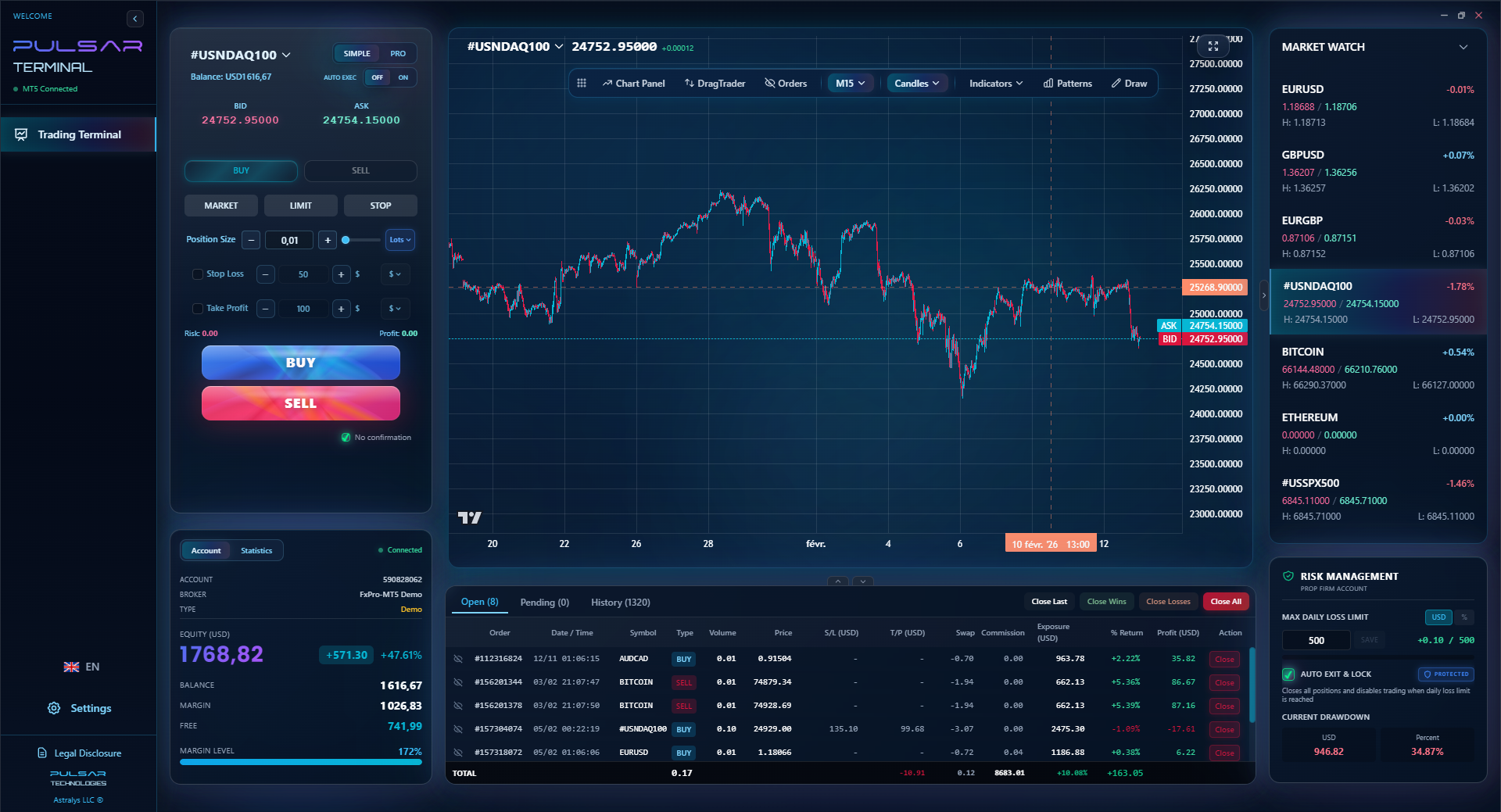
MT5 is powerful, but it can be clunky. This is where professional tools come in. Think about order management: placing a trade with multiple take-profit levels or a trailing stop in MT5 requires manual calculations and separate orders. It's slow and error-prone in a fast market.

Example: You buy GBP/USD at 1.2600. You want to take 50% profit at 1.2650, move stop to breakeven, and let the rest run with a 50-pip trailing stop. Doing this manually on MT5 while the market is moving is a stressful juggling act.
Managing complex trades and strict prop firm rules manually is a headache; Pulsar Terminal automates multi-TP/SL, trailing stops, and daily loss limits directly on your MT5 chart.
Pulsar Terminal
MT5オールインワンツール:ドラッグ&ドロップ注文、マルチTP/SL、トレーリングストップ、グリッドトレード、出来高プロファイル、プロップファーム保護。毎日1,000人以上のトレーダーが利用。
“I learned more from one 15% loss than from any winning streak.”
I've fallen into most of these. Learn from my scars.
The Prop Firm Mirage: Prop firm challenges are everywhere. They promise you a $100k account if you pass a challenge. The reality? Their rules are often designed for you to fail. The daily loss limits are incredibly tight. You become so focused on not hitting the daily loss that you can't trade properly. If you go this route, you need surgical risk management. A tool that can automatically enforce your max daily loss would be the only way I'd attempt it again.
The 'Sure Thing' from a Friend: Your cousin knows a guy at a bank who 'has information.' No, he doesn't. If he did, he wouldn't be sharing it with you. Trade your own analysis.
Ignoring the Cost of Trading: It's not just the spread. It's the swap rates (overnight financing) if you hold positions long-term. It's the withdrawal fees from your broker. These costs eat into your profits. A profitable system can become a loser if the costs are too high. Always calculate your break-even point including all costs.
💡 ウィンストンのヒント
A profitable system with poor execution is a losing system. Spend as much time mastering your trading platform's mechanics as you do on analysis. Slippage and order errors are silent account killers.
“Your broker and tools are your teeth and claws. If they're dull, you starve.”
Enough theory. Let's build a simple, actionable plan for your first 90 days.
Phase 1: Observation (Weeks 1-4)
- Open a demo account with a reputable broker.
- Don't trade. Just watch. Follow EUR/USD and XAU/USD.
- Note the time it's most active in your timezone.
- Practice using a position size calculator religiously. Risk 1% of your demo account on every hypothetical trade.
Phase 2: Pattern Recognition (Weeks 5-8)
- Now, on demo, start identifying one simple pattern. Maybe it's a bounce off a key moving average on the 4-hour chart.
- Paper trade it. Write down every entry, exit, and reason in a journal.
- Your goal is not profit. Your goal is a 55% win rate with your risk-reward ratio at 1:1.5 or better.
Phase 3: Execution with Capital (Weeks 9-12+)
- If your journal shows consistency, fund a live account with money you can afford to lose completely.
- Start trading with real money, but cut your position size in HALF from your demo size. Real money feels different.
- Review your journal every Sunday.
This process is boring. It's not wolf-like at all. But it's how you build the foundation that lets you be a wolf later, instead of just another carcass on the savannah.
FAQ
Q1Is forex trading legal in Nigeria?
Yes, forex trading is legal. The Central Bank of Nigeria (CBN) and the Securities and Exchange Commission (SEC) are the main regulators. However, the specific rules for retail traders are evolving. You are responsible for using licensed brokers and paying applicable taxes (like the 10% Capital Gains Tax on profits).
Q2How do I fund my forex trading account in Nigeria?
Directly using your Naira debit card for large international transactions is often restricted by the CBN. The most common methods are: 1) Funding a domiciliary account with your Nigerian bank and transferring from there, or 2) Using international e-wallets like Skrill or Neteller. Always check your broker's supported deposit options.
Q3What's the best trading style for a beginner in Nigeria?
Avoid scalping as a beginner. The pressure and low timeframes are brutal. Start with swing trading on the 4-hour or daily charts. It gives you time to analyze, doesn't require glued-to-screen attention, and is better suited to capturing the larger moves common in volatile markets.
Q4What broker should I use as a Nigerian trader?
Choose a broker with strong international regulation (e.g., ASIC, FCA), low and stable spreads, reliable MT4/MT5 platforms, and crucially, deposit/withdrawal methods that work from Nigeria (like e-wallets or bank transfers to domiciliary accounts). Do your own research on brokers like IC Markets or Pepperstone to see if they fit your needs.
Q5How much money do I need to start trading forex?
You can start with as little as $50-$100 with some brokers. But realistically, to properly manage risk and not get wiped out by a couple of losses, a starting capital of $500-$1000 is more sensible. This allows you to risk small amounts (1-2%) per trade while still making meaningful progress. Never trade with money you need for rent or bills.
Q6What does a 'forex wolf' actually do differently?
A real forex wolf combines aggression with extreme discipline. They hunt for high-probability setups (often around volatility), but they have strict rules for entry, exit, and risk management. They control their emotions, learn from losses, and understand that patience - waiting for the right moment to strike - is their greatest weapon. They are students of the market, not its gamblers.
ウィンストン教授のレッスン
重要ポイント:
- ✓Risk a maximum of 1-2% of your capital on any single trade.
- ✓A 1:1.5 risk-reward ratio is the minimum viable target.
- ✓After a loss, walk away for at least one hour.
- ✓Journal every trade, including your emotional state.
- ✓Volatility is not your enemy; it's your hunting ground.
この記事はどれくらい役に立ちましたか?
星をクリックして評価
週刊トレーディングインサイト
無料の週刊分析&戦略。スパムなし。
著者について
Olumide Adeyemi
西アフリカ・トレーディングの先駆者
ナイジェリアで最もアクティブなFXトレーディング教育者の一人。ラゴスから8年のトレード経験。アフリカのトレーダー向けの少額資金戦略とプロップファームチャレンジを専門とする。
コメント
リスク警告
金融商品の取引には大きなリスクが伴い、すべての投資家に適しているわけではありません。過去の実績は将来の結果を保証するものではありません。本コンテンツは教育目的のみであり、投資助言として解釈すべきではありません。取引前に必ずご自身で調査を行ってください。
こちらもおすすめ

Cara Trading Forex Sukses: 7 Prinsip dari Trader Profesional
Cara trading forex sukses dengan 7 prinsip trader pro: manajemen modal, disiplin, journal trading, backtest. Data nyata, bukan janji profit palsu.
Jam Trading Forex Terbaik untuk Trader Indonesia: Panduan Lengkap dengan Tabel Waktu
Panduan jam trading forex untuk trader Indonesia. Tabel 4 sesi dunia, jam emas 20:00-00:00, sesi mana yang harus dihindari. Data akurat + tips dari trader berpengalaman.
Top 5 Sàn Forex Uy Tín Nhất 2026: Review Jujur dari Trader Indonesia
Top 5 sàn forex uy tín 2026 untuk trader Indonesia. Review jujur: spread, deposit, withdraw, dukungan lokal. Exness, XM, IC Markets & lebih.
