


In January 2026, a prop firm called Funding Ticks announced it was shutting down.

James Mitchell
シニアトレーディングアナリスト
☕ 11 分で読める
学べること:

In January 2026, a prop firm called Funding Ticks announced it was shutting down. This wasn't a quiet exit. Just a month earlier, they'd changed their rules mid-game, angering thousands of traders and tanking their reputation overnight. Their story is a perfect case study in why the prop firm world is so risky, especially here in the US where regulations are a moving target. If you're thinking about using a prop firm to get funded, you need to understand what happened with Funding Ticks. It's a lesson in fine print, shifting rules, and the reality that most of these firms are built on shaky ground.
Funding Ticks launched in early 2025, right in the middle of the prop firm boom. They were a futures-focused firm, offering traders the classic two-step deal: pay a monthly fee for an evaluation account, hit certain profit targets and rules, and get a "funded" master account where you could trade the firm's capital.
On paper, their offer was attractive. They promised a 90% profit split on master accounts, which is on the higher end. They used popular platforms like Tradovate, NinjaTrader, and TradingView, which gave traders familiar tools. For a $25,000 evaluation account, the monthly fee started around $99. A $50,000 account was about $138 per month. If you passed, you'd pay a one-time "activation" deposit (around $5,000 for that $50k account) to get your live credentials.
They looked like just another player in a crowded field. But the cracks started showing fast. The entire business model of these firms is precarious. They're not brokers; they're risk managers betting against their own traders. When too many traders start winning, the math falls apart. Funding Ticks is a stark example of what happens next.

Warning: A high profit split (like 90%) is a marketing tool, not a stability guarantee. A firm offering 80% but with a five-year track record is almost always a safer bet than a new firm promising the moon.
The end for Funding Ticks began in December 2025. Facing what I suspect were unsustainable payouts, they introduced new trading rules and applied them retroactively. This is the nuclear option in the prop world, and it almost never ends well.
The Rule Changes That Broke Trust
Overnight, they changed the game for scalpers by imposing a one-minute minimum hold time on all trades. They also raised daily profit targets and, crucially, slashed the profit split from up to 90% down to 80%. The real kicker? They went back and invalidated trades and profits that were perfectly valid under the old rules. Imagine working for a month, hitting your target, and then being told the goalposts moved last week, so you actually failed.
The backlash was immediate and brutal. Their Trustpilot rating, which was a decent 4.1 in October 2025, plummeted to 3.2 as traders flooded it with one-star reviews. The trust was completely shattered. By January 2026, they threw in the towel and announced a wind-down of operations.
I've seen this pattern before, but rarely this blatantly. It's a classic sign of a firm that didn't properly hedge its risk or manage its capital. When they panic, they change the rules. It’s why reading the fine print on rule changes isn't just careful, it's survival. Their promised refund and payout plan for active accounts was the final act, but for many, the damage was done.
This is why a strategy like scalping is so dangerous with prop firms. Your edge often relies on speed, and a rule change like a minimum hold time can completely destroy your system overnight.

💡 ウィンストンのヒント
A prop firm's main product isn't capital; it's hope. They sell the dream of a large account. Your job is to buy only if your strategy's edge is larger than their business model's need for you to fail.
“Funding Ticks is a stark example of what happens when a prop firm's business math fails: they change the rules.”
Here's the critical thing most US traders miss: prop firms like Funding Ticks operate in a massive regulatory gray area. They're not your broker. You're not depositing money to trade; you're paying a fee for an evaluation service. This clever loophole lets them mostly avoid direct oversight from the big watchdogs like the SEC (Securities and Exchange Commission) or the CFTC (Commodity Futures Trading Commission).
But that's changing, fast. Regulators are starting to look closer.
- The SEC's Failed Move: In 2024, the SEC tried to expand the definition of a "dealer" to potentially include some prop firms, which would have forced registration and stricter rules. A Texas court shot it down, and the SEC dropped its appeal in early 2025. For now, that threat is gone, but the intent was clear.
- The CFTC's Bigger Threat: This is the one to watch. The CFTC is actively debating whether futures prop firms should be classified as Commodity Trading Advisors (CTAs). If that happens, it's game over for the current model. CTAs need to register with the CFTC and the NFA, meet capital requirements, and undergo regular audits. It would force transparency and stability.
What does this mean for you? Right now, you have very little legal recourse if a firm pulls a "Funding Ticks." Your fee is for a service, and their terms of service give them broad power to change rules. It's a buyer-beware market. Always check if a firm at least follows basic AML (Anti-Money Laundering) and KYC (Know Your Customer) rules - it's a bare minimum sign of legitimacy.

Pro Tip: When researching a prop firm, don't just look for reviews on their site. Search for "[firm name] + withdrawal problem" or "[firm name] + rule change" on Twitter and trading forums. The real complaints live there.

Let's talk cold, hard numbers. The prop firm industry loves selling dreams, but the data tells a different story. Between 2020 and 2024, global searches for prop firms exploded by over 600%. Everyone wants in. But here's what happens after they sign up.
Large-scale studies of prop firm data show a brutal reality:
- Only 5-10% of traders pass the evaluation challenges. That's 9 out of 10 people failing and losing their evaluation fee.
- Only about 7% of traders ever receive a payout. Passing is one thing; keeping the funded account and making withdrawable profit is another huge hurdle.
- The average payout is just 4% of the funded account size. So if you have a $100,000 account, the average trader walks away with $4,000. Not nothing, but not life-changing.
- The average return on investment (from challenge fee to payout) is about 4x.
The industry itself has been collapsing. In 2024 alone, an estimated 80-100 prop firms shut down. Challenge pass rates dropped, and the average amount traders were willing to invest in challenges fell by half. This was the environment Funding Ticks was born into - a gold rush that was already turning into a bust.
I learned this the hard way early on. I blew two $500 evaluation fees in a row on a $50k challenge before I passed a third. My total take from that first funded account? A $1,850 payout after three months of stress. The math worked, but just barely. It taught me to treat the evaluation fee as a sunk cost for education, not a ticket to riches.
Managing this extreme risk is why a tool like a position size calculator is non-negotiable. One oversized trade can blow your challenge in minutes.
💡 ウィンストンのヒント
If you wouldn't risk $500 of your own money on a single trade, why would you risk a $500 evaluation fee on a single firm's stability? Diversify your learning, not just your trades.
“Only about 7% of traders who start a prop firm challenge ever receive a payout. The odds are built into the model.”
So, with Funding Ticks gone and the industry in flux, how do you pick a firm that won't disappear next year? You need to look for stability, not just shiny offers.
1. Track Record is Everything: Prioritize firms that have been operating for 3+ years and have a consistent history of payouts. A firm like FTMO (though not US-focused) set an early standard. In the US, look for firms that survived the 2024-2025 shakeout.
2. Platform & Instrument Stability: Make sure they offer a platform you know and trust, like a strong MT5 setup or Tradovate. Check if their offered instruments - like EUR/USD or XAU/USD - have consistent, reasonable spreads. Funding Ticks used good platforms, which shows even that isn't enough, but it's a base requirement.
3. Clear, Consistent Rules: Read the rulebook. Then read it again. Look for firms with straightforward, non-changing rules during the evaluation period. Be wary of any firm that mentions they can change rules at any time. Your strategy needs to fit their rules perfectly, especially concerning daily loss limits and drawdowns.
4. Payout Proof & Community Sentiment: Search for real, recent payout screenshots from traders (not the firm's marketing). Join Discord servers or Telegram groups for the firm and lurk. Is the conversation filled with support tickets and complaints, or genuine discussion?
5. Regulatory Posture: While not fully regulated, does the firm voluntarily adhere to certain standards? Do they have a clear legal entity and address? It’s a low bar, but many fail it.
Here’s a quick comparison of critical factors:
| Feature | What to Look For | Red Flag |
|---|---|---|
| Profit Split | 80-90%, clearly stated. | "Up to 100%" (hidden conditions). |
| Rule Changes | Rules are fixed for your challenge period. | "We reserve the right to change rules." |
| Payout Schedule | Weekly or bi-weekly, with clear history. | "Payouts processed within 30 days." |
| Support | Responsive, live chat or quick ticket reply. | Email-only, 5-day response time. |
My personal preference now leans towards firms with slightly lower profit splits (80-85%) but a long, verifiable history. I’d rather get 80% of something for years than 90% of nothing from a firm that closes in 12 months.
The prop firm space is getting a tech upgrade. It's not just about giving you NinjaTrader anymore. The smarter firms are building what's being called a "Trading OS" - a unified environment that combines trading, journaling, analytics, and risk management.
This is a response to the high failure rate. Firms are starting to see value in helping traders improve, not just filtering them out. We're seeing:
- AI-Powered Analytics: Tools that analyze your trades to spot behavioral biases, like overtrading after a loss or shrinking your position size after a win.
- Predictive Risk Management: Systems that warn you if your current market exposure is outside your historical successful patterns.
- Democratized Low-Latency Tech: Access to co-location and proximity hosting, which was once only for institutional players, is trickling down.
For you, this means the evaluation process might become more about development than just a pass/fail test. It also means the tools you use on your platform matter more than ever. Having advanced order management can be the difference between hitting a profit target and accidentally breaching a drawdown rule.
For example, managing a swing trading position with multiple take-profit levels and a trailing stop is clunky on vanilla MT5. The right tools automate that, letting you focus on the analysis. This tech integration is becoming a key differentiator between a bare-bones firm and one that's building for the future.
💡 ウィンストンのヒント
The most important indicator for a prop firm isn't on the chart. It's their year of incorporation and their terms of service section on 'Amendments.'

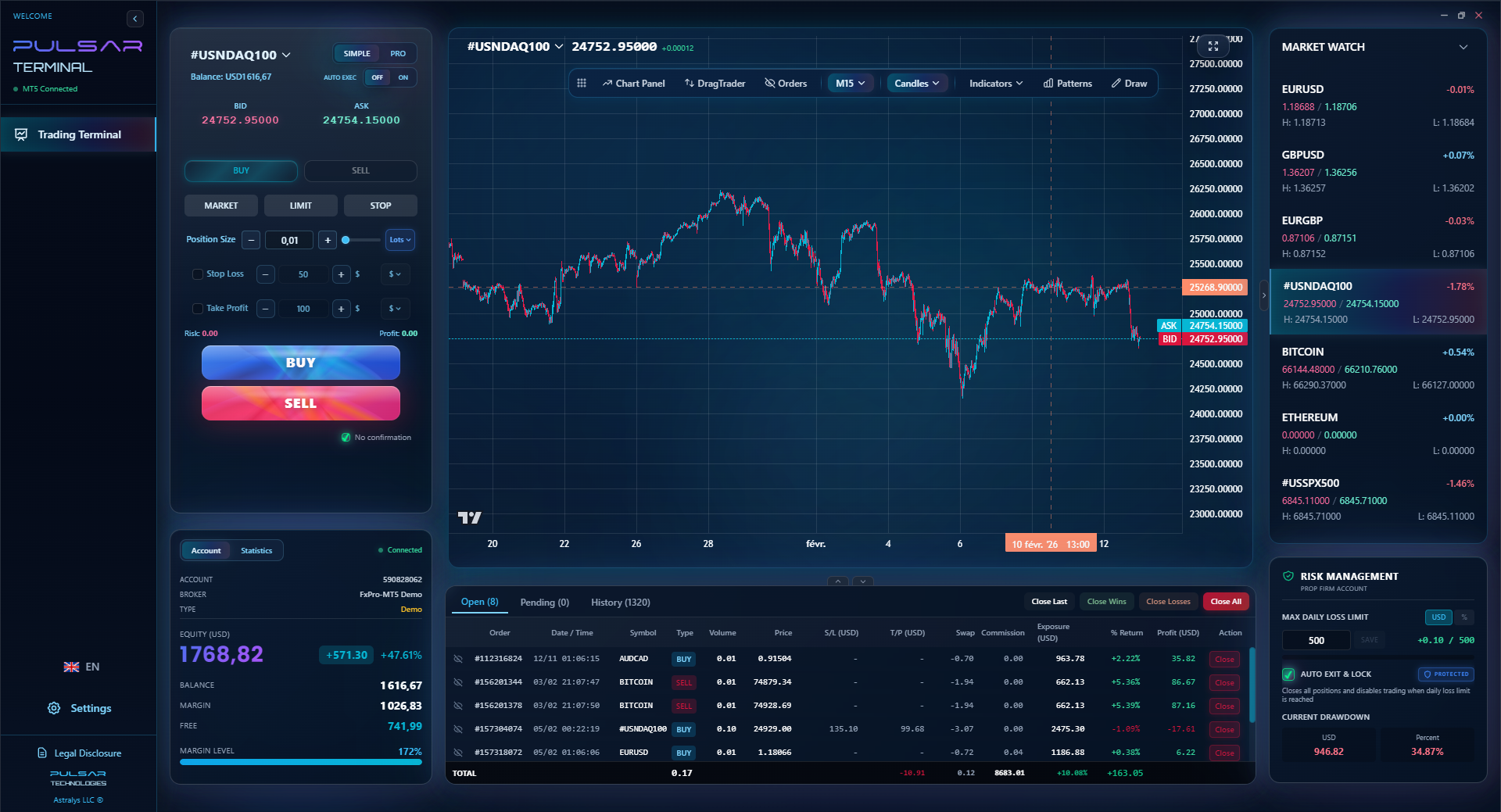
Managing complex prop firm rules, like daily loss limits and trailing stops, is where a tool like Pulsar Terminal automates the protection directly on your MT5 platform, so you can focus on trading.
Pulsar Terminal
MT5オールインワンツール:ドラッグ&ドロップ注文、マルチTP/SL、トレーリングストップ、グリッドトレード、出来高プロファイル、プロップファーム保護。毎日1,000人以上のトレーダーが利用。
“You're not just trading charts; you're trading against the firm's business model. Make sure you understand both.”
Honestly? For most US traders right now, I'd say proceed with extreme caution. The Funding Ticks saga isn't an anomaly; it's a symptom of an immature, unstable industry under growing regulatory scrutiny.
Consider a prop firm if:
- You have a proven, rule-based strategy with a positive expectancy over hundreds of trades.
- You have the discipline to trade a small account just as seriously as a large one.
- You can afford to lose the evaluation fee (and several more) without it affecting your life.
- You treat it primarily as a costly educational course with a potential capital reward at the end.
Avoid prop firms if:
- You're new to trading and see this as a way to start with "free" money.
- Your trading plan isn't crystal clear and documented.
- You need the potential payout to cover bills.
- You get frustrated by bureaucratic rules and fine print.
The dream of trading $100,000 of someone else's money is powerful. But the reality is a gauntlet of rules, psychological pressure, and the real risk that the firm itself might not be there tomorrow. Use the MACD or RSI to find your edge, but use cold, hard business analysis to choose where to deploy it. Build your skills and track record with your own capital first. The prop firm path should be an option, not the goal.
The collapse of Funding Ticks prop firm is a wake-up call. In this market, you're not just trading charts; you're trading against the firm's business model. Make sure you understand both.
FAQ
Q1Is Funding Ticks completely shut down?
Yes. In January 2026, Funding Ticks announced it was winding down all operations. They outlined a plan for final payouts and refunds for active accounts, but the firm is no longer accepting new traders or evaluations.
Q2Why did Funding Ticks fail?
The direct cause was a decision in December 2025 to impose new, stricter trading rules (like a 1-minute minimum hold time) retroactively, which invalidated previously earned profits. This caused massive trader backlash, destroyed their reputation, and likely exposed underlying financial or risk management issues that made continuing unsustainable.
Q3Are prop firms legal in the United States?
They operate in a legal gray area. They are not brokers, so they often avoid direct SEC or CFTC registration by charging an "evaluation fee" for a service. However, this is under scrutiny, especially from the CFTC, which is considering classifying futures prop firms as Commodity Trading Advisors (CTAs), which would bring strict regulation.
Q4What's a realistic success rate for passing a prop firm challenge?
Industry-wide data suggests only 5-10% of traders pass the initial evaluation. Of those who pass, only about 7% ever receive a payout. The odds are heavily stacked against the trader, by design.
Q5What should I look for in a stable prop firm?
Prioritize track record (3+ years in business), consistent and clear rules that don't change mid-challenge, verifiable payout proofs from real traders, and the use of reputable trading platforms. A slightly lower profit split from an established firm is safer than a high split from a new one.
Q6Did traders get their money back from Funding Ticks?
Funding Ticks stated they would process refunds and final payouts as part of their wind-down plan announced in January 2026. The success and timeliness of this process for all affected traders is not fully documented, highlighting the risk of relying on a firm's promises during a closure.
ウィンストン教授のレッスン
重要ポイント:
- ✓Prop firm success rates are below 10%.
- ✓Rule changes mid-challenge are a major red flag.
- ✓US regulation is currently a gray area, shifting.
- ✓Prioritize firm longevity over profit split percentage.
この記事はどれくらい役に立ちましたか?
星をクリックして評価
週刊トレーディングインサイト
無料の週刊分析&戦略。スパムなし。
著者について
James Mitchell
シニアトレーディングアナリスト
ニューヨーク拠点で9年以上のトレード経験を持つ。主要USDペア、プロップファームチャレンジ、米国の規制環境を専門とする。
コメント
リスク警告
金融商品の取引には大きなリスクが伴い、すべての投資家に適しているわけではありません。過去の実績は将来の結果を保証するものではありません。本コンテンツは教育目的のみであり、投資助言として解釈すべきではありません。取引前に必ずご自身で調査を行ってください。
こちらもおすすめ

Cara Trading Forex Sukses: 7 Prinsip dari Trader Profesional
Cara trading forex sukses dengan 7 prinsip trader pro: manajemen modal, disiplin, journal trading, backtest. Data nyata, bukan janji profit palsu.
Jam Trading Forex Terbaik untuk Trader Indonesia: Panduan Lengkap dengan Tabel Waktu
Panduan jam trading forex untuk trader Indonesia. Tabel 4 sesi dunia, jam emas 20:00-00:00, sesi mana yang harus dihindari. Data akurat + tips dari trader berpengalaman.
Top 5 Sàn Forex Uy Tín Nhất 2026: Review Jujur dari Trader Indonesia
Top 5 sàn forex uy tín 2026 untuk trader Indonesia. Review jujur: spread, deposit, withdraw, dukungan lokal. Exness, XM, IC Markets & lebih.
