


Here's a number that should grab your attention: global payouts from prop firms smashed past $325 million in 2025.

James Mitchell
シニアトレーディングアナリスト
☕ 11 分で読める
学べること:
- 1What Are Futures Prop Firms, Really?
- 2The Rulebook: How Prop Firms Stay Legal (And How You Get Busted)
- 3The Real Cost of Getting Funded (It's Not Just the Fee)
- 4Picking Your Firm: What Actually Matters
- 5Trading for a Prop Firm: You Have to Change Your Style
- 6You Passed! Now What? (The Funded Trader Reality)
- 7Mistakes I've Made (So You Don't Have To)
Here's a number that should grab your attention: global payouts from prop firms smashed past $325 million in 2025. That's real money being handed to traders who passed an evaluation. But here's the other side of that coin: for every trader who gets funded, dozens more blow their challenge fee on a single bad trade. Futures prop trading firms aren't a golden ticket; they're a specific business arrangement with brutal rules. I've traded with firm capital for years, and I'll tell you exactly how it works, what it really costs, and how to not get chewed up by the system.
Let's cut through the marketing. A futures prop trading firm isn't hiring you. You're not an employee. It's more like a performance-based leasing agreement. You pay a fee for the chance to prove you can trade their simulated capital without breaking their very strict rules. If you pass, they give you a live account with their real money. You keep most of the profits, and they take a cut for providing the capital and infrastructure.
The big appeal is use. Instead of scraping together $50k of your own cash to trade one E-mini S&P 500 contract with decent breathing room, you might get access to $150k of the firm's money. That's serious buying power. But remember, it's their money. That means their rules are absolute law. One wrong move, and you're out. No appeals, no second chances on a rule breach. I learned that the hard way early on with a max daily loss violation I thought was a gray area. It wasn't.

Warning: Don't confuse prop firms with brokers. You don't deposit money to trade with a prop firm (aside from the evaluation fee). You're trading their capital. A broker like IC Markets or Pepperstone holds your money and executes your trades. The prop firm model is fundamentally different.

💡 ウィンストンのヒント
When sizing a prop firm trade, calculate your risk from the firm's starting balance, not your current equity. It's the only number that never changes.
This is the part most traders gloss over, and it's the most important. How can these firms operate without being regulated like a bank? Simple: they're selling you an evaluation service, not a financial product.
The Regulatory Gray Zone
Most of these firms aren't registered with the CFTC as Futures Commission Merchants (FCMs). They structure themselves as educational or assessment companies. You pay a fee to take a trading test on a simulated account. If you pass, you're "graduating" to trade the firm's proprietary capital. Since they're not handling client funds for trading (you're not depositing margin with them), they sidestep a ton of regulation. The National Futures Association (NFA) doesn't oversee them in the traditional sense. This is why you won't see SIPC insurance on these accounts.
Your New Bible: The Challenge & Funded Rules
This is where your focus needs to be. The firm's rulebook is your trading constitution. It typically includes:
- Profit Target: You must hit a specific profit goal to pass the evaluation (e.g., 8-10% on a $100k account).
- Maximum Daily Loss: Usually 3-5% of the account's starting balance. Hit this, and your challenge is instantly failed. This is the most common killer.
- Maximum Overall Loss (Trailing Drawdown): Often equal to the profit target. As you make profits, your "floor" rises. If you then have a losing streak and hit this trailing floor, you fail.
- Minimum Trading Days: You might need to trade on 5-10 different days to prevent lucky one-trade passes.
I once failed a $50k challenge from a major firm after being up $2,800. I got cocky, took a oversized position on the NASDAQ, and a sudden reversal hit my max daily loss of $1,500. Game over. I was focused on the profit target and ignored the daily loss limit. That $200 evaluation fee was a very expensive lesson in reading the fine print. Always, always use a position size calculator that incorporates these firm-specific loss limits.
“The evaluation fee isn't a ticket to profits; it's tuition for a brutal course in trading discipline.”
Let's talk numbers, because the advertised "$99 Challenge" is rarely the full story. Here’s what you’re actually paying for.
| Cost Type | Typical Range | What It Is & Why It Matters |
|---|---|---|
| Evaluation Fee | $100 - $400+ | Your ticket to the test. Larger account sizes cost more. This is a sunk cost if you fail. |
| Reset/Retry Fee | $60 - $80 | The cost to restart a failed challenge. Some firms offer free retries if you're close. |
| Activation Fee | $0 - $150 | A newer trend. Some firms charge this one-time fee when you pass and get your live funded account. |
| Trading Commissions | ~$4-$8 per RT | The cost to trade one standard contract (buy and sell). This comes out of your running profit/loss. |
| Platform/Data Fees | $0 - $150/month | Some firms include platform access (like Tradovate). Others require you to pay for NinjaTrader or Rithmic data. |

Example: Let's say you buy a $200, 2-step evaluation for a $100k account. You fail and reset once for $70. You pass and pay a $100 activation fee. Before you've made a single profitable trade in the live account, you've spent $370. You then need to make that back in profits just to break even on your prop firm venture.
The profit split is your potential reward. Most start at 80/20 or 90/10 in your favor. A few have stellar offers, like 100% of the first $10k. But remember, that split is on net profits after commissions and fees. High-frequency scalping can get murdered by commission costs if you're not careful.
My advice? Budget for at least two fails. If you can't afford to pay the evaluation fee twice without it hurting, you probably shouldn't be doing it. The psychological pressure is immense enough without financial desperation.
With dozens of futures prop trading firms out there, choice paralysis is real. Don't just look at the biggest profit split. Dig deeper.
1. Platform & Data Costs: This is a huge hidden factor. Firms using Tradovate often have all-inclusive pricing. Firms using Rithmic might require a separate NinjaTrader license ($1,100 one-time or $100/month) plus data fees. That's an extra $60-$150 per month eating into your profits. Ask: "What software do I use, and what are ALL the monthly fees?"
2. Payout Frequency & History: Weekly payouts are gold. They improve your cash flow and psychology. Monthly is standard. Also, check if the firm actually pays. Look for third-party proof, not just testimonials on their site. Apex Trader Funding, for instance, has publicly stated paying out over $598 million cumulatively. That track record matters.
3. The Rule Set: Compare the key rules side-by-side.
- Profit Target: Lower is easier, but often paired with a tighter drawdown.
- Daily Loss Limit: A 5% buffer is much more forgiving than 3%.
- Trailing Drawdown: Does it start immediately, or only after you hit a certain profit? Non-trailing drawdowns are significantly easier to manage.
4. Scaling Plans: What happens when you're successful? How quickly can you grow your account size? A good scaling plan is what turns a $50k account into a $250k account over time.
I made a mistake early on by choosing a firm with a 90/10 split but a brutal 3% daily loss limit on a trailing drawdown. I should have picked a firm with an 80/20 split but a 5% static drawdown. The extra breathing room is worth far more than the 10% profit difference. Your first goal is to get and stay funded, not to optimize the top-end split.
💡 ウィンストンのヒント
The most valuable skill for a prop challenge isn't picking entries; it's the discipline to stop trading for the day after a 2% loss, even if you 'know' the next setup is perfect.
“Your primary indicator in a prop challenge isn't the RSI or MACD; it's your daily P&L relative to your max loss limit.”
Your usual trading approach might not fly here. Prop firm challenges are a game of survival, not just speculation. You need a strategy built for their rulebook.
Risk Management is Your #1 Strategy
Forget about your amazing MACD indicator crossover for a second. Your primary indicator is your daily P&L relative to your max loss. You must know your exact risk on every single trade. If your max daily loss is $2,500 on a $100k account, you cannot risk $1,000 per trade. That leaves you room for only two losing trades. That's too tight.
I adapt by risking a maximum of 0.5% of the account's starting balance per trade. For that $100k account, that's $500 risk. This means I can have a terrible day with 4-5 losing trades in a row and still be well within my daily limit. It forces me to use tighter stops, which isn't always ideal, but it keeps me in the game. This is where a tool for automated risk management is a lifesaver.
The Psychology of the Drawdown
That trailing drawdown is a mental monster. Say you start a $100k challenge with a $6,000 trailing max loss (94% floor). You make $3,000. Your new floor is now $97,000. You're "up" but your drawdown buffer is still only $6,000 from your highest equity. A string of losses can quickly wipe your profits and hit that trailing line. This is why so many traders fail after a good start.
The counterintuitive fix? Withdraw profits psychologically as you make them. Once your equity is $3,000 above your starting point, pretend your account balance is back at $100k. Trade with the same conservative size you started with. Don't let paper profits make you aggressive. A swing trading mindset often works better here than hyper-active scalping, as it reduces commission drag and emotional fatigue.

Pro Tip: The best prop firm traders I know are masters of boring, consistent, small gains. They aim for 0.5%-1% days, not 5% home runs. They let compounding do the work over time, and they never, ever flirt with the daily loss limit.
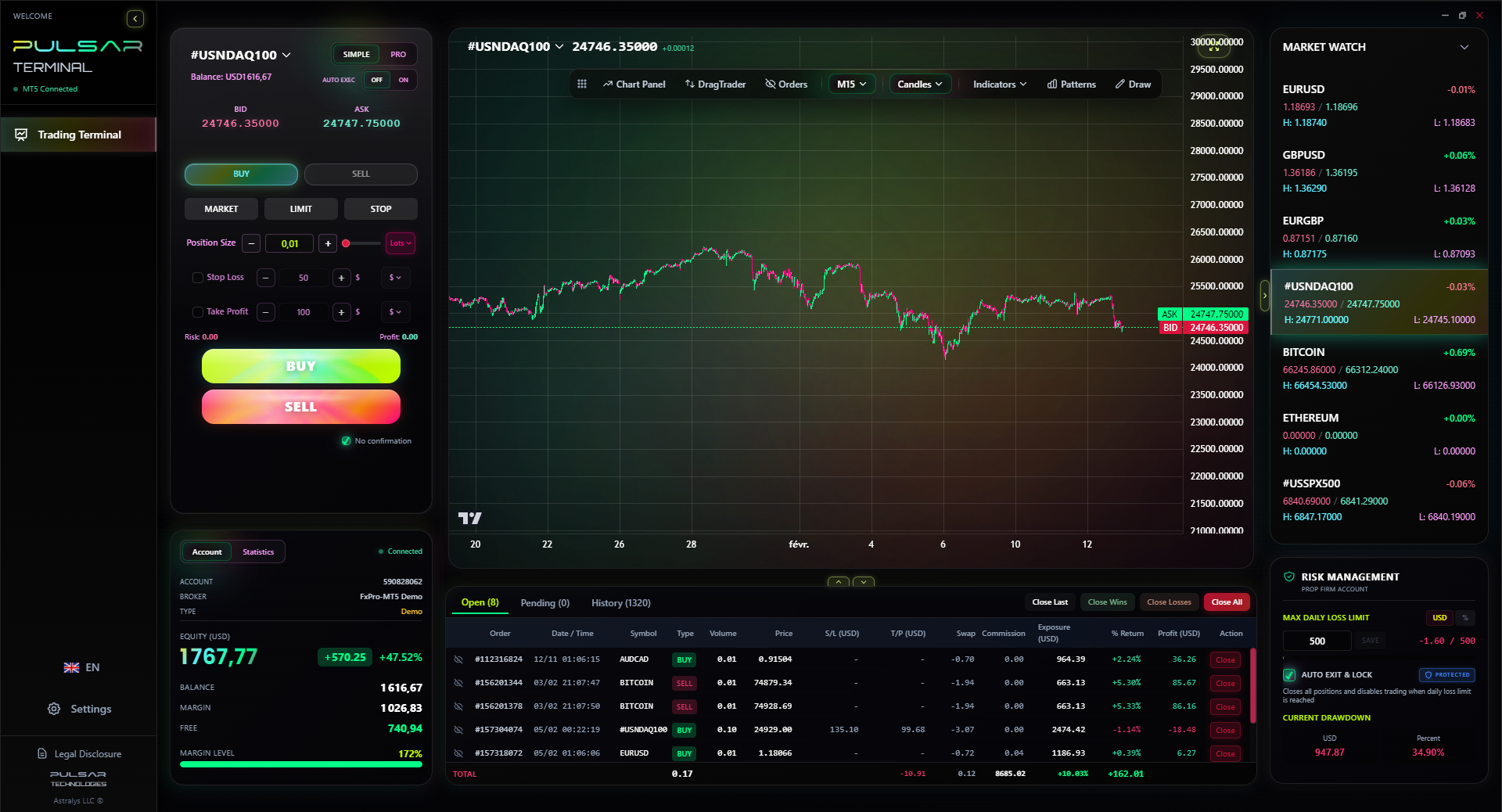
Managing multiple take-profit levels and a trailing stop manually while watching a prop firm's daily loss limit is a nightmare; Pulsar Terminal automates all of it on your MT5 chart with a single drag-and-drop order.
Pulsar Terminal
MT5オールインワンツール:ドラッグ&ドロップ注文、マルチTP/SL、トレーリングストップ、グリッドトレード、出来高プロファイル、プロップファーム保護。毎日1,000人以上のトレーダーが利用。
Congratulations, you did the hard part. But the work isn't over. The live funded account phase has its own nuances.
First Payout Hurdle: Many firms have a "first payout threshold." You might need to generate $1,000 in net profits before you can request your first withdrawal. This ensures they're not processing tiny payments. Plan for this.
The Profit Split Dance: Your first payout will clearly show the split. Remember, it's on net profit. If you made $2,000 but paid $200 in commissions, your split is calculated on $1,800. Request payouts regularly. Don't let large sums build up in the account - it changes your risk perception and it's not your money until it's in your bank.
Rule Changes: The rules usually relax slightly (e.g., no more minimum trading days), but the daily and overall loss limits remain. Violate them, and your funded account is gone. No warnings. I treat the daily loss limit as a hard stop for the entire day. If I lose 2.5% by noon, I'm done. I walk away. Protecting the capital is the only job.
The Grind: This isn't glamorous. It's a job. You have a risk budget to manage each day. Some days you'll make $300, some days $80, some days you'll lose $500 and shut down. The consistency is what gets your account scaled up over months. The real benefit of futures prop trading firms is that this grind can scale. A 2% month on a $50k account is $1,000. A 2% month on a scaled-up $200k account is $4,000. That's the path they offer.
“Prop firms aren't funding traders; they're funding risk managers who can also speculate.”
Let me save you some time and money. Here are the classic blunders.
1. Over-leveraging on the First Trade: The adrenaline is high. You want to pass fast. So you take a huge position on day one. One bad tick and you've blown 80% of your daily loss. You're psychologically wrecked for the rest of the challenge. Start small. Always.
2. Ignoring Commissions in Your Strategy: If you're a scalper aiming for 5-tick profits on the Micro E-mini S&P (MES), remember: at $1.50 per side, a round-turn trade costs $3. Your profit is $6.25. Commissions just ate nearly 50% of your gain. Your strategy must have a high enough win rate and profit target to overcome this friction. Test this in simulation first.
3. Chasing the Profit Target Near the End: You're at 7% profit, need 8%. You take a sub-par trade you wouldn't normally take just to "get over the line." This is how you give back 3% and put yourself in a hole. Stick to your process. The target will come.
4. Not Understanding the Spread and Slippage: In fast markets, your fill can be worse than your stop price. If your risk is calculated at $500 per trade, a bad fill could turn it into a $750 loss, potentially triggering a rule violation. Always factor in a buffer for execution.
The biggest pitfall is emotional trading. The evaluation fee creates a "fear of loss" that corrupts judgment. The only way past it is to treat the fee as tuition for an education. If you pass, great. If you fail, you paid for a course on discipline under pressure. That reframe alone helped me pass my next two challenges in a row.
FAQ
Q1Are futures prop trading firms a scam?
Most reputable ones are not scams in the traditional sense - they do pay out. However, their business model is built on statistical probability: most traders will fail their challenges and pay evaluation fees, which funds the payouts to the few who pass. It's a legitimate, if tough, model. The 'scam' feeling comes from traders underestimating the difficulty and overestimating their own skill.
Q2What's the best futures prop firm for beginners?
Beginners should look for firms with: 1) A lower profit target (6-8%), 2) A higher daily loss limit (5% or more), 3) A non-trailing or loosely trailing drawdown, and 4) Clear, simple rules. Firms with these features offer more room to learn and manage emotions. Starting with a smaller, cheaper account is also smarter than going for the $300k challenge right away.
Q3How much money can I realistically make with a prop firm?
It's entirely dependent on your skill and risk management. A consistently profitable trader making 2-3% per month on a $100k account is looking at $2k-$3k monthly before split. After an 80/20 split, that's $1,600-$2,400. The realistic goal isn't getting rich quick; it's building a consistent secondary income that can scale over time as your account size grows.
Q4Can I trade cryptocurrencies with a futures prop firm?
Typically, no. Most US-based futures prop firms are focused on regulated CME Group futures (like ES, NQ, CL, GC). They don't offer direct crypto trading. Some newer or international firms might offer crypto derivatives, but you must be extremely careful about their regulation and payout reliability.
Q5What happens if I hit a margin call on a funded account?
You should never get near a traditional margin call with a prop firm. Their internal daily and overall loss limits will shut down your account long before your equity gets low enough for an exchange-mandated margin call. Hitting their max loss rule results in account termination, not a request for more funds.
Q6Do prop firms provide training or mentorship?
Some offer basic educational resources, but don't expect hand-holding. Their core business is evaluating and funding traders who already have a strategy. You are responsible for your own education and edge. Relying on a prop firm to teach you to trade is a sure way to lose your evaluation fees.
ウィンストン教授のレッスン
重要ポイント:
- ✓Risk 0.5% of the starting balance per trade, not your equity.
- ✓Choose firms for their loss limits, not their profit splits.
- ✓Budget for two failed challenges before you see a profit.
- ✓Commissions can eat 50% of a scalper's tiny gains.
この記事はどれくらい役に立ちましたか?
星をクリックして評価
週刊トレーディングインサイト
無料の週刊分析&戦略。スパムなし。
著者について
James Mitchell
シニアトレーディングアナリスト
ニューヨーク拠点で9年以上のトレード経験を持つ。主要USDペア、プロップファームチャレンジ、米国の規制環境を専門とする。
コメント
リスク警告
金融商品の取引には大きなリスクが伴い、すべての投資家に適しているわけではありません。過去の実績は将来の結果を保証するものではありません。本コンテンツは教育目的のみであり、投資助言として解釈すべきではありません。取引前に必ずご自身で調査を行ってください。
こちらもおすすめ

Cara Trading Forex Sukses: 7 Prinsip dari Trader Profesional
Cara trading forex sukses dengan 7 prinsip trader pro: manajemen modal, disiplin, journal trading, backtest. Data nyata, bukan janji profit palsu.
Jam Trading Forex Terbaik untuk Trader Indonesia: Panduan Lengkap dengan Tabel Waktu
Panduan jam trading forex untuk trader Indonesia. Tabel 4 sesi dunia, jam emas 20:00-00:00, sesi mana yang harus dihindari. Data akurat + tips dari trader berpengalaman.
Top 5 Sàn Forex Uy Tín Nhất 2026: Review Jujur dari Trader Indonesia
Top 5 sàn forex uy tín 2026 untuk trader Indonesia. Review jujur: spread, deposit, withdraw, dukungan lokal. Exness, XM, IC Markets & lebih.
