


Everyone's selling you the dream: pass a simple test, get a six-figure account, and keep most of the profits.
James Mitchell
シニアトレーディングアナリスト
☕ 10 分で読める
学べること:
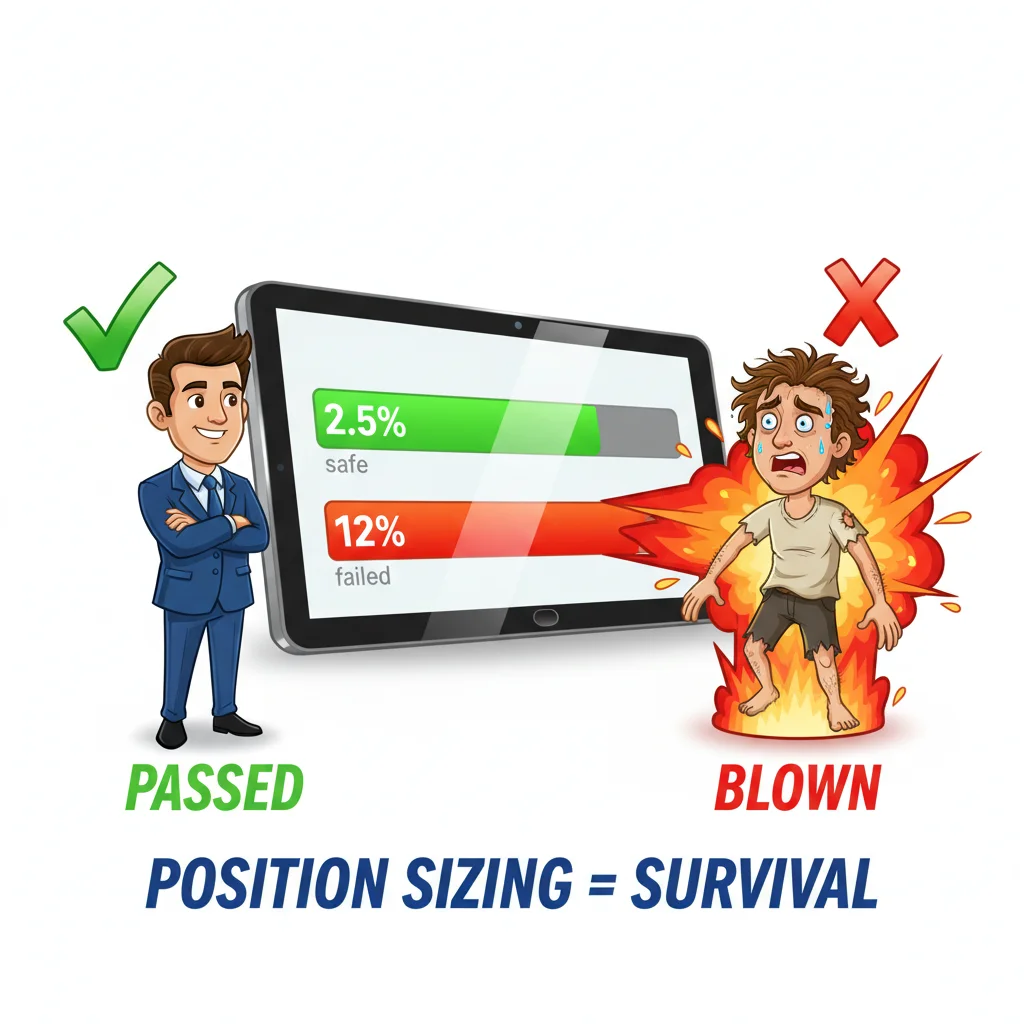
Everyone's selling you the dream: pass a simple test, get a six-figure account, and keep most of the profits. It sounds like a shortcut to trading with real capital. I bought into that dream, too, and it cost me. The reality of futures trading prop firms is a lot more complicated, and frankly, a lot less glamorous. Let me walk you through what I wish I'd known before I wrote my first check for an evaluation.
At its core, a futures prop firm gives you a simulated account with their rules. You pay a fee (anywhere from $25 to over $2,950) to take a "challenge" or "evaluation." If you hit their profit target without breaking their risk rules, they may grant you a "funded" account where you trade their capital and split the profits.
The key word there is "may." And the key distinction is "simulated." For the most part, during the evaluation, you're not trading real market risk for them. You're proving you can follow a system under pressure. The real prop trading happens only after you're funded, and even then, the structure is unique.

Warning: Don't confuse these retail prop firms with the old-school Wall Street proprietary trading desks. Those are heavily regulated entities within banks. The firms we're talking about operate in a regulatory gray area, which is a critical point we'll get into.
Their business model is simple: they collect evaluation fees from the 90-95% of traders who fail. The math is brutally efficient. If 100 people pay a $100 evaluation fee, that's $10,000 in revenue. If only 5 pass and get funded, the firm's risk is limited to those five accounts. It's a numbers game, and you're one of the numbers.
I learned this the hard way. My first attempt was with a popular firm offering a $50k account challenge for about $180. I was so focused on the potential profit split I glossed over the rules. I blew the account in three days trying to scalp the NQ without a solid plan. That $180 was a very expensive, but very effective, lesson.

💡 ウィンストンのヒント
Treat the daily loss limit as a sacred rule. If you're down 60% of it by 10 AM, walk away. The market will be there tomorrow. Protecting the account is your only job.
That upfront challenge fee is just the ticket to the show. The real expenses start piling up if you're serious about this long-term. Most guides don't stress this enough, so I'll break it down from my own P&L.
First, you have data fees. To trade futures properly, you need real-time data from the CME. This isn't optional. Through most prop firm platforms, you're looking at $130-$135 per month. Some firms bundle a basic feed, but for professional trading, you'll need the full suite.
Then there are platform fees. If the firm uses NinjaTrader, you might pay $99/month for the license. If they use Tradovate, it's often included. This varies wildly, so read the fine print.
Commissions are per trade. For a standard E-mini S&P 500 contract (ES), expect about $3-$4 per side. So a round trip (enter and exit) costs $6-$8. That adds up fast. For micro contracts (MES), it's cheaper, around $1 per contract, which is why they're great for starting out and practicing precise position size management.
Let's talk about the profit split. The advertised "up to 90%" is often tiered. You might get 80% or 90% after your first few payouts. Some offer 100% on the first $10k. It sounds great, but remember, you're paying all those underlying fees out of your share before you even see a dollar.
And finally, withdrawal fees. Need your money? That could be a $25 wire fee or a free ACH transfer. It depends on the firm.
Here’s a snapshot of my monthly overhead when I was actively trading a funded account:
| Expense | Approximate Cost |
|---|---|
| CME Real-Time Data | $135 |
| Platform (NinjaTrader) | $99 |
| Commissions (20 RT trades) | ~$120 |
| Total Monthly Operational Cost | ~$354 |
I had to make at least $354 in net profit just to break even on costs before taking a single dollar home. It changes your entire approach to profit targets.
“The evaluation fee isn't an investment; it's the price of admission to a test most people are designed to fail.”
This is where most traders fail. You can be a profitable trader in your personal account and still bomb a prop firm challenge. Their rules are designed to test discipline, not just profitability.
The Daily Loss Limit
This is the biggest killer. It's usually a fixed dollar amount or a percentage of the account's starting balance. Hit it, and your challenge is instantly failed. No warning. For a $50k account, a typical daily loss limit is $1,000 to $2,500. This means you cannot, under any circumstances, have a single day where your net loss exceeds that limit. It forces you to stop trading after a bad start - a discipline many lack.
The Maximum Drawdown Rule
This is your trailing safety net. It's often a larger percentage (e.g., 5-10% of the starting balance). Your account's peak value is tracked. If your current equity falls more than the max drawdown from that peak, you fail. This prevents you from giving back all your profits in a slump. You must protect your gains aggressively.
The Profit Target
You need to hit a specific profit goal to pass, usually 5-10% of the account size, without violating the other rules. The trick? You often have a minimum trading day requirement (e.g., 5-10 days). You can't just hit a home run on day one and quit. They want to see consistency.
I failed my second challenge not on a loss, but on the max drawdown rule. I made a quick $3,000 on the NQ, hit my profit target, and got cocky. The next week, I gave back $2,800 of it on a stubborn trade. Even though I was still up $200 overall, my drawdown from the peak ($3,000) exceeded the allowed limit. Account terminated. Lesson learned: in prop firm world, protecting the peak is sometimes more important than making new highs. Tools that help automate trailing stop logic are worth their weight in gold for this reason.
💡 ウィンストンのヒント
Before you pay for an evaluation, paper trade their exact rules for a full month. Every loss, every drawdown calculation. If you can't pass on paper, you won't pass with real money on the line.

This is the part that keeps me up at night, and it should give you pause. Most retail futures prop firms are not regulated like your standard broker. They're not Futures Commission Merchants (FCMs) registered with the CFTC and NFA.
They structure themselves as educational or evaluation services. You're paying for a test, not for them to hold your funds or execute trades. This is how they navigate the rules. The actual trade execution often happens through a partnered, fully-regulated broker like Tradovate or Rithmic. That's good - it means your orders hit a real, regulated market.
But the prop firm itself? Their capital, their payout promises, their stability? That's not subject to the same strict capital requirements, audits, or client fund segregation rules. If the firm goes under, your funded account balance and any unpaid profits could be gone. We saw a wave of firm closures in 2024 - dozens just vanished.
By 2026, this is changing. Regulators are circling. Stricter rules are coming, likely requiring more transparency and maybe even registration. For now, you must do your own due diligence. Choose firms that are transparent about their business, have a long track record of payouts, and partner with reputable, regulated brokers. The days of sending money to a flashy website with no physical address are over.
“In prop firm world, protecting your peak equity is sometimes more important than making new highs.”
With hundreds of options, how do you pick one? Don't just look at the biggest profit split. Dig deeper.
- Payout History & Reputation: Search for real payout proofs from traders on forums, not just testimonials on the firm's site. A firm like Topstep, which is an actual NFA-registered broker, has a long public history. Others have come and gone.
- Rule Clarity: The rules should be crystal clear, not hidden in legalese. What's the daily loss? Max drawdown? Are there silly rules like no holding over weekends or no trading news? I avoid firms with the latter - it's not realistic for all strategies.
- Fee Structure: Look for transparency on all fees: evaluation, data, platform, commissions, withdrawal. A firm that hides fees will cause problems later.
- Platform & Tools: You'll be living on their platform. Do they offer TradingView, NinjaTrader, or something else? Can you use the tools you rely on, like the MACD indicator or RSI in your preferred way?
- Scaling Plan: What happens when you're successful? Do they automatically increase your capital? What are the new rules? A good scaling plan is the sign of a firm that wants you to succeed long-term.

Pro Tip: Start small. Don't go for the $250k challenge because the dream is bigger. Buy a $50k or $100k evaluation. The rules are proportionally similar, but the fee risk is much lower. Use it to learn their system and your own psychology.
My first funded account was with a firm known for clean execution via Rithmic. The process was smooth, but their platform was clunky. I later moved to a firm using Tradovate because the all-inclusive fee structure and cleaner interface fit my swing trading style better.

I passed. I had a $100k funded account. I was getting an 80% split. I felt invincible. Then I made a classic error.
It was a Tuesday morning. The ES was grinding higher in a tight range. My system gave a long signal at 4550. I took it. Price moved to 4555, then stalled. My plan was a tight stop, but I thought, "It's a funded account, I have a bigger drawdown cushion. Let it breathe." I moved my stop-loss further away, violating my own trading plan.
Price reversed. Hard. It sliced through my original stop, then through my wider stop, and kept going. I was frozen. The loss hit $1,800 before I manually closed. I didn't hit my daily loss limit, but I had vaporized two weeks of careful profits in one undisciplined trade.
The firm didn't fail me. The market didn't fail me. I failed. I treated the "real" capital with less respect than my own money because it felt like house money. That psychological shift is deadly. A funded account isn't a reward; it's a higher-stakes test. Managing that trade with a proper, unemotional breakeven stop and trailing mechanism would have saved me most of that loss. It's a lesson in automation over emotion.
💡 ウィンストンのヒント
Your first withdrawal from a funded account is a milestone. Take it, even if it's small. It proves the system works and makes the whole endeavor psychologically real. Then get back to work.
Managing the complex risk rules of a prop firm challenge is stressful enough without manual calculations; a tool that can automate trailing drawdown and breakeven stops removes a huge psychological burden.
Pulsar Terminal
MT5オールインワンツール:ドラッグ&ドロップ注文、マルチTP/SL、トレーリングストップ、グリッドトレード、出来高プロファイル、プロップファーム保護。毎日1,000人以上のトレーダーが利用。

“A funded account isn't a reward; it's a higher-stakes test of the discipline you just proved you had.”
Futures trading prop firms are not a golden ticket. They're a specific tool for a specific type of trader.
It might be worth it if:
- You have a proven, rule-based trading strategy but lack significant capital.
- You possess extreme discipline and can follow strict, external risk rules.
- You treat the evaluation fee as a cost of education, not an investment.
- You're comfortable with the regulatory ambiguity and have chosen a reputable firm.
It's probably NOT for you if:
- You're a beginner hoping the structure will teach you to trade. (It won't. It will take your money).
- You're an emotional trader who struggles with stop-losses.
- You can't afford to lose the evaluation fee multiple times.
- You expect a quick, easy path to wealth.
The brutal statistic says it all: only about 5-15% pass the evaluation. Of those, maybe half blow the funded account within months. You're aiming for a tiny slice of the pie. Your edge must be in your process, not just your market analysis.
For me, the journey through futures trading prop firms was valuable. It forced a level of discipline I didn't have trading my own account. The structure exposed every weakness in my risk management. But I entered it with my eyes open, after years of experience, and with money I could afford to lose on the attempts. That's the only way to approach it.
FAQ
Q1What's the main difference between a prop firm and a regular broker like Interactive Brokers?
A broker provides you access to the market with your own capital. A prop firm provides you access to their capital after you pass their test. With a broker, you keep 100% of your profits (and losses). With a prop firm, you split profits but your personal loss is typically capped at your evaluation fee.
Q2Can I trade any futures contract with a prop firm?
Most allow trading on major U.S. exchanges (CME, CBOT, NYMEX, COMEX). This includes the ES (S&P), NQ (Nasdaq), YM (Dow), CL (Crude Oil), GC (Gold like XAU/USD), and their micro counterparts. Some restrict ultra-low liquidity products.
Q3How often do prop firms actually pay out?
The reputable ones pay reliably, often on a weekly or monthly schedule. The key is "reputable." Always research a firm's payout history on independent forums before giving them any money. The closure of many firms in 2024 proved that not all could honor their commitments.
Q4What happens if I have a winning trade but my platform disconnects?
This is a major risk. Reputable firms have clear policies, often honoring demonstrable "platform-side" errors. However, you are responsible for your connection and orders. It's a good reason to choose a firm with a stable, professional platform and to have a backup internet source.
Q5Are there any prop firms that don't charge an evaluation fee?
Virtually all do. The fee is their primary business model. Any firm claiming a completely free evaluation is likely making money through wider spreads or other hidden costs. Consider the fee a realistic cost of accessing their capital pool.
Q6Can I use automated trading or algorithms?
It depends entirely on the firm. Many allow it, but they often require you to disclose the strategy and may have it reviewed. Some prohibit fully automated trading during the evaluation phase to ensure a human is monitoring. Never assume it's allowed - always check the rules.
Q7Do prop firm payouts count as taxable income?
Yes. In the U.S., your profit share is considered ordinary income. You will receive a 1099 form from the firm (if they are legitimate) at the end of the year. You are responsible for reporting this income and paying the appropriate taxes.
ウィンストン教授のレッスン
重要ポイント:
- ✓Only 5-15% pass evaluations. Assume you'll need multiple attempts.
- ✓Monthly costs (data, platform) can exceed $350 before you make a dime.
- ✓The daily loss limit is your #1 priority, not profit targets.
- ✓Choose firms with a multi-year public payout history.
この記事はどれくらい役に立ちましたか?
星をクリックして評価
週刊トレーディングインサイト
無料の週刊分析&戦略。スパムなし。
著者について
James Mitchell
シニアトレーディングアナリスト
ニューヨーク拠点で9年以上のトレード経験を持つ。主要USDペア、プロップファームチャレンジ、米国の規制環境を専門とする。
コメント
リスク警告
金融商品の取引には大きなリスクが伴い、すべての投資家に適しているわけではありません。過去の実績は将来の結果を保証するものではありません。本コンテンツは教育目的のみであり、投資助言として解釈すべきではありません。取引前に必ずご自身で調査を行ってください。
こちらもおすすめ

Cara Trading Forex Sukses: 7 Prinsip dari Trader Profesional
Cara trading forex sukses dengan 7 prinsip trader pro: manajemen modal, disiplin, journal trading, backtest. Data nyata, bukan janji profit palsu.
Jam Trading Forex Terbaik untuk Trader Indonesia: Panduan Lengkap dengan Tabel Waktu
Panduan jam trading forex untuk trader Indonesia. Tabel 4 sesi dunia, jam emas 20:00-00:00, sesi mana yang harus dihindari. Data akurat + tips dari trader berpengalaman.
Top 5 Sàn Forex Uy Tín Nhất 2026: Review Jujur dari Trader Indonesia
Top 5 sàn forex uy tín 2026 untuk trader Indonesia. Review jujur: spread, deposit, withdraw, dukungan lokal. Exness, XM, IC Markets & lebih.
