


Let's get one thing straight: most 'Islamic accounts' offered to Nigerian traders are just marketing gimmicks.

Olumide Adeyemi
西アフリカ・トレーディングの先駆者 ·  Nigeria
☕ 9 分で読める
学べること:
- 1What Actually Makes Forex Trading Halal? It's More Than No Swap
- 2Nigeria's 2025 Rules: What the New Law Means for You
- 3The Real Costs of a Halal Account (Forget 'Zero Commission')
- 4Your 5-Point Halal Broker Verification Checklist
- 5Your Strategy Matters: Avoiding Gharar in Your Trades
- 6Zakat, Taxes, and Your Trading Profit
- 7Getting Started: Your Action Plan
Let's get one thing straight: most 'Islamic accounts' offered to Nigerian traders are just marketing gimmicks. A swap-free label doesn't automatically make a broker halal. I've seen too many traders get this wrong, focusing on the wrong details while missing the real principles. In this guide, I'll show you what actually makes a forex broker compliant for a Muslim trader in Nigeria, how to verify it, and which brokers are doing it right under our new 2025 laws. We'll cut through the noise and get to what matters for your faith and your trading account.
When we talk about halal forex, most traders immediately think 'swap-free account.' That's the start, but it's only about 20% of the picture. The core principles of Islamic finance - avoiding riba (interest), gharar (excessive uncertainty), and maysir (gambling) - apply to your entire trading activity, not just your account type.
Think about it. If you're using 1:500 use on a news spike, that's pure speculation (gharar). If your broker is using your idle cash to earn interest without your explicit consent, that's riba. The account label is just the entry ticket.
I learned this the hard way early on. I opened a 'swap-free' account with a broker, proud of my compliance. Then I dug into their terms. They reserved the right to charge 'administrative fees' on positions held over 30 days, which were disguised interest payments. I was avoiding overnight swaps but getting hit with a different form of riba. That's when I realized checking the fine print is a religious duty.

Warning: A broker can offer a swap-free account but still engage in non-Sharia-compliant activities with your funds, like interest-based lending. The account type is a feature; the broker's overall operation is what needs scrutiny.
True compliance means the broker's entire operation aligns with Islamic principles. This includes how they hold client funds, their business investments, and their fee structure. It's about the source of their profit, not just how they charge you. For a deeper understanding of managing risk in a principled way, our guide on swing trading discusses timeframes that can reduce speculative gharar.

💡 ウィンストンのヒント
A broker's 'Islamic account' terms are in the appendix, not the homepage. The real cost of compliance is buried in the fee schedule PDF. Find it.
The game changed with the Investments and Securities Act, 2025 (ISA 2025). Before this, it was a bit of a wild west. Now, it's illegal for any platform - including forex brokers - to operate here without formal SEC registration. This is huge for anyone seeking halal forex brokers.
Why? Because regulation creates a paper trail and accountability. A broker registered with Nigeria's SEC and CBN is far more likely to have transparent operations you can audit for Sharia compliance. They can't just hide behind an offshore shell company. The law is forcing legitimacy.
The numbers back up the shift. Nigeria's Islamic finance sector hit NGN2.5 trillion in 2023, with deposits in Islamic banks jumping 92.5%. The demand is there, and the regulators are finally building the framework. However, don't get it twisted: Nigerian regulation ensures a broker is legal, not that it's halal. That second part is still on you to verify.
The Registration Checklist
When researching a broker, your first question shouldn't be about spreads. It should be: "Are you registered with the SEC under ISA 2025?" If they hesitate or give a vague answer about 'international regulation,' walk away. A broker serious about the Nigerian market will have this registration front and center. This is your first filter for finding a legitimate partner, which is the foundation for finding a halal one. Understanding broker structures is key; you can compare some major international brokers with strong reputations in our Exness review and IC Markets review.
“A swap-free label doesn't make a broker halal; it just makes one of their features compliant.”
Let's talk numbers, because this is where brokers get sneaky. They'll advertise 'zero commission' and 'tight spreads' on their Islamic accounts. Sounds perfect, right? Often, it's a trap.
Here's the reality. Brokers have costs. If they aren't earning overnight swap interest (riba), they need to cover that lost revenue somewhere else. They usually do it in one of two ways: 1) Wider spreads, or 2) Higher fixed commissions.
Look at these real examples from my research:
| Broker | 'Standard' Account Spread (EUR/USD) | 'Islamic' Account Spread (EUR/USD) | 'Islamic' Account Commission |
|---|---|---|---|
| Broker A | 0.9 pips | 1.5 pips | $0 |
| Broker B | 0.0 pips + $5 lot commission | 0.0 pips | $12 lot commission |
See the shift? Broker A hides the cost in the spread. Broker B slaps on a clear commission. Personally, I prefer the Broker B model - it's transparent. That $12 commission is known, agreed upon, and isn't interest. It's a service fee. The 1.5 pip spread from Broker A is a hidden cost that changes with market volatility, which can feel closer to gharar.
I once made a scalp trade on EUR/USD, thinking I got in at 1.0850 with a 1 pip spread. On my 'Islamic' account, the execution was 1.0849. I lost a pip the moment I entered. That hidden cost ate 20% of my 5-pip target. It was a brutal lesson in reading the true execution policy, not the marketing headline. Always, always use a demo account to test the actual execution and costs before funding. And always know your exact cost per pip.
Don't take a broker's word for it. You need a due diligence process. Here's the checklist I use for every broker I consider.
- SEC/CBN Registration: Confirm their Nigerian regulatory status. This is non-negotiable post-2025.
- Sharia Compliance Certificate: The gold standard. Does the broker have a certificate from a recognized Islamic financial authority? This isn't common, but a few international brokers have them. If they do, it's a strong positive signal.
- Full Fee Disclosure: Request a complete schedule of all fees for the Islamic account - not just spreads. Ask specifically about: rollover administration fees, account inactivity fees, and funding/withdrawal fees. Get it in writing.
- Client Fund Segregation: Are client funds held in segregated accounts at reputable banks? This ensures your money isn't being mixed with the broker's operational funds for non-halal activities.
- use Policy: While not directly a halal issue, excessive use promotes maysir (gambling). A responsible broker offering Sharia-compliant services should have sensible use limits. I'm wary of any 'halal' broker offering 1:1000 use.

Pro Tip: The best test is a direct question. Email their support: "Can you provide documentation on how your swap-free account ensures no riba is generated, including on your side with bank placements of client funds?" A vague or copy-pasted answer tells you everything. A detailed, principled response is a very good sign.
This verification is part of smart risk management, just like using a position size calculator. It protects your capital and your principles.
💡 ウィンストンのヒント
Your most important indicator for halal trading isn't on the chart. It's your journal. If your entries look like lottery tickets, you've got a gharar problem.
“The 10% capital gains tax is your duty to the state. The 2.5% Zakat is your duty to purify the wealth.”
You can have the most perfectly halal account with a certified broker, and still make your trading haram through your own actions. This is the part no one talks about. If your strategy is pure gambling on news or chasing pumps, you're deep in gharar.
Halal trading is about informed risk-taking, not speculation. It means having a clear reason for every entry and exit, based on analysis - not a 'feeling' or a tweet. I had to unlearn my bad habits. I used to sit on my phone, watching the XAU/USD chart jump around, tapping in and out based on 5-minute candles. That wasn't trading; it was digitized gambling, and it lost me money consistently.
I shifted to a rules-based scalping strategy with strict entry criteria using the RSI indicator and volume. Every trade had a predefined stop-loss and take-profit before I clicked buy. The uncertainty (gharar) was managed and contained. The profit became a reward for analysis and discipline, not luck. That was the spiritual and financial turning point.
Your tools should promote clarity, not confusion. Using a platform that helps you define your risk visually is crucial. For instance, setting multiple take-profit levels allows you to lock in profit rationally, removing the emotion of 'should I close now?' which is a form of doubt and uncertainty.
You made a halal profit. Congratulations. Now, your obligations begin. In Nigeria, you are subject to a 10% Capital Gains Tax on your net trading profits, payable to the FIRS. This is a legal requirement. Keeping detailed records of every trade (entry, exit, profit/loss) is not just good trading hygiene; it's essential for accurate tax filing.
Beyond the government's share is your spiritual share: Zakat. If your trading capital and profits meet the nisab (threshold), you must calculate and pay Zakat (typically 2.5%) on that wealth. There's a beautiful clarity in this. It purifies your wealth and reminds you that the profit is a provision, not just a score.
I set up a simple system. At the end of every lunar year, I:
- Total the value of my trading account and any cash from withdrawals.
- Subtract any outstanding debts (like a margin call loan, which you should avoid anyway).
- Calculate 2.5% of the remainder.
That amount gets transferred to a dedicated Zakat fund I distribute. It turns the abstract principle into a practical, non-negotiable line item in my P&L. Paying your 10% tax and your 2.5% Zakat is the final, fulfilling step that completes the cycle of halal trading.
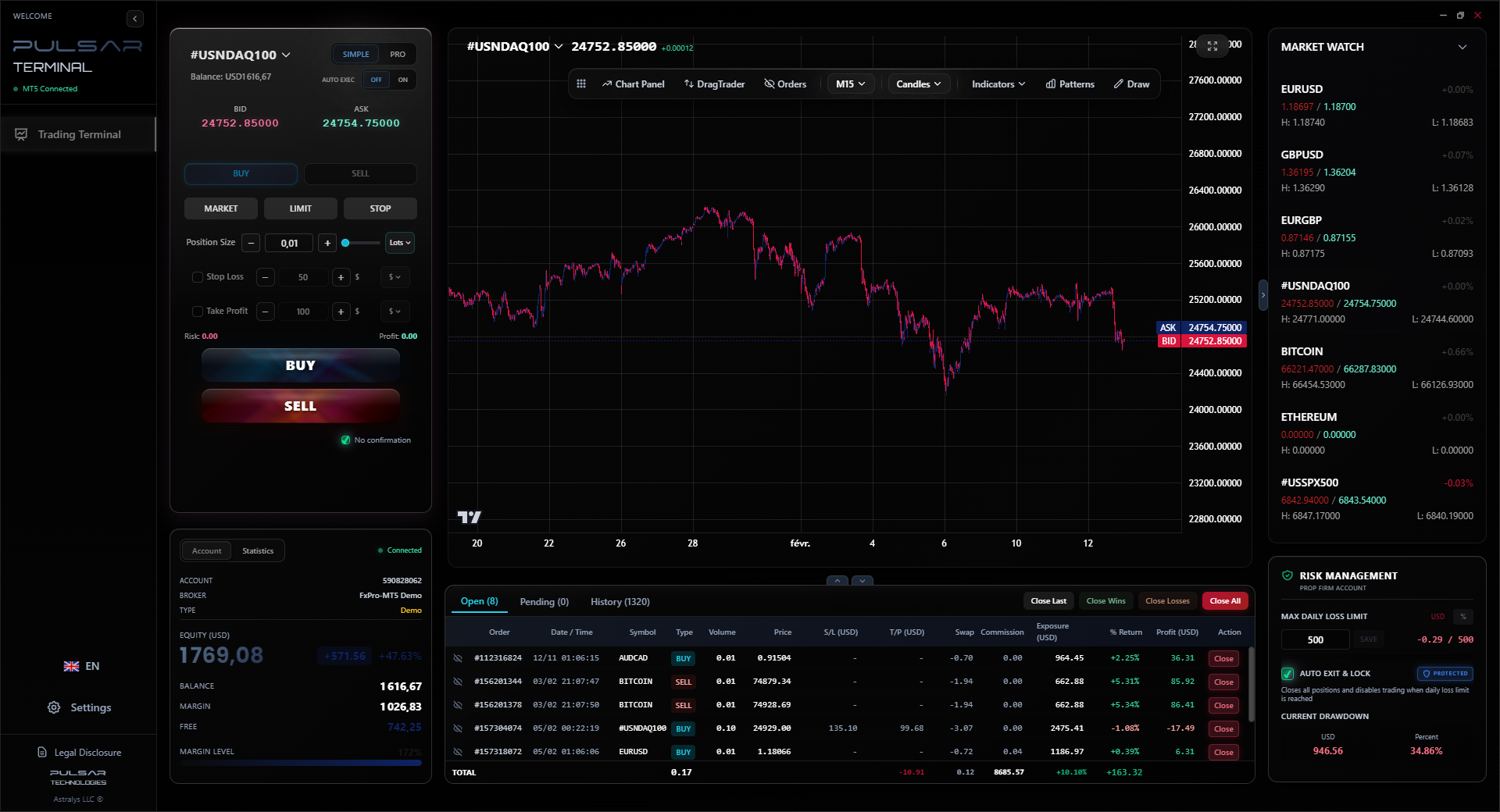
Managing risk and removing emotional guesswork is key to avoiding gharar; Pulsar Terminal lets you set multi-level take-profits and stop-losses visually before you enter, turning your plan into an automated rule.
Pulsar Terminal
MT5オールインワンツール:ドラッグ&ドロップ注文、マルチTP/SL、トレーリングストップ、グリッドトレード、出来高プロファイル、プロップファーム保護。毎日1,000人以上のトレーダーが利用。
“True compliance means the broker's entire operation aligns with Islamic principles, not just their fee structure for you.”
Alright, so where does this leave you? Overwhelmed? Don't be. Here's a simple, step-by-step plan to move forward correctly.
Step 1: Education First. Don't deposit a single naira. Spend two weeks learning. Understand the MACD indicator, support/resistance, what a spread really is. Paper trade.
Step 2: The Shortlist. Using the checklist from Section 4, identify 2-3 brokers that seem legitimate. Focus on those with clear Nigerian registration and transparent Islamic account terms. Read our deep dives on brokers like Pepperstone and XM to see how their structures and offerings compare.
Step 3: The Demo Test. Open a demo Islamic account with your shortlisted brokers. Trade for a month. Test their execution speeds, see the real spreads during Lagos market hours, and practice your strategy. Feel how their platform works.
Step 4: Start Small. When you fund a live account, start with an amount you can afford to lose completely - maybe 20,000 NGN. The goal of your first 100 trades is not to get rich. It's to learn discipline, test your strategy in real conditions, and confirm the broker's operations without major risk.
Finding a true halal forex broker in Nigeria is work. It requires skepticism, diligence, and a commitment to your principles over convenience. But doing it right from the start builds a foundation for trading that is not only potentially profitable but also spiritually sound. That's a peace of mind no amount of pip gains can buy.
FAQ
Q1Is forex trading haram in Nigeria?
Forex trading itself is not inherently haram. It becomes haram if it involves riba (interest), excessive speculation (gharar), or gambling-like behavior (maysir). Trading through a verified halal (swap-free) account with a disciplined, analytical strategy can make it a permissible activity. The new ISA 2025 law also provides a regulated framework for legal operation.
Q2Do halal forex brokers charge any fees?
Yes, absolutely. They have to make money. Instead of earning interest (riba), they typically charge higher spreads or fixed trading commissions. For example, a standard account might have a 0.9 pip spread, while the Islamic account on the same broker has a 1.5 pip spread. Others charge a clear commission, like $12 per standard lot. The key is that these fees are transparent service charges, not interest.
Q3What is the difference between a swap-free account and a halal account?
This is critical. A 'swap-free' account simply doesn't charge or pay overnight interest. A true 'halal' account implies the broker's entire handling of your funds complies with Sharia law - including how they hold and use client money. Many brokers offer swap-free as a technical feature but don't run their overall business Islamically. Always ask for deeper compliance documentation.
Q4How do I pay Zakat on my trading profits?
You calculate Zakat on your wealth that has been held for one lunar year. This includes the total value of your trading account plus any cash you've withdrawn and saved. If this total meets the nisab (threshold, often equivalent to the value of 85g of gold), you pay 2.5% of that amount. Keep good records of your account balance at the start and end of the Zakat year.
Q5Can I use high use on a halal account?
Technically, you can, as use itself isn't riba. However, using extremely high use (like 1:500) encourages gambling behavior (maysir) and massive risk, which goes against the principle of avoiding excessive uncertainty (gharar). A responsible, disciplined approach aligns with using moderate use to manage risk, not chase lottery-style wins.
Q6Does Nigerian law guarantee a broker is halal?
No. The ISA 2025 law and SEC registration guarantee a broker is operating legally in Nigeria. They provide a layer of security and transparency. However, determining if the broker's operations are Sharia-compliant is a separate, religious due diligence process you must undertake using the checklist in this guide.
ウィンストン教授のレッスン
重要ポイント:
- ✓Verify SEC registration first (ISA 2025 is law).
- ✓Demand full Islamic account fee disclosure.
- ✓Avoid use over 1:100 to reduce gharar.
- ✓Calculate 2.5% Zakat on annual trading wealth.
- ✓Strategy discipline is part of compliance.
この記事はどれくらい役に立ちましたか?
星をクリックして評価
週刊トレーディングインサイト
無料の週刊分析&戦略。スパムなし。
著者について
Olumide Adeyemi
西アフリカ・トレーディングの先駆者
ナイジェリアで最もアクティブなFXトレーディング教育者の一人。ラゴスから8年のトレード経験。アフリカのトレーダー向けの少額資金戦略とプロップファームチャレンジを専門とする。
コメント
リスク警告
金融商品の取引には大きなリスクが伴い、すべての投資家に適しているわけではありません。過去の実績は将来の結果を保証するものではありません。本コンテンツは教育目的のみであり、投資助言として解釈すべきではありません。取引前に必ずご自身で調査を行ってください。
こちらもおすすめ

Cara Trading Forex Sukses: 7 Prinsip dari Trader Profesional
Cara trading forex sukses dengan 7 prinsip trader pro: manajemen modal, disiplin, journal trading, backtest. Data nyata, bukan janji profit palsu.
Jam Trading Forex Terbaik untuk Trader Indonesia: Panduan Lengkap dengan Tabel Waktu
Panduan jam trading forex untuk trader Indonesia. Tabel 4 sesi dunia, jam emas 20:00-00:00, sesi mana yang harus dihindari. Data akurat + tips dari trader berpengalaman.
Top 5 Sàn Forex Uy Tín Nhất 2026: Review Jujur dari Trader Indonesia
Top 5 sàn forex uy tín 2026 untuk trader Indonesia. Review jujur: spread, deposit, withdraw, dukungan lokal. Exness, XM, IC Markets & lebih.
