


You've seen that little candlestick with a long lower wick everywhere, haven't you? The 'hammer.' Every guru on Nairaland and YouTube screams it's a guaranteed buy signal.

Olumide Adeyemi
西アフリカ・トレーディングの先駆者 ·  Nigeria
☕ 13 分で読める
学べること:
- 1What Exactly Is a Hammer Candlestick? (Beyond the Basic Definition)
- 2How to Spot a Real Hammer Forex Pattern in Nigeria (And Ignore the Fakes)
- 3A Simple, Actionable Hammer Candlestick Trading Strategy
- 4Common Mistakes Nigerian Traders Make with the Hammer (I've Made Them All)
- 5Brokers & Tools for Trading Hammer Patterns in Nigeria
- 6The Inverted Hammer & Shooting Star: The Hammer's Family
- 7Advanced Concepts: Taking Your Hammer Forex Trading Further
You've seen that little candlestick with a long lower wick everywhere, haven't you? The 'hammer.' Every guru on Nairaland and YouTube screams it's a guaranteed buy signal. But how many times have you bought that hammer only to watch the price smash right through it and take your money with it? Let's be honest, most explanations of hammer forex patterns are rubbish. They show you perfect textbook examples from 2017, not the messy, deceptive charts you're staring at right now. I've traded this market for over a decade, from the days of struggling with unreliable internet in Lagos to now. I've made money with hammers, and I've been cleaned out by them. This isn't theory. This is what actually works on the charts you and I see every day.
Forget the fluffy definitions. A hammer is a price action shout. It's the market screaming, 'We tried to go lower, and the sellers got absolutely rejected.' Visually, it's a candlestick with a small body at the top and a lower wick that's at least twice the length of the body. The upper wick is tiny or non-existent.
The Anatomy of a Real Hammer
The body represents the opening and closing price range. The color (green/white or red/black) matters less than you think in a true hammer. A green hammer shows buyers managed to close near the high of the period, which is stronger. A red hammer shows buyers fought back to close near the open, which is still a rejection of lower prices.
The wick is the story. That long lower shadow shows the price was pushed down aggressively during the candle's formation (by the hour, day, etc.), but then buyers stepped in and forced it back up. That's the battle, and the buyers won that round.

Warning: A long lower wick alone doesn't make a hammer. If the candle has a huge body and a long wick, it's just volatility. The body must be small, showing indecision at the top after the rejection.
Here’s the thing most Nigerians miss: context is everything. A hammer after 10 straight down candles on the daily chart? Pay attention. A hammer in the middle of a messy, sideways range on the 5-minute chart? Probably noise. I learned this the hard way early on. I was scalping GBP/USD and saw a perfect hammer on the M5 chart during the London session. I jumped in, thinking it was a sure thing. The spread was wide, the market was choppy, and I got stopped out for a 1.5% loss in minutes. The pattern was textbook, but the market context was all wrong.

💡 ウィンストンのヒント
A hammer without a story is just a candle. Always ask: 'What story is the higher timeframe chart telling?' If it's not a clear downtrend, walk away.
“A hammer is a price action shout. It's the market screaming, 'We tried to go lower, and the sellers got absolutely rejected.'”
This is where you separate the pros from the punters. Spotting a hammer isn't about drawing tools; it's about understanding market mechanics, especially with the unique volatility we see with pairs like GBP/NGN or even EUR/USD during Nigerian market hours.
First, you need the right location. A hammer is a reversal pattern. It must appear at the bottom of a downtrend. You can't have a hammer in the middle of a strong uptrend and call it a buy signal - that's just a pullback. I always zoom out to the higher timeframe first. Is the weekly chart showing a clear sell-off? Good. Now, on the daily or 4-hour chart, look for the hammer forming after a series of lower lows.
Second, check the volume. Most platforms have a volume indicator. A hammer with significantly higher volume is a much stronger signal. It means a lot of traders participated in that rejection. A low-volume hammer is suspect; it might just be low liquidity during off-hours (like late night Nigerian time).
Third, confirm with support. The best hammers form right on a known support level. This could be a previous swing low, a round number (like 1.0800 on EUR/USD), or a key moving average like the 50 or 200 EMA. When price dips to a major support and prints a hammer, the odds of a bounce are exponentially higher.
Let me give you a real example from last year. USD/JPY was in a steep downtrend. It approached the key 140.00 psychological level. On the daily chart, it touched 139.85, formed a massive hammer with a huge lower wick, and closed back above 140.50. The volume was the highest in a week. That wasn't just a hammer; it was a declaration. I entered a long at 140.55, placed my stop loss below the hammer's low at 139.75, and rode it for over 200 pips. The location (support at 140.00), the volume, and the clear downtrend made it a high-probability trade. You can learn more about trading key levels in our guide on swing trading.
“I've made money with hammers, and I've been cleaned out by them. This isn't theory. This is what actually works.”
Okay, you've spotted a valid hammer. Now what? You need a plan, not a prayer. Here's the step-by-step strategy I've used consistently.
Step 1: Wait for the Close. Never, ever trade a hammer before the candle is fully formed. That wick can keep growing until the last second of the time period. Patience is a weapon.
Step 2: Entry Point. The safest entry is a buy order placed above the high of the hammer candle. Why? You're waiting for confirmation that the buyers who created the hammer are still in control and are pushing price higher. This often means entering on the next candle. It's less exciting than buying the exact low, but it's far more reliable.
Step 3: Stop Loss Placement. This is non-negotiable. Your stop loss goes below the low of the hammer's wick. This is your invalidation point. If price goes back down there, the hammer failed. The market rejected the rejection. Protect your capital. Always use a position size calculator to ensure this stop distance doesn't risk more than 1-2% of your account.
Step 4: Take Profit Targets. I use a multi-tier approach.
- Target 1: The nearest resistance level. This could be the previous swing high or a key moving average.
- Target 2: A 1:1.5 or 1:2 risk-to-reward ratio measured from your entry. If your stop loss is 50 pips away, Target 2 is 75-100 pips above your entry.
Using Other Indicators: Don't clutter your chart, but one or two confirmations help. I often look at the RSI indicator. A hammer forming while the RSI is in oversold territory (below 30) adds conviction. Similarly, a bullish divergence on the MACD indicator alongside the hammer is a powerful combo.

Example: You see a hammer on EUR/USD daily chart. Hammer high: 1.0720. Hammer low: 1.0680.
- Entry: Buy at 1.0725 (above the high).
- Stop Loss: 1.0675 (5 pips below the low). Your risk is 50 pips.
- Take Profit 1: Previous resistance at 1.0780 (55 pips profit).
- Take Profit 2: 1.0825 (100 pips profit for a 1:2 risk-reward).
This structure gives you a clear roadmap. For very quick moves, this concept can also be adapted for a scalping strategy on lower timeframes, but the risk management must be even tighter.
“I've made money with hammers, and I've been cleaned out by them. This isn't theory. This is what actually works.”
Let's talk about the pitfalls. This is the stuff that costs you money, and I've donated plenty to the market learning these lessons so you don't have to.
1. Trading Every Single Hammer. This is the biggest killer. The chart will show dozens of hammers, especially on lower timeframes. Most are meaningless noise. You must filter for only the high-quality, high-context hammers as described earlier. The 5-minute chart during low volatility is a minefield of fake hammers.
2. Ignoring the Overall Trend. A hammer in a strong downtrend has a chance. A hammer in a strong uptrend is not a buy signal; it's just a minor pullback. Always know the direction of the higher timeframe. Trading a hammer against the major trend is like trying to swim upstream in the Third Mainland Bridge traffic.
3. Placing the Stop Loss Too Tight. Putting your stop loss just below the hammer's body, instead of below its wick, is asking for trouble. Normal market volatility can easily tap you out before the real move begins. You must give the trade room to breathe. This is why understanding the spread definition of your broker is crucial, as a wide spread can eat into that breathing room.
4. No Confirmation. Jumping in the second the hammer closes is greedy. Waiting for a small pullback or a break above the high is a discipline that saves accounts. I once lost $400 on a beautiful gold (XAU/USD) hammer because I entered at the market close and it immediately reversed. I didn't wait for any confirmation. Now, I wait for the next candle to at least start moving my way. You can study more about gold's unique behavior in our XAU/USD guide.
5. Risking Too Much. A hammer is a signal, not a certainty. Even the best-looking pattern fails. If you risk 5% of your account on one hammer trade, a few failures will blow you up. Stick to 1-2% max. This is the most important rule in the book, especially when using the high use offered by brokers like Exness or XM. High use + poor risk management = a guaranteed margin call.
💡 ウィンストンのヒント
Your first profit target should often be the nearest obvious resistance. Don't get greedy trying to catch the whole move. Bank partial profits and move your stop to breakeven.
“Trading every hammer you see, especially on low timeframes, is a fast track to losses.”
You can have the best strategy in the world, but if your broker's platform is laggy or their spreads are criminal, you're finished before you start. Here’s the lay of the land for us in Nigeria.
Choosing a Broker: You're trading with international brokers. The key is finding one with reliable deposits/withdrawals in Naira, decent spreads on the majors, and a stable platform. Based on real use and community feedback:
- Exness: Popular for raw spreads (from 0.0 pips) and smooth Naira transactions. Their use is high, which is a double-edged sword. Minimum deposit is around $10.
- IC Markets: A favorite for serious technical traders. Their spreads on Raw Spread accounts are consistently tight, and the MT4/MT5 execution is excellent. Minimum deposit is higher, around $200.
- XM: Great for beginners. Low minimum deposit ($5), solid educational resources, and they accept Nigerian clients easily. Spreads are a bit higher than the raw accounts elsewhere.
- Pepperstone: Known for top-tier execution speed and the Razor account with tight spreads + commission. Very professional, but may have stricter verification.
The Platform Matters: You need MetaTrader 4 or 5. Full stop. The charting tools for drawing support/resistance and analyzing candlesticks are industry standard. Most brokers offer it.
The Hidden Cost: The Spread When you're trading a hammer, your entry is often just above the high. If the spread on your EUR/USD is 2.0 pips instead of 0.8, you're starting your trade at a significant disadvantage. Always check live spreads on the account type you're using before you fund it. A small difference in spread definition compounds over hundreds of trades.

Pro Tip: Open a demo account with 2-3 brokers. Plot the same hammer pattern on their charts and try to execute the trade. You'll quickly feel which platform responds better and which has more favorable trading conditions for your style.
“Trading every hammer you see, especially on low timeframes, is a fast track to losses.”
The hammer has two close relatives you need to know. They're the same pattern, just flipped for different market contexts.
The Inverted Hammer: This is a hammer that forms at the bottom of a downtrend, but it has a long upper wick and a small body at the bottom. It signals that buyers tried to push price up during the period, but sellers rejected it, closing it near the lows. However, the mere attempt to rally shows buying interest. It's a less reliable bullish reversal signal than the standard hammer. It often needs more confirmation (like a strong green candle the next day).
The Shooting Star: This is the bearish counterpart to the hammer. It forms at the top of an uptrend. It has a small lower body and a long upper wick, showing buyers pushed price high, but sellers smashed it back down to close near the open. This is a potential sell signal. The rules are the mirror image: look for it after an uptrend, place a sell stop below its low, and set a stop loss above its high.
Quick Comparison Table:
| Pattern | Trend Location | Body Position | Long Wick | Signal |
|---|---|---|---|---|
| Hammer | Downtrend Bottom | Top | Lower | Bullish Reversal |
| Inverted Hammer | Downtrend Bottom | Bottom | Upper | Potential Bullish Reversal |
| Shooting Star | Uptrend Top | Bottom | Upper | Bearish Reversal |
Recognizing the shooting star can save you from buying into a false hammer breakout at the top of a move. It's all part of reading the market's story.
💡 ウィンストンのヒント
The best hammer trade you'll ever take is the one you skip because the context wasn't perfect. Preserving capital is a profitable trade in itself.
“Your stop loss goes below the low of the hammer's wick. This is your invalidation point. If price goes back down there, the hammer failed.”
Once you're consistently identifying and trading basic hammers, you can layer in more sophistication.
The "Hammer Zone" Confluence: Don't just look for a hammer. Look for a hammer that forms in a zone of multiple confluences. Example: A daily hammer that forms at a 61.8% Fibonacci retracement level, which is also a previous weekly support level, and coincides with a bullish divergence on the weekly RSI. This multi-timeframe, multi-indicator confluence turns a good signal into a great one. The probability of success shoots up.
Failed Hammers as a Signal: Sometimes, a hammer forms, you get your long confirmation, but then price reverses and breaks below the hammer's low. This is a failed hammer or a bull trap. This is actually a powerful signal in the opposite direction! It shows the initial buying was weak and the sellers are now in overwhelming control. A failed hammer can be an excellent trigger for a short trade, with a stop loss placed above the hammer's high.
Volume Profile & Hammers: For the technically inclined, using a Volume Profile tool can be eye-opening. A hammer that forms at a High Volume Node (HVN) on the profile carries more weight because it shows a lot of trading activity (and potential support) at that price. A hammer at a Low Volume Node (LVN) is easier for price to slice through.
Integrating with Price Action: A hammer is one piece of price action. Combine it with other structures. Is the hammer part of a double bottom pattern? Even better. Does it form after a clear bearish trend break? The context strengthens the signal. The goal is to move from seeing a single candle to understanding the entire narrative on the chart, of which the hammer is a key chapter. For mastering these multi-candle patterns, deep chart analysis is key, and tools that aid this, like advanced MT5 companions, become useful.
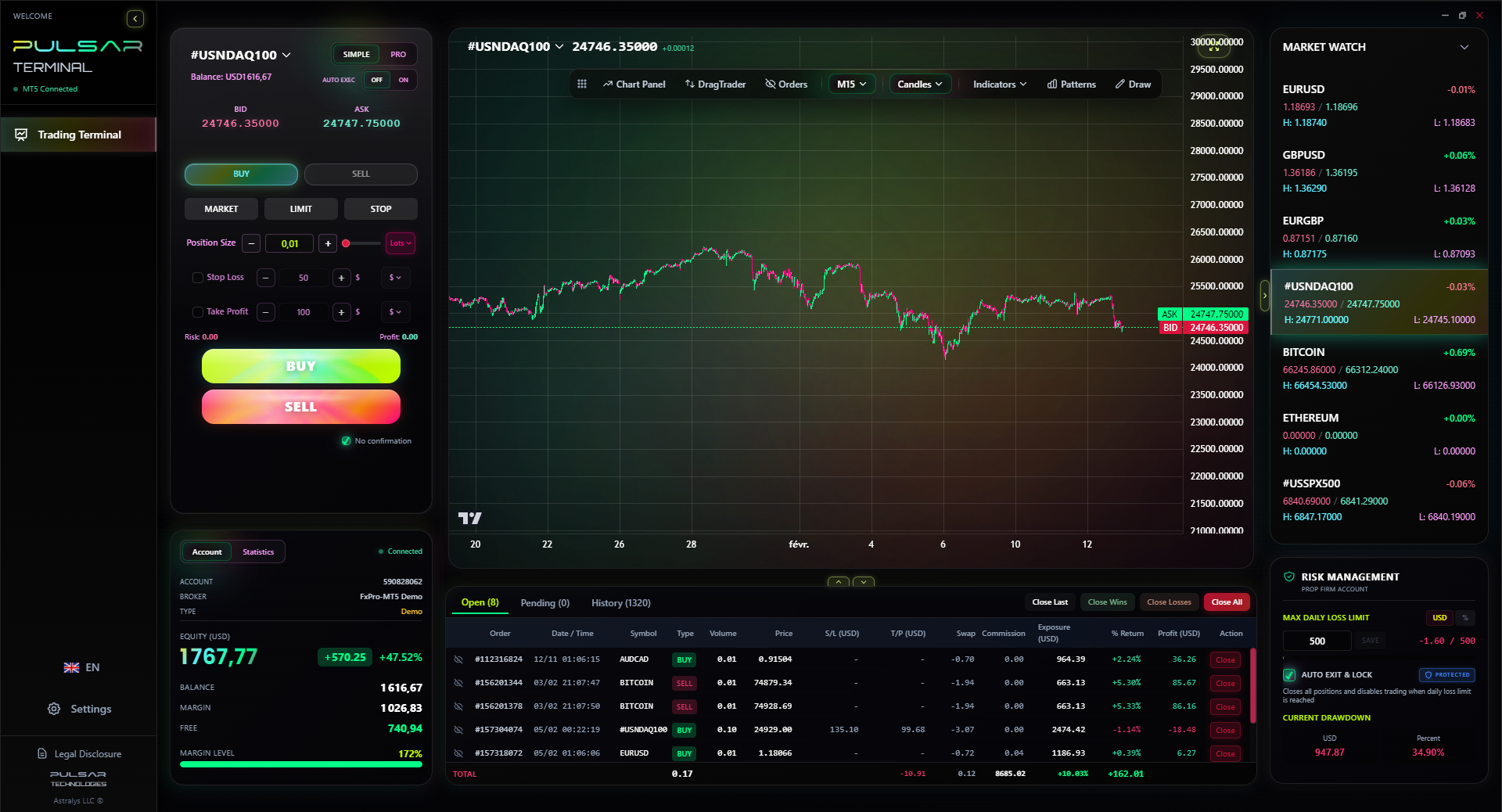
Managing multiple take-profit levels and a trailing stop on a hammer trade manually is stressful; Pulsar Terminal automates this directly on your MT5 chart, letting you focus on finding the next setup.
Pulsar Terminal
MT5オールインワンツール:ドラッグ&ドロップ注文、マルチTP/SL、トレーリングストップ、グリッドトレード、出来高プロファイル、プロップファーム保護。毎日1,000人以上のトレーダーが利用。
FAQ
Q1Is the hammer pattern reliable for forex trading in Nigeria?
It can be, but not by itself. Its reliability skyrockets when you combine it with the right context: a clear downtrend, a key support level, and confirming volume. Trading every hammer you see, especially on low timeframes, is a fast track to losses. Filter for only the high-quality setups.
Q2What timeframe is best for trading hammer patterns?
I've found the daily and 4-hour charts offer the best balance between signal strength and noise reduction. Hammers on the 1-minute or 5-minute charts are often fakeouts caused by minor liquidity shifts. Start with the higher timeframes (H4, Daily) for more significant moves, then use lower timeframes for precise entry.
Q3Can I use the hammer pattern for scalping?
You can, but it's trickier and requires a broker with ultra-low spreads and fast execution. The pattern's principles are the same, but market noise is higher. You must be extremely disciplined with your stop loss and take profit, aiming for smaller, quicker gains. It's not for beginners.
Q4What's the difference between a hammer and a doji?
Both have small bodies, showing indecision. The key difference is the wick. A hammer has a long lower wick specifically, telling a story of a sell-off and recovery. A doji has roughly equal upper and lower wicks (like a cross), showing a pure standoff between buyers and sellers with no clear winner during that period.
Q5How do I know if a hammer signal has failed?
A hammer fails if the price moves below the low of the hammer's long lower wick. This is why your stop loss MUST be placed there. If price breaks that level, the initial rejection of lower prices was invalidated, and the downtrend is likely resuming. This is a clear exit signal.
Q6Which forex pairs work best with the hammer pattern?
It works on any liquid pair. Major pairs like EUR/USD, GBP/USD, and USD/JPY are excellent because they have clean trends and ample volume. Avoid exotic pairs or pairs with consistently wide spreads, as the noise can distort the pattern and make your entries/exits less precise.
Q7Do I need other indicators to trade the hammer successfully?
You don't need them, but they help with confirmation. I often use the RSI to check for oversold conditions and moving averages to identify the overall trend and key dynamic support/resistance. The hammer is your primary trigger; other tools help you assess the battlefield.
ウィンストン教授のレッスン
重要ポイント:
- ✓Only trade hammers at the bottom of a clear downtrend.
- ✓Always place your stop loss below the hammer's low wick.
- ✓Wait for the candle to close and get confirmation before entering.
- ✓Risk a maximum of 1-2% of your account on any single hammer trade.
- ✓A hammer at a key support level is 10x stronger than a random one.
この記事はどれくらい役に立ちましたか?
星をクリックして評価
週刊トレーディングインサイト
無料の週刊分析&戦略。スパムなし。
著者について
Olumide Adeyemi
西アフリカ・トレーディングの先駆者
ナイジェリアで最もアクティブなFXトレーディング教育者の一人。ラゴスから8年のトレード経験。アフリカのトレーダー向けの少額資金戦略とプロップファームチャレンジを専門とする。
コメント
リスク警告
金融商品の取引には大きなリスクが伴い、すべての投資家に適しているわけではありません。過去の実績は将来の結果を保証するものではありません。本コンテンツは教育目的のみであり、投資助言として解釈すべきではありません。取引前に必ずご自身で調査を行ってください。
こちらもおすすめ

Cara Trading Forex Sukses: 7 Prinsip dari Trader Profesional
Cara trading forex sukses dengan 7 prinsip trader pro: manajemen modal, disiplin, journal trading, backtest. Data nyata, bukan janji profit palsu.
Jam Trading Forex Terbaik untuk Trader Indonesia: Panduan Lengkap dengan Tabel Waktu
Panduan jam trading forex untuk trader Indonesia. Tabel 4 sesi dunia, jam emas 20:00-00:00, sesi mana yang harus dihindari. Data akurat + tips dari trader berpengalaman.
Top 5 Sàn Forex Uy Tín Nhất 2026: Review Jujur dari Trader Indonesia
Top 5 sàn forex uy tín 2026 untuk trader Indonesia. Review jujur: spread, deposit, withdraw, dukungan lokal. Exness, XM, IC Markets & lebih.
