


Over 90% of Nigerian retail forex traders lose money.

Olumide Adeyemi
西アフリカ・トレーディングの先駆者 ·  Nigeria
☕ 12 分で読める
学べること:
- 1The Nigerian Forex Reality Check
- 2Step 1: Choosing Your Broker (The Real Numbers)
- 3Step 2: Funding Your Account: Naira to Forex
- 4Step 3: The Trading Platform: MT5 is Your Office
- 5Step 4: Your First Trade: A 5-Step Process
- 6Step 5: Risk Management (Not Getting Rich)
- 7Common Pitfalls for Nigerian Traders
- 8Building a Sustainable Trading Plan
Over 90% of Nigerian retail forex traders lose money. That's not a myth, it's the cold, hard data from regulators worldwide. The real question isn't 'how do I do forex trading,' but 'how do I do it without becoming another statistic?' I've been trading for 12 years, and I've blown up an account myself. The market doesn't care about your hustle. This guide cuts through the 'get rich quick' noise and shows you the actual mechanics, legal pitfalls, and risk management you need to survive. We'll use real Nigerian numbers, broker spreads, and tax rules you can't ignore.
Let's get this straight first. Forex trading is legal in Nigeria. You can use your personal funds. But the local regulatory framework for online retail trading is, frankly, still catching up. The Central Bank of Nigeria (CBN) and the Securities and Exchange Commission (SEC) are the main players, but their direct oversight of the platforms you'll likely use is limited.
This creates a critical gap. Because the CBN restricts using official forex windows to fund trading accounts, and Naira cards have limits on international transactions, most serious traders end up with international brokers. That means you're relying on a broker regulated in Cyprus, Australia, or the UK, not Lagos. It's permitted, but it shifts the responsibility for due diligence onto you.
The SEC has warned against unregulated platforms. So your first job isn't picking a currency pair, it's picking a properly licensed broker. I made the mistake early on of chasing the highest use from a shady outfit. It ended predictably. Don't be me.

Warning: The 10% Capital Gains Tax is real. It applies to your gross profits, whether your broker is in Malta or Marina. The FIRS isn't joking. Factor this into your profit calculations from day one. A N100,000 profit means N10,000 for the taxman.
One bright spot? The market is exploding. Turnover hit $8.6 billion in 2025, up over 56% from the year before. There are roughly 300,000 retail traders here now, and nearly 94% are under 35. You're not alone in wanting to learn how to do forex trading. But the crowd is usually wrong.

💡 ウィンストンのヒント
Your first profit target should be survival for six months, not a specific Naira amount. If you can keep your account roughly intact for that long, you're ahead of 80% of starters.
This is your most important decision. A bad broker will make profitable trading impossible, no matter your strategy. You need to compare apples to apples using cold, hard data.
Regulation is Non-Negotiable
Look for brokers licensed by the Financial Conduct Authority (FCA UK), the Australian Securities and Investments Commission (ASIC), or the Cyprus Securities and Exchange Commission (CySEC). These are top-tier regulators that enforce client fund segregation. This means your money is held separately from the broker's operating funds. If the broker goes bust, your capital isn't part of the bankruptcy estate.
Many popular brokers like Exness, IC Markets, and XM accept Nigerian clients under their international entities. They offer Naira accounts, which simplifies things, but check which regulator oversees that specific entity.
The Cost Breakdown: Spreads & Commissions
Your broker makes money from the spread (the difference between buy and sell price) and sometimes a commission. Here’s what you’re actually paying on a standard lot (100,000 units) of EUR/USD, based on 2026 data:
| Broker (Example) | Typical EUR/USD Spread | Commission (per lot) | Effective Cost on $100k Trade |
|---|---|---|---|
| 'Raw' ECN Account | 0.0 pips | $7.00 | $7.00 |
| Standard Account | 1.0 pip | $0.00 | $10.00 |
| High-Spread Account | 1.6 pips | $0.00 | $16.00 |
A pip's value on EUR/USD is roughly $10 for a standard lot. So a 1-pip spread costs you $10 before your trade even moves. If you're a scalping strategy trader taking 5 trades a day, that's $50 in daily spreads. It adds up fast.

Pro Tip: If you trade frequently or with larger sizes, a raw spread account with a commission is almost always cheaper. For example, a 0.2 pip spread + $7 commission costs $9 total, beating a standard 1.0 pip ($10) account. Do the math.
Minimum Deposits & use Traps
Yes, you can start with $1. But should you? No. Starting with $10 or $50 forces you to use insane use just to see a meaningful gain in Naira terms. That's a guaranteed path to a margin call. A realistic starter amount that allows for sane risk management is $500-$1000. It's not sexy, but it's survivable.
use here can be crazy high - 1:1000 or even 'unlimited.' This is a test, not a feature. Using maximum use is like driving a Ferrari in first gear everywhere; you'll blow the engine. I once turned $200 into $2,000 in a week using 1:500 use on XAU/USD. I felt like a genius. I gave it all back, plus another $300, in one bad trade the next Monday. use magnifies your losses faster than your profits.
“Starting with $10 forces you to use insane use just to see a meaningful gain in Naira terms. That's a guaranteed path to a margin call.”
Getting money into your trading account is your first practical hurdle. Due to CBN restrictions, you can't use the official forex window. Here are your main options:
- Domiciliary Account Transfer: This is the most straightforward method if your broker supports it. You transfer USD/GBP/EUR from your Nigerian domiciliary account directly to the broker's bank account. Low fees, but slower processing (1-3 business days).
- Credit/Debit Cards (Visa/Mastercard): Instant, but your Naira card has daily and monthly limits for international transactions. You might need to split a larger deposit over several days. Watch for additional currency conversion fees from your bank.
- E-Wallets (Skrill, Neteller, Perfect Money): Fast and widely accepted. You fund the e-wallet via your card or bank transfer, then send to the broker. Useful for smaller, frequent deposits. Fees apply.
- Cryptocurrency (USDT, Bitcoin): Increasingly popular. Fast, often low-fee, and bypasses traditional banking channels. You send crypto from your wallet to the broker's crypto address. Volatility during transfer is a minor risk. Ensure your broker explicitly supports crypto deposits.
Withdrawal is usually via the same method you deposited. Brokers typically process withdrawals within 24 hours. The real delay is your bank or payment processor crediting your account.

Example: You want to deposit ₦500,000. Your bank's rate is ₦1,450/$. That gives you ~$345. A 2% card fee would take another $6.90. You'd land about $338 in your trading account. Start with a demo account to practice before moving real money.
Your broker provides access to the market through a trading platform. MetaTrader 5 (MT5) is the global standard and my strong recommendation. MT4 is older but still popular. Forget the broker's flashy proprietary platform for now; MT5 has everything you need.
This is where you'll learn how to do forex trading mechanically. You need to know how to:
- Open a Chart: Drag EUR/USD onto the screen.
- Place an Order: Click 'New Order,' choose market or pending order, set your volume (lot size), and add your Stop Loss and Take Profit immediately.
- Modify/Trade Management: Move your stop loss to breakeven, add to a position, or close part of a trade.
I spent my first three months just clicking buttons on a demo account. I didn't place a single real trade. It felt boring, but it built muscle memory so when real money was on the line, I wasn't fumbling.
Platforms like Pulsar Terminal (a companion app for MT5) take this further by letting you drag and drop orders directly on the chart and set advanced rules for partial closures and trailing stops. But master the basics of plain MT5 first.
The real power is in the analysis. You'll use indicators like the RSI indicator or MACD indicator to gauge momentum. But remember, indicators are lagging. They tell you what has happened, not what will happen. Price action is king.
💡 ウィンストンのヒント
Never calculate your trade size in Naira. Always think in percentages of your account and pip risk. The market doesn't know what the Naira is worth.
“How to do forex trading successfully is 95% risk management, 5% analysis.”
Here's a concrete, repeatable process for how to do forex trading on a single trade. This is what I wish someone had given me.
Step 1: Analysis (The Plan) Don't just look at a 5-minute chart. Start with the daily chart to see the overall trend. Then zoom into the 4-hour and 1-hour charts for your entry. Is the price making higher highs and higher lows (uptrend)? Or is it stuck in a range? Write down your bias: Bullish or Bearish.
Step 2: Find Your Entry & Key Levels Identify clear support (price floor) and resistance (price ceiling). Look for price to approach these levels. Maybe the RSI indicator is oversold near support in an uptrend. That's a potential buy zone. Mark it on your chart.
Step 3: Calculate Your Risk (This is Everything) Decide how much you are willing to lose on this trade. Never more than 1-2% of your account. Let's say you have a $1,000 account. Your max risk is $20.
Find your logical stop loss level. If you want to buy EUR/USD at 1.0850, and your stop loss is at 1.0820, that's a 30-pip risk.
Now, use a position size calculator. A 30-pip risk on EUR/USD means each micro lot (0.01) risks $3. To risk only $20, you can trade 0.07 lots. This step prevents one bad trade from wrecking you.
Step 4: Place the Trade with Stop Loss & Take Profit Enter the trade at your chosen price. Set your stop loss immediately. Set a take profit target at a risk-to-reward ratio of at least 1:1.5. If you're risking 30 pips, aim for 45 pips profit.
Step 5: Manage & Journal Once in profit, you can move your stop loss to breakeven to eliminate risk. Don't sit and watch it. Let your plan work. After the trade closes, win or lose, write it down. What was your reasoning? What did you feel? This journal is how you improve.
Warning: The most common mistake here is skipping Step 3. You see a 'sure thing,' throw in 0.5 lots on your $500 account, and a 20-pip move against you blows 10% of your capital. Game over in 10 trades.
Executing a disciplined trade plan with multiple take-profit levels and a trailing stop is complex in vanilla MT5, but tools like Pulsar Terminal automate this directly on your charts.
Pulsar Terminal
MT5オールインワンツール:ドラッグ&ドロップ注文、マルチTP/SL、トレーリングストップ、グリッドトレード、出来高プロファイル、プロップファーム保護。毎日1,000人以上のトレーダーが利用。
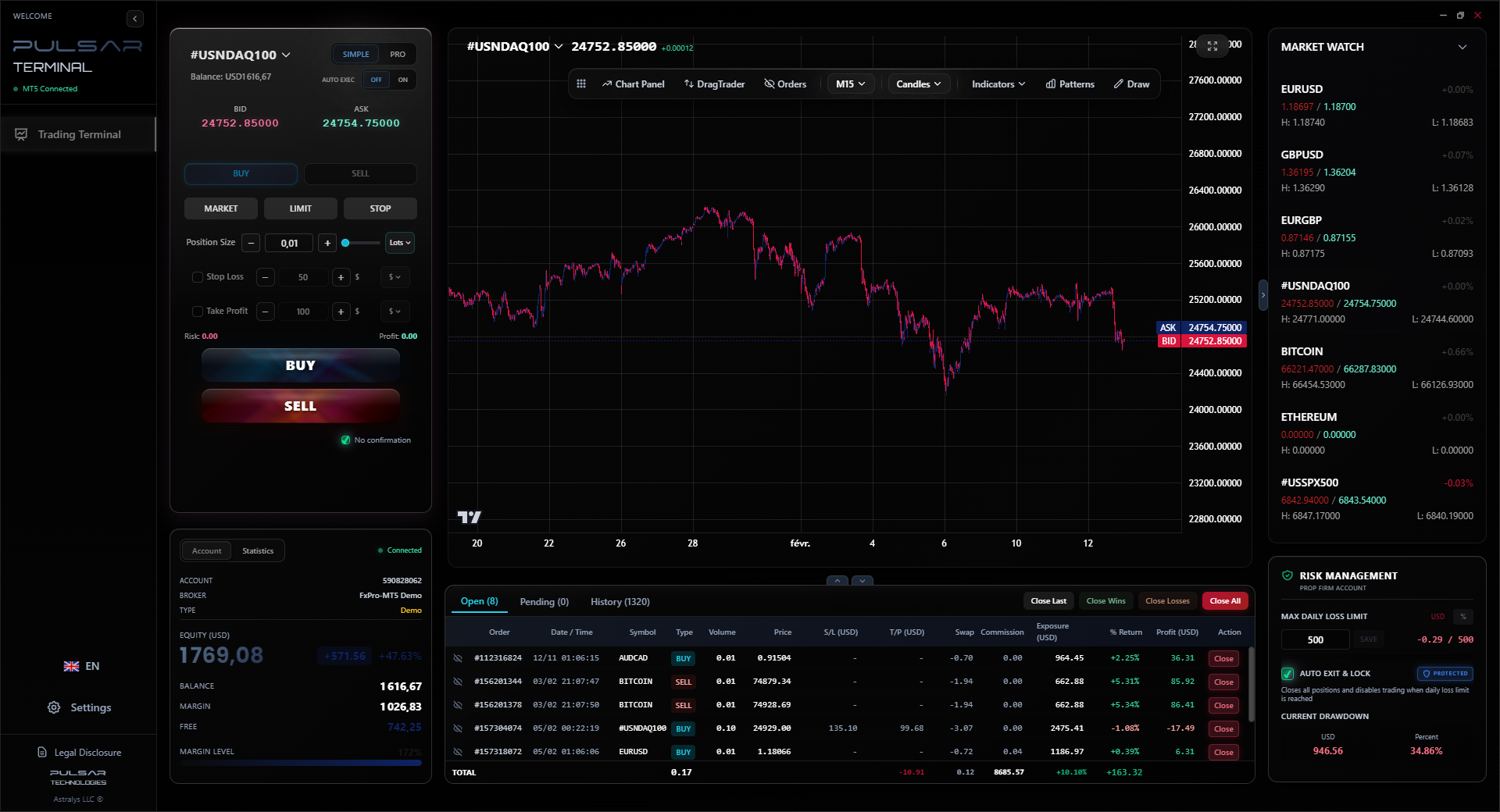
This section is the entire game. How to do forex trading successfully is 95% risk management, 5% analysis.
The 1% Rule: Never risk more than 1% of your account equity on a single trade. On a $1,000 account, that's $10. This means your position size must be small enough that your stop loss, if hit, only costs you $10. This protects you from a string of losses. Even 10 losing trades in a row only takes 10% of your account, leaving you alive to fight.
Risk-to-Reward Ratio (RRR): Your profit target should be larger than your stop loss. A 1:1.5 RRR means for every 1 pip you risk, you aim to make 1.5 pips. If you're right only 40% of the time, you can still be profitable. If you're chasing 1:0.5 RRR (taking 10-pip profits with 20-pip stops), you need to be right over 67% of the time just to break even. That's nearly impossible long-term.
use is a Tool, Not a Toy: Your broker might offer 1:500. Your risk management should dictate you use maybe 1:10 or 1:20 for your actual position size. use is for reducing margin requirement, not for maximizing position size.
Emotional Discipline: This is the hardest part. You will have losing trades. The system only works if you take every signal, not just the ones that 'feel' right. I once skipped a valid sell signal on GBP/USD because I was 'sure' it would bounce. It fell 200 pips. My rule-based account took the sell and made money. My discretionary 'gut feeling' account sat and watched. Kill your ego.
“The market doesn't care about your hustle or your bills. Trade the chart, not your expenses.”
We face unique cultural and market challenges.
1. The 'Side Hustle' Mentality: Forex is not a side hustle. It's a skilled profession with a brutal learning curve. Treating it as easy extra income leads to undercapitalization and reckless trades.
2. Signal Seller Dependency: Paying for signals from a 'guru' on WhatsApp or Telegram is a rite of passage - and a waste of money. You learn nothing, have no idea of the risk involved, and are forever dependent. The guru makes money from subscriptions, not trading.
3. Overtrading: Because spreads and commissions feel small, it's easy to take 10, 15, 20 trades a day. This is just making your broker rich. Quality over quantity. A good swing trading setup might come once a week.
4. Ignoring Total Costs: Between spreads, potential commissions, bank transfer fees, and the 10% tax, your trading edge needs to be significant just to break even. A strategy that looks profitable on a demo account with ideal prices might be a loser with real costs.
5. Chasing Naira Amounts: 'I need to make ₦50,000 this week to pay rent.' This is the fastest way to blow your account. You force trades, widen your stop loss, and abandon your plan. The market doesn't care about your bills. Trade the chart, not your expenses.
💡 ウィンストンのヒント
Print out your trading plan and tape it next to your screen. When in doubt, read the rules you wrote when you were calm and logical.
Your trading plan is your business plan. It's a written document that removes emotion. Here's what it must include:
- Trading Style: Are you a scalper (holding minutes), day trader (holding hours), or swing trader (holding days/weeks)? Your style dictates your chart timeframes. You can't scalp on a daily chart.
- Markets & Sessions: Which currency pairs will you trade? Major pairs like EUR/USD have the tightest spreads. Will you trade during the London session (8 AM - 5 PM WAT) when volatility is high?
- Entry Rules: What specific conditions must be met for you to enter? (e.g., "Price pulls back to the 50-period EMA in a daily uptrend, with RSI above 40.")
- Exit Rules: Your exact stop loss and take profit methodology. (e.g., "Stop loss placed below the recent swing low. Take profit set at 1.5x the risk distance.")
- Risk Parameters: The 1% rule. Your maximum daily loss limit (e.g., stop trading if down 3% in a day). Your maximum weekly loss limit.
- Journaling Template: A simple spreadsheet to log Date, Pair, Entry, Exit, P&L, and most importantly, 'Notes on Trade.'
Backtest this plan on at least 100 past trades. Does it hold up? Then forward-test it on a demo account for a month. Only then, with real confidence, go live with small capital.
The goal isn't a Lamborghini in month three. The goal is consistent, small gains that compound over time while strictly controlling losses. That's how you do forex trading as a business, not a gamble.
FAQ
Q1Is forex trading legal and taxable in Nigeria?
Yes, it's legal to trade forex with your personal funds. And yes, you are subject to a 10% Capital Gains Tax on your gross trading profits. You are responsible for declaring this income to the Federal Inland Revenue Service (FIRS).
Q2What is the minimum amount I need to start forex trading in Nigeria?
While some brokers allow deposits as low as $1, a realistic minimum to practice proper risk management is between $500 and $1,000 (roughly ₦725,000 - ₦1,450,000). Starting with less often forces traders to use excessive use to see meaningful returns, which dramatically increases risk.
Q3Which broker is best for Nigerian traders?
There's no single 'best' broker. Focus on internationally regulated brokers (like FCA, ASIC) that accept Nigerian clients, offer reasonable funding methods (domiciliary accounts, e-wallets), and have competitive costs. Popular choices include Exness, IC Markets, XM, and Pepperstone. Always verify the specific entity you're signing up with is properly licensed.
Q4Can I use my Naira debit card to fund my forex account?
You can, but with limitations. The CBN restricts the use of Naira cards for large international transactions. You'll face daily and monthly spending caps, and your bank will apply its own currency conversion rate and fees. For larger deposits, a domiciliary account transfer or cryptocurrency is often more efficient.
Q5What's the biggest mistake new Nigerian traders make?
Overtrading and poor risk management. The combination of high available use and the desire for quick Naira profits leads traders to take too many trades with positions that are too large. They violate the 1% risk rule and are often wiped out by a single string of losses.
Q6Do I need to pay for trading signals or a mentor?
No, and I strongly advise against it initially. Most paid signal services are scams. The vast amount of quality educational material - from broker webinars to free YouTube courses from reputable educators - is sufficient to build a foundation. A mentor can be valuable later, but only after you have a basic understanding and can vet their real track record.
Q7How long does it take to become profitable?
Assume a minimum of 1-2 years of dedicated study and practice. This isn't a get-rich-quick scheme. The first year is often spent losing money while learning. Consistency comes from mastering psychology and risk management, which takes significant screen time and emotional experience.
ウィンストン教授のレッスン
重要ポイント:
- ✓Risk only 1% of your account per trade.
- ✓Aim for a minimum 1:1.5 risk-to-reward ratio.
- ✓Factor in the 10% capital gains tax from day one.
- ✓Use use to reduce margin, not increase size.
- ✓Demo trade for 3 months before using real money.
この記事はどれくらい役に立ちましたか?
星をクリックして評価
週刊トレーディングインサイト
無料の週刊分析&戦略。スパムなし。
著者について
Olumide Adeyemi
西アフリカ・トレーディングの先駆者
ナイジェリアで最もアクティブなFXトレーディング教育者の一人。ラゴスから8年のトレード経験。アフリカのトレーダー向けの少額資金戦略とプロップファームチャレンジを専門とする。
コメント
リスク警告
金融商品の取引には大きなリスクが伴い、すべての投資家に適しているわけではありません。過去の実績は将来の結果を保証するものではありません。本コンテンツは教育目的のみであり、投資助言として解釈すべきではありません。取引前に必ずご自身で調査を行ってください。
こちらもおすすめ

Cara Trading Forex Sukses: 7 Prinsip dari Trader Profesional
Cara trading forex sukses dengan 7 prinsip trader pro: manajemen modal, disiplin, journal trading, backtest. Data nyata, bukan janji profit palsu.
Jam Trading Forex Terbaik untuk Trader Indonesia: Panduan Lengkap dengan Tabel Waktu
Panduan jam trading forex untuk trader Indonesia. Tabel 4 sesi dunia, jam emas 20:00-00:00, sesi mana yang harus dihindari. Data akurat + tips dari trader berpengalaman.
Top 5 Sàn Forex Uy Tín Nhất 2026: Review Jujur dari Trader Indonesia
Top 5 sàn forex uy tín 2026 untuk trader Indonesia. Review jujur: spread, deposit, withdraw, dukungan lokal. Exness, XM, IC Markets & lebih.
