


I remember a client back in 2022 asking me why he couldn't just open his own brokerage.

Olumide Adeyemi
西アフリカ・トレーディングの先駆者 ·  Nigeria
☕ 10 分で読める
学べること:
I remember a client back in 2022 asking me why he couldn't just open his own brokerage. 'The spreads these guys charge are criminal!' he'd say. He tried, partnering with a cheap tech provider and marketing on Instagram. He was operational for about four months before the first major issue: a client deposited 5 million Naira, the trade went south, and the withdrawal request triggered a liquidity crisis he couldn't handle. He hadn't accounted for the capital buffer needed just to process normal client cash flow, let alone cover operational licenses. He lost everything, including his reputation. That experience taught me that becoming a broker isn't about flipping a switch; it's a capital-intensive, compliance-heavy marathon. If you're serious about learning how to become a forex broker in Nigeria today, you need to understand it's a completely different ballgame post-2025.
Forget everything you thought you knew about Nigeria's forex scene. The 'anything goes' era is officially over. The government and financial watchdogs have been closing the net, and in 2025, they slammed it shut.
The big change is the Investment and Securities Act, 2025 (ISA 2025). Before this, operating an online forex trading platform lived in a grey area. Now, it's black and white: if you're not registered with the Securities and Exchange Commission (SEC), you're illegal. Full stop. This act gave the SEC the teeth it needed to go after unlicensed operators.
At the same time, the Central Bank of Nigeria (CBN) dropped the Nigeria Foreign Exchange Code (FX Code). While this primarily targets the big players like banks and BDCs, its spirit of 'transparency and integrity' trickles down to everyone. The message is clear: the market must be clean, well-reported, and above board.
What does this mean for you? You're no longer just competing with other brokers. You're applying for permission to exist from a regulator that's now fully empowered and watching closely. Your entire business plan must be built around compliance first, not marketing gimmicks or crazy use offers.

Warning: Thinking of operating without an SEC license after 2025 is a direct path to severe penalties, including hefty fines and potential criminal liability. The regulatory bodies are actively monitoring and enforcing these new rules.
“Becoming a broker isn't about flipping a switch; it's a capital-intensive, compliance-heavy marathon.”
So, you're committed to doing it right. Here's the actual path, which is more of an obstacle course.
Foundation First: The Company
You can't apply as an individual. Your first step is to incorporate a limited liability company in Nigeria. You'll need at least two directors and one shareholder (nationality isn't a barrier here, which is helpful). Get a proper office address - a virtual office might work initially, but be prepared for the SEC to want to know you have a real operational base. Appoint a company secretary; this is a legal requirement.
The Heart of the Matter: The SEC Application
This is where you prove you're serious. You'll submit a mountain of documents: your company's MEMART (Memorandum and Articles of Association), detailed business plans, risk management frameworks, and the backgrounds of all your directors and major shareholders. The SEC will vet everyone. If you have a history of financial misconduct anywhere in the world, it'll show up here.
The key document is your application for a Capital Market Operator (CMO) license with a specific authorization for forex/CFDs brokerage. Don't try to cut corners by applying under a different, cheaper category. They will know.
The Waiting Game and On-Site Inspection
After submitting, you wait. The SEC will review every comma in your application. Expect them to ask for clarifications. If you pass the paper test, they will likely conduct an on-site inspection of your proposed operations. They'll want to see your tech, your compliance manuals, and interview your team. This isn't a formality; it's a test.
I've advised a firm going through this in late 2025. The single biggest delay (over 3 months) wasn't the capital, it was satisfying the SEC's questions about their trade execution model and client fund segregation. They had to re-write their entire client agreement and provide letters from their prospective liquidity provider and custodian bank. Patience isn't just a virtue here; it's a necessity.

Pro Tip: Hire a law firm in Abuja or Lagos that specializes in SEC financial licensing. The 2-3 million Naira you'll spend on their fees will save you months of headaches and costly rejections. They speak the regulator's language and know what the current examiners are looking for.
“The 'anything goes' era is officially over.”
Let's talk numbers, because this is where dreams meet reality. The published figures are just the entry ticket.
First, the Minimum Paid-up Share Capital. To get a license as a forex/CFDs broker from the SEC, your company must have at least 10 Million Naira in paid-up capital. This isn't a fee you pay; it's money that must be sitting in your company's bank account, fully verified and untouched, to prove you have skin in the game.
But wait, there's more. In January 2026, the SEC revised capital requirements across the board. For broker-dealers (the category you'd likely fall under for advanced activities), the new minimum is 500 Million Naira. Yes, five hundred million. While there might be interpretations and sub-categories, the trend is unambiguous: they want only well-funded, serious players. You must budget for the 10 million Naira minimum, but be psychologically and financially prepared for requirements to be much higher by the time your application is processed.
Beyond the Capital:
- Application & Licensing Fees: These run into several million Naira with the SEC.
- Technology: A reliable, low-latency trading platform (like a branded MT4/MT5 suite) costs $5,000 to $20,000 upfront plus monthly fees. A cheap, buggy platform will lose you clients instantly.
- Liquidity: You need to connect to a prime broker or liquidity provider for real prices and execution. They require minimum deposits, often starting from $100,000.
- Bank Guarantees & Client Fund Segregation: Your bank will require guarantees to set up the special accounts needed to keep client funds separate from your company's operational funds.
- Annual Renewals & Compliance: Your license renews yearly, with more fees. You'll need a full-time compliance officer - another salary on the payroll.

Example: A realistic bare-minimum startup budget for a small-scale broker, after the 10M Naira capital, is another $200,000 to $500,000 (approx. 250M to 625M Naira) for technology, liquidity, legal fees, and 12 months of operational runway (salaries, office, marketing). If that number shocks you, this business isn't for you.

💡 ウィンストンのヒント
The 10M Naira capital is just the proof of concept money. The real capital is what you need to survive 24 months of building, compliance, and acquiring your first 100 loyal clients. If you can't visualize that number in your account, don't start.
“Your edge must be local understanding, superior service, and ruthless compliance.”
Once you have the license (a huge 'if'), you build the house. It stands on three pillars.
1. Technology & Infrastructure: This is your shop front and warehouse. You need a trading platform that is stable, familiar to Nigerian traders (MT4/MT5 is king), and can handle deposits and withdrawals in Naira. You need a strong website, a client portal, and most importantly, a Liquidity Bridge. This is the software that connects your platform to the real market. A failure here means your clients' trades don't get executed, or get executed at terrible prices. I've seen brokers lose their entire client base in a week because of a faulty bridge during high volatility.
2. Liquidity & Banking: You are not the market. You need a partnership with a prime broker or an institutional liquidity provider who gives you access to interbank rates. Your profit will largely come from the mark-up you add (the spread) and sometimes a commission. You also need a solid relationship with a Nigerian bank that understands your business model and can handle frequent, large forex transactions for client deposits/withdrawals. This is harder than it sounds.
3. Risk Management: This is the pillar most new brokers ignore until it's too late. You must manage your own risk as a company. What if a client makes a huge profit? You have to pay them. Your liquidity provider will demand collateral from you. You need systems for automatic margin call protection, monitoring of client exposure, and hedging your own book. This isn't optional. A single client on a winning streak can bankrupt an unprepared broker.
Managing this risk manually is a nightmare. This is where professional tools come in. For instance, using a platform that allows for sophisticated order management can be a lifesaver. Setting multi-level take-profits or automated trailing stops isn't just for your clients' benefit; it helps you manage the aggregate risk on your own books more predictably.
“Your edge must be local understanding, superior service, and ruthless compliance.”
You're licensed, you're operational. Now you need clients. The Nigerian retail forex trader is savvy, skeptical, and bombarded with offers.
Forget the Old Playbook: Promising '1000% returns' or 'no loss guarantees' will get you fined into oblivion by the SEC now. Your marketing must be compliant, clear, and focus on real value.
What Works:
- Education: Nigerian traders are hungry for knowledge. Offering real, high-quality trading education (webinars, courses, analysis) builds trust and attracts serious clients. It also fulfills a regulatory 'suitability' requirement - you're ensuring your clients understand the risks.
- Localized Support: Offer customer service 24/5 in English and Pidgin. Have phone, WhatsApp, and live chat support. Being accessible is a massive competitive advantage over international brokers.
- Seamless Naira Transactions: If you make deposits and withdrawals fast, easy, and cheap, you will win clients. The pain point for traders using offshore brokers is funding and cashing out. Solve that.
- Community Building: Create a genuine community around your brand. Not a fake Telegram pump group, but a place for serious discussion about market strategies like scalping or swing trading.
A Personal Mistake I've Seen: A broker spent 5 million Naira on Instagram influencers. They got a surge of sign-ups from people who didn't understand trading. These clients blew their accounts in days, blamed the broker, and created a torrent of bad reviews. The cost of acquisition was high, and the lifetime value was zero. It nearly sank them. Quality over quantity, always.
Your competition isn't just other new brokers. It's established international names like Exness and XM that have huge marketing budgets. Your edge must be local understanding, superior service, and ruthless compliance.
💡 ウィンストンのヒント
Your first hire shouldn't be a marketing guru. It should be a ruthless compliance officer who loves saying 'no.' They will save you from your own ambition and keep the SEC from your door.
“Think of your brokerage like a bank. It requires prudence, massive reserves, and obsessive attention to risk.”
Let's be blunt about where you'll likely stumble.
Pitfall 1: Underestimating Capital and Runway. You see the 10M Naira capital and think that's the main cost. It's the smallest part. You need at least 18-24 months of operational runway (all salaries, tech fees, office costs, marketing) in the bank after paying all setup costs. Running out of money in month 13 is the most common cause of death for new brokers.
Pitfall 2: Choosing Cheap, Unreliable Technology. You get a 'white label' platform from a dubious provider for $500 a month. It crashes during NFP news. Your clients can't close trades, they lose money, and your reputation is destroyed in one hour. Never, ever cheap out on your core technology. Test it under stress conditions.
Pitfall 3: Ignoring Compliance. Hiring a compliance officer as an afterthought is a mistake. They should be one of your first hires. The rules on client onboarding (KYC), reporting, advertising, and fund handling are complex and non-negotiable. One misstep can lead to a suspended license.
Pitfall 4: Poor Risk Management. You get a few big clients and celebrate. One of them goes long on XAU/USD (gold) with huge size during a calm market. Suddenly, geopolitical news hits, gold gaps up $100 overnight. Your client's profit is your liability. If you haven't hedged that exposure with your liquidity provider, that single trade can wipe out your entire capital. You must understand and actively manage your book's risk every single day. Using tools that help visualize exposure and set automatic risk controls isn't a luxury; it's business survival.
Think of your brokerage like a bank. It requires prudence, massive reserves, and obsessive attention to risk. The traders you serve, whether they're using the RSI indicator or complex strategies, are trusting you with their money. That trust, once broken, is gone forever.
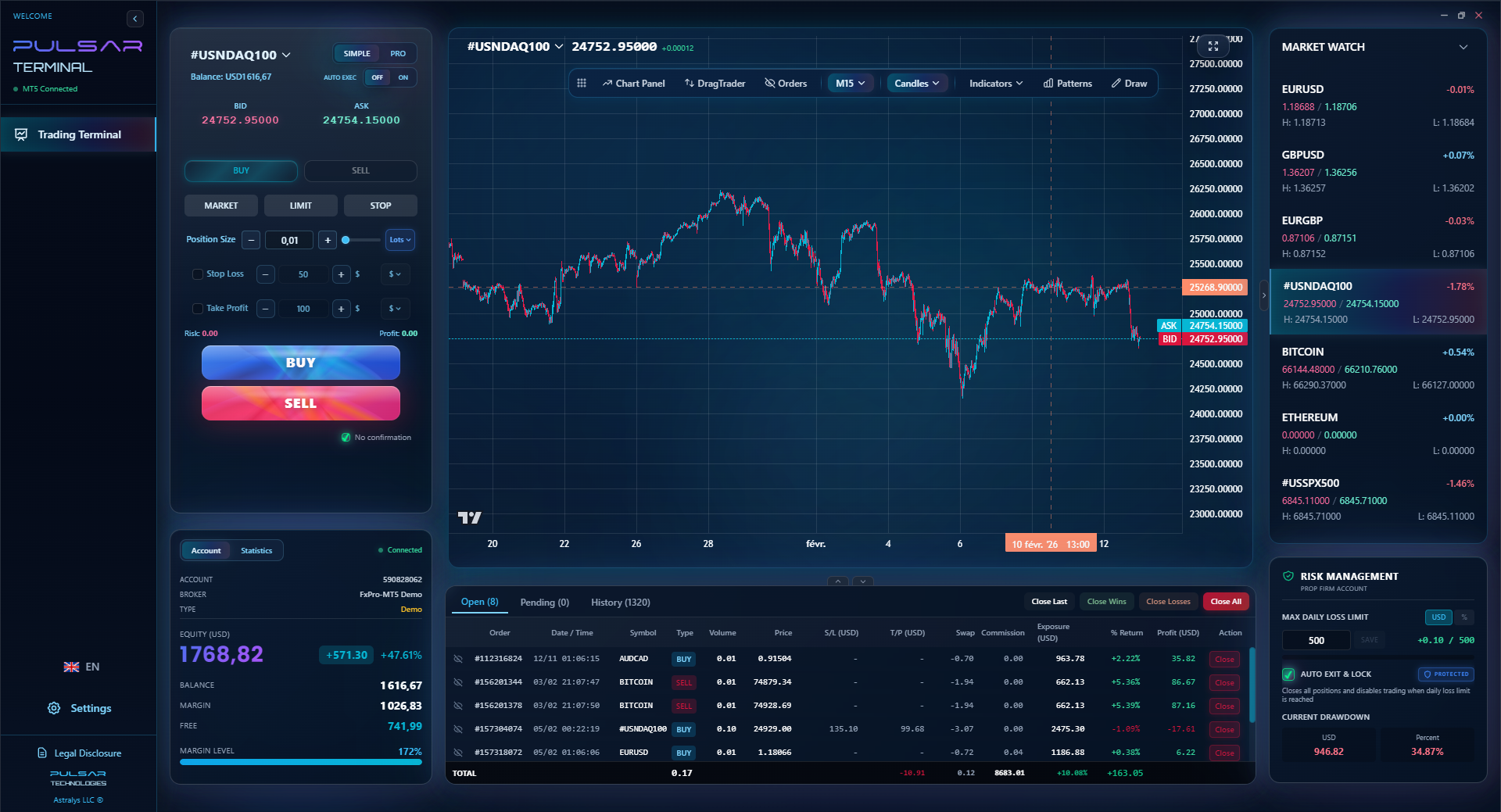
Managing complex risk exposure across all client accounts is a core broker challenge, and tools like Pulsar Terminal provide the advanced order and risk management features needed to handle it efficiently on MT5.
Pulsar Terminal
MT5オールインワンツール:ドラッグ&ドロップ注文、マルチTP/SL、トレーリングストップ、グリッドトレード、出来高プロファイル、プロップファーム保護。毎日1,000人以上のトレーダーが利用。
FAQ
Q1Is forex brokerage legal in Nigeria?
Yes, but it is now highly regulated. Since the Investment and Securities Act 2025 (ISA 2025), it is illegal to operate an online forex trading platform without a formal license from the Securities and Exchange Commission (SEC). Operating without one carries serious penalties.
Q2What is the minimum capital required to start a forex broker in Nigeria?
The specific minimum paid-up share capital for an SEC license to operate as a forex/CFDs broker is 10 Million Naira. However, you must be aware that the SEC revised general capital requirements upwards significantly in early 2026, and you should budget for a total startup cost (including technology, liquidity, legal fees, and 1-2 years of operational expenses) that can easily reach 250-500 Million Naira or more.
Q3Can a foreigner own a forex brokerage in Nigeria?
Yes, the corporate structure allows for directors and shareholders of any nationality. There is no legal barrier to foreign ownership. However, the company must be incorporated in Nigeria, have a local office address, and comply fully with all SEC and CBN regulations.
Q4How long does the SEC licensing process take?
There is no fixed timeline, but you should prepare for a process that takes 6 to 12 months, or even longer. It involves company incorporation, document preparation, submission, SEC review, potential queries, and an on-site inspection. Delays are common, so factor this into your financial planning.
Q5What's the biggest mistake new forex brokers make?
Underestimating the total capital required and the operational runway needed. Many focus only on the official 'minimum capital' and then run out of money within the first year because they didn't budget for technology costs, liquidity provider deposits, legal fees, salaries, and marketing. They also often choose cheap, unreliable technology that fails when it's needed most.
Q6Who are the main regulators for forex brokers in Nigeria?
The primary regulator for licensing and overseeing forex/CFDs brokerage operations is the Securities and Exchange Commission (SEC). The Central Bank of Nigeria (CBN) regulates the broader foreign exchange market, banking relationships, and sets codes like the FX Code that impact market conduct. You will need to satisfy both bodies indirectly.
Q7Can I use a white-label solution to start faster?
A white-label solution (where you rent a pre-built platform from a larger broker) can speed up the tech setup. However, it does not absolve you from obtaining your own SEC license. You are still the licensed broker responsible for your clients. Also,, you must ensure the white-label provider is reputable, stable, and allows you full control over compliance and client funds.
ウィンストン教授のレッスン
重要ポイント:
- ✓The SEC license is non-negotiable post-2025.
- ✓Minimum capital is 10M Naira, but real startup costs are 250M+.
- ✓Technology and liquidity are your biggest cost centers.
- ✓Hire compliance before marketing.
- ✓Plan for an 18-24 month financial runway.
この記事はどれくらい役に立ちましたか?
星をクリックして評価
週刊トレーディングインサイト
無料の週刊分析&戦略。スパムなし。
著者について
Olumide Adeyemi
西アフリカ・トレーディングの先駆者
ナイジェリアで最もアクティブなFXトレーディング教育者の一人。ラゴスから8年のトレード経験。アフリカのトレーダー向けの少額資金戦略とプロップファームチャレンジを専門とする。
コメント
リスク警告
金融商品の取引には大きなリスクが伴い、すべての投資家に適しているわけではありません。過去の実績は将来の結果を保証するものではありません。本コンテンツは教育目的のみであり、投資助言として解釈すべきではありません。取引前に必ずご自身で調査を行ってください。
こちらもおすすめ

Cara Trading Forex Sukses: 7 Prinsip dari Trader Profesional
Cara trading forex sukses dengan 7 prinsip trader pro: manajemen modal, disiplin, journal trading, backtest. Data nyata, bukan janji profit palsu.
Jam Trading Forex Terbaik untuk Trader Indonesia: Panduan Lengkap dengan Tabel Waktu
Panduan jam trading forex untuk trader Indonesia. Tabel 4 sesi dunia, jam emas 20:00-00:00, sesi mana yang harus dihindari. Data akurat + tips dari trader berpengalaman.
Top 5 Sàn Forex Uy Tín Nhất 2026: Review Jujur dari Trader Indonesia
Top 5 sàn forex uy tín 2026 untuk trader Indonesia. Review jujur: spread, deposit, withdraw, dukungan lokal. Exness, XM, IC Markets & lebih.
