


I remember watching the USD/LKR chart in May 2022, watching it hit 372.

Daniel Harrington
コンテンツ責任者
☕ 9 分で読める
学べること:
I remember watching the USD/LKR chart in May 2022, watching it hit 372. The panic was palpable. My phone was buzzing with messages from other traders, some celebrating shorts, others watching their import business margins evaporate. That moment wasn't just a number on a screen; it was a brutal lesson in how global forex directly slams into your life in Sri Lanka. If you're thinking about how to start forex trading in Sri Lanka, you need to understand that first. This isn't a game. It's navigating a market where the rules are written in Colombo, the money moves through tricky channels, and your own currency's weakness is both a risk and a potential opportunity. Let's get you set up without getting your account frozen or your profits taxed into oblivion.
Right off the bat, forget everything you've heard from YouTube gurus about 'unregulated freedom.' In Sri Lanka, forex trading is legal, but it's wrapped in a specific set of controls managed by the Central Bank of Sri Lanka (CBSL). Their Department of Foreign Exchange runs the show under the Foreign Exchange Act of 2017. Their job is market stability, not helping you get rich.
The critical, non-negotiable rule is this: You cannot legally send money directly from your Sri Lankan bank account to an international forex broker for margin trading. The Exchange Control Act blocks it. Trying to do this is a fast track to having your transfer reversed and your bank asking you some very uncomfortable questions. I learned this the hard way back in 2019 when a $500 test deposit got stuck for weeks before being returned.
So how do people fund accounts? They use third-party payment gateways. E-wallets like Skrill, Neteller, or Perfect Money are the standard workaround. You load them via a local bank transfer or card (often categorized as an 'online purchase'), then send funds to your broker. It's a legal grey area you operate in, but it's the common practice. Just ensure everything is above board for anti-money laundering purposes.
Also, understand this: no offshore broker like XM or IC Markets is 'approved' by the CBSL for Sri Lankan residents. Their international regulation (like ASIC or FCA) protects you from broker fraud, but it doesn't override Sri Lankan law on moving money out of the country. Your protection is your own due diligence.

Warning: Profits from trading are considered income by the Inland Revenue Department (IRD). You are liable to pay income tax on them. Ignoring this because the money sits offshore is a risk. Keep detailed records of all trades, deposits, and withdrawals.

💡 ウィンストンのヒント
Your first trade isn't with a currency pair. It's with the payment gateway. Test the entire deposit/withdrawal cycle with $20 before you risk a single rupee on the charts.
“In Sri Lanka, your trading edge dies on the vine of hidden fees and a weakening rupee.”
Let's talk numbers, because your trading edge dies on the vine of hidden fees. You're dealing with a weakening rupee, so every dollar of cost hurts more.
Broker Costs: Spreads & Commissions
Your main cost is the spread (the difference between buy and sell price) and sometimes a commission. This varies wildly by broker and account type.
| Broker | Typical EUR/USD Spread | Minimum Deposit (Approx. in LKR) | Key Note |
|---|---|---|---|
| IC Markets | 0.0 pips + commission | ~LKR 60,000 ($200) | True ECN, very tight spreads. |
| Exness | 0.1 - 0.2 pips | ~LKR 3,750 ($10) | Very low entry point, high use offered. |
| XM | From 0.8 pips | ~LKR 1,875 ($5) | Massive bonus offers, but read the terms. |
| Pepperstone | From 0.0 pips + commission | $0 to register | No forced minimum, great for testing. |
| AvaTrade | From 0.9 pips | ~LKR 30,000 ($100) | Fixed spreads, good for beginners wary of slippage. |
A 1-pip spread definition on EUR/USD might cost you $10 on a standard lot. On a 0.1-pip spread, that's $1. Over 100 trades, that's $900 saved. It matters.
The LKR Transfer Tax
This is the silent killer. When you use a payment gateway to fund your e-wallet, your bank may charge a forex markup (often 2-3% above the official rate) and a transaction fee. When you withdraw profits back to Sri Lanka, you face the same in reverse. If the LKR weakens between your deposit and withdrawal, your profit in dollars buys fewer rupees. I once made a $1,000 profit, but by the time it landed in my account after fees and LKR movement, it was effectively LKR 280,000 instead of the expected LKR 315,000. That's an 11% 'tax' you never see on your broker statement.
Income Tax
Sri Lanka uses a progressive tax system. For the 2025/26 year, the first LKR 500k of taxable income is taxed at 6%, the next LKR 500k at 12%, and so on. Your trading profits add to your total income. You need to declare this.
“Forget scalping. A strategy requiring millisecond execution is a recipe for disaster when your connection is unstable.”
Given the legal constraints, your broker choice hinges on two things: 1) Do they accept the e-wallets you can use? 2) Are they reputable enough to trust with your workaround?
Most major international brokers cater to this reality. Exness, XM, and IC Markets all readily accept Skrill, Neteller, and others. Your first step should be visiting their websites and checking their 'Deposit Methods' page for 'Sri Lanka'.
Here’s my practical advice:
- Start small. Open a demo account, then a live account with the absolute minimum. I recommend trying Pepperstone or Exness for their low minimums. Deposit $50 via Skrill. Withdraw it back. Test the entire pipeline - from your bank to your pocket - before committing serious capital. Does it take 2 days or 2 weeks? What were the total fees?
- Ignore 'CBSL-approved' lists. They don't exist for retail forex. Focus on brokers regulated by top-tier authorities like ASIC (Australia), FCA (UK), or CySEC (EU).
- Platform is key. You'll likely use MetaTrader 4 or 5 (MT4/MT5). Ensure the broker supports it. Most do. The platform is your battlefield; you need to be comfortable with it before worrying about fancy tools.

Pro Tip: When you sign up, use accurate personal details matching your bank and NIC. Brokers have strict KYC (Know Your Customer) rules. A mismatch between your Skrill name and your trading account name can freeze your funds during withdrawal for weeks.
💡 ウィンストンのヒント
The LKR's weakness is a fundamental you can't ignore. It silently taxes your international purchasing power. Factor a 3-5% annual depreciation into your long-term profit goals.
“Your protection is your own due diligence, not a CBSL stamp that doesn't exist for retail forex.”
Trading from Sri Lanka isn't just about charts; it's about context. Your internet might drop during a monsoon. Power cuts happen. You're likely trading part-time around a day job. This changes everything.
Forget scalping. A scalping strategy requiring millisecond execution and rock-solid internet is a recipe for disaster when your connection is unstable. I tried it early on and got caught in a trade during a blackout. Came back online to a stopped-out account.
Focus on higher timeframes. Swing trading on the 4-hour or daily charts is your friend. You place a trade, set your stop-loss and take-profit, and check in a few times a day. It fits a busy life and is more forgiving of occasional connectivity issues.
Understand the 'LKR Pairs'. You might be tempted to trade USD/LKR. Don't. The offshore CFD price you see (around 315 as I write this) isn't the rate you get at the bank. There's limited liquidity, and it's more for speculation on LKR direction than practical trading. Focus on the major pairs like EUR/USD, GBP/USD, and commodities like XAU/USD (Gold). Their markets are deep, liquid, and open to you.
Risk management is non-negotiable. Use a position size calculator for every single trade. Never risk more than 1-2% of your account on a trade. With the added friction of moving money in and out, rebuilding a blown account is twice as hard here. A margin call isn't just a loss; it's a logistical nightmare to re-fund.
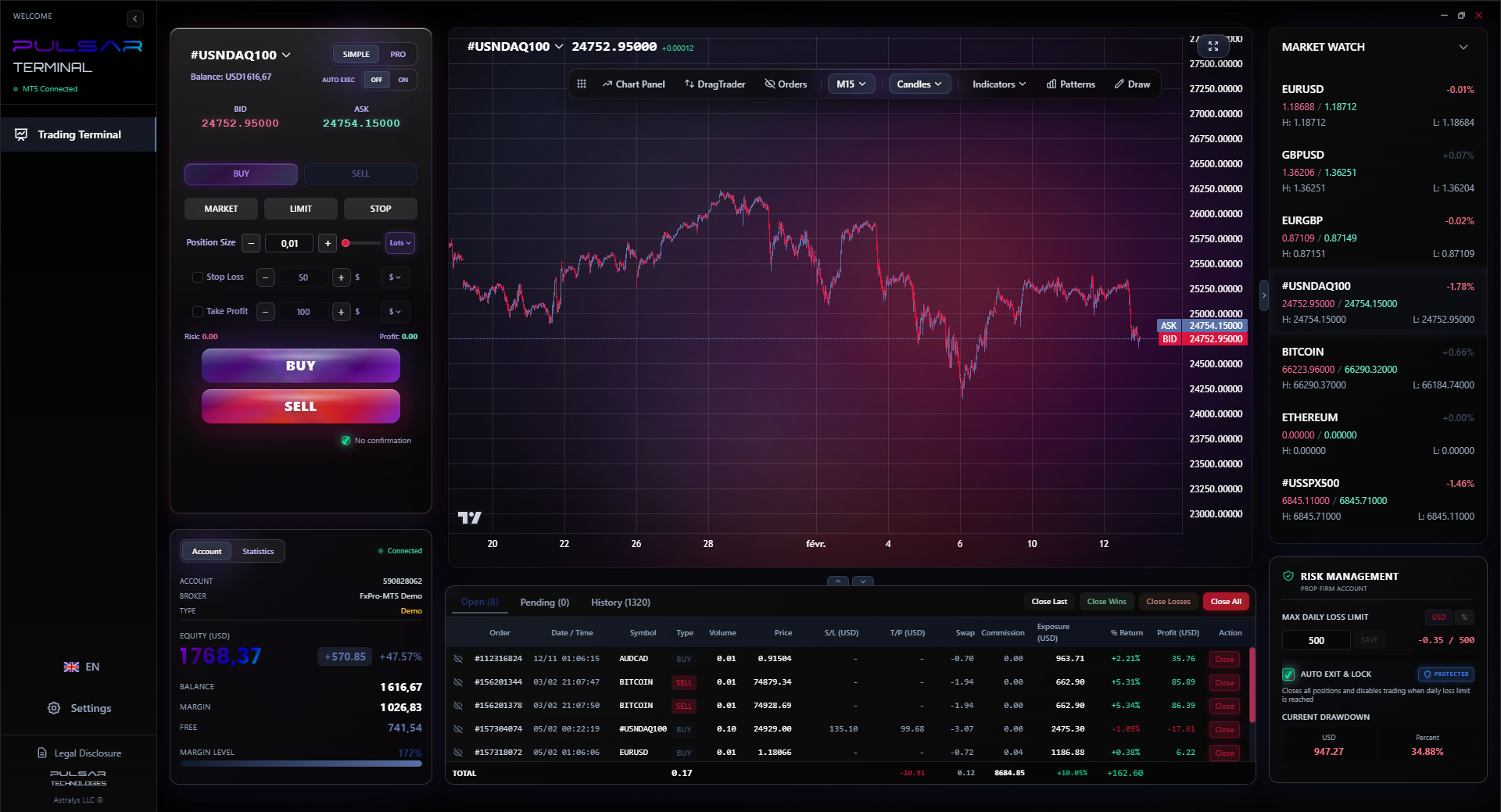
When swing trading from Sri Lanka, managing multiple trades and protecting profits is key; Pulsar Terminal's multi-TP/SL and trailing stop features automate this directly on your MT5 platform.
Pulsar Terminal
MT5オールインワンツール:ドラッグ&ドロップ注文、マルチTP/SL、トレーリングストップ、グリッドトレード、出来高プロファイル、プロップファーム保護。毎日1,000人以上のトレーダーが利用。
“Your protection is your own due diligence, not a CBSL stamp that doesn't exist for retail forex.”
This is where most traders screw up. They think because the money is offshore, it's invisible. It's not, and as forex gains more attention, the IRD will get better at looking.
You need a simple, bulletproof system from day one:
- A dedicated trading journal. Use a spreadsheet (Google Sheets works). Columns for: Date, Pair, Long/Short, Entry Price, Exit Price, Size (lots), P&L (USD), P&L (LKR at withdrawal rate).
- Document the money trail. Save every single receipt. Bank statement showing LKR to Skrill. Skrill transaction ID to broker. Broker statement showing all trades. Broker withdrawal to Skrill. Skrill to LKR bank statement. This chain proves your profit.
- Calculate profit in LKR. For tax purposes, your profit is the LKR you finally receive. If you deposit $1,000 (LKR 315,000) and end up withdrawing $1,500 which becomes LKR 450,000, your taxable profit is LKR 135,000. Add that to your other income for the year.
Talk to a local accountant familiar with online business income. A few thousand rupees for their advice can save you a massive headache later. I didn't do this for three years and spent a stressful week with my accountant reconstructing everything. It was avoidable.
💡 ウィンストンのヒント
Your greatest asset isn't a secret indicator. It's patience. The best setups might only come 2-3 times a week. Waiting for them is a skill that beats frantic trading every time.
“use of 1:2000 isn't an opportunity; it's a trap designed to separate you from your capital faster.”
Let me save you some pain by listing the classic errors I've seen (and made) in the Sri Lankan trading scene.
Chasing 'CBSL Licensed' Brokers: You'll see ads for local 'bucket shops' claiming to be licensed. They are often just introducing you to an offshore broker while taking a huge markup on the spread. Your money isn't any safer, and your costs are higher. Stick with the known international brands.
Over-leveraging: Brokers like Exness offer insane use like 1:2000. This is a trap for new traders. It magnifies losses as fast as gains. Start with 1:10 or 1:20 max. use is a tool, not a strategy.
Ignoring Time Zones: The London and New York overlaps are when the market moves most. That's often late night/early morning here. Don't enter trades just before you go to sleep if you can't manage them. Use pending orders and stops.
Strategy Hopping: You'll learn about the MACD indicator, then the RSI indicator, then some complex system. You'll lose money with each, blame the tool, and jump to the next. Pick one simple method (like price action on support/resistance) and stick with it for 100 trades. Master your psychology first, the tools second.
Underestimating the Psychological Toll: Trading in isolation, with the difficulty of moving money, watching the LKR weaken your savings... it's stressful. Find a community, even an online one, of serious traders to talk to. It prevents you from going down rabbit holes of bad ideas.
FAQ
Q1Is forex trading legal in Sri Lanka?
Yes, trading currencies is legal. However, sending money directly from a Sri Lankan bank to an international broker for margin trading is restricted under Exchange Control laws. Traders typically use legal third-party e-wallets like Skrill or Neteller as an intermediary.
Q2How much money do I need to start forex trading in Sri Lanka?
Technically, you can start with as little as $5-10 with brokers like XM or Exness (approx. LKR 1,500-3,000). However, I strongly recommend starting with at least $200-500 (LKR 60,000-150,000) to properly manage risk and absorb the transaction fees involved in funding and withdrawing.
Q3Do I have to pay tax on my forex trading profits?
Yes. The Inland Revenue Department (IRD) considers trading profits as taxable income. You must declare them and pay income tax according to Sri Lanka's progressive tax bands (starting at 6%). Keep careful records of all transactions.
Q4Which is the best broker for Sri Lankan traders?
There's no single 'best' broker. It depends on your needs. For low minimum deposits, check Exness or XM. For tight raw spreads, look at IC Markets or Pepperstone. The critical factor is choosing a reputable, internationally regulated broker that accepts deposit methods you can use from Sri Lanka.
Q5Can I trade the Sri Lankan Rupee (USD/LKR)?
Some offshore brokers offer USD/LKR as a CFD, but I don't recommend it for beginners. The liquidity is low, the spread is wide, and the price may not match the actual bank rate you get. It's better to focus on major global pairs like EUR/USD.
Q6What is the safest way to deposit and withdraw money?
The safest, most common method is using an established e-wallet like Skrill or Neteller. You transfer LKR from your bank to the e-wallet (coded as a purchase), then fund your broker from the e-wallet. Reverse the process for withdrawals. Always test with a small amount first.
Q7Can I trade forex full-time in Sri Lanka?
It's possible, but extremely difficult. The challenges of moving money, tax implications, market hours, and the need for a substantial, well-capitalized account make it a high-risk career path. Most successful traders here treat it as a supplemental income stream alongside their main job.
ウィンストン教授のレッスン
重要ポイント:
- ✓Test your money pipeline before trading.
- ✓Swing trade higher timeframes (4H/Daily).
- ✓Never risk more than 2% per trade.
- ✓Keep perfect records for the IRD.
- ✓Broker regulation > local 'approval'.
この記事はどれくらい役に立ちましたか?
星をクリックして評価
週刊トレーディングインサイト
無料の週刊分析&戦略。スパムなし。
著者について
Daniel Harrington
コンテンツ責任者
The Trading Mentorのコンテンツ責任者。複雑なトレード概念をわかりやすく伝えることに情熱を持つベテラントレーダー。グローバルなトピック、戦略、プラットフォームガイドを担当。
コメント
リスク警告
金融商品の取引には大きなリスクが伴い、すべての投資家に適しているわけではありません。過去の実績は将来の結果を保証するものではありません。本コンテンツは教育目的のみであり、投資助言として解釈すべきではありません。取引前に必ずご自身で調査を行ってください。
こちらもおすすめ

Cara Trading Forex Sukses: 7 Prinsip dari Trader Profesional
Cara trading forex sukses dengan 7 prinsip trader pro: manajemen modal, disiplin, journal trading, backtest. Data nyata, bukan janji profit palsu.
Jam Trading Forex Terbaik untuk Trader Indonesia: Panduan Lengkap dengan Tabel Waktu
Panduan jam trading forex untuk trader Indonesia. Tabel 4 sesi dunia, jam emas 20:00-00:00, sesi mana yang harus dihindari. Data akurat + tips dari trader berpengalaman.
Top 5 Sàn Forex Uy Tín Nhất 2026: Review Jujur dari Trader Indonesia
Top 5 sàn forex uy tín 2026 untuk trader Indonesia. Review jujur: spread, deposit, withdraw, dukungan lokal. Exness, XM, IC Markets & lebih.
