


I bought my first gold futures contract on the MCX back in 2015, convinced a breakout was imminent.

Rajesh Sharma
シニアFXアナリスト ·  India
India
☕ 11 分で読める
学べること:
- 1Why Bother with Gold? The Indian Context
- 2Physical & Digital Gold: The Simple (and Costly) Route
- 3Sovereign Gold Bonds (SGBs) & Gold ETFs: The Paper Trail
- 4The Big Leagues: Gold Futures & XAU/USD (Where Pros Play)
- 5The Silent Killer: Taxes & Costs for the Indian Gold Trader
- 6A Practical Trading Setup for an Indian
- 7Mistakes I've Made (So You Don't Have To)
- 8Final Verdict: What's the Best Route for You?

I bought my first gold futures contract on the MCX back in 2015, convinced a breakout was imminent. I was right about the direction, but dead wrong on the size. A 5-rupee move against me on a 1kg contract, and my ₹40,000 margin turned into a ₹5,000 loss in an hour. I hadn't accounted for the volatility or the overnight charges. That lesson, paid for in real money, is what most Indian traders miss when they ask how to trade in gold in India. It's not just about buying low and selling high; it's about navigating a minefield of taxes, product choices, and use that can wipe you out faster than you can say 'Sona'.
Let's be honest. For most of us, gold isn't a trade, it's a family heirloom, a wedding gift, or a panic buy during a market crash. But that emotional baggage is exactly why it's a fantastic trading asset. It moves on fear, inflation whispers, and a weakening rupee. When global uncertainty hits, Indian investors don't just buy stocks, they flock to gold. That creates predictable patterns.
From a pure trading perspective, gold (especially international XAU/USD) offers clean technical moves. It doesn't have company-specific risk like a stock. Its correlation to the Indian rupee (INR) adds another layer. If you think the USD/INR is going up (rupee weakening), buying gold in rupee terms often works as a hedge. But here's the kicker: the 'how' matters more than the 'why'. Choosing the wrong vehicle to express your view is where 80% of beginners fail.

Warning: Don't confuse long-term family investment with short-term trading. The jewellery you buy for 50% over market price for a wedding is not a 'trade'. It's a cultural expense. Separate the two in your mind completely.
This is where everyone starts. Walking into a Tanishq or local jeweller, buying a coin or bar. Or now, clicking 'Buy Gold' on your PhonePe app.
Physical Gold (Coins, Bars, Jewellery)
You know this. You buy at 'market rate' plus making charges (for jewellery) plus a 3% GST. The moment you walk out, you're already down 3-10% depending on the craftsmanship. Selling it back? You'll get the daily scrap price, which is always lower than the buying price. The spread is your first, silent loss. There's no official limit on how much you can hold, but try buying over ₹2 lakh in cash and see how fast the taxman gets interested. A PAN card is mandatory for purchases above ₹50,000.
Digital Gold (MMTC-PAMP, SafeGold, Paytm Gold)
This seems smarter. You own fractional, vaulted gold with purity assurance. You can buy for as low as ₹1. It's easy. But it's not a trading tool. It's a slightly more efficient savings tool. The buy-sell spread still exists (though smaller than physical), and you still pay 3% GST on every purchase. The biggest red flag? It's not regulated by SEBI. Your gold is only as safe as the company backing the promise. For a long-term hold, maybe. For active trading? Forget it.

Example: You buy ₹10,000 of digital gold. Instantly, ₹300 (3% GST) goes to the government. For you to break even, the gold price needs to rise by over 3% just to cover the tax. That's a huge hurdle for short-term trades.

💡 ウィンストンのヒント
The 3% GST on physical gold is the market's first line of defense. It's a 3% headwind your trade must overcome just to break even. Treat it like a guaranteed loss on entry.

“Choosing the wrong vehicle to express your gold view is where 80% of beginners fail.”
Now we're getting into tradable instruments. These are for the investor-speculator hybrid.
Sovereign Gold Bonds (SGBs)
Issued by the RBI, these are the best long-term gold investment for Indians. You get the value of 1 gram of gold, plus 2.5% annual interest, plus tax-free gains if you hold to the 8-year maturity. The catch? They're terrible for trading.
They trade on the stock exchange, but the liquidity can be pathetic. I once tried to sell an SGB lot mid-series. The bid-ask spread was so wide I would have lost a year's interest in one transaction. They're also subject to Long-Term Capital Gains tax rules (12.5% after 3 years for SGBs sold on exchange, not at maturity). Limit: 4 kg per person per year.
Gold ETFs & Mutual Funds
These are SEBI-regulated funds that track physical gold prices. You buy and sell units on the stock exchange just like a stock. This is where you can start thinking about trading.
Pros: No GST on purchase (huge advantage over digital/physical). High liquidity in top ETFs. You can start with the value of 1 gram. Expense ratios are low (0.1%-0.2%).
Cons: You're still trading on Indian exchanges during Indian hours. You miss the big overnight moves in global gold. The price includes the USD/INR rate, which adds noise. For pure gold exposure, it's diluted.
I used Gold ETFs for years as a 'set and forget' allocation. But for active swing trading based on global charts, they felt sluggish and disconnected.
This is where you learn how to trade in gold in India for real, and where you can lose real money fast. This is for active traders, not investors.
MCX Gold Futures
Traded on the Multi Commodity Exchange. You're trading contracts (like 1kg), not grams. You put down a margin (typically 4-8% of the contract value). This is use. This is danger.
Let me give you a real, painful example. In 2018, gold was in a tight range. I sold a 1kg mini contract at ₹31,500, expecting a breakdown. My margin was about ₹12,000. A geopolitical headline hit, and gold spiked ₹300 in minutes. That's a ₹3,000 loss on my ₹12,000 margin - a 25% loss in moments. I hadn't even considered a trailing stop. The volatility is immense, and you have expiry dates to manage. It's a full-time job.
XAU/USD with International Brokers
This is trading international gold priced in US dollars. Platforms like Exness, IC Markets, or Pepperstone offer this. This is pure, undiluted gold volatility.
Why it's powerful: You trade 24/5, react to global news instantly, and use much higher use (if you're reckless). The spreads are tight. The charts are clean.
The massive catch for Indians: It's legally gray. You're technically not allowed to use an international broker to circumvent FEMA rules for currency speculation. Your money movement (deposit/withdrawal) is the biggest hurdle. Many do it, but you operate in a regulatory shadow. Also, the use (often 1:500) is a guaranteed account destroyer if you don't have military-grade discipline. I blew a $2,000 account in 2012 using 1:500 use on a 0.1 lot XAU/USD trade that went 50 pips against me. It was over in seconds.

Pro Tip: If you trade MCX futures, always, always use a position size calculator. Never risk more than 1-2% of your capital on a single trade. That gold spike will happen, and it will hunt your stop loss.
“A strategy that yields 10% before tax might yield 7% after tax. Does it still work?”
This is the boring stuff that determines if you're actually profitable. Most traders I know can pick directions but are clueless here.
| Instrument | GST on Buy | STCG (Short-Term) | LTCG (Long-Term) | Other Costs |
|---|---|---|---|---|
| Physical/Digital | 3% (on gold value) | As per your income tax slab (if sold < 3 yrs) | 12.5% without indexation (after 3 yrs) | Making charges, high buy-sell spread |
| Gold ETF | None | As per your tax slab (if sold < 3 yrs) | 12.5% without indexation (after 3 yrs) | Expense Ratio (~0.15%), brokerage |
| SGB (Held to Maturity) | None | N/A | ZERO on redemption at 8 yrs | N/A |
| MCX Futures | None | Business Income (added to total income) | Treated as Business Income | Brokerage, exchange fees, STT |
| XAU/USD | None | Legally ambiguous; could be treated as business income | Legally ambiguous | Spread, swap/overnight fees |
The Big Takeaway:
- GST is a trade killer. Active trading in physical/digital gold is mathematically stupid because of the 3% entry tax.
- Taxation changes your strategy. If you're a scalping futures trader, your profits are business income. You need to account for that 30%+ tax before you calculate your real returns. I've seen traders have a winning year, then get wiped out by a tax bill they didn't save for.
- SGBs are a tax haven... but only if you hold for 8 years. Selling early on the exchange makes them tax-inefficient.
You must factor this in from day one. A strategy that yields 10% before tax might yield 7% after tax. Does it still work?

So, how to trade in gold in India without the common pitfalls? Here's a conservative framework based on my scars.
Step 1: Define Your Timeframe & Vehicle
- Long-term Investor (5+ years): Use Sovereign Gold Bonds. Max out the 4kg limit if you can. Ignore the price noise.
- Medium-term Swing Trader (Weeks to Months): Use Gold ETFs or MCX Mini contracts (100 grams). This avoids GST and gives you decent liquidity. Use daily and weekly charts for the MACD indicator and trendline breaks.
- Short-term/Day Trader: This is MCX Futures or XAU/USD territory. You need skill, a fast platform, and ice-cold nerves. I don't recommend this for anyone with less than 3 years of consistent profitability in simulators.
Step 2: The Entry & Risk Management Rule Never enter a trade without knowing your exit. For every ₹1 of potential profit, you should know where you'll lose ₹0.50. Use ATR (Average True Range) to set your stop loss. If gold's daily ATR is ₹300, placing a ₹100 stop is just donating money to the market.
Step 3: Mind the Rupee When trading MCX or ETFs, you're trading Gold in INR. A falling rupee (USD/INR up) can push MCX gold higher even if international gold (XAU/USD) is flat. Watch the USD/INR pair. Sometimes you're just betting on the rupee, not gold.

Example from my journal: On March 15, 2023, I bought a 100gm MCX Mini contract at ₹58,200. My stop was at ₹57,800 (₹400 risk, about 0.7%). My target was ₹59,200. My risk (₹400) to reward (₹1000) was 1:2.5. I used the previous day's high as a resistance level for my target. The trade worked, but the 1:2.5 ratio meant I could be wrong 70% of the time and still break even. That's the math of survival.
💡 ウィンストンのヒント
If you can't articulate your exact stop loss and take profit levels in rupees before you click 'buy', you are not trading. You are gambling with a fancy chart open.

“The single biggest mistake is not having a written plan. 'I think gold will go up' is not a plan.”
- Trading Physical/Digital for Short-Term Moves: Paid 3% GST to enter, price went up 2%, I 'won' but lost 1% net. Stupid.
- Ignoring Overnight Charges (Carry Cost) on Futures: Held a long futures position over expiry. The rollover cost ate half my paper profits. Now I always check the cost of carry.
- Using Too Much use on XAU/USD: As mentioned, 1:500 use is a suicide pact. Even 1:100 is extreme for gold. Start with 1:10 or less. Your goal is to survive, not get rich tomorrow.
- Chasing Liquidity in SGBs: Trying to exit a large position in a low-liquidity SGB series. The market saw my order and the spread widened against me. If you need liquidity, stick to the most recent SGB series or just use ETFs.
- Not Accounting for Tax Before the Year-End: Having a great trading year in March, then realizing in July that I owe 30% of those profits as advance tax. Cash flow nightmare.
The single biggest mistake is not having a written plan. 'I think gold will go up' is not a plan. 'I will buy a Gold ETF unit if it closes above the 20-day moving average with RSI above 50, with a stop loss 5% below, risking no more than 1% of my capital' is a plan. One works. The other doesn't.
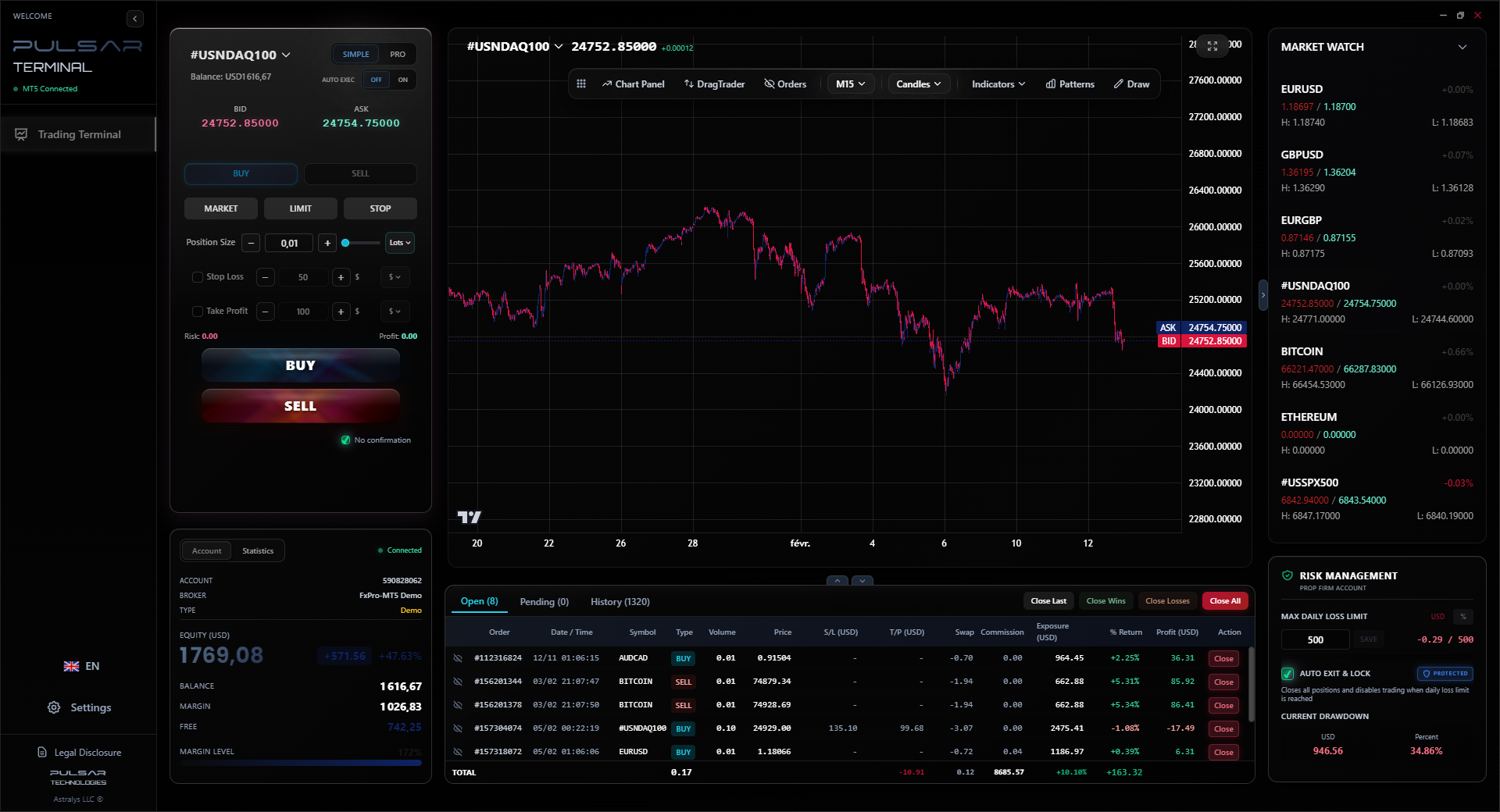
Managing complex futures trades with multiple targets and stops is chaotic on basic platforms, which is why professional tools that automate this process are essential for survival.
Pulsar Terminal
MT5オールインワンツール:ドラッグ&ドロップ注文、マルチTP/SL、トレーリングストップ、グリッドトレード、出来高プロファイル、プロップファーム保護。毎日1,000人以上のトレーダーが利用。
After 12 years, here's my blunt assessment.
- For 95% of Indians asking how to trade in gold in India: Don't 'trade' it. Invest in Sovereign Gold Bonds for the long haul. Get the interest, the tax-free maturity, and sleep well. Use your trading energy on other assets.
- For the 5% who are serious, disciplined traders: Use Gold ETFs for swing trades based on weekly charts. It's simple, tax-efficient (no GST), and keeps you out of the lethal use game. It's a great training ground.
- For the 1% who are professional risk-managers: MCX Futures (with strict size limits) or, if you understand the legal and currency risks, XAU/USD with a reputable international broker like IC Markets or Pepperstone. This is the major league. The volatility is brutal, but the opportunities are pure. You need tools that match this complexity.
Gold is a beautiful, treacherous market. It feels solid because you can hold it, but its price moves on air - fear, hope, and central bank whispers. Respect it. Size small. Manage your risk first, and the profits will take care of themselves over time. Start by pretending the 3% GST on physical gold is a 3% loss on every trade you take. That mindset alone will keep you in the game longer than most.

FAQ
Q1Is trading gold legal in India?
Yes, but the 'how' matters. Trading physical gold, SGBs, Gold ETFs, and MCX gold futures is completely legal and regulated. Using international forex brokers to trade XAU/USD (gold in dollars) exists in a legal gray area concerning foreign exchange regulations (FEMA). While many do it, the primary risk isn't the trade itself, but moving money in and out of the country for speculative purposes.
Q2What is the cheapest way to trade gold in India?
For active trading, Gold ETFs are the cheapest. There's no 3% GST on purchase (unlike physical/digital), the expense ratios are low (~0.15%), and brokerage is minimal. For long-term holding, Sovereign Gold Bonds (SGBs) are cheapest at maturity due to zero capital gains tax.
Q3How much money do I need to start trading gold?
It varies wildly. You can start a Gold ETF SIP with ₹100. For one unit of an ETF (approx. 1 gram), you need about ₹7,000-₹8,000. For MCX Gold Mini futures (100gm), the initial margin can be ₹15,000-₹25,000. For trading XAU/USD with an international broker, you can start with $100, but that's dangerously low. A realistic starting capital for serious trading is at least ₹50,000 for ETFs or ₹1 lakh for futures, allowing for proper position sizing and risk management.
Q4Do I pay tax on gold trading profits?
Always. The type depends on the instrument and holding period. Physical/Digital/ETF gold held under 3 years incurs Short-Term Capital Gains taxed at your income slab. Over 3 years, it's 12.5% LTCG. MCX futures profits are treated as business income. SGBs have tax-free gains only if held to the 8-year maturity. Never ignore tax in your profit calculations.
Q5Which is better for trading: Gold ETF or MCX Futures?
Gold ETFs are better for most traders. They're simpler, have no expiry, no use (so you can't get a margin call), and no GST. MCX Futures are powerful but dangerous. They offer use (amplifying gains and losses), have expiry dates, and require more active management. Only use futures if you are an experienced trader who understands derivative risks.
Q6Can I trade gold 24 hours in India?
Through Indian exchanges (MCX, NSE), no. MCX has specific trading hours. To trade gold 24/5, you need to use an international broker and trade the XAU/USD pair. This comes with the legal and currency risk mentioned above.
Q7How does the USD/INR rate affect my gold trades in India?
Massively. The price of MCX gold and Gold ETFs is: (International Gold Price in USD) x (USD/INR rate). If international gold is flat but the Indian rupee weakens (USD/INR rises), your gold price in rupees will go up. Sometimes you're profiting more from a falling rupee than a rising gold price.
ウィンストン教授のレッスン
重要ポイント:
- ✓Avoid 3% GST: Use ETFs or Futures, not physical/digital, for trading.
- ✓SGBs are for 8-year investment, not active trading.
- ✓MCX Futures use can wipe you out in minutes.
- ✓Always calculate profit AFTER 30%+ tax on short-term gains.
この記事はどれくらい役に立ちましたか?
星をクリックして評価
週刊トレーディングインサイト
無料の週刊分析&戦略。スパムなし。
著者について
Rajesh Sharma
シニアFXアナリスト
インド・南アジア市場で10年以上のトレード経験。NSEの通貨デリバティブからキャリアをスタートし、国際FXへ転向。USD/INRと新興国通貨ペアを専門とする。
コメント
リスク警告
金融商品の取引には大きなリスクが伴い、すべての投資家に適しているわけではありません。過去の実績は将来の結果を保証するものではありません。本コンテンツは教育目的のみであり、投資助言として解釈すべきではありません。取引前に必ずご自身で調査を行ってください。
こちらもおすすめ

Cara Trading Forex Sukses: 7 Prinsip dari Trader Profesional
Cara trading forex sukses dengan 7 prinsip trader pro: manajemen modal, disiplin, journal trading, backtest. Data nyata, bukan janji profit palsu.
Jam Trading Forex Terbaik untuk Trader Indonesia: Panduan Lengkap dengan Tabel Waktu
Panduan jam trading forex untuk trader Indonesia. Tabel 4 sesi dunia, jam emas 20:00-00:00, sesi mana yang harus dihindari. Data akurat + tips dari trader berpengalaman.
Top 5 Sàn Forex Uy Tín Nhất 2026: Review Jujur dari Trader Indonesia
Top 5 sàn forex uy tín 2026 untuk trader Indonesia. Review jujur: spread, deposit, withdraw, dukungan lokal. Exness, XM, IC Markets & lebih.
