


If you're reading this, you've probably said 'I am a forex trader' to yourself or someone else.

Olumide Adeyemi
西アフリカ・トレーディングの先駆者 ·  Nigeria
☕ 10 分で読める
学べること:
- 1What It Really Means to Say 'I Am a Forex Trader'
- 2The Nigerian Forex Landscape: Rules and Realities
- 3The Costs Nobody Talks About (Until It's Too Late)
- 4Building Your Nigerian Trading Business: A Practical Plan
- 5use: The Siren Song That Sinks Accounts
- 6Choosing Your Battles: Currency Pairs and Sessions
- 7From Survival to Consistency: The Professional's Edge
If you're reading this, you've probably said 'I am a forex trader' to yourself or someone else. Let me be blunt: most of you saying that will lose every kobo you put in. The stats are merciless. But Nigeria's market is exploding, with daily turnover hitting $8.6 billion in 2025. The opportunity is real, but so is the carnage. I've been in this game for over a decade, and I've blown up accounts myself. This isn't a motivational speech. It's a risk manager's blueprint for the few who might actually make it.
In Nigeria, declaring yourself a forex trader carries a certain weight. Among the youth, it's a badge of hustle. To your aunties, it's a suspicious activity somewhere between betting and magic. Let's strip away the fantasy.
Saying 'I am a forex trader' means you are a risk manager first, a speculator second. Your primary job isn't predicting the market. Your job is to not get wiped out. The global daily turnover is $9.6 trillion. You are a microscopic plankton in that ocean, and the whales (banks, funds) don't care if you live or die.
The Nigerian context adds layers. You're navigating power outages, data costs, and a Naira that can move on a single CBN tweet. Your success isn't just about your scalping strategy. It's about your backup power supply and your broker's withdrawal reliability. I learned this the hard way in 2018. I was up $1,200 on a USD/NGN position, feeling like a genius. Then, a network outage from my ISP lasted six hours. By the time I got back online, the trade had reversed and hit my stop-loss. I lost $400. The market didn't beat me. My infrastructure did.

Warning: The romantic idea of trading from your phone on the beach is a marketing lie. This is a technical, stressful business. If you're not prepared to treat it like one, save your money.

💡 ウィンストンのヒント
Your first profit target should always be to keep your capital intact. Profits are a secondary objective that only a surviving trader can achieve.
The Regulatory Grey Zone
Forex trading is legal in Nigeria, but the regulatory framework for retail online trading is, frankly, a work in progress. The Central Bank of Nigeria (CBN) controls the official flow of forex. The Securities and Exchange Commission (SEC) is the body that should oversee this space. They've said forex trading is a securities activity and warn constantly about unlicensed 'investment schemes'.
Here's the practical reality for you: most Nigerian traders use international brokers regulated offshore (like Seychelles or BVI). There's no law against this. Your protection comes from the broker's own regulatory body, not the SEC. This means you must do your own due diligence. A broker like Exness or XM, popular here, operates under these offshore licenses for Nigerian clients.
The Taxman Cometh
This is non-negotiable and often ignored. If you make a profit, you owe the Federal Inland Revenue Service (FIRS) a 10% Capital Gains Tax. You must file a tax return within 90 days of the year ending December 31. I know traders who've made millions of Naira and thought they could ignore this. The FIRS has ways of finding out, especially when you start moving large sums into your Nigerian bank account. Factor this into your profit calculations from day one.
The Naira Account Advantage
Many top brokers now offer Naira-denominated accounts. This is a game-changer. It means you can deposit and withdraw in NGN, and your profit/loss is displayed in your local currency, removing the mental friction of constant conversion. It also sidesteps some of the CBN's restrictions on international card transactions. When choosing a broker, this feature should be high on your list.
“Saying 'I am a forex trader' means you are a risk manager first, a speculator second.”
You know about spreads and commissions. Let's talk about the silent account killers.
The Spread Trap: On a major pair like EUR/USD, a 'standard' account might have a 1.6 pip spread. An ECN account might have a 0.1 pip spread but charge a $4 commission per lot. Which is cheaper? You need to do the math. For a typical 1-lot (100,000 unit) trade, the standard account cost is $16 (1.6 pips * $10 per pip). The ECN cost is $5 (0.1 pips * $10 + $4 commission). The ECN is dramatically cheaper for active traders. I used standard accounts for years, oblivious to how much I was bleeding.
Swap Fees (Overnight Financing): If you hold a trade past 5 PM EST, you pay or receive a swap fee. For some pairs, especially where you're selling a high-interest currency, this cost can be massive. I once held a USD/ZAR sell position for three weeks. I made 120 pips ($1,200), but the swap fees deducted over $300. My net gain was only $900. Always check the swap rates in your platform before holding a trade long-term.
The Psychology Tax: This is the biggest cost. A losing trade doesn't just cost you money. It costs you confidence, leading to hesitation on the next setup (which then wins without you), or worse, revenge trading to win it back immediately. This 'tax' can bankrupt you faster than any spread. Using a tool like a position size calculator religiously is the only way to manage this psychological risk.
| Cost Type | Typical Example | Impact on a 1-Lot Trade |
|---|---|---|
| Spread (Standard) | 1.6 pips on EUR/USD | $16.00 |
| Spread (ECN) + Commission | 0.1 pips + $4/lot | $5.00 |
| Swap Fee (Overnight Hold) | -$2.50 per lot per day | Can compound to hundreds |
| Psychological Error (Revenge Trade) | One impulsive 2-lot trade | Can be 100% of your account |
Step 1: Capital – The Hard Truth
You'll see brokers advertising minimum deposits of $1 or ₦4,000. Technically true, but practically useless. With $10 (about ₦15,000), a single 0.01-lot trade with a 20-pip stop-loss risks $2. That's 20% of your capital on one trade. You're one bad trade from a 40% drawdown. It's a guaranteed path to failure.
My strong, evidence-based advice? Start with no less than $500 (roughly ₦750,000). This allows you to risk a sane 1% ($5) per trade on 0.05 lots, giving your strategy room to breathe. If you don't have this, save up. Trading with scared money is a recipe for disaster.
Step 2: The Holy Trinity – Strategy, Mindset, Execution
Your strategy doesn't need to be complex. It needs to be clear and testable. Are you a swing trader looking at daily charts, or a scalper on the 5-minute? Pick one. I combined MACD indicator crossovers on the 4-hour chart with key support/resistance levels for years. It worked until it didn't, and I lost $3,000 in a month because I didn't adapt when market volatility changed.
Mindset is everything. Your goal for the first year is not to get rich. Your goal is to survive. To not blow up. Execution means following your plan without emotion. This is where tools like Pulsar Terminal help, letting you set orders and stops objectively before you enter.
Step 3: Infrastructure
You need a reliable laptop, a stable internet connection (consider a backup like a MiFi), and a power bank or inverter. Your trading platform is your office. MetaTrader 4 or 5 is the industry standard. Brokers like IC Markets and Pepperstone offer strong MT5 support. Don't trade seriously on a phone alone.
💡 ウィンストンのヒント
If you can't articulate the exact economic reason for your trade in one sentence, you're gambling, not trading. Close the position.
“High use makes you feel powerful right up until you get a margin call.”
Brokers in Nigeria offer insane use - 1:500, 1:1000, even 'unlimited.' They market it as a benefit. It's a weapon of mass destruction pointed at your account.
Here's the math that will save you. use amplifies your buying power, not your wisdom. With a $500 account at 1:500 use, you can control $250,000 worth of currency. A mere 0.2% move against you wipes out your entire capital. That's less than a 20-pip move on EUR/USD.

Example: You have $1,000. You buy 1 standard lot of EUR/USD (controlling €100,000) at 1:100 use. Each pip move = $10. A 50-pip stop-loss (reasonable) risks $500. That's a 50% risk on one trade! This is how people blow up in days.
My rule, and the rule of every professional I know: Use the minimum use required for your position size. If you have $1,000 and want to risk 1% ($10) on a 50-pip stop, you need a position size of 0.02 lots. You can do this with 1:20 use. Anything more is gambling. High use makes you feel powerful right up until you get a margin call. I learned this with a £500 account in 2015. I used 1:200 use, got three trades wrong in a row, and was liquidated in 48 hours. The market didn't even move that much.
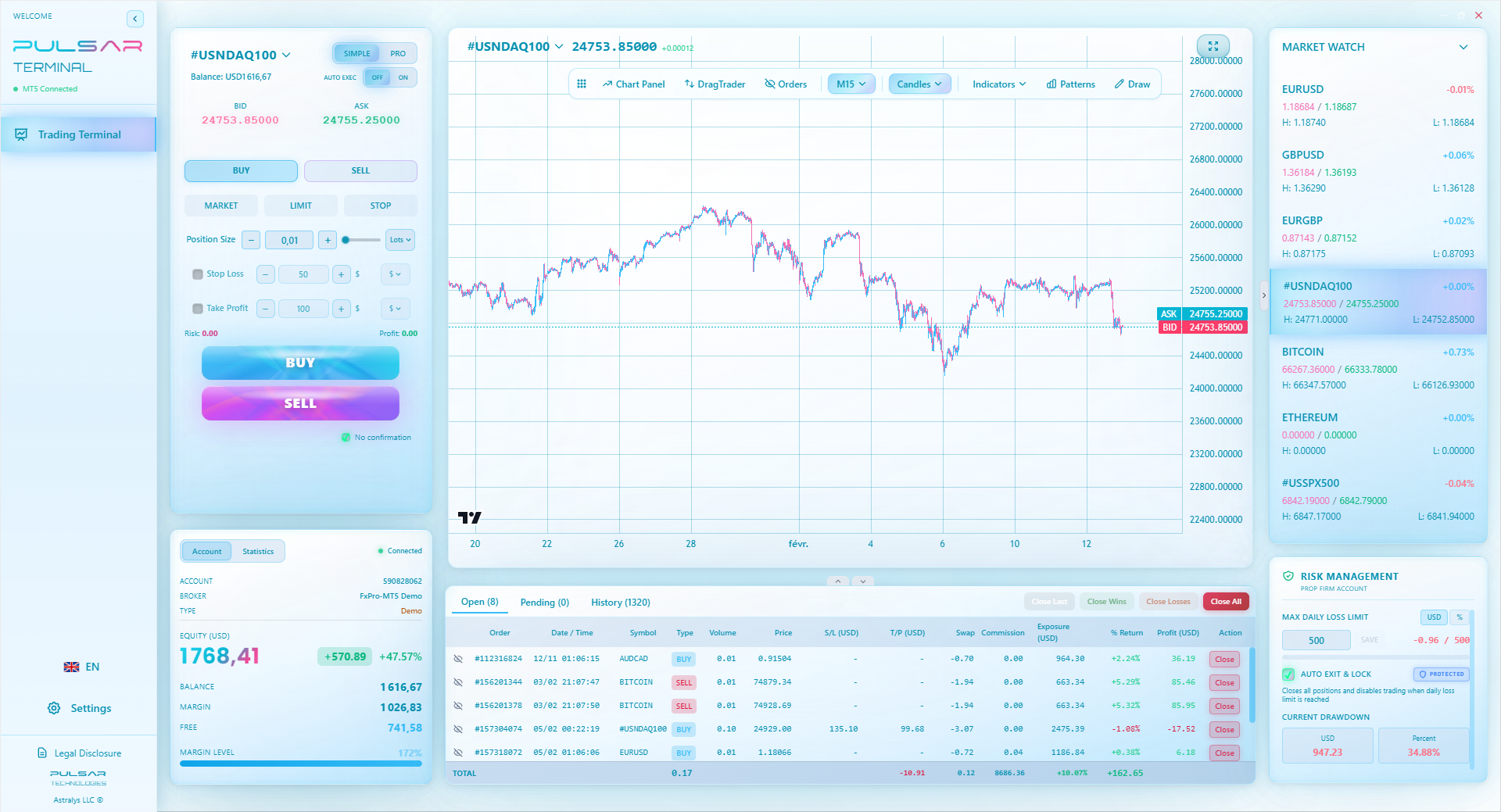
Managing the extreme risk of high leverage requires flawless trade execution, which is where a tool like Pulsar Terminal excels by letting you pre-set multi-level take-profits and stop-losses on MT5 without emotional interference.
Pulsar Terminal
MT5オールインワンツール:ドラッグ&ドロップ注文、マルチTP/SL、トレーリングストップ、グリッドトレード、出来高プロファイル、プロップファーム保護。毎日1,000人以上のトレーダーが利用。
Stick to the Majors
As a beginner, avoid exotic pairs like USD/NGN or USD/ZAR. The spreads are wide, the liquidity can be thin, and the moves are erratic. Your battleground should be the major pairs: EUR/USD, GBP/USD, USD/JPY, and AUD/USD. They have the tightest spreads and most predictable liquidity. I built my first consistent year of profits solely trading EUR/USD. Master one pair before you add another.
Trade the London-New York Overlap
The best volatility for your trading day is between 1:00 PM and 6:00 PM West Africa Time (WAT). This is when the London session is still open and the New York session comes in. Volume spikes, trends develop, and spreads are often at their tightest. Waking up at 2 AM to trade the Asian session is pointless for most strategies. Work smart with the market's rhythm.
Understand What Moves Your Pair
If you're trading AUD/USD, you need to watch iron ore prices and Chinese economic data. If you're trading XAU/USD (Gold), you need to watch real interest rates and the US Dollar. Forex isn't just lines on a chart. It's a reflection of global economics. Read.
💡 ウィンストンのヒント
A trading journal is more important than any indicator. Your past self is your most dangerous opponent; the journal tells you how he thinks.
“Your edge isn't a secret indicator. It's your discipline.”
Surviving the first year means you've controlled risk. Achieving consistency means you've mastered process.
Journal Every Trade. Not just 'won' or 'lost.' Log your entry rationale, your emotional state, the time of day, your risk percentage. Review it weekly. You'll find your mistakes are repetitive. I found I lost 70% of my trades entered after 10 PM local time. I was tired and impulsive. I made a rule: no trades after 9 PM. My win rate improved instantly.
Specialize. The jack-of-all-trades is master of none and broker of all. Don't jump from forex to crypto to indices daily. Become an expert in one market. Use tools like the RSI indicator or Volume Profile to understand that market's nuances deeply.
Scale Slowly. When you have six consecutive profitable months, you can consider adding 10-20% to your position size. Not before. The desire to 'get rich now' will destroy the compound growth you've built. This is a marathon run at a sprint pace by everyone around you. Let them burn out. You keep your steady, managed pace.

Pro Tip: Your edge isn't a secret indicator. It's your discipline. It's your risk management. It's your patience. The market will give you opportunities; your job is to be solvent and sane enough to take them.
FAQ
Q1Is forex trading illegal in Nigeria?
No, forex trading is completely legal in Nigeria. However, the online retail trading space is not heavily regulated by Nigerian authorities like the SEC. Most traders use internationally regulated brokers, which is a legal and common practice.
Q2How much money do I need to start forex trading in Nigeria?
While you can technically start with $10, I strongly advise a minimum of $500 (approx. ₦750,000). This allows for proper risk management, where a 1% risk per trade is a meaningful amount ($5) that lets you trade sensible position sizes without being wiped out by a few small losses.
Q3Which broker is best for Nigerian forex traders?
There's no single 'best' broker. Look for brokers that offer Naira accounts, reliable withdrawals, and are regulated by a reputable offshore authority. Popular and well-regarded options include Exness, XM, IC Markets, and Pepperstone. Always read recent, detailed reviews like our XM review before depositing.
Q4Do I pay tax on my forex trading profits in Nigeria?
Yes. Profits from forex trading are subject to a 10% Capital Gains Tax, which must be reported to the Federal Inland Revenue Service (FIRS). You are required to file a tax return within 90 days after the end of the calendar year (December 31st).
Q5What is the best time to trade forex in Nigeria?
The most active and optimal time is between 1:00 PM and 6:00 PM West Africa Time (WAT). This window captures the overlap of the London and New York trading sessions, offering the highest liquidity and best trading conditions for major currency pairs.
Q6Why do most forex traders in Nigeria fail?
They fail primarily due to poor risk management, using excessive use, trading with insufficient capital, and lacking a disciplined, tested strategy. Emotional trading - like revenge trading after a loss - is the final nail in the coffin for most accounts.
ウィンストン教授のレッスン
重要ポイント:
- ✓Start with a minimum of $500 for sane risk management.
- ✓Use use as a tool, not a weapon; 1:20 is often enough.
- ✓Trade only the 1 PM - 6 PM WAT window for best liquidity.
- ✓Pay your 10% Capital Gains Tax to the FIRS without fail.
- ✓Master one major currency pair before adding another.
この記事はどれくらい役に立ちましたか?
星をクリックして評価
週刊トレーディングインサイト
無料の週刊分析&戦略。スパムなし。
著者について
Olumide Adeyemi
西アフリカ・トレーディングの先駆者
ナイジェリアで最もアクティブなFXトレーディング教育者の一人。ラゴスから8年のトレード経験。アフリカのトレーダー向けの少額資金戦略とプロップファームチャレンジを専門とする。
コメント
リスク警告
金融商品の取引には大きなリスクが伴い、すべての投資家に適しているわけではありません。過去の実績は将来の結果を保証するものではありません。本コンテンツは教育目的のみであり、投資助言として解釈すべきではありません。取引前に必ずご自身で調査を行ってください。
こちらもおすすめ

Cara Trading Forex Sukses: 7 Prinsip dari Trader Profesional
Cara trading forex sukses dengan 7 prinsip trader pro: manajemen modal, disiplin, journal trading, backtest. Data nyata, bukan janji profit palsu.
Jam Trading Forex Terbaik untuk Trader Indonesia: Panduan Lengkap dengan Tabel Waktu
Panduan jam trading forex untuk trader Indonesia. Tabel 4 sesi dunia, jam emas 20:00-00:00, sesi mana yang harus dihindari. Data akurat + tips dari trader berpengalaman.
Top 5 Sàn Forex Uy Tín Nhất 2026: Review Jujur dari Trader Indonesia
Top 5 sàn forex uy tín 2026 untuk trader Indonesia. Review jujur: spread, deposit, withdraw, dukungan lokal. Exness, XM, IC Markets & lebih.
