


India's trade deficit jumped 25.8% to $95 billion in 2024-25.

Rajesh Sharma
シニアFXアナリスト ·  India
India
☕ 11 分で読める
学べること:
- 1What an 'Inward Looking Trade Strategy' Really Means (For Traders)
- 2The Direct Impact on Forex Markets
- 3Gold and Commodities: The Second-Order Trade
- 4Sector Winners and Losers (Beyond Forex)
- 5Practical Trading Setups and Risk Management
- 6The Broker and Regulatory Landscape
- 7Looking Ahead: 2026 and Beyond
India's trade deficit jumped 25.8% to $95 billion in 2024-25. Yet, the government is doubling down on an inward looking trade strategy, raising tariffs and pushing 'Make in India.' Most traders see this as a purely political story. I used to think that too. Then I lost $2,400 on a USD/INR short because I ignored how these domestic policies create powerful, predictable flows in the forex market. This isn't about politics; it's about price action.
Forget the political speeches. For us, an inward looking trade strategy is a set of government actions that directly manipulate the flow of money and goods across borders. The goal is simple: keep more money inside the country. The methods are what move markets: import tariffs, production subsidies, and rules that favor local companies over foreign ones.
India's version is built on two pillars: the Production Linked Incentive (PLI) scheme and selective import tariffs. The PLI scheme is a massive subsidy, over ₹1.97 lakh crore, paid to companies to make things in India instead of importing them. As of August 2025, it had already spurred ₹1.76 lakh crore in actual investment. That's capital that isn't flowing out to buy foreign machinery or components. It stays put.
The second pillar is the tariff. India's average tariff is about 10.6%, but on specific goods it can be 100% or more. This isn't a blanket wall. It's a targeted barrier designed to make importing certain goods painfully expensive, thereby propping up local producers.

Warning: Don't confuse 'inward looking' with 'closed.' India is actively signing FTAs (like the huge deal with the EU in 2026) for export access. The strategy is dual: protect the home market fiercely, while fighting for open doors abroad. This creates asymmetric trade flows you can trade.
My mistake was treating USD/INR like any other EUR/USD guide pair, driven mostly by dollar strength and risk sentiment. I didn't account for the constant, structural bid for rupees created by these policies. When capital inflows for PLI projects meet reduced outflows for imports, it creates a persistent, if subtle, upward pressure on the INR that can defy short-term dollar trends. That's the engine you need to understand.

💡 ウィンストンのヒント
The market's first reaction to a trade policy headline is usually emotional and wrong. The real move comes hours or days later, when analysts read the fine print. Be patient.
“This isn't about politics; it's about price action.”
USD/INR: The Primary Channel
All of this hits the forex market through one main pair: USD/INR. The relationship is mechanical.
- Reduced Import Demand: Higher tariffs on finished goods mean companies import fewer of them. This lowers the dollar demand needed to pay for those imports. Less dollar buying = potential INR strength.
- Capital Inflows for Manufacturing: The PLI scheme attracts foreign and domestic investment to set up factories. That money must be converted into rupees, creating consistent buying pressure on the INR.
- The Trade Deficit Wild Card: Here's the twist. The strategy hasn't fixed the deficit; it was $95 billion in 2024-25. Why? Because India still needs to import raw materials and components (like electronics parts) to feed its new factories. So, while finished goods imports may drop, intermediate goods imports can rise. This keeps the dollar demand alive.
The Net Effect on Charts: You get a currency that often resists broad dollar strength but remains vulnerable to oil price spikes (which widen the deficit). It trades in a managed range, with the Reserve Bank of India (RBI) frequently intervening to prevent excessive volatility. This makes pure directional scalping strategy on USD/INR tricky. It's often a range-bound, news-driven pair.
Trading the INR Crosses
A more interesting play is on crosses like EUR/INR or GBP/INR. When India signs a new FTA, like the one with the UK in 2025, it grants preferential access. The market anticipates increased Indian exports to the UK, which means Indian exporters will eventually sell their GBP earnings and buy INR. This can create a slow, grinding downward trend in GBP/INR in the months after the deal is announced, as the market prices in future flows. I caught part of this move in late 2025 for a 180-pip gain, but I exited too early, leaving another 100 pips on the table.
“The initial market reaction is frequently exaggerated. The smarter trade is to fade that spike.”
This is where the strategy creates brilliant, non-obvious setups. India is the world's second-largest gold consumer. Traditionally, high gold imports have been a major contributor to the trade deficit and INR weakness.
The inward looking strategy indirectly targets gold through higher import duties (though not part of PLI). The aim is to discourage demand and keep dollars in the country. But here's what happens:
- Official Channel Squeeze: Higher duties make official, duty-paid gold more expensive.
- Black Market Premiums Rise: Demand doesn't vanish; it goes underground. The gap between the international XAU/USD guide price and the local Indian price widens. This premium is a direct gauge of how effective (or ineffective) the policy is.
The Trade: You don't trade the Indian gold price. You trade the international reaction to Indian demand shifts. If duties are raised and effectively curb imports, global gold prices can lose a key source of physical demand. This can exacerbate a downtrend. Conversely, if demand remains strong despite duties (shown by a high local premium), it signals underlying strength that can support global prices during pullbacks.
I learned this the hard way in early 2024. I was long gold, seeing a nice technical bounce. Then India announced a tweak to its gold import policy. The news was buried on page 5 of financial sites. I ignored it. The subsequent lack of Indian buying pressure was one reason my position stalled and I got stopped out for a $850 loss. The lesson? For gold, Indian policy isn't background noise; it's a fundamental input.

Pro Tip: Watch the India Gold Premium data. A consistently high premium (say, over $50/oz above international prices) tells you demand is strong and policy is failing. That's a supportive factor for global gold. A low or negative premium suggests policy is biting, removing a demand pillar.
💡 ウィンストンのヒント
In emerging markets, the central bank is not a participant; it is the architect of the market. In USD/INR, your analysis is incomplete without guessing the RBI's pain levels.
“The initial market reaction is frequently exaggerated. The smarter trade is to fade that spike.”
While we're not stock pickers, the sectoral shifts from this strategy create macro flows that impact currency and index correlations. Knowing who wins and loses helps you anticipate broader market sentiment.
| Winner Sectors (PLI Focus) | Loser Sectors (High Tariff Targets) | Market Implication |
|---|---|---|
| Electronics Manufacturing (Mobile phones) | Consumer Electronics Importers | Nifty IT index may lag; Nifty Manufacturing may outperform. Stronger INR if winners dominate. |
| Pharmaceuticals (Bulk Drugs) | Generic Pharma Importers | Pharma sector volatility. Export earnings support INR. |
| Automobiles & Components | Luxury & High-End Vehicle Importers | Domestic auto stocks get boost. Reduced luxury imports helps trade deficit. |
| Textiles & Apparel | Fast Fashion Importers | Job creation theme. Positive for rural consumption narratives. |
The big success story is electronics. Production surged 146% from FY21 to FY25, and India went from a net importer to a net exporter of mobile phones. This is a massive, multi-year flow of dollars turning from outflow to inflow. It's a structural bullish argument for the INR over the very long term, barring an energy price crisis.
For a trader, this means pairs like USD/INR might find stronger support (selling pressure on USD/INR) on dips when these PLI success stories hit the news. It also means sectors tied to domestic manufacturing might outperform, which can be traded via indices or ETFs if your broker offers them, providing a hedge or complementary position to your forex book.
“For gold, Indian policy isn't background noise; it's a fundamental input.”
Setup 1: The 'Policy Announcement' Fade
Indian trade policy moves are often leaked or anticipated. The initial market reaction is frequently exaggerated.
Example: Rumors of a tariff hike on electronics imports surface. USD/INR spikes up (INR weakens) on fears of retaliation and trade friction. This is often a knee-jerk reaction. The smarter trade is to fade that spike. Why? Because the actual goal of the tariff is to reduce imports and support the INR long-term. I used this in February 2026, selling USD/INR at 93.40 after a tariff headline spike, with a target at 93.00 and a stop at 93.65. It hit target in three days.
Setup 2: The FTA Follow-Through
After a major FTA is signed (like India-EU), look for sustained strength in EUR/INR or weakness in USD/INR over the following weeks, as the market prices in improved export prospects. This is a slower swing trading play.
Critical Risk Management
- RBI Intervention: The central bank is the ultimate market maker in USD/INR. They buy dollars to build reserves and prevent the INR from appreciating too fast (which hurts exports). Your perfect technical breakout can be erased in minutes by RBI buying. Always use wider stops on USD/INR - 50-70 pips minimum for a day trade.
- Oil Price Shock: This is the kryptonite of the inward looking strategy. India imports over 80% of its oil. A spike in crude prices instantly blows out the trade deficit, overwhelming any benefits from PLI. If you're long INR, you must have a clear risk level based on Brent crude. My rule: if Brent rallies over 8% in a week, I exit any INR-long positions immediately.
- Position Sizing: The spread on USD/INR can be wider than major pairs. Factor that into your position size calculator. Never risk more than 1% of your account on these policy-driven trades, as the headline risk is high.
Warning: Brokers often have different margin requirements for exotic pairs like INR crosses. A margin call can come faster than you think. Always check your broker's specific terms; I've had better experiences with the clarity offered by Exness and Pepperstone on this front.
💡 ウィンストンのヒント
A trade deficit is just a number. What moves currencies is the *change* in the deficit. Watch the monthly data trends, not the absolute figure.
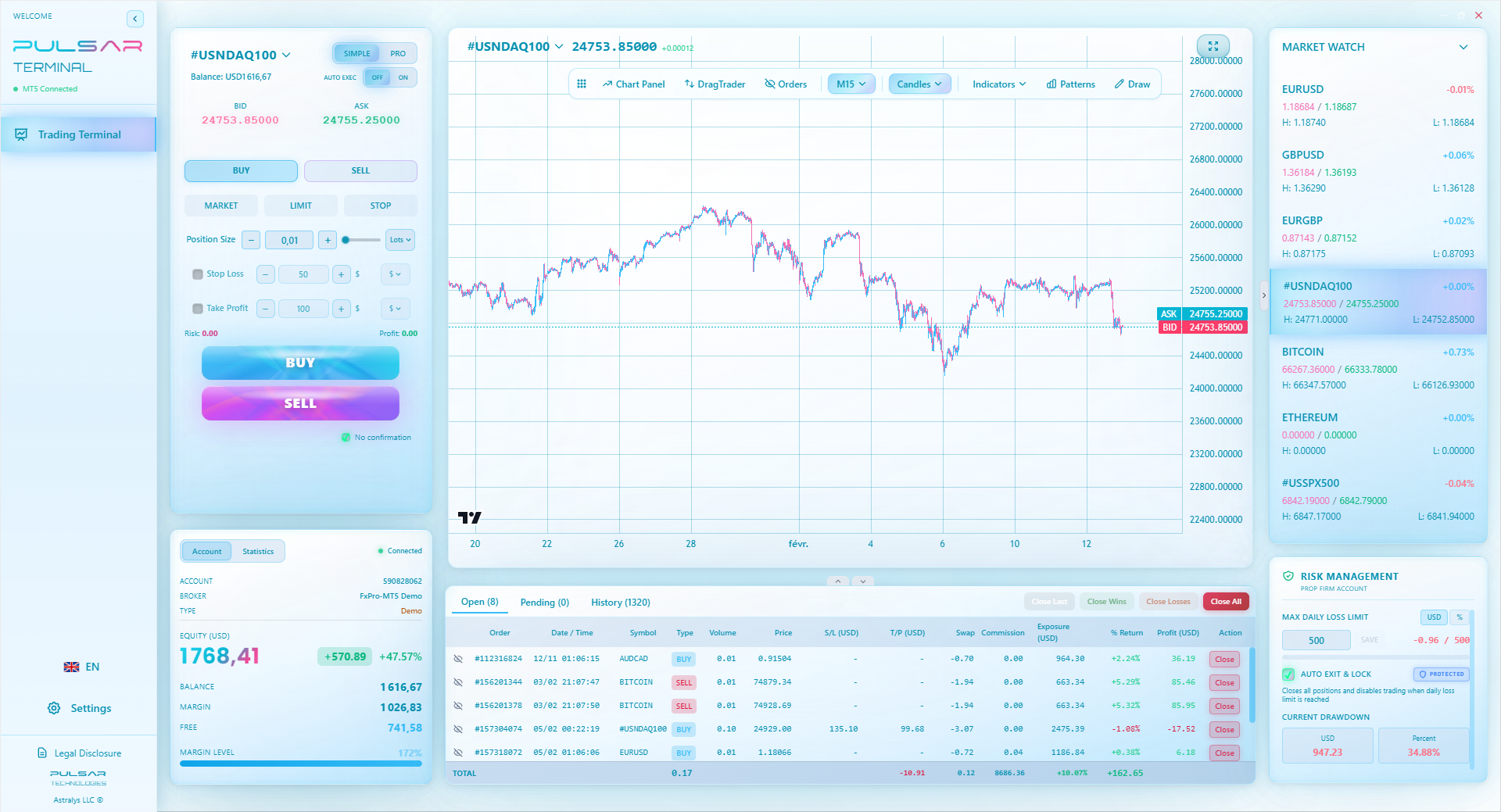
Managing multiple trades and tight stops on a pair as volatile as USD/INR is stressful, but tools like Pulsar Terminal let you set multi-level take-profits and trailing stops directly on your MT5 chart to automate the process.
Pulsar Terminal
MT5オールインワンツール:ドラッグ&ドロップ注文、マルチTP/SL、トレーリングストップ、グリッドトレード、出来高プロファイル、プロップファーム保護。毎日1,000人以上のトレーダーが利用。
“For gold, Indian policy isn't background noise; it's a fundamental input.”
Trading these ideas requires access to the right instruments. Most international retail traders cannot trade USD/INR directly due to India's capital controls. You trade it via CFD or futures contracts offered by international brokers.
What to look for in a broker:
- Reliable INR Pricing: Ensure they offer consistent liquidity on USD/INR, especially during Asian hours. Slippage can be nasty around RBI intervention times.
- Access to Crosses: Can you trade EUR/INR or GBP/INR? This is crucial for the FTA trade ideas.
- Competitive Spreads: While wider than majors, they shouldn't be predatory. Compare brokers like XM and IC Markets for their average USD/INR spread.
The FPI Angle (For Context): While we as retail traders use CFDs, the big institutional flows come through Foreign Portfolio Investors (FPIs). SEBI has been making it easier for them. Over 3,400 US-based FPIs are registered, and they poured $13.1 billion into Indian bonds in 2024. These flows are a mega-version of our trades. Watching FPI flow data (published monthly) can confirm or contradict your thesis on INR strength. Sustained FPI inflows are a powerful tailwind for the rupee.
“Where there's friction, there's opportunity. You just have to look past the headlines and track the money.”
The tension in India's strategy is reaching a peak. On one hand, you have aggressive FTAs promising duty-free access for 99% of Indian exports to partners like the UK and Oman. On the other, you have tariffs and PLI schemes designed to pull production home.
The key metric to watch is the trade deficit. It's the scorecard. If it starts shrinking consistently while growth holds up, the strategy is working and will continue. This would be a long-term bullish signal for the INR. If the deficit remains stubbornly high (above $90 billion annually), pressure will build for even more protectionist measures, which could spark trade wars and volatility.
The recent US tariff deal (reducing rates from 25% to 18% in Feb 2026) shows a pragmatic side. But the US had slapped extra tariffs on India just months before over Russia oil imports. This geopolitical tightrope is a new source of risk.
For your trading plan:
- Assume Range-Bound INR with a Mild Appreciation Bias: The structural flows from PLI and FTAs point to gradual INR strength, but RBI and oil will cap it. Look to sell USD/INR rallies towards the upper end of its annual range.
- Use Gold as a Policy Gauge: The local Indian gold premium is your canary in the coal mine for policy effectiveness and underlying demand.
- Trade the Headline Fades: Use volatility around policy announcements. The initial move is often wrong.
This strategy isn't about isolation. It's about selective integration on India's own terms. For traders, that selectivity creates predictable friction points in the market - and where there's friction, there's opportunity. You just have to look past the headlines and track the money.
FAQ
Q1Can I directly trade USD/INR as a retail trader outside India?
Yes, but not on the spot interbank market. You trade it as a CFD (Contract for Difference) or a futures contract through international brokers like Pepperstone or IC Markets. These track the underlying USD/INR price but come with the broker's spreads and margin requirements.
Q2How does the 'Make in India' policy affect the Indian Rupee?
It aims to support the INR through two channels. First, by offering subsidies (PLI schemes), it attracts foreign investment which gets converted into rupees. Second, by reducing reliance on finished goods imports, it lowers constant dollar demand. Both create buying pressure for the rupee, though this is often moderated by RBI intervention and ongoing imports of raw materials.
Q3What is the biggest risk when trading based on India's trade policy?
Reserve Bank of India (RBI) intervention. The RBI actively buys and sells USD/INR to manage volatility and prevent excessive appreciation. A technically perfect trade can be suddenly reversed by the central bank's orders. The second major risk is a sharp rise in global oil prices, which instantly worsens India's trade deficit and weakens the rupee.
Q4Why should a gold trader care about India's inward looking strategy?
India is a world-leading gold consumer. Policies aimed at reducing the trade deficit often target gold imports via higher duties. This can suppress official demand, affecting global prices. More importantly, the difference between the local Indian gold price and the international price (the premium) is a real-time indicator of how strong underlying demand is, which is a key fundamental input for gold markets everywhere.
Q5Has the Production Linked Incentive (PLI) scheme been successful?
By the numbers, in specific sectors, yes. As of August 2025, it generated over ₹1.76 lakh crore in investment and 1.2 million jobs. Electronics production jumped 146%, turning India into a net mobile phone exporter. For traders, this success means sustained capital inflows and export earnings that structurally support the Indian Rupee over the long term.
Q6How do India's new FTAs fit with an inward looking strategy?
It's a dual-track approach: be inward-looking to protect and build domestic industry (via PLI/tariffs), but outward-aggressive to secure markets for those now-domestic industries (via FTAs). For traders, an FTA announcement can lead to sustained currency strength for the rupee against the partner's currency, as markets price in future export flows.
ウィンストン教授のレッスン
重要ポイント:
- ✓Fade the initial spike on Indian trade policy headlines.
- ✓USD/INR trades in a range; sell rallies, buy dips (with wide stops).
- ✓Use the India Gold Premium as a fundamental indicator for XAU/USD.
- ✓A 8% weekly rise in Brent Crude means exit INR-long positions.
この記事はどれくらい役に立ちましたか?
星をクリックして評価
週刊トレーディングインサイト
無料の週刊分析&戦略。スパムなし。
著者について
Rajesh Sharma
シニアFXアナリスト
インド・南アジア市場で10年以上のトレード経験。NSEの通貨デリバティブからキャリアをスタートし、国際FXへ転向。USD/INRと新興国通貨ペアを専門とする。
コメント
リスク警告
金融商品の取引には大きなリスクが伴い、すべての投資家に適しているわけではありません。過去の実績は将来の結果を保証するものではありません。本コンテンツは教育目的のみであり、投資助言として解釈すべきではありません。取引前に必ずご自身で調査を行ってください。
こちらもおすすめ

Cara Trading Forex Sukses: 7 Prinsip dari Trader Profesional
Cara trading forex sukses dengan 7 prinsip trader pro: manajemen modal, disiplin, journal trading, backtest. Data nyata, bukan janji profit palsu.
Jam Trading Forex Terbaik untuk Trader Indonesia: Panduan Lengkap dengan Tabel Waktu
Panduan jam trading forex untuk trader Indonesia. Tabel 4 sesi dunia, jam emas 20:00-00:00, sesi mana yang harus dihindari. Data akurat + tips dari trader berpengalaman.
Top 5 Sàn Forex Uy Tín Nhất 2026: Review Jujur dari Trader Indonesia
Top 5 sàn forex uy tín 2026 untuk trader Indonesia. Review jujur: spread, deposit, withdraw, dukungan lokal. Exness, XM, IC Markets & lebih.
