


I lost $2,800 in 45 minutes.

Olumide Adeyemi
西アフリカ・トレーディングの先駆者 ·  Nigeria
☕ 9 分で読める
学べること:
- 1The Legal Definition in Nigeria: What the CBN and SEC Actually Say
- 2The Psychology of a Bet vs. A Trade
- 3use: The Ultimate Mind Game
- 4Data & Skills vs. Luck: What Are You Relying On?
- 5Funding & Withdrawals: The Reality Check
- 6The Prop Firm Challenge: The Ultimate Litmus Test
- 7How to Stop Betting & Start Trading (Today)
I lost $2,800 in 45 minutes. It was 2015, and the Swiss National Bank had just removed the EUR/CHF peg. My screen flashed red, my broker's server froze, and by the time I could react, my account was gutted. In that moment of pure chaos, it sure felt like I'd placed a catastrophic bet. My friend in Lagos, watching the same carnage unfold on his own terminal, called me and said, 'Bro, this thing is just gambling, abi?' That question - is forex trading betting - is the most important one you'll ever answer. Your entire approach, your psychology, and your bankroll depend on getting it right.
Let's get the official line out of the way first. In the eyes of Nigerian law, forex trading is not classified as betting or gambling. The Central Bank of Nigeria (CBN) oversees the foreign exchange market for monetary stability, while the Securities and Exchange Commission (SEC) considers online forex trading a capital market activity. They've even issued warnings against unregulated platforms, which they wouldn't bother with for a game of chance.
But here's the messy reality, the part they don't put in the press releases. The regulation for you, the retail trader sitting in Ajah or GRA, is patchy at best. There's a regulatory void. Most of us end up using international brokers regulated in places like Seychelles (FSA) or Cyprus (CySEC) because local, retail-focused spot forex regulation is still catching up. This doesn't make it betting, but it does mean you're often operating in a less-protected space. You need to be your own first line of defense.
The CBN's restrictions on using Naira cards for large international transfers? That's a practical hurdle, not a judgment on legality. It forces us to use domiciliary accounts or e-wallets. And yes, your profits are subject to a 10% Capital Gains Tax, which you're supposed to declare to the FIRS. The taxman doesn't come for gambling winnings in the same way. So legally, no, it's not betting. But legality and reality on the charts are two very different things.
“High use is a risk accelerator, not a profit multiplier.”
This is where the rubber meets the road. The law can call it what it wants, but your brain is the final judge. I've seen brilliant analysts turn into degenerate gamblers the second a live position is open.
Where It Feels Like Betting
You're guessing. You heard a rumor about the Naira on Twitter, you see a big green candle, and you FOMO in with a huge position. You have no stop-loss, no profit target, just a prayer. You're emotionally attached, watching every tick. When it goes against you, you double down, trying to 'win back' your loss. That's not trading. That's pure, unadulterated gambling, and I've been there. I once turned a $500 loss on GBP/JPY into a $2,100 disaster by refusing to accept I was wrong. That was a bet, dressed in a trader's clothes.
Where It Becomes a Calculated Business Decision
You have a written plan. You've identified a setup based on price action or a tested indicator like the RSI indicator. You know your exact entry, your stop-loss (which defines your risk), and your take-profit. Your position size calculator tells you exactly how many lots to trade based on a small percentage of your capital. You place the trade and walk away. The outcome of that single trade is irrelevant. You're playing a statistical game over hundreds of trades. The profit or loss is just data. That's the mindset shift. When you treat it like a business with defined risk, the question 'is forex trading betting' starts to fade. The fear gets replaced by discipline. It's the difference between a punter at a betting shop and a casino owner. The punter hopes. The owner knows the odds are in his favor over time.

💡 ウィンストンのヒント
If you feel a rush of excitement when you click 'buy' or 'sell,' you're not trading. You're feeding an addiction. Close the platform and go for a walk.
“The gambler never makes a withdrawal. The trader has a withdrawal schedule.”
If there's one thing that blurs the line between trading and betting, it's use. In Nigeria, it's ridiculously easy to get use of 1:500, 1:1000, or even higher from brokers like Exness or XM. This is a double-edged sword sharper than a razor.

Warning: High use is a risk accelerator, not a profit multiplier. It turns small market movements into account-ending events.
Let's use real numbers. With a $100 account and 1:1000 use, you might think you can control $100,000. On EUR/USD, a move of just 10 pips against you with a 1-lot position would wipe out your entire account. That's not trading. That's a coin flip with your rent money. I learned this the hard way early on. I used 1:500 use on a gold (XAU/USD) trade, caught a minor retracement, and got a margin call before the main trend even resumed. Poof. Gone.
Contrast that with using use responsibly. Maybe you use 1:10 or 1:20. That same 10-pip move is a manageable 1-2% loss. You live to trade another day. The availability of insane use doesn't mean you have to use it. This is a critical distinction. A gambler uses all the use they can get. A trader uses only what is necessary to efficiently deploy capital while strictly controlling risk.
“The gambler never makes a withdrawal. The trader has a withdrawal schedule.”
Ask yourself this: what is your edge? If your answer is 'gut feeling' or 'this YouTuber said so,' you're betting.
A trader's edge is built on analyzable, repeatable skills. It's understanding how the spread affects your scalping strategy. It's using the MACD indicator to confirm momentum shifts on the 4-hour chart for swing trading. It's backtesting a strategy over years of data to see if it has a positive expectancy.
Let's look at the Nigerian context. The daily trading volume in the local forex market can hit NGN 300-450 million. That's a market moving with purpose, driven by fundamentals like CBN policy, oil prices, and diaspora remittances. Trading the USD/NGN pair without understanding these factors is just guessing.

Example: A disciplined trader might have a strategy that wins 55% of the time, with an average win of 15 pips and an average loss of 10 pips. Over 100 trades, that's a statistical expectation of profit. A bettor has no such model. Their 'strategy' is hope. One is a profession. The other is a pastime that costs you money. The 2021 data showing about 300,000 retail traders in Nigeria? I'd wager a large majority are in the 'hoping' category. Don't be one of them.
💡 ウィンストンのヒント
Your trading journal is your truth serum. If you're not logging every trade - including the reason for entry - you're hiding from your own bad bets.
“If you can't write your plan down, you don't have a plan. You have a wish.”
How you fund your account is a dead giveaway of your mindset. The gambler funds his account with his last NGN 50,000, dreaming of a quick double to solve a financial problem. He's emotionally invested before the first trade is even placed.
The trader funds his account with capital he can afford to lose. He treats it like a business startup cost. He navigates the CBN's restrictions by using a domiciliary account or a verified e-wallet, seeing it as a standard operational procedure, not a barrier.
And withdrawals? The gambler never makes one. He wins, reinvests everything, and loses it all. The cycle continues. The trader has a withdrawal schedule. He takes profits out of the market regularly, paying himself a 'salary.' This psychologically reinforces that the money is real and that the trading business is generating cash flow. It severs the emotional connection to the balance on the screen. When you start scheduling monthly withdrawals to your Nigerian bank account, you'll stop asking if forex trading is betting. You'll know it's your business.
“If you can't write your plan down, you don't have a plan. You have a wish.”
Forex prop trading firms have exploded in Nigeria. They offer a clear test for the 'betting vs. trading' question. Their challenges have strict rules: a maximum daily loss (e.g., 5%), a maximum overall loss (e.g., 10%), a profit target (e.g., 10% in 30 days), and often a ban on holding trades over the weekend.
A gambler sees these rules as annoying restrictions. He'll blow through the daily loss limit in one reckless trade, treating the challenge account like a lottery ticket. I've failed two challenges this way, trying to force a win.
A professional trader sees these rules as the blueprint for survival. They force the very discipline that separates trading from betting. Managing to a daily loss limit requires precise position size calculation. Hitting a profit target requires patience, not greed. These firms aren't testing your luck. They're testing your ability to execute a business plan under pressure. Passing one is a strong indicator that you've moved beyond betting. Failing one (repeatedly) is a sure sign you haven't.
💡 ウィンストンのヒント
Withdraw your first profit and buy something tangible. It breaks the casino cycle and makes the business real. I bought a terrible pair of shoes with mine. Best shoes ever.
Managing the strict daily loss limits of a prop firm challenge is where most fail, but tools like Pulsar Terminal can automate this protection directly on your MT5 platform.
Pulsar Terminal
MT5オールインワンツール:ドラッグ&ドロップ注文、マルチTP/SL、トレーリングストップ、グリッドトレード、出来高プロファイル、プロップファーム保護。毎日1,000人以上のトレーダーが利用。
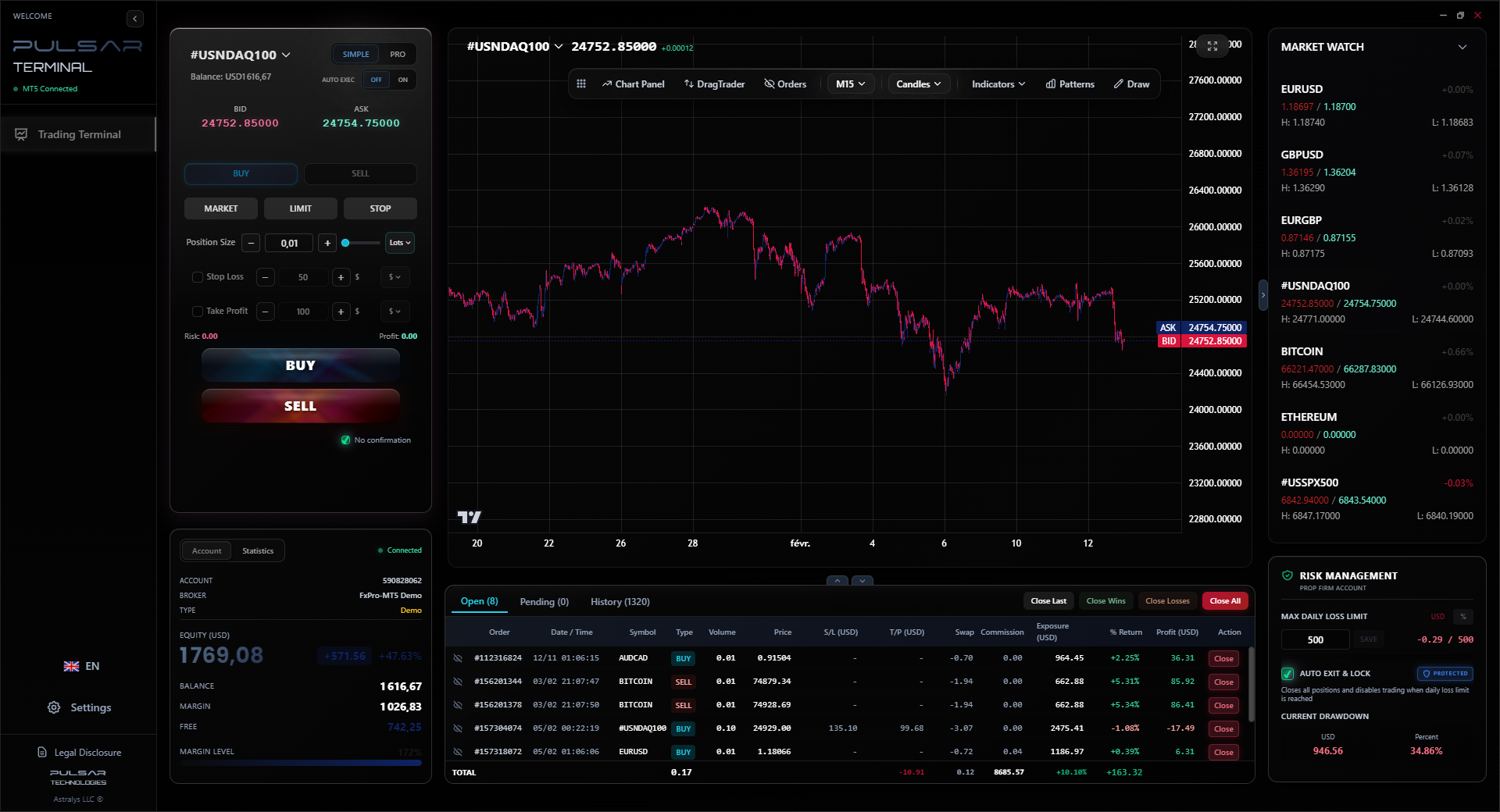
“Passing a prop firm challenge is a test of business discipline, not luck.”
Feeling called out? Good. Here's your action plan to cross the line.
- Define Your Risk Per Trade. Now. Never, ever enter a trade without knowing exactly where you'll get out if you're wrong. This is non-negotiable. Risk 1-2% of your account per trade, max. Use a stop-loss order, not a mental one.
- Write a Trading Plan. One page. What pairs do you trade? What's your setup? What's your entry, stop, and target logic? What time of day? If you can't write it down, you don't have a plan. You have a wish.
- Backtest or Demo Trade for 100 Trades. Don't touch live money until you've executed your plan 100 times in a simulated environment. Record every trade in a journal. This builds statistical confidence, not hope.
- Choose a Broker for Execution, Not Bonuses. Pick a reputable, well-regulated broker known for good execution, like IC Markets or Pepperstone. Ignore the 100% deposit bonus offers. They're candy for gamblers.
- Withdraw Your First Profit. As soon as you make a net profit equivalent to 10% of your starting capital, withdraw it. Make the money real. Celebrate that your system works.
The Nigerian market is growing - turnover hit $8.6 billion in 2025. The opportunity is real. But the opportunity is for traders, not bettors. Which one will you be?
FAQ
Q1If forex trading isn't betting, why do so many Nigerians lose money?
For the same reason most small businesses fail: lack of a solid plan, undercapitalization, and poor risk management. They approach it like a get-rich-quick bet, not a skilled profession. The high use available exacerbates these mistakes, turning small errors into account blowouts.
Q2Does the Nigerian government see my forex profits as gambling income?
No. The Federal Inland Revenue Service (FIRS) treats it as capital gains, subject to a 10% Capital Gains Tax. You are legally required to declare these profits. Gambling winnings are treated differently and are often subject to withholding tax at the point of payout.
Q3I use technical analysis. Isn't that just predicting luck?
No. Technical analysis is the study of historical price patterns and market psychology. It doesn't predict the future; it identifies high-probability scenarios based on past behavior. A gambler guesses. A trader assesses probabilities and manages risk accordingly. It's the difference between a weather guess and a meteorologist's forecast model.
Q4Are forex prop firms legal in Nigeria?
There is no specific law banning them. However, they operate in a grey area, as they are typically international companies. The SEC warns against unregulated investment schemes. It's crucial to research a prop firm's track record, payout history, and terms thoroughly before funding a challenge.
Q5What's the biggest sign I'm betting, not trading?
You're checking your P&L constantly during a trade, and your emotions change with every pip movement. You're married to the outcome of a single trade. A trader places the trade based on their plan and is indifferent to the result of any one position. It's the overall expectancy that matters.
Q6Can I start forex trading in Nigeria with just 20,000 Naira?
Technically, yes. Brokers like FBS or Exness allow very small deposits. But practically, it's a terrible idea. With such a small amount, the temptation to use extreme use to make it 'meaningful' is overwhelming, which guarantees a gambling mindset. Start with an amount you can afford to lose completely, but that's large enough to force you to take risk management seriously - think of it as tuition for your trading education.
ウィンストン教授のレッスン
重要ポイント:
- ✓Legality doesn't define your mindset; your risk management does.
- ✓Risk more than 2% per trade, and you're a speculator, not a trader.
- ✓100 demo trades are worth more than 10 live, emotional ones.
- ✓Withdraw profits monthly to cement the 'business' psychology.
この記事はどれくらい役に立ちましたか?
星をクリックして評価
週刊トレーディングインサイト
無料の週刊分析&戦略。スパムなし。
著者について
Olumide Adeyemi
西アフリカ・トレーディングの先駆者
ナイジェリアで最もアクティブなFXトレーディング教育者の一人。ラゴスから8年のトレード経験。アフリカのトレーダー向けの少額資金戦略とプロップファームチャレンジを専門とする。
コメント
リスク警告
金融商品の取引には大きなリスクが伴い、すべての投資家に適しているわけではありません。過去の実績は将来の結果を保証するものではありません。本コンテンツは教育目的のみであり、投資助言として解釈すべきではありません。取引前に必ずご自身で調査を行ってください。
こちらもおすすめ

Cara Trading Forex Sukses: 7 Prinsip dari Trader Profesional
Cara trading forex sukses dengan 7 prinsip trader pro: manajemen modal, disiplin, journal trading, backtest. Data nyata, bukan janji profit palsu.
Jam Trading Forex Terbaik untuk Trader Indonesia: Panduan Lengkap dengan Tabel Waktu
Panduan jam trading forex untuk trader Indonesia. Tabel 4 sesi dunia, jam emas 20:00-00:00, sesi mana yang harus dihindari. Data akurat + tips dari trader berpengalaman.
Top 5 Sàn Forex Uy Tín Nhất 2026: Review Jujur dari Trader Indonesia
Top 5 sàn forex uy tín 2026 untuk trader Indonesia. Review jujur: spread, deposit, withdraw, dukungan lokal. Exness, XM, IC Markets & lebih.
