


I blew up my first account in 2012.
Miguel Reyes
FXアナリスト ·  Philippines
☕ 10 分で読める
学べること:
- 1The Legal Reality in the Philippines: What the SEC & BSP Actually Say
- 2The Psychology: When Trading Feels Exactly Like Gambling
- 3The Hard Numbers: What the Profit & Loss Stats Really Mean
- 4Building a Skill, Not Relying on Luck
- 5Local Pitfalls for Filipino Traders
- 6Reading Between the Lines: The SEC's Warnings Are Your Guide
- 7The Final Verdict: How to Know Which Side You're On
I blew up my first account in 2012. I had PHP 50,000 saved up, watched a few YouTube videos, and jumped into GBP/USD because it 'looked like it was going up.' No stop loss, no plan, just a feeling. I was down PHP 15,000 in an hour when some UK news hit. My heart was pounding like I was at a casino table. That feeling, that's what makes people ask: is forex trading gambling? For me back then, absolutely. The difference now, after 12 years, is knowing why it felt that way and how to make sure it never feels that way again.
Let's clear the air first. No, trading forex with your own money through a legitimate international broker isn't illegal for you as an individual Filipino. The police won't knock on your door. But the government isn't rolling out the red carpet either. The regulatory stance here is best described as 'permissive but wary.'
The Bangko Sentral ng Pilipinas (BSP) and the Securities and Exchange Commission (SEC) have one main job: protect the financial system and the public. They see unregulated, leveraged speculation as a risk. That's why you won't find a local, SEC-licensed broker offering you 500:1 use on USD/PHP. The local industry is stifled by design.

Warning: The SEC regularly issues advisories against unregistered platforms, especially those using MLM schemes or promising 'guaranteed returns.' If a 'broker' approaches you on Facebook with a Filipino office and those promises, run. That's the gambling side of this world - betting your money with a shady operator.
You'll be using offshore brokers regulated elsewhere (like the UK's FCA or Australia's ASIC). Your protection comes from their rules, not Philippine law. And yes, your profits are taxable as 'Other Income.' Ignoring that is a gamble with BIR.
The most crucial recent update is BSP Circular No. 1212 (April 2025). It clamped down hard on peso derivatives, banning their use for pure speculation. This tells you everything about the official mood: hedging a real business need is fine; betting on peso direction for fun is not. This framework pushes you toward major pairs like EUR/USD or XAU/USD, traded on global platforms.
“The line between trading and gambling isn't defined by the asset; it's defined by your mind and method.”
This is where most traders, including my former self, get lost. The line isn't defined by the asset; it's defined by your mind and method.
Gambling is defined by three things: randomness, chasing losses, and action based on emotion or 'hunches.' Sound familiar? I've seen traders treat the charts like a slot machine, pulling the lever on every minor move. The rush is the same. The outcome, statistically, is also the same: you lose.
The Trader's Mindset vs. The Gambler's Hope
A gambler hopes the next card is an ace. A trader assesses probability based on historical data, market structure, and defined risk. One is passive hope; the other is active analysis. When I took that GBP/USD trade with no stop, I was a gambler. I had no edge, just hope.
The Tells You're Gambling
You might be gambling if:
- You move your stop loss further away because 'it'll come back.'
- You double your lot size after a loss to 'make it back quick.'
- Your 'analysis' is a gut feeling or a tip from a Telegram group.
- You have no written plan for entry, exit, and risk before the trade.
Trading has random outcomes in the short term, yes. But over hundreds of trades, a professional's edge - a slight statistical advantage - plays out. A gambler has no edge, only luck. Your job is to build and maintain an edge. Tools like the RSI indicator or MACD indicator are part of that, but only if used systematically, not magically.

Pro Tip: Keep a trade journal. Not just entries and exits, but your emotional state. If you write 'felt nervous, FOMO'd into the trade,' you've caught yourself gambling. Review it weekly. It's the most effective mirror you'll ever have.

💡 ウィンストンのヒント
If you can't articulate the reason for your trade in one clear sentence before you click 'buy,' you're not trading. You're guessing. Close the platform.
“Your losses aren't vanishing into a casino's coffers. They're being transferred to better-prepared traders and your own self-sabotage.”
Let's talk about the scary statistic you've seen: 70-90% of retail traders lose money. People use this to scream 'GAMBLING!' But they miss the point. This number doesn't measure the market; it measures unprepared participants.
Think of it like this: if 90% of people who pick up a guitar quit within a year, does that make music a scam? No. It makes it a skill most people don't commit to mastering. The forex market is a zero-sum game. For every PHP you win, someone loses it. The 'someone' is often the underprepared retail trader.
Where the Money Actually Goes
Your losses aren't vanishing into a casino's coffers. They're being transferred to:
- Other better-prepared traders (often institutional).
- The broker, via the spread and commission. This is the house's cut, and it's why choosing a broker with tight spreads like Pepperstone or IC Markets matters. Even a 0.5 pip difference adds up brutally over time.
- Yourself, through self-sabotage (overtrading, no stop loss).
A realistic profit target for a consistent retail trader is 1.5% to 6% per month on their capital. That's it. Not 50%. On a $10,000 account, that's $150 to $600 a month. The gambler's brain rejects this. It wants the 100% return now. That desire is what feeds the loss statistics.

Example: Let's say you trade a standard lot of EUR/USD (100,000 units). A 1-pip spread on a broker like XM might cost you $10 just to enter and exit. If you're scalping for 5-pip profits, that spread is eating 20% of your potential gain before you even start. This isn't gambling; it's a cost of business you must calculate. Use a position size calculator to see how fees destroy small accounts.
“Your losses aren't vanishing into a casino's coffers. They're being transferred to better-prepared traders and your own self-sabotage.”
Gambling is a game of chance. Trading, done right, is a craft. You wouldn't call a carpenter a gambler because sometimes wood splits. He learns grain, uses sharp tools, and measures twice. Your charts and risk management are your tools.
The Foundation: Risk Management
This is your non-negotiable. It's the difference between a calculated venture and a bet. You must decide, before every single trade, how much you are willing to lose. I risk no more than 1% of my account on any trade. Ever. This means a string of 20 losses won't destroy me. A gambler risks it all on one 'sure thing.'
Your first skill is using a stop loss correctly. Not as a suggestion, but as a law. Your second is position sizing. Trading 5 lots on a $500 account isn't trading; it's a lottery ticket with a near-certain margin call.
The Edge: Strategy & Analysis
You need a repeatable process. This could be price action on key levels, a swing trading strategy based on moving averages, or a scalping strategy using order flow. The key is it's documented, tested, and followed dispassionately.
I learned this the hard way. In 2018, I had a great month swing trading AUD/USD, making about 8%. Got cocky. The next month, I abandoned my rules, chased news events, and gave back 12%. That wasn't the market's fault. It was me switching from a trader to a gambler mid-game. Discipline is the skill that contains all other skills.
💡 ウィンストンのヒント
The market doesn't owe you a win because you're down. Your last loss and your next trade are completely unrelated. Chasing losses is the gambler's signature move.
“Discipline is the skill that contains all other trading skills.”
Our environment creates unique traps that can push you toward gambling behavior.
The 'Suki' Mentality & Social Pressure: We're community-oriented. Trading can become social, with groups sharing 'puhunan' (capital) or tips. This turns analysis into gossip and pressure to follow the crowd. I've seen groups pile into a USD/PHP trade because one 'guru' said so, with no individual risk planning. That's a group bet, not a portfolio of individual trades.
Access to High use: Offshore brokers offer use like 500:1 or 1000:1. To a new trader with PHP 20,000, that looks like a shortcut. It's a trap. It amplifies not just gains, but the gambling feeling. The swings are so huge they trigger pure emotion. Start with 10:1 or 20:1 max. Treat use like chili - a little enhances the meal, a lot destroys it.
Payment Ease with GCash: The growing integration of GCash for deposits is a double-edged sword. It makes funding instant, which also makes re-funding a blown account instant. The friction of a bank transfer used to be a cooling-off period. Now, the temptation to 'reload' like a casino chip is stronger.
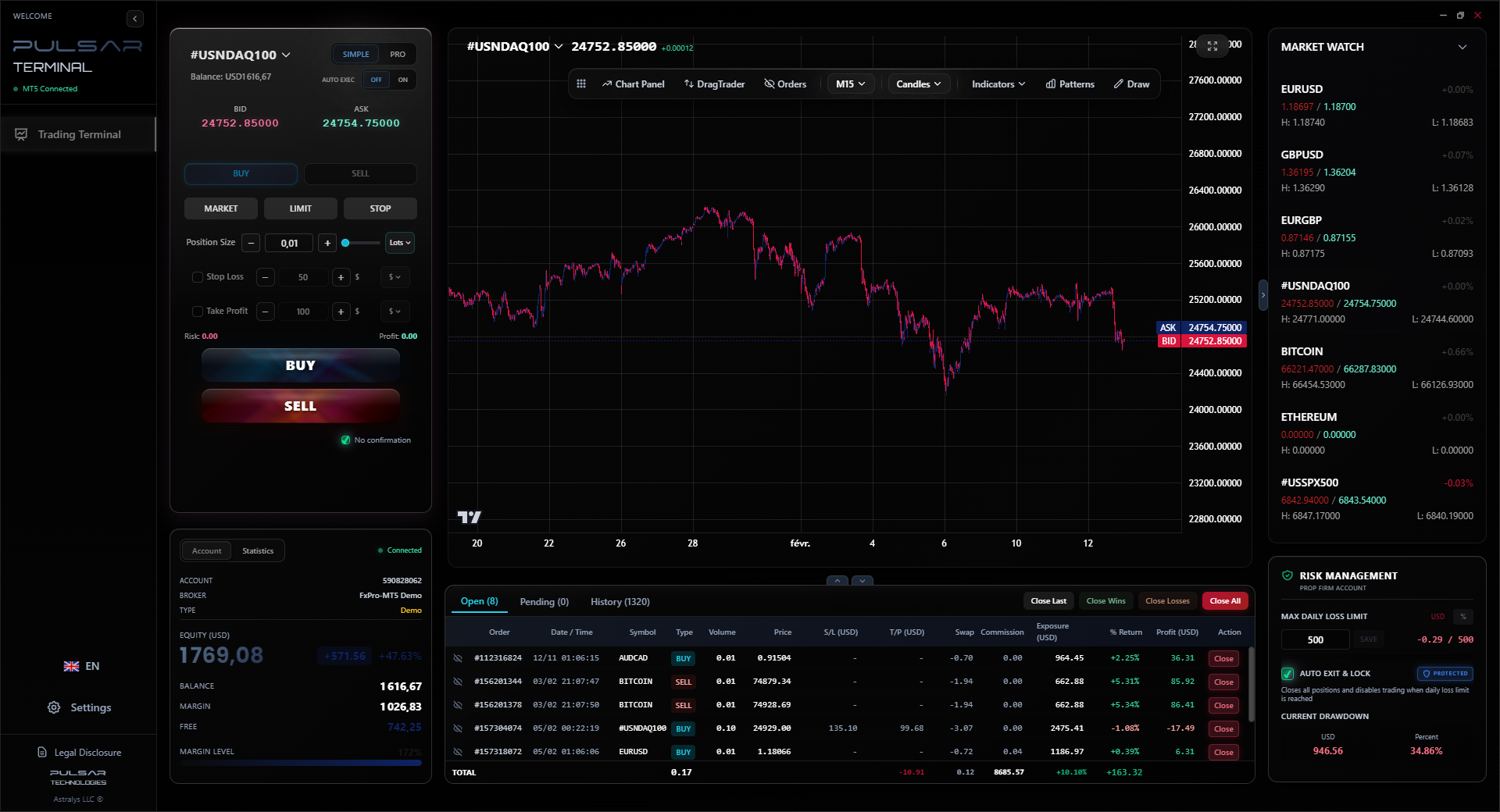
The Prop Firm Hustle: Many turn to prop firms to trade with 'house money.' But their challenges have strict daily loss limits. The pressure to hit a target without breaching that limit can force frantic, gambly trades. You need iron-clad rules to pass these, something a tool that automates daily loss protection can help with, but the discipline must come from you first.
Managing the emotional pressure of prop firm challenges requires automating your rules, which is where a tool that enforces daily loss limits and trailing stops becomes essential.
Pulsar Terminal
MT5オールインワンツール:ドラッグ&ドロップ注文、マルチTP/SL、トレーリングストップ、グリッドトレード、出来高プロファイル、プロップファーム保護。毎日1,000人以上のトレーダーが利用。
“Discipline is the skill that contains all other trading skills.”
Don't view the SEC's frequent advisories as them trying to stop you. View them as a cheat sheet for what to avoid. They're literally listing the gambling hallmarks.
They warn about:
- 'Guaranteed' high returns: In trading, nothing is guaranteed. Anyone promising this is running a Ponzi scheme, not a market.
- Unlicensed entities: The equivalent of an unlicensed casino. Your funds have no protection.
- MLM recruitment: If making money relies more on recruiting others than trading, it's a pyramid scheme.
By steering you away from these obvious scams, the SEC is indirectly guiding you toward what legitimate trading requires: personal responsibility, education, and risk capital you can afford to lose. Their stance forces you to go international, which often means better-regulated brokers like Exness or Interactive Brokers, albeit with the complexity of foreign regulation.
The BSP's ban on speculative peso derivatives is another clue. It tells you the authorities see unhedged, leveraged betting on the peso as systemically dangerous. As a retail trader, your takeaway should be to focus on the deep, liquid major pairs where you're a drop in the ocean, not a target in a regulated local market.
💡 ウィンストンのヒント
Your first profit target should always be your risk. Moving your stop to breakeven at 1:1 risk/reward turns a gamble into a risk-free business decision. Do it every time.
“When you can look at a -1% day and say 'the system worked,' you're a trader. When it makes your stomach drop, you're still gambling.”
So, is forex trading gambling? The market itself isn't. But your approach to it can be, 100%.
Here’s a quick test. Answer yes or no:
- Do you know the exact peso amount you will lose if your next trade hits its stop loss?
- Is that amount a small fraction (≤2%) of your total trading capital?
- Do you have a written rule for why you will enter a trade, beyond 'it's going up'?
- Can you walk away for a week after a loss without feeling the urge to 'get back in' immediately?
- Do you review your losing trades as intently as your winners?
If you answered 'no' to any, you have gambling tendencies to fix. Most of us start with several 'nos.' I did.
The core difference is control. In gambling, you control only your bet size. In trading, you control your risk, your entry, your exit, your psychology, and your exposure. You surrender control only over the market's final movement - and you plan for all its possible movements beforehand.
Your goal isn't to be right on every trade. Your goal is to be so disciplined in your process that a losing trade is just a cost of business, not a emotional catastrophe. When you can look at a -1% day and say 'the system worked, that was within parameters,' you're a trader. When you look at the same loss and feel your stomach drop, needing to trade again right now, you're still gambling. I've been in both seats. I know which one lets you sleep at night.
FAQ
Q1Is forex trading illegal in the Philippines?
No, it's not illegal for an individual Filipino to trade forex with their own money through a legitimate international broker. However, the Philippine SEC does not license local brokers to offer leveraged retail forex trading, so you'll be using offshore-regulated platforms. The SEC's warnings target unlicensed entities and scams, not individual traders.
Q2Why do so many people say forex is gambling?
Because most people who try it approach it like gambling. They trade with emotion, no plan, and no risk management, which leads to predictable losses. The high use available can create casino-like swings in account balance, reinforcing that feeling. The activity itself isn't gambling, but an undisciplined approach to it certainly is.
Q3What percentage of forex traders actually make money?
Studies and broker data suggest between 11% and 49% of retail accounts are profitable over time, meaning a majority lose. The critical point isn't the percentage, but why. The profitable minority typically has a tested strategy, strict risk management (often risking 1-2% per trade), and the emotional discipline to follow their plan.
Q4Do I need to pay tax on forex profits in the Philippines?
Yes. The BIR considers trading profits as 'Other Income' subject to the graduated income tax rates (0%-35%). You are responsible for declaring this in your annual income tax return. Not declaring it is tax evasion.
Q5Can I use GCash for forex trading?
Yes, many international brokers now integrate GCash as a deposit and withdrawal method for Filipino clients. It's fast and convenient, but be mindful - this ease can also make it too easy to deposit more funds impulsively after losses, a common gambling behavior.
Q6What's the biggest difference between a trader and a gambler?
A trader has a pre-defined risk for every single trade and accepts that loss as a cost of doing business. A gambler risks money hoping for a win, with no controlled loss parameter. The trader focuses on process; the gambler focuses on outcome.
Q7Is high use the reason people lose money?
It's the amplifier, not the cause. High use (like 500:1) turns small market moves into huge account swings. This triggers fear and greed, causing traders to abandon their plans. The cause is poor risk management. use just makes the consequences of bad management catastrophic much faster.
ウィンストン教授のレッスン
重要ポイント:
- ✓Risk a maximum of 2% of capital per trade.
- ✓Define entry, stop, and target BEFORE clicking.
- ✓use amplifies emotion; start below 20:1.
- ✓Profits are taxable 'Other Income' in PH.
- ✓Use regulated brokers, not social media tips.
この記事はどれくらい役に立ちましたか?
星をクリックして評価
週刊トレーディングインサイト
無料の週刊分析&戦略。スパムなし。
著者について
Miguel Reyes
FXアナリスト
2020年からマニラで副業としてFXを始め、現在は専業。アジアセッションでのUSD/PHPと主要通貨ペアに注力。無料のYouTube講座とデモ口座でトレーディングを学んだ元BPOワーカー。
コメント
リスク警告
金融商品の取引には大きなリスクが伴い、すべての投資家に適しているわけではありません。過去の実績は将来の結果を保証するものではありません。本コンテンツは教育目的のみであり、投資助言として解釈すべきではありません。取引前に必ずご自身で調査を行ってください。
こちらもおすすめ

Cara Trading Forex Sukses: 7 Prinsip dari Trader Profesional
Cara trading forex sukses dengan 7 prinsip trader pro: manajemen modal, disiplin, journal trading, backtest. Data nyata, bukan janji profit palsu.
Jam Trading Forex Terbaik untuk Trader Indonesia: Panduan Lengkap dengan Tabel Waktu
Panduan jam trading forex untuk trader Indonesia. Tabel 4 sesi dunia, jam emas 20:00-00:00, sesi mana yang harus dihindari. Data akurat + tips dari trader berpengalaman.
Top 5 Sàn Forex Uy Tín Nhất 2026: Review Jujur dari Trader Indonesia
Top 5 sàn forex uy tín 2026 untuk trader Indonesia. Review jujur: spread, deposit, withdraw, dukungan lokal. Exness, XM, IC Markets & lebih.
