


Let's cut through the noise.

David van der Merwe
新興市場トレーダー ·  South Africa
☕ 12 分で読める
学べること:
- 1Why Trading in SA Isn't Like Trading Anywhere Else
- 2The FSCA Rulebook: Your Legal Safety Net
- 3The Real Costs: It's More Than Just the Spread
- 4Picking a Broker That Won't Screw You Over
- 5Your First Strategy: Keep It Stupid Simple (KISS)
- 6Risk Management: The Only Reason You Won't Be in the 72%
- 7Funding Your Trading Journey: Start Small, Think Big
- 8Your First 100 Hours: A Survival Checklist
Let's cut through the noise. Most of what you see online about learning to trade forex in South Africa is either a scam or dangerously oversimplified. The truth is, the market is designed for you to lose, especially if you're new. I've seen it wipe out accounts in Joburg, Cape Town, and Durban. But that doesn't mean you can't succeed. It means you need the right map for this specific terrain - the FSCA rules, the ZAR pairs, the local broker traps. This guide won't promise you a Lambo. It will show you how to survive long enough to have a real shot.
You can't just follow a generic YouTube strategy and expect it to work here. Our market has unique quirks that will eat a careless trader alive. The first is liquidity. When London and New York are closed, trading the ZAR pairs (like USD/ZAR or EUR/ZAR) can feel like walking through molasses. Spreads widen, and a single large bank order can cause a spike that triggers your stop-loss before reversing. I learned this the hard way in 2018 on a USD/ZAR trade. I entered at 14.25, set a tight stop at 14.20 because I was overconfident. A random, thin-market sell order spiked it to 14.19 for about 30 seconds, took me out, and it then rallied to 14.40. Poof. R2,000 gone on a move that wasn't 'real'.
Then there's the regulatory landscape. The FSCA is our watchdog, and they've been tightening the screws. The big one is the use cap. For retail traders, it's 30:1. That's a lot lower than the 500:1 or 1000:1 you'll see advertised by offshore brokers. Some guys think, 'Great, I'll just sign up with that broker in Cyprus for more use!' Sure, you can. But if that broker decides to freeze your withdrawals or manipulate prices, the FSCA can't lift a finger to help you. Your money is gone. Trading with an FSCA-licensed broker might feel restrictive, but it's your first line of defence.
Finally, our economic data releases (like CPI, interest rate decisions, and budget speeches) cause massive volatility in ZAR pairs. You need to know the SA economic calendar as well as you know the US one. Trading USD/ZAR during a SARB announcement without a plan is financial suicide.
Ignoring the FSCA's rules is like driving without a license. You might get away with it for a while, but when you crash, you have zero protection. Let's break down what matters to you as a trader.
The use Cap (30:1)
This is the big one. It means for every R1,000 in your account, you can control a position worth R30,000. A lot of new traders hate this rule. They want the 400:1 use to 'make money faster.' Trust me, this rule saves more accounts than it hinders. Higher use just magnifies losses faster. If you're struggling to make profits with 30:1, you'd have been bankrupt with 400:1. It forces you to learn proper position size calculator discipline from the start.
Client Money Protection
This is non-negotiable. A proper FSCA-licensed broker must keep your money in a separate, segregated bank account. This means if the broker goes bankrupt (it happens), your funds are ring-fenced and should be returned to you. It's not the broker's money to play with. Always verify the broker's FSP number on the FSCA's website. Don't just take their word for it.
What the FSCA Doesn't Do
They don't guarantee your profits. They don't bail you out if you have a bad trade. And crucially, their jurisdiction has limits. If you use an international broker that isn't licensed here, you're on your own. I've had friends get into disputes with offshore brokers over spread definition manipulation during news events. It was a nightmare with no local recourse. Your best bet is a broker with a solid local presence and an FSCA license, like those reviewed in our Exness review or IC Markets review.

💡 ウィンストンのヒント
The market's primary goal isn't to make you money; it's to find the price where the maximum number of traders are wrong. Your job is to not be in that crowd.
“If you're struggling to make profits with 30:1 use, you'd have been bankrupt with 400:1.”
Brokers love to advertise 'tight spreads!' but that's just one piece of the puzzle. If you don't understand all the costs, they'll silently drain your account.
Here’s a breakdown of what you're really paying:
| Cost Type | What It Is | Typical Example (ZAR Account) |
|---|---|---|
| Spread | Difference between buy/sell price | 1.5 pips on EUR/USD, 45 pips on USD/ZAR |
| Commission | Fee per lot traded | $7 per standard lot (≈ R130) |
| Overnight Financing (Swap) | Cost to hold a position past 5pm NY time | Can be +/- R50 per lot per night |
| Currency Conversion | Cost to fund a USD account with ZAR | 1-2% on deposit/withdrawal |
| Inactivity Fee | Penalty for not trading | $10 (≈ R185) per month after 12 months |

Example: Let's say you trade 2 standard lots of EUR/USD. The spread cost is 2 lots * 1.5 pips * $10 (per pip value) = $30. Add a $14 commission. That's $44 (≈ R814) in costs before the trade even moves. You need the market to move over 4.4 pips in your favor just to break even.
The ZAR pairs are a special kind of expensive. USD/ZAR can have a spread of 40-60 pips during active hours. That means the price needs to move 60 pips before you're in profit. This makes scalping strategy on these pairs almost impossible for most. It's better suited for longer-term swing trading where the spread becomes a smaller percentage of your target profit.

Warning: The 'zero spread' accounts are a trap for beginners. They lure you in with no spread but hit you with a hefty commission. Your total trading cost is often the same or higher. Always calculate the total cost (spread + commission) per lot.
Your broker is your gateway to the market. A bad one will make winning impossible. Here’s my blunt assessment of the landscape.
FSCA-Licensed is the Baseline. This is your minimum requirement. It ensures basic standards. Some reputable international brokers with local FSCA licenses include Pepperstone and IC Markets. You can check our detailed Pepperstone review for specifics on their conditions.
Look Beyond the Minimum Deposit. Yes, brokers like XM let you start with $5 (read our XM review). That's great for testing. But ask yourself: what are the withdrawal fees? How long do withdrawals take to a South African bank account? I once waited 9 business days for a payout from an obscure broker. Local brokers like Khwezi Trade might process withdrawals in 24 hours.
Platform & Execution Matter. You want MetaTrader 4 or 5 (MT5). It's the industry standard. More importantly, you need stable, fast execution. Requotes (when your order price changes before it's filled) and slippage (getting a worse price than you asked for) are profit killers. Test the broker with small trades first. If you get frequent requotes during the SA market open (8-9 am), find another broker.
The Funding Hassle. Funding in ZAR to a USD account often involves a hidden fee. Some local brokers now offer ZAR-denominated accounts. This eliminates conversion fees but check if their spreads on international pairs (like EUR/USD guide) are still competitive. It's a trade-off.
“You can have a mediocre strategy and good risk management and survive. You can have a brilliant strategy and poor risk management and you will fail.”
Forget the fancy indicators with 15 lines on your chart. When you learn to trade forex South Africa, you need a foundation. Here's a simple, price-action based strategy that works on the 4-hour chart. It's boring. It's slow. It saves accounts.
The Concept: Support & Resistance with a Trend Filter.
- Identify the Trend: Use a simple 50-period and 200-period Exponential Moving Average (EMA). If the price is above both, look for buys only. If it's below both, look for sells only. If it's between, the market is ranging - stay out.
- Find Key Levels: Draw horizontal lines at recent swing highs and swing lows. These are your support and resistance zones.
- Wait for the Bounce: In an uptrend, wait for the price to pull back to a support zone. Look for the price action to show signs of rejecting that level (a bullish pin bar, a strong engulfing candle).
- Enter and Manage Risk: Enter on a break of the high of that rejection candle. Place your stop-loss just below the support zone. Your take-profit should be at least 1.5 times your risk (Risk/Reward of 1:1.5). Use a position size calculator so you never risk more than 1% of your account.

Pro Tip: Practice this strategy first on XAU/USD guide (Gold). It often respects technical levels beautifully and has clear trends. It's a great teacher.
Why this works for beginners: It forces patience. You might only get 2-3 signals a week. It keeps you out of the noisy, choppy markets. I used a version of this for my first profitable year, turning R15,000 into about R22,000 over 8 months. Not glamorous, but it was growth, not loss.
What about indicators? Use them sparingly. The RSI indicator can help identify overbought/oversold conditions within a trend. The MACD indicator can help confirm trend momentum. But the price and its levels are king.
💡 ウィンストンのヒント
If you can't write down your exact entry, stop, and target before you click 'buy,' you're not trading. You're gambling. A plan reduces fear.
Remember that stat? 72% of new SA forex accounts blow up within six months. The single, universal cause is poor risk management. You can have a mediocre strategy and good risk management and survive. You can have a brilliant strategy and poor risk management and you will fail. Every. Single. Time.
The 1% Rule. This is your bible. Never, ever risk more than 1% of your total account balance on a single trade. If you have a R10,000 account, your maximum loss per trade is R100. This protects you from a string of losses destroying your capital. How do you enforce this? You calculate your position size for every trade. Don't guess.
Stop-Losses Are Not Optional. Your stop-loss is your life jacket. Placing it is a strategic decision. Don't place it based on how much you're willing to lose. Place it based on where the market structure tells you your trade idea is wrong. If that distance is too large for a 1% risk, the trade is invalid. Walk away.
The Psychology of Letting Losses Run. This is the killer instinct. You're in a losing trade. 'Maybe it will come back,' you think. You move your stop-loss further away. This is how a R100 loss becomes a R500 loss, which becomes a margin call. You must be robotic. The stop is placed. If it's hit, you're out. No debate. The market doesn't care about your hope.
Embrace the Winning Loser. You will have more losing trades than winning trades. Most successful traders have a win rate of 40-55%. The key is making your average winner bigger than your average loser. That's your Risk/Reward Ratio. Aim for at least 1:1.5. If you risk R100 to make R150, you only need to be right 40% of the time to be profitable.
“Your stop-loss is your life jacket. Placing it is a strategic decision, not an emotional one.”
How much money do you actually need to start? The marketing says $5. The reality is different.
The Minimum Viable Account. You can technically start with R500-R2,000. But with a R2,000 account and the 1% rule, you're risking R20 per trade. After broker costs (spreads/commissions), you're fighting an uphill battle. The psychological pressure is also immense. Every pip definition move feels life-or-death, which leads to bad decisions.
My honest advice: Start with an amount you can afford to lose completely - money that, if it vanished, wouldn't affect your rent, your car payment, or your kids' school fees. For most new traders, that's between R5,000 and R10,000. This gives you room to breathe, to make mistakes, and to apply the 1% rule meaningfully (R50-R100 risk per trade).
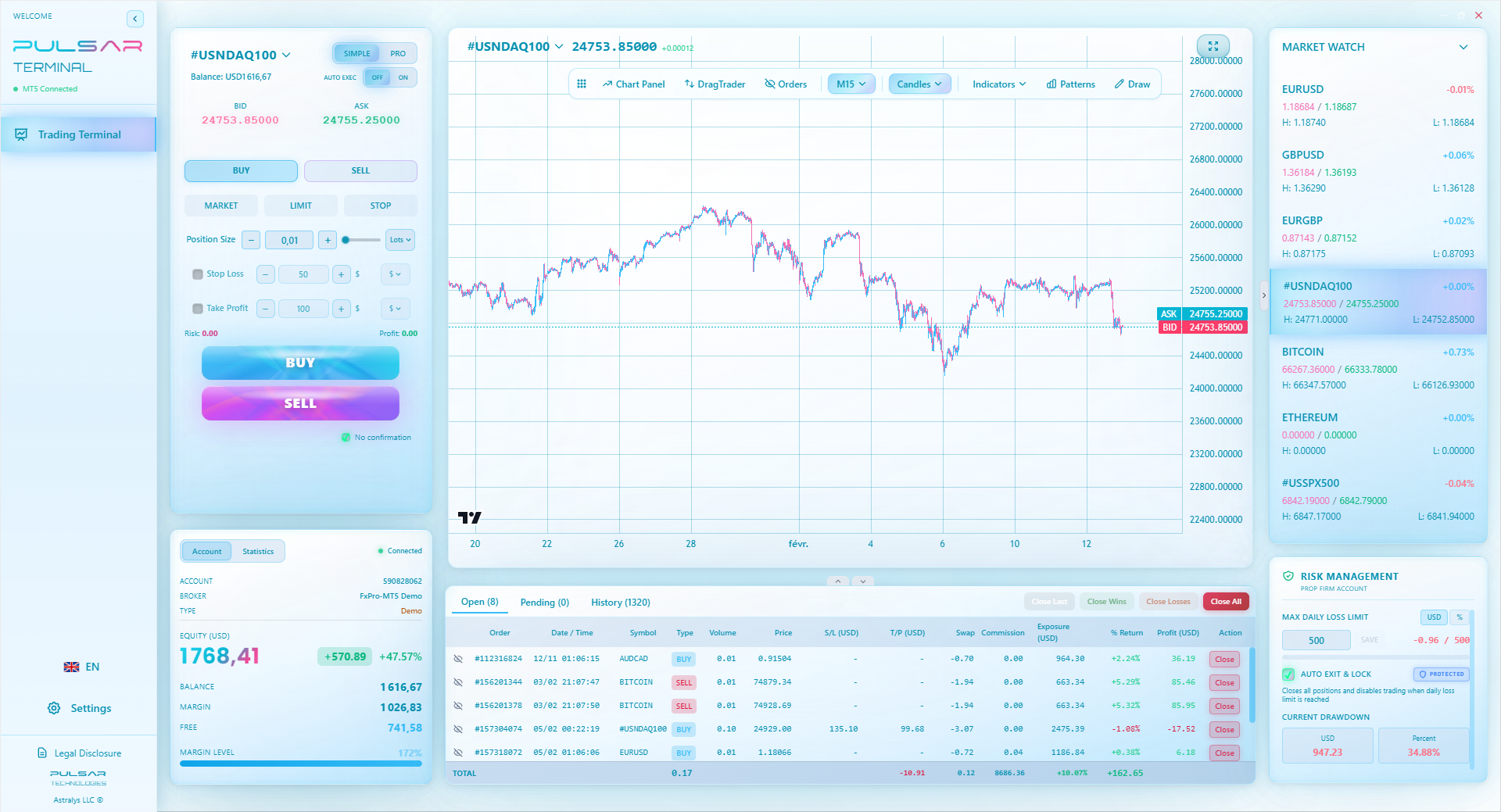
The Prop Firm Shortcut (and its Dangers). Prop firms like FTMO or The5%ers are popular. You pass a challenge trading their simulated capital, and they give you a funded account. It's tempting: you trade $100,000 of 'their' money. But the challenges are designed to be difficult. They have strict drawdown limits (like 5-10%) that force hyper-aggressive risk management. It's a fantastic learning tool for discipline, but don't mortgage your house to buy challenges. Use a small portion of your own capital to try it. The skills you learn - like protecting a daily loss limit - are useful, and tools that automate this protection can be a huge edge.
Managing the strict daily loss limits of a prop firm challenge requires robotic discipline, which is exactly what a tool like Pulsar Terminal automates directly within your MT5 platform.
Pulsar Terminal
MT5オールインワンツール:ドラッグ&ドロップ注文、マルチTP/SL、トレーリングストップ、グリッドトレード、出来高プロファイル、プロップファーム保護。毎日1,000人以上のトレーダーが利用。
Your first few months are about learning, not earning. Here’s a step-by-step plan.
- Open a Demo Account: Do this with your chosen FSCA broker. Don't just click buttons. Treat it like real money. Start with a virtual R10,000. Practice the KISS strategy from Section 5. Your goal is not to double the account. Your goal is to have three consecutive months where you don't lose the virtual capital. This builds discipline.
- Journal Relentlessly: For every trade, note: Date/Pair, Entry/Exit, Reason for entry (e.g., 'Bounce off 50 EMA support'), Risk (Rands), Outcome, and most importantly, Emotional State. You'll start to see patterns. 'I was bored' or 'I was chasing losses' are common losing reasons.
- Go Live, Tiny: After 30-60 consistent demo days, fund a live account with your starter capital (e.g., R5,000). Trade micro lots (0.01). Your only mission for the first month is to end with more money than you started, however small. The psychological shift from demo to live is massive.
- Analyze, Don't Obsess: Check the markets 2-3 times a day max. Don't sit glued to the screen. The 4-hour chart moves slowly. Set alerts for your key levels and walk away. Overtrading is the disease of the beginner.
- Find a Community (Carefully): Avoid 'signal groups' that promise guaranteed wins. Instead, look for communities focused on education and review. Be skeptical of anyone selling a 'secret system.' The real secret is consistent work.
This path is slow. It's frustrating. But it's the only one that leads to sustainable trading. I've taken the fast, reckless path too. It ends at zero. The choice is yours.
💡 ウィンストンのヒント
Your first R10,000 profit is less important than your first R10,000 loss. How you handle the loss defines what kind of trader you'll become.
FAQ
Q1Is forex trading legal and taxable in South Africa?
Yes, it's completely legal through FSCA-regulated brokers. And yes, it's taxable. Any profit from trading is considered income by SARS and must be declared. Keep careful records of all your trades, deposits, and withdrawals. Losses can sometimes be offset against other income, but you should consult a tax professional who understands trading.
Q2What is the best time to trade forex in South Africa?
The most liquid and active overlaps are: SA Open (8am-10am) with the end of the US session and the start of Europe. Then the European session (10am-5pm SA time) is excellent for pairs like EUR/USD. The London/New York overlap (3pm-5pm SA time) is the most volatile. Avoid trading major ZAR pairs around local political or budget announcements unless you're specifically trading the news.
Q3Can I start trading forex with R500?
Technically, yes, some brokers allow it. But practically, it's almost pointless. With R500, risking 1% means you can only lose R5 per trade. Broker costs will consume a huge percentage of that. The pressure will force you to break your rules. View R500 as a fee to learn a broker's platform, not as serious trading capital. A realistic minimum is R5,000.
Q4What's the difference between CFDs and actual forex trading?
In South Africa, when you 'trade forex' with a retail broker, you're almost always trading CFDs (Contracts for Difference). You don't own the actual currency. You have a contract with the broker to exchange the difference in price from when you open and close the trade. The practical outcome is the same, but it's important to know you're trading a derivative product.
Q5How do I know if a broker is really FSCA regulated?
Don't trust the logo on their website. Go directly to the FSCA's official website (www.fsca.co.za) and use their 'Search for an authorised Financial Services Provider (FSP)' tool. Enter the broker's name or FSP number. If they're not on that list, they are not regulated by the FSCA for business in South Africa.
Q6Why do I keep hitting my stop-loss before the price reverses in my favor?
Welcome to the world of 'stop-hunting' or market liquidity runs. In thin markets (like ZAR pairs off-peak or around news), large players can push price to obvious stop-loss levels to trigger a flood of orders before moving the other way. The solution? 1) Avoid placing stops at round numbers or obvious recent highs/lows. Place them just beyond key structural levels. 2) Trade during higher liquidity sessions. 3) Accept that this happens and ensure your position size is small enough that one stopped-out trade doesn't matter.
ウィンストン教授のレッスン
重要ポイント:
- ✓FSCA's 30:1 use cap is a protective gift, not a limit.
- ✓Realistic starting capital is R5,000+, not R500.
- ✓Risk a maximum of 1% of your account per trade.
- ✓Aim for a Risk/Reward ratio of at least 1:1.5.
- ✓72% fail in 6 months; your risk plan beats the odds.
この記事はどれくらい役に立ちましたか?
星をクリックして評価
週刊トレーディングインサイト
無料の週刊分析&戦略。スパムなし。
著者について
David van der Merwe
新興市場トレーダー
ヨハネスブルグ拠点で新興市場通貨11年のトレーダー。ZARペア、FSCA規制下の取引、南アフリカ市場分析を専門とする。
コメント
リスク警告
金融商品の取引には大きなリスクが伴い、すべての投資家に適しているわけではありません。過去の実績は将来の結果を保証するものではありません。本コンテンツは教育目的のみであり、投資助言として解釈すべきではありません。取引前に必ずご自身で調査を行ってください。
こちらもおすすめ

Cara Trading Forex Sukses: 7 Prinsip dari Trader Profesional
Cara trading forex sukses dengan 7 prinsip trader pro: manajemen modal, disiplin, journal trading, backtest. Data nyata, bukan janji profit palsu.
Jam Trading Forex Terbaik untuk Trader Indonesia: Panduan Lengkap dengan Tabel Waktu
Panduan jam trading forex untuk trader Indonesia. Tabel 4 sesi dunia, jam emas 20:00-00:00, sesi mana yang harus dihindari. Data akurat + tips dari trader berpengalaman.
Top 5 Sàn Forex Uy Tín Nhất 2026: Review Jujur dari Trader Indonesia
Top 5 sàn forex uy tín 2026 untuk trader Indonesia. Review jujur: spread, deposit, withdraw, dukungan lokal. Exness, XM, IC Markets & lebih.
