


Here's a hard truth to start with: over 70% of retail traders lose money.

David van der Merwe
新興市場トレーダー ·  South Africa
☕ 9 分で読める
学べること:
- 1What Makes an App 'Legit'? It's Not About the Features
- 2The Real Deal: FSCA Brokers and Their Apps
- 3The Real Cost of Trading: It's More Than the Spread
- 4Spotting the Fakes: Red Flags That Scream 'Scam'
- 5How to Choose: It's About Your Style
- 6Your First Steps: Opening an Account the Right Way
- 7Leveling Up: When You Need More Than the Basic App
Here's a hard truth to start with: over 70% of retail traders lose money. In South Africa, that number might be even higher, not because the market is rigged, but because most people start with the wrong tool - a dodgy, unregulated app promising easy riches. A legit forex trading app isn't just about fancy charts; it's your connection to a broker that follows the rules, keeps your money safe, and gives you a fair shot. Let's cut through the noise and find you a real platform you can trust.
When you're searching for a legit forex trading app, you're not really looking for an app. You're looking for a legitimate, regulated broker whose mobile platform you happen to be using. The app is just the window. The foundation is the broker's license.
In South Africa, that means one thing: the Financial Sector Conduct Authority (FSCA). If the broker behind the app isn't on the FSCA's public register, walk away. It's that simple. Regulation means they have to keep your deposits in a segregated account (so they can't use your rent money for their office party), they have to be transparent about costs, and they have to adhere to certain standards of conduct.
I learned this the hard way early on. I was drawn in by an app with incredible-looking tools and "zero spread" promises. The broker was registered offshore. When I tried to withdraw R8,000 in profits, the process took weeks, involved endless "verification" loops, and they eventually deducted "banking fees" that wiped out 30% of my gain. That was my tuition fee for understanding that the slickest app means nothing without a solid foundation.

Warning: An FSCA license doesn't guarantee you'll be profitable. It just means you're playing in a supervised arena, not a back alley. The 30:1 use cap for retail traders is a rule for a reason - it's to stop you from blowing up your account in two seconds flat.

💡 ウィンストンのヒント
A trader once asked me how to get rich quick. I told him to deposit his money, then delete the app for a year. He didn't listen. The market collected its tuition fee in three weeks.
Let's get specific. Here are a few brokers with solid FSCA regulation and the trading apps they offer. Remember, the minimum deposit is just to open the account. For sensible trading with a proper position size calculator, you'll want more.
| Broker | FSCA License No. | Min. Deposit (ZAR) | Typical EUR/USD Spread | Key App Platform |
|---|---|---|---|---|
| Exness | 51024 | From ~R90 ($5) | From 0.0 pips* | MT4, MT5, Proprietary App |
| IC Markets | 39476 | R1,850 ($100) | From 0.0 pips* | MT4, MT5, cTrader |
| XM | 44632 | R185 ($10) | From 0.6 pips | MT4, MT5, Proprietary App |
| Pepperstone | 414034 | R1,850 ($100) | From 0.0 pips* | MT4, MT5, cTrader, Proprietary App |
*Zero-pip accounts usually charge a small commission per lot traded.
My Go-To Setup
Personally, I split my trading between IC Markets and Pepperstone. Why? Their raw spreads are consistently tight, which is crucial for my scalping strategy. I use the MetaTrader 5 (MT5) app on my phone for monitoring and quick adjustments, but all my serious analysis and order placement happens on the desktop version. The mobile app is for management, not for making snap decisions based on a tiny screen.

Pro Tip: Don't get hung up on proprietary broker apps. MetaTrader 4/5 (MT4/MT5) or cTrader are industry standards for a reason. They're stable, have thousands of indicators, and your skills transfer if you ever switch brokers. A broker's own "super app" often locks you into their environment.
“A legit forex trading app isn't just about fancy charts; it's your connection to a broker that follows the rules.”
That "legit forex trading app" might be free to download, but trading isn't free. You need to understand where your money goes.
- The Spread: This is the main cost. A 0.6 pip spread on EUR/USD means you're down R6 on a R1,000 trade (1 pip = R10 on a standard lot) the moment you enter. On a zero-spread account, you pay a commission instead (e.g., $3.50 per 100k traded). Do the math for your typical trade size.
- Overnight Financing (Swap): If you hold a position past 10 PM SAST, you'll pay or earn a small interest fee. Going long on a high-interest currency (like the ZAR historically) against a low-one (like the JPY) could earn you a tiny credit. The reverse costs you. It adds up over time for swing trading.
- Inactivity Fees: Some brokers charge you if you don't trade for 3-6 months. Read the fee schedule.
- Deposit/Withdrawal Fees: This is a big one for us. Funding in ZAR via EFT is often free, but some brokers add a markup to the exchange rate. Withdrawing back to your South African bank account can sometimes incur a small international transfer fee.
Here's a real example from last month: I took a swing trade on XAU/USD (gold). Entry at $2,318, stop loss at $2,298. The spread was 0.25, costing me $2.50 on my mini-lot position. I held for 8 days, paying a total of $4.80 in overnight fees. I exited at $2,345. My gross profit was $270. After spreads and swaps, my net was R263.20. Not accounting for those costs would have given me a false sense of performance.
The unregulated space is a minefield. Here’s what a scam "legit forex trading app" often looks like:
- Guaranteed Profits or 'Risk-Free' Trading: If it sounds too good to be true, it's a lie. Full stop.
- Pressure to Deposit More: "Add R5,000 now to unlock the premium signal service that will make you rich!" This is a classic recovery scam tactic.
- Withdrawal Problems: The number one sign. Excuses about "processing," "bonus terms," or sudden "verification" requirements when you try to take your money out.
- Clone Firms: They use a name and license number similar to a real FSCA broker. Always verify the FSP number directly on the FSCA website.
- The 'Prop Firm' That Isn't: Be wary of apps offering "funded accounts" with impossible rules (like 50% profit in a week) and huge upfront "evaluation" fees. A real prop firm challenge is difficult but fair, with clear rules. Managing the daily loss limit on these is a huge stress, something a tool like Pulsar Terminal can automate, but that's a topic for later.
I once tested a signal service app that required a minimum R2,000 deposit. The signals came via push notification: "BUY EUR/USD NOW!". No rationale, no stop loss. It felt like gambling with a fancy UI. I lost 15% in two days before I deleted it. The app was just a front for an unregulated bucket shop - they were betting against my trades.
💡 ウィンストンのヒント
The most important feature of any trading app is the 'Withdraw' button. Test it with a small amount before you commit serious capital. If it's slow or complicated, that's your red flag.
“The slickest app means nothing without a solid FSCA-regulated foundation.”
Your trading style should dictate your choice of app and broker.
For the Active Scalper: You need razor-thin spreads and instant execution. Look at Exness or IC Markets ECN accounts. The MT5 app is fine, but you'll likely need a desktop for the speed and tools like advanced order management. A trailing stop feature is vital here to lock in profits on fast moves.
For the Swing Traver: Spreads are less critical, but swap rates and charting tools are more important. XM or Pepperstone are good contenders. You'll want a strong app with good drawing tools to mark support and resistance on the daily charts. The ability to set multiple take-profit levels is a game-saver for scaling out of positions.
For the Beginner: Keep it simple. A user-friendly proprietary app with educational resources might help, but ensure it's from an FSCA broker. Start with a cent account or a very small live account. Your goal in the first year isn't to make money, it's to not lose all your money while you learn. Understanding a basic indicator like the RSI indicator or MACD indicator inside out is better than knowing 10 indicators poorly.

Example: Let's say you have R4,000. A beginner mistake is to think "I'll trade 1 mini lot (R1 per pip)." That's 25% of your account risk on a single trade! With a 20-pip stop loss, you're risking R200 (5% of your account) on one trade - that's still high. A better start? Trade a micro lot (R0.10 per pip). A 20-pip loss is only R20. It feels small, but it teaches discipline without the panic.
- Pick One Broker: From the regulated list above, choose one that fits your style. Don't open five accounts at once.
- Download the App & Demo Trade: But don't just play around. Treat the demo like real money. Use your planned strategy and risk management for at least a month. Track every trade in a journal.
- Verify Your Identity (KYC): When you go live, you'll need your SA ID and proof of residence (a utility bill). This is a sign of a legit operation, not a hassle.
- Fund Your Account: Use the broker's designated EFT details. Start with an amount you can afford to lose completely. I always recommend your first live deposit be no more than you'd spend on a weekend away.
- Trade Small, Think Big: Your first ten live trades should be at 1/10th of your planned position size. The psychological pressure is real, and it makes you do stupid things.
The biggest lesson I can give you isn't about picking apps. It's about managing your own head. A legit app gives you a fair platform, but it won't stop you from revenge trading after a loss or blowing your margin because you didn't understand what a margin call really meant. That's on you.
“Your first ten live trades should be at 1/10th of your planned position size. The psychological pressure is real.”
After a few years, you might find the standard MT5 app limiting. You want to set a breakeven stop automatically after a price moves a certain distance, or trail your stop with a custom rule, or place a grid of orders. Doing this manually on a phone is a nightmare.
This is where professional trading software comes in. These are desktop applications that connect to your MT4/MT5 and automate complex tasks. They don't replace your broker's app; they supercharge your desktop trading platform.
For example, let's say you're in a prop firm challenge. The number one reason people fail is violating the daily drawdown rule. Manually watching this is stressful and error-prone. The right software can monitor your equity in real-time and automatically close all trades if you hit that limit, saving your challenge. It can also manage partial take-profits and trailing stops across multiple trades at once, which is something I now rely on for my swing trades. It turns your emotional reactions into pre-programmed, disciplined rules.
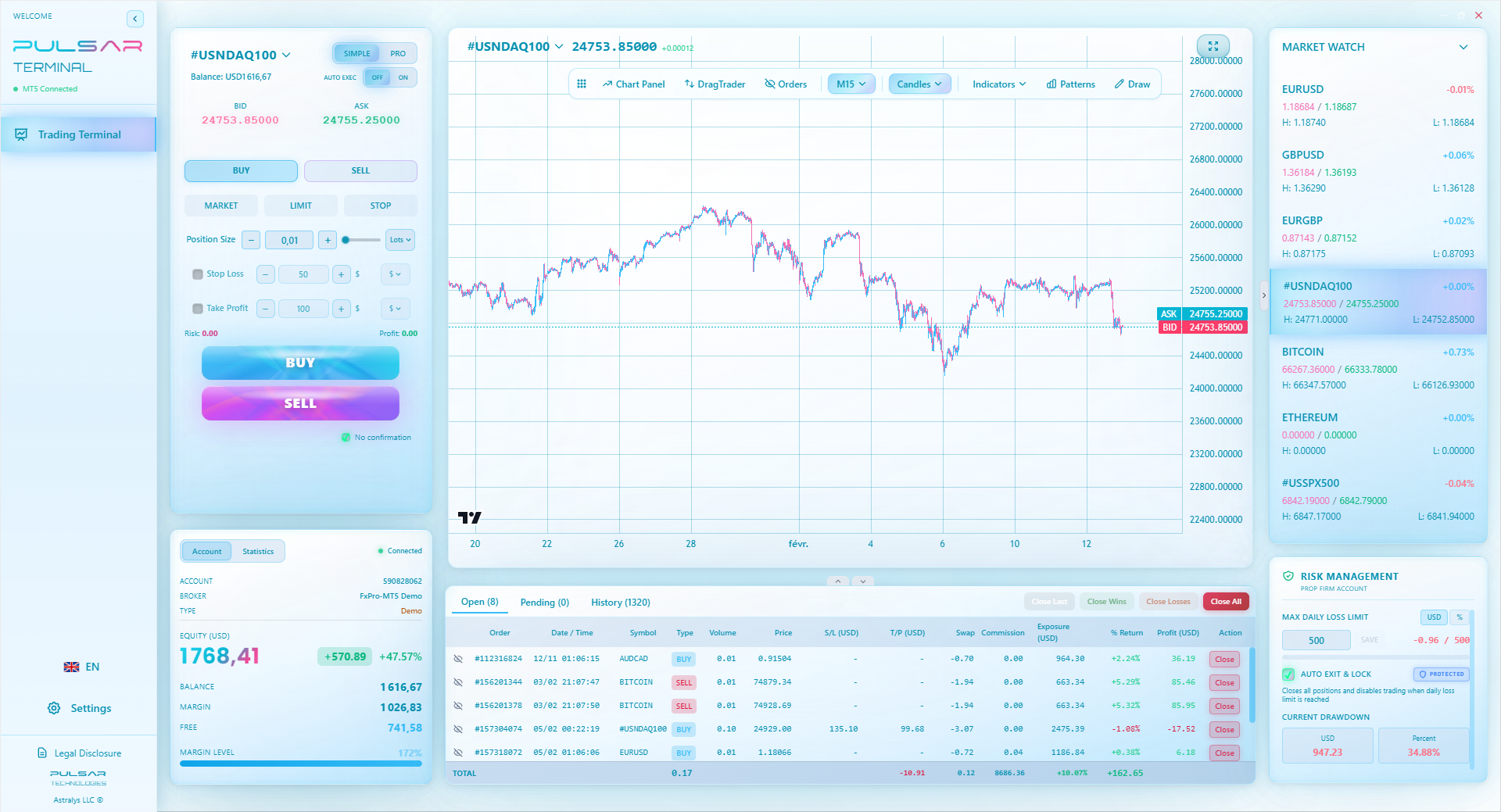
When you're ready to move beyond basic order management and automate complex strategies or prop firm rules, a professional tool like Pulsar Terminal connects directly to your MT5 to handle it all.
Pulsar Terminal
MT5オールインワンツール:ドラッグ&ドロップ注文、マルチTP/SL、トレーリングストップ、グリッドトレード、出来高プロファイル、プロップファーム保護。毎日1,000人以上のトレーダーが利用。
FAQ
Q1Is forex trading legal in South Africa?
Yes, it is completely legal, provided you trade with a broker that is licensed by the Financial Sector Conduct Authority (FSCA). Trading with unregulated, offshore entities is where you run into legal and financial risk.
Q2What is the safest way to fund my forex trading account in SA?
The safest way is always via a direct EFT (Electronic Funds Transfer) into the broker's designated South African bank account, which should be in the name of the regulated entity. Avoid methods like depositing gift cards, cryptocurrency to personal wallets, or direct transfers to individuals.
Q3Can I use international brokers like IG or Saxo Bank?
You can, but it's more complicated. They are not FSCA-regulated for the South African market. To use them, you'd need to use your annual foreign investment allowance (R10 million) to send funds abroad, which involves paperwork with your bank as an Authorised Dealer. For most retail traders, starting with a local FSCA broker is far simpler and offers the same protection.
Q4Do I pay tax on my forex trading profits in South Africa?
Yes. Profits from forex trading are considered taxable income by SARS. You need to declare them in your annual tax return. Keep detailed records of all your trades, deposits, and withdrawals. Losses can often be offset against other income, but you should consult with a tax professional familiar with trading.
Q5What's the difference between MT4 and MT5? Which app is better?
MT5 is the newer, more powerful platform. It has more timeframes, more order types, and a built-in economic calendar. MT4 is simpler and is still beloved by many pure forex traders. For most new traders in South Africa, MT5 is the better choice as it's more future-proof. Both have very similar mobile apps.
Q6I only have R500 to start. Is it even worth it?
Honestly? It's a very tough starting point. With R500, proper risk management is nearly impossible on standard accounts. Your best bet is to look for a broker offering a cent account (where 1 USD = 100 cents) or a micro account. This lets you practice real-money psychology with very small amounts. Consider that R500 better spent on a few good trading books and use a demo account until you can save a more realistic starter bankroll of R2,000-R5,000.
ウィンストン教授のレッスン
重要ポイント:
- ✓Verify the FSCA FSP number. Always.
- ✓Start with a demo, but trade it like real money.
- ✓Your first deposit should be money you can afford to lose.
- ✓Tight spreads matter most for scalping, not swing trading.
この記事はどれくらい役に立ちましたか?
星をクリックして評価
週刊トレーディングインサイト
無料の週刊分析&戦略。スパムなし。
著者について
David van der Merwe
新興市場トレーダー
ヨハネスブルグ拠点で新興市場通貨11年のトレーダー。ZARペア、FSCA規制下の取引、南アフリカ市場分析を専門とする。
コメント
リスク警告
金融商品の取引には大きなリスクが伴い、すべての投資家に適しているわけではありません。過去の実績は将来の結果を保証するものではありません。本コンテンツは教育目的のみであり、投資助言として解釈すべきではありません。取引前に必ずご自身で調査を行ってください。
こちらもおすすめ

Cara Trading Forex Sukses: 7 Prinsip dari Trader Profesional
Cara trading forex sukses dengan 7 prinsip trader pro: manajemen modal, disiplin, journal trading, backtest. Data nyata, bukan janji profit palsu.
Jam Trading Forex Terbaik untuk Trader Indonesia: Panduan Lengkap dengan Tabel Waktu
Panduan jam trading forex untuk trader Indonesia. Tabel 4 sesi dunia, jam emas 20:00-00:00, sesi mana yang harus dihindari. Data akurat + tips dari trader berpengalaman.
Top 5 Sàn Forex Uy Tín Nhất 2026: Review Jujur dari Trader Indonesia
Top 5 sàn forex uy tín 2026 untuk trader Indonesia. Review jujur: spread, deposit, withdraw, dukungan lokal. Exness, XM, IC Markets & lebih.
