


You've seen the ads, right? 'Trade with 1:1000 use and turn ₦50,000 into millions!' It sounds like a shortcut, but what's the real use meaning in forex? Is it a magic wand or a loaded gun? From my 12 years trading Lagos time, I can tell you it's both.

Olumide Adeyemi
西アフリカ・トレーディングの先駆者 ·  Nigeria
☕ 9 分で読める
学べること:
- 1What is use? The Simple Definition (Forget the Jargon)
- 2How use Works: A Naira and Dollar Example
- 3Margin vs. use: Understanding the Critical Difference
- 4Common use Ratios in Nigeria: What's Realistic?
- 5The Real Risks: How High use Leads to Margin Calls
- 6How to Choose the Right use For Your Trading Style
- 7use Mistakes Every Nigerian Trader Makes (And How to Stop)

You've seen the ads, right? 'Trade with 1:1000 use and turn ₦50,000 into millions!' It sounds like a shortcut, but what's the real use meaning in forex? Is it a magic wand or a loaded gun? From my 12 years trading Lagos time, I can tell you it's both. The brokers won't give you the full picture, just the dream. Let me break down what use actually is, how it works with our Naira, and the brutal math that keeps traders awake at night.
Forget the textbook definitions. In simple terms, use is a loan from your broker. That's it. You put down a small deposit (your margin), and they lend you the rest to control a much larger position. It's like putting down a 10% deposit on a ₦10 million property. You don't own the full property, but you get all the profit or loss from its price movement.
The key number is the ratio. 1:100 use means for every ₦1 of your money, the broker lends you ₦99. Your ₦10,000 can control a ₦1,000,000 position. This is the core of the use meaning in forex. It's not free money; it's amplified risk and reward.
I learned this the hard way in 2015. I deposited $500 (about ₦90,000 back then) with a broker offering 1:500 use. I felt like a king, controlling a $250,000 position. A 20-pip move meant hundreds of dollars. The thrill was incredible. The reckoning, when it came, was swift.
Let's make this local. You want to trade USD/NGN. Yes, you can speculate on the Naira's value against the dollar with many international brokers, though you'll be trading a CFD (Contract for Difference).
Let's say the rate is 1 USD = 1,500 NGN. You believe the Naira will strengthen. Without use, to buy $10,000 worth, you'd need ₦15,000,000. Impossible for most. With 1:100 use, you only need 1% as margin: ₦150,000.
The Profit & Loss Calculation
If the rate moves to 1 USD = 1,450 NGN (the Naira strengthens), your profit is: Profit = (1,500 - 1,450) * $10,000 = 50 NGN * $10,000 = ₦500,000. On your margin of ₦150,000, that's a 333% return. Amazing.
Now, the flip side. If the Naira weakens to 1,550 NGN/USD: Loss = (1,550 - 1,500) * $10,000 = 50 NGN * $10,000 = ₦500,000. You've lost ₦500,000 on a ₦150,000 deposit. You owe the broker ₦350,000. This is a margin call scenario.

Warning: Most brokers automatically close your position (liquidation) before your balance goes negative. That ₦150,000? Gone. That's the real use meaning in forex: it can wipe your account faster than you can say 'God abeg'.
For major pairs like EUR/USD, the math uses pips. With 1:100 use, a 1 pip move on a standard lot ($100,000) is $10. Your margin might be $1,000. So a 100-pip move against you is a 100% loss. This is why a solid scalping strategy needs ultra-tight stops.

💡 ウィンストンのヒント
use is a multiplier for your IQ and your emotions. If you're not a disciplined genius at 1:1, you'll be a catastrophic fool at 1:100.

“use doesn't improve a bad trade; it just makes the funeral more expensive.”
This is where 90% of new traders get confused. They're two sides of the same coin, but you must understand both.
- use is the ratio of borrowed funds to your own (e.g., 1:100).
- Margin is the amount of your own money required to open the trade.
Think of it like this: use is the engine's power (1:100 is a sports car, 1:10 is a family sedan). Margin is the fuel in your tank. You need the right fuel for the engine you're using.
Margin Requirement Calculation: Margin = (Trade Size / use Ratio)
If you want to trade 1 mini lot (10,000 units) of GBP/NGN and your use is 1:200: Margin = 10,000 / 200 = 50 units of the account currency. If your account is in USD, that's $50. But remember, you're on the hook for the full 10,000-unit move.
Brokers like Exness and IC Markets show you 'Used Margin' and 'Free Margin' in your terminal. Used Margin is locked up. Free Margin is what's left to open new trades or absorb losses. If your losses eat into your Free Margin and it gets too low, the broker's system starts closing positions. Never let your account equity get near your Used Margin. I always keep at least 50% of my account as Free Margin. It's saved me from forced liquidations more times than I can count.
Brokers advertise crazy numbers to attract clients. Here’s the reality for Nigerian traders in 2024-2025.
| use Ratio | Margin Required | What It Means For You |
|---|---|---|
| 1:30 | 3.33% | Common for major pairs under ESMA-like rules. Safe for beginners. |
| 1:100 | 1% | The sweet spot for many experienced retail traders. Balanced power. |
| 1:200 | 0.5% | Offered by many offshore brokers to Nigerian clients. High risk. |
| 1:500+ | <0.2% | A trap for the greedy. One bad trade can obliterate your account. |
International brokers serving Nigeria (think XM, Pepperstone) often offer 1:100 to 1:500 on forex majors for non-EU clients. But just because you can use 1:500 doesn't mean you should.
My rule? I never use the maximum. On a broker offering 1:500, I set my account use to 1:100 in the client portal. This self-imposed limit forces me to trade smaller positions relative to my capital. It's the single best discipline hack I've found. A position size calculator is non-negotiable here. You input your account size, risk percentage (I risk 1% max), stop-loss distance, and it tells you the exact lot size. This makes use your servant, not your master.
💡 ウィンストンのヒント
The market's job is to find the price point that causes the maximum pain to the maximum number of people. High use makes you a primary target.

“The 'best' use is the lowest amount that still allows you to execute your strategy while sleeping at night.”
Let me tell you a story. Early in my career, I funded an account with ₦200,000. use 1:400. I traded gold (XAU/USD), a volatile asset. I bought 2 lots, using almost all my margin. My stop-loss was 50 pips away, risking about $100. I thought I was 'managing risk.'
Then news hit. Gold dropped 100 pips in minutes. My stop was hit, but in a volatile 'gap,' the price skipped right past it. This is called slippage. My position was closed at a 120-pip loss. That was $240 per lot. Total loss: $480.
On my ₦200,000 (about $250 then), that was a 192% loss. My account went negative. I owed the broker money. They covered it, but my account was wiped out, and I learned a visceral lesson about margin call mechanics. The broker's system doesn't care about your analysis. It's just math: Equity ≤ Used Margin? LIQUIDATE.

Pro Tip: To avoid this, use a 'Margin Level' alarm. Margin Level = (Equity / Used Margin) * 100%. Most brokers warn you at 100% and liquidate around 50%. Set a personal alarm at 150%. If you get there, close some positions manually. Don't let the machine do it for you.
High use makes you more vulnerable to normal market noise. A 20-pip retracement on a highly leveraged trade can trigger panic or stop you out, even if your long-term thesis was correct. This is why swing trading with lower use often works better for Nigerians, as we can't always watch the screen 24/7.

Your use should match your strategy, not your dreams.
- Scalpers: You're in and out for 5-10 pips. You might use higher use (1:100-1:200) because your stop-losses are tiny (5-10 pips). But your position size must be calculated precisely. A 10-pip stop on 1 lot is $100 risk. If your account is $1000, that's 10% risk on one trade. Too high.
- Day Traders: Holding for hours, aiming for 30-80 pips. Moderate use (1:50-1:100) works. It gives you power without insane volatility on your balance.
- Swing Traders: Holding for days/weeks, aiming for 200+ pips. Use low use (1:10-1:30). Your stops are wide, so a high use would require a huge margin for the same position size, or an insanely risky position size for your margin.
Here's my personal formula now:
- Decide the maximum % of my account I'll risk on a trade (Never more than 1%).
- Determine my stop-loss distance in pips.
- Use a calculator to find the lot size.
- The use required is whatever that lot size demands from my margin. It's a result, not a starting point.
This flips the script. You start with risk, not with 'how much can I make.' It's boring. But it keeps you in the game. Tools that help you visualize this risk in real-time, like setting multi-level take-profits and stop-losses, are useful. Managing trades manually under pressure is how mistakes happen.
💡 ウィンストンのヒント
Your first calculation before any trade shouldn't be potential profit. It should be: 'At what price will I admit I'm wrong, and what will that cost me?' That cost must be a fraction of your capital.

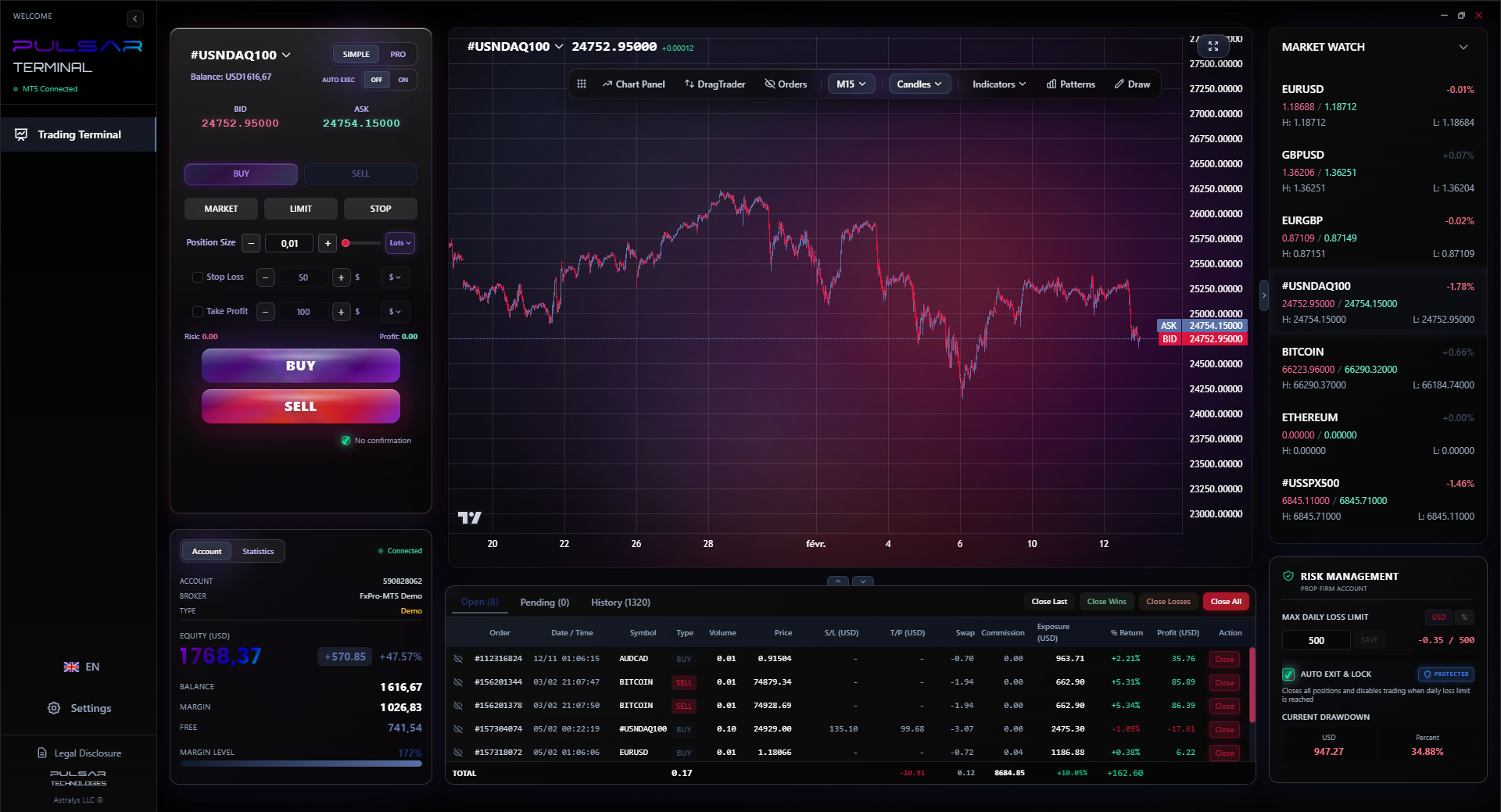
Manually calculating risk for multiple trades under pressure is where errors happen; Pulsar Terminal's drag-and-drop order system lets you set precise take-profit and stop-loss levels visually, so your pre-calculated risk plan is executed flawlessly every time.
Pulsar Terminal
MT5オールインワンツール:ドラッグ&ドロップ注文、マルチTP/SL、トレーリングストップ、グリッドトレード、出来高プロファイル、プロップファーム保護。毎日1,000人以上のトレーダーが利用。
“You start with risk, not with 'how much can I make.' It's boring. But it keeps you in the game.”
I've made them all so you don't have to.
Mistake 1: Overleveraging on a 'Sure Thing.' Your uncle in the CBN gives you a 'tip.' You max out use. Even if the tip is right, normal market volatility can shake you out before the move happens. The market doesn't know your uncle.
Mistake 2: Adding to a Losing Position (Averaging Down) with High use. This turns a small loss into a catastrophic one. Your margin gets eaten up twice as fast. I did this with USD/JPY, thinking 'it has to reverse.' It didn't. A 2% drawdown turned into a 40% account loss in a day.
Mistake 3: Ignoring the Spread Cost. With high use, you trade larger lots. The spread (the broker's fee) is a fixed cost per lot. On a 2-lot trade, you pay double. If you're scalping for 5 pips and the spread is 3 pips, you need the market to move 8 pips just to break even. High use on low-timeframe trades makes spreads a killer.
Mistake 4: Not Understanding Correlation. You go long on EUR/USD and GBP/USD with high use, thinking you've diversified. They're highly correlated. A dollar-strength move hits both positions simultaneously, doubling your effective use and triggering a margin call.
The fix? A trading journal. Write down every trade: use used, position size, reason. Review it weekly. The patterns of your own destruction will become painfully clear. Also, using indicators like the RSI indicator or MACD indicator can help confirm entries, but they don't change the use math. A good signal with bad use is still a bad trade.
FAQ
Q1What is the best use for a beginner forex trader in Nigeria?
Start with no use. Seriously. Use a demo account and pretend use is 1:1. Once you're consistently profitable for 3 months, move to 1:10 or 1:20 with real money. The 'best' use is the lowest amount that still allows you to execute your strategy while sleeping at night. For most beginners, anything above 1:50 is a fast track to losing your deposit.
Q2Is 1:500 use illegal for Nigerian traders?
No, it's not illegal. Nigeria's SEC is still developing its forex trading framework. International brokers regulated elsewhere (CySEC, FCA, ASIC) can offer high use to Nigerian clients because local restrictions don't apply. However, just because it's legal doesn't make it wise. A broker's legality is about their license and your fund security, not about protecting you from your own greed.
Q3How do I calculate my margin requirement?
Use this formula: Margin = (Trade Size in Units) / use Ratio. For example, to trade 0.5 lots (50,000 units) with 1:100 use, Margin = 50,000 / 100 = 500 units of your account currency. If your account is in USD, you need $500 as margin. Always use your broker's position size calculator to be exact, as they may have specific per-instrument requirements.
Q4Can I change my use ratio after opening an account?
Yes, with most brokers. You usually request it in your client cabinet or account settings. However, you can often only lower it if you have open positions. Increasing it may require closing all trades. My advice: set it low from the start (like 1:50) and leave it. Your self-control will thank you.
Q5What happens if I get a margin call?
You'll get an alert (email, SMS, platform pop-up) that your Margin Level is critically low (e.g., 100%). This means your account equity equals your used margin. You have two choices: 1) Deposit more funds immediately to increase equity, or 2) Close some losing positions to free up margin. If you do nothing and your Margin Level falls to the broker's stop-out level (often 50%), they will automatically close your positions, starting with the biggest loser, until your Margin Level is back above the threshold. You will likely be left with significant losses.
Q6Does higher use mean higher spreads or commissions?
Not directly. The spread or commission is usually per lot traded, regardless of use. However, with higher use, you might be tempted to trade larger lot sizes, which means you pay the spread on a larger volume. So indirectly, yes, it can lead to higher total trading costs if it influences your position sizing behavior.
ウィンストン教授のレッスン
重要ポイント:
- ✓Never risk more than 1% of capital on a single trade.
- ✓Choose use based on strategy, not broker's maximum offer.
- ✓A margin call is a failure of risk math, not bad luck.
- ✓Use a position size calculator for every single entry.
この記事はどれくらい役に立ちましたか?
星をクリックして評価
週刊トレーディングインサイト
無料の週刊分析&戦略。スパムなし。
著者について
Olumide Adeyemi
西アフリカ・トレーディングの先駆者
ナイジェリアで最もアクティブなFXトレーディング教育者の一人。ラゴスから8年のトレード経験。アフリカのトレーダー向けの少額資金戦略とプロップファームチャレンジを専門とする。
コメント
リスク警告
金融商品の取引には大きなリスクが伴い、すべての投資家に適しているわけではありません。過去の実績は将来の結果を保証するものではありません。本コンテンツは教育目的のみであり、投資助言として解釈すべきではありません。取引前に必ずご自身で調査を行ってください。
こちらもおすすめ

Cara Trading Forex Sukses: 7 Prinsip dari Trader Profesional
Cara trading forex sukses dengan 7 prinsip trader pro: manajemen modal, disiplin, journal trading, backtest. Data nyata, bukan janji profit palsu.
Jam Trading Forex Terbaik untuk Trader Indonesia: Panduan Lengkap dengan Tabel Waktu
Panduan jam trading forex untuk trader Indonesia. Tabel 4 sesi dunia, jam emas 20:00-00:00, sesi mana yang harus dihindari. Data akurat + tips dari trader berpengalaman.
Top 5 Sàn Forex Uy Tín Nhất 2026: Review Jujur dari Trader Indonesia
Top 5 sàn forex uy tín 2026 untuk trader Indonesia. Review jujur: spread, deposit, withdraw, dukungan lokal. Exness, XM, IC Markets & lebih.
