


I remember my first 'profitable' trade back in 2015.

Olumide Adeyemi
西アフリカ・トレーディングの先駆者 ·  Nigeria
☕ 11 分で読める
学べること:
- 1The Spread Basics: It's Just the Gap Between Two Prices
- 2How Spreads Actually Affect Your Trades (With Real Naira Examples)
- 3Fixed vs. Variable Spreads: What Works for Nigeria?
- 4A Real Look at Broker Spreads for Nigerian Traders
- 5When Spreads Widen (And How to Avoid Getting Killed)
- 6Smart Strategies to Minimize Spread Costs
- 7Spread Myths We Need to Debunk in Nigeria
- 8The Final Word: It's About Managing All Costs
I remember my first 'profitable' trade back in 2015. I bought EUR/USD at 1.1050 and sold at 1.1065. I was buzzing - 15 pips in the bag! Then I checked my account. My profit was about $8 on a $1,000 position, not the $15 I'd calculated. That missing $7 was the spread, my first real lesson in the hidden cost of trading. For us trading from Nigeria, where every dollar counts double thanks to Naira volatility, understanding the true meaning of spread in forex isn't just theory - it's survival.
Alright, let's strip this back. Forget the fancy terms for a second. Every currency pair you see has two prices: the price you can sell at (the bid) and the price you can buy at (the ask). The spread is simply the gap between them.
Think of it like a roadside bureau de change in Lagos. They'll buy your dollars at one rate (say, ₦1,380/$) and sell dollars to you at a slightly higher rate (say, ₦1,400/$). That ₦20 difference is their spread, their profit for providing the service. In forex, your broker does the same thing.
On your MT4 or MT5 platform, you'll see it like this for EUR/USD:
- Bid (Sell): 1.08500
- Ask (Buy): 1.08508
That's an 0.8 pip spread. The moment you open a buy trade, you start at a slight loss equal to that spread. Your trade needs to move in your favor by at least that amount just to break even. This is the core meaning of spread in forex: it's the built-in transaction cost you pay on every single trade.

Warning: Never confuse the spread with commission. On a standard account, the spread is the broker's fee. On an ECN account, you might see tiny spreads but pay a separate commission per lot. You need to add both costs to know your true break-even point. I learned this the hard way on an ECN account, thinking my 0.1 pip spread was magic, until I saw the $7 commission hit my statement.
This is where theory meets your bank account. Let's talk numbers, because that's what matters.
The Scalper's Nightmare
If you're into scalping strategy, chasing 5-10 pips per trade, the spread is your biggest enemy. A 2-pip spread on a pair like GBP/USD means you're giving up 20-40% of your target profit before the market even moves. I tried scalping USD/ZAR a few years back. The average spread was 15 pips during my session. I needed a 20-pip move just to make 5 pips. It was a losing game from the start.
The Swing Trader's Silent Tax
For swing trading, holding trades for days, the spread seems less important. And it is, relatively. But it still adds up. If your average winning trade is 80 pips, a 1.5-pip spread takes about 1.9% off that win right away. Over 100 trades, that's a lot of profit left on the table.
Let's Do the Naira Math
Let's make it local. Say you trade 1 standard lot (100,000 units) of EUR/USD with a 1.0 pip spread.
- 1 pip on EUR/USD = $10
- Spread cost = 1.0 pip * $10 = $10 per trade.
Now, with the Naira at roughly ₦1,400/$, that's ₦14,000 gone on every round-turn trade (open and close), just in spread. If you make 20 trades a month, that's ₦280,000 in spread costs alone. That's someone's monthly salary! This is why using a position size calculator is non-negotiable - it forces you to account for this cost before you enter.

Example: Trade: Buy 0.5 lots EUR/USD Entry Ask Price: 1.08550 Exit Bid Price Needed to Break Even: 1.08550 + Spread If spread is 0.8 pips, you need price to hit 1.08558 just to get back to zero. Your first 0.8 pips of movement just covers the broker's fee.

💡 ウィンストンのヒント
A spread is a toll, not a tax. You choose when and how often to pay it. Trade less, trade smarter.
“The spread is the first hurdle your trade has to jump over. If your strategy can't clear it, you lose before you start.”
You'll see brokers offer two main types: fixed and variable. Your choice here can make or break your strategy, especially with our internet and power issues.
Fixed Spreads stay the same, no matter what. Market going crazy at 2 PM Lagos time when US data drops? Your spread stays at 1.5 pips. Sounds great, right? The catch is they're usually wider on average than variable spreads during calm times. Brokers offering them, like some accounts at XM, are basically insuring you against gap risk during news - and you pay the premium for that insurance.
Variable Spreads move with market liquidity. They can be super tight - I've seen 0.2 pips on EUR/USD with brokers like IC Markets during the London session. But when liquidity dries up (like during Asian lunch hour) or when major news hits, they can widen dramatically. I once saw USD/JPY spread blow out to 15 pips during a surprise Bank of Japan announcement. My stop-loss got triggered at a horrible price because of that.
My take for Nigerian traders? If you trade during high-liquidity sessions (London or New York overlap) and have a stable internet connection, variable spreads on a good ECN broker will save you money 90% of the time. But if you trade exotic pairs or can't risk a sudden spread widening, a fixed-spread account might let you sleep better. Just know you're paying for that peace of mind.
Don't just believe the 'from 0.0 pips' ads on Instagram. You need to see typical spreads, not just the best-case scenario. Here's a rough guide based on my experience and checking accounts over the last year. Remember, these are for standard, commission-free accounts unless noted. Always verify on the broker's site.
| Broker | EUR/USD Avg. Spread | GBP/USD Avg. Spread | Key Note for Nigerians |
|---|---|---|---|
| Exness | 0.7 - 1.2 pips | 1.2 - 1.8 pips | Very popular here, good local payment support. |
| XM | 0.8 - 1.1 pips | 1.0 - 1.7 pips | Low $5 minimum deposit, consistent execution. |
| Pepperstone | 0.6 - 1.0 pips | 0.9 - 1.5 pips | Razor account has tighter spreads + commission. |
| IC Markets | 0.4 - 0.7 pips* | 0.6 - 1.2 pips* | *On Raw Spread account, plus $7 round-turn commission. |
| HF Markets | 1.0 - 1.4 pips | 1.5 - 2.0 pips | Offers Naira-denominated accounts. |
The Commission vs. Spread Trade-Off: Notice IC Markets and Pepperstone offer raw accounts. You pay a commission (e.g., $7 per 100k round turn) but get spreads that often hover near 0.0 pips. This is usually cheaper for larger volume traders. If you trade 1 lot, your total cost might be $7 commission + $0.2 spread = $7.2. On a standard account with a 1-pip spread, your cost is $10. The raw account wins.
But if you trade 0.01 lots (a mini lot), the commission is still $0.07, but the spread on a standard account might cost $0.10. The difference is tiny. For most Nigerians starting small, a standard account with a decent, honest broker is often simpler.
“In Nigeria, where the value of a dollar changes daily, being cost-conscious isn't being cheap - it's being professional.”
This is critical. Spreads don't just sit there nicely. They explode during specific times, and if you don't know when, you will get burned.
Major Economic News: The #1 killer. When US Non-Farm Payrolls or CBN interest rate decisions drop, liquidity vanishes for a second. Spreads on majors can jump from 1 pip to 10-20 pips instantly. I lost ₦50,000 in seconds back in 2019 because I had a pending order during ECB news. The spread widened, my order filled at a terrible price, and the market immediately reversed.
Market Open/Close: The spread on USD/JPY is always wider when Tokyo opens if you're trading from Nigeria late at night. The London/New York session overlap (3-5 PM Nigerian time) usually has the tightest spreads.
Low-Liquidity Pairs: Avoid trading exotics like USD/NGN (if you even find it) or USD/TRY with tight stops. Their normal spread might be 20 pips. That's your stop-loss buffer gone before you start.
Your Survival Rule: If you're a news trader, you need a broker with reliable execution during volatility and you must use limit orders, not market orders. Better yet, stay out 5 minutes before and after major news unless you really know what you're doing. For your everyday trading, check the economic calendar. If there's a red-flag high-impact event, either don't trade or widen your stop-loss to account for potential spread expansion.

Pro Tip: Most platforms show the current spread in the Market Watch window. Right-click, select 'Spread', and add it as a column. Always glance at it before clicking buy or sell. If it's double its normal size, ask yourself why. Something is happening.
💡 ウィンストンのヒント
If you can't calculate your exact cost in Naira before the trade, you're not trading, you're gambling.
You can't avoid the spread, but you can outsmart it. Here's how I've adjusted over the years.
1. Trade the Right Pairs at the Right Time. Stick to major pairs (EUR/USD, USD/JPY, GBP/USD, USD/CHF, AUD/USD, USD/CAD, NZD/USD). They have the tightest spreads. My favorite for low costs is actually EUR/USD. It's boring sometimes, but the liquidity is insane. Compare our guides on EUR/USD and something like XAU/USD (gold) to see the typical spread difference.
2. Consider Longer Timeframes. This was a game-changer for me. On the 1-hour or 4-hour chart, a 1-pip spread is noise. On a 1-minute chart, it's a huge percentage of your move. Moving to higher timeframes naturally reduces the spread's impact on your strategy's profitability.
3. Get Your Entry Right. Use limit orders to enter at your price. A market order guarantees a fill but at the current ask price (which includes the spread). A buy limit order sits at or below the current bid price. If the market comes down to hit it, you get filled at your price, potentially getting a better deal than the ask. This takes patience.
4. Factor Spread into Your Risk-Reward. If your strategy needs a 1:2 risk-reward, and you risk 50 pips to make 100, but the spread is 2 pips, your real risk-reward is (50+2) vs (100-2) = 52 vs 98, which is nearly 1:1.9. It's eroded. Always add the spread to your stop-loss distance and subtract it from your take-profit target when calculating. A proper position size calculator will do this for you.
5. Choose Your Broker and Account Type Wisely. Match your trading style to the account. High-volume day trader? Look at raw spread ECN accounts. Casual swing trader? A standard account with a reputable broker like Exness or XM might be perfect and simpler.
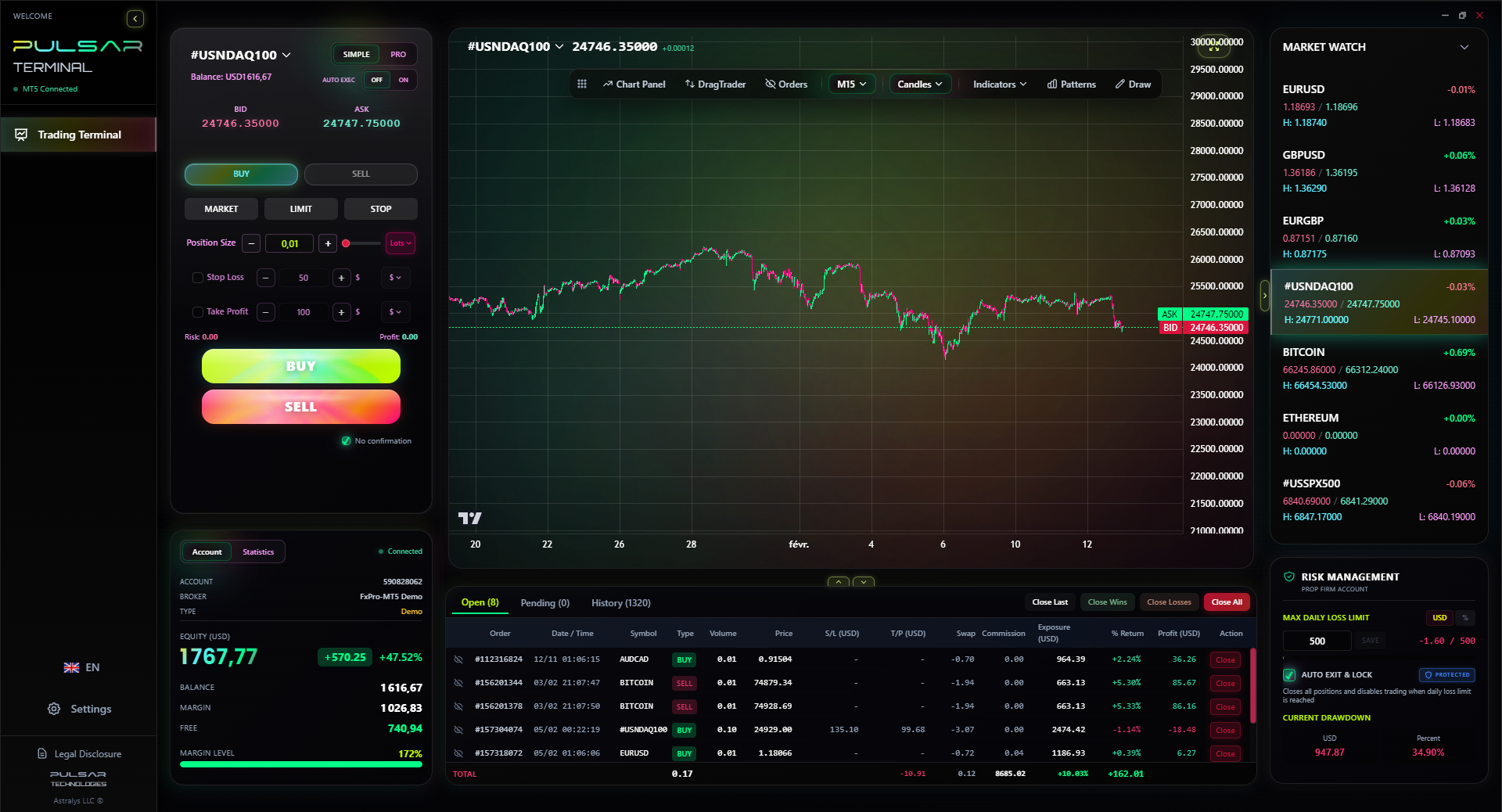
Manually calculating spread-adjusted stop-loss and take-profit levels for every trade is tedious; Pulsar Terminal automates this with its multi-TP/SL and breakeven tools directly on your MT5 chart.
Pulsar Terminal
MT5オールインワンツール:ドラッグ&ドロップ注文、マルチTP/SL、トレーリングストップ、グリッドトレード、出来高プロファイル、プロップファーム保護。毎日1,000人以上のトレーダーが利用。
“I'd rather pay 0.8 pips with instant, reliable fills than 0.2 pips with constant slippage and requotes.”
Let's clear up some nonsense I hear in trading groups all the time.
Myth 1: "The broker widens the spread to hit my stop-loss." This is the big one. While unethical brokers can do this (which is why regulation matters), most stops are hit by normal market volatility during low liquidity. Your stop is a market order. If the spread widens at that moment, your stop executes at the worse price. It's not always malice; sometimes it's just bad timing. Protect yourself with wider stops around news.
Myth 2: "A lower spread always means a better broker." Not true. A broker could offer 0.1 pip spreads but have terrible execution, constant requotes, or hidden fees. The total cost of trading includes spread, commission, swap fees, and the quality of execution. I'd rather pay 0.8 pips with instant, reliable fills from a top-tier broker than 0.2 pips with constant slippage.
Myth 3: "You don't pay the spread if your trade wins." Oh, you absolutely pay it. It's deducted the moment you open the trade. Your platform might not show it as a separate line item, but it's baked into your entry price. A winning trade simply made enough to cover the spread and then some. It's the first hurdle your trade has to jump over.
Understanding these myths is part of mastering the real meaning of spread in forex. It turns you from someone who blames the broker for every loss into a trader who manages their risks proactively.
Look, the spread is just one piece of the puzzle, but it's a fundamental one. It's the entry fee to the casino. In Nigeria, where the value of a dollar changes daily and capital is hard to come by, being cost-conscious isn't being cheap - it's being professional.
Don't obsess over finding the absolute lowest spread. Obsess over finding a reliable broker with fair, transparent costs. Combine that with a solid strategy that accounts for those costs, and you've got a fighting chance.
Remember my first trade story? I now have a rule: I never place a trade without knowing the exact spread at that moment and having already calculated my true break-even point. That simple habit has saved me thousands of dollars (and millions of Naira) over my career. The spread isn't your enemy if you respect it. Ignore it, and it'll quietly drain your account until there's nothing left.
Start today. Open your platform, look at the spread on your favorite pair, and calculate what it costs you in Naira per trade. That reality check is the first step towards smarter, more profitable trading.
FAQ
Q1What is a good spread for forex trading in Nigeria?
For major pairs like EUR/USD, a 'good' spread on a standard account is typically between 0.7 and 1.2 pips during the main trading sessions (London/New York). For GBP/USD, expect 1.0 to 1.8 pips. Anything consistently higher than that on a major pair is on the wide side. Always compare brokers using real-time data, not just their advertised 'from' spreads.
Q2How is the spread paid in forex?
You pay it automatically and instantly. It's not a separate fee. When you click 'Buy', you enter at the higher Ask price. If you were to close the trade immediately, you'd sell at the lower Bid price. That difference (the spread) is your loss, paid to the broker as the cost of the transaction. It's deducted from your potential profit or added to your loss.
Q3Do I pay spread on both buy and sell trades?
Yes, on every single trade you open, regardless of direction. When you sell (go short), you enter at the Bid price. To close, you'd need to buy back at the higher Ask price. So the spread cost is always the distance between the Bid and Ask at your entry point.
Q4Why does the spread change so much sometimes?
Spreads are a reflection of market liquidity and risk. When lots of banks and institutions are trading (high liquidity), spreads are tight. When trading is thin - like during holidays, off-hours (Asian lunch), or right before major news - liquidity dries up. Market makers and brokers widen spreads to protect themselves from the increased risk of sharp, volatile price moves.
Q5Should I choose a fixed or variable spread account?
It depends on your style. Variable spreads are generally lower on average and are best for traders who avoid high-volatility news periods. Fixed spreads offer predictability and can be better if you trade during volatile times or have a strategy sensitive to cost fluctuations. Most active Nigerian traders I know opt for variable spreads from reputable ECN brokers.
Q6How does the spread relate to a pip?
The spread is quoted in pips. A pip is the standard unit of movement. If the EUR/USD Bid is 1.08500 and the Ask is 1.08510, the difference is 0.00010, or 1 pip. So we say the spread is 1 pip. Understanding the pip definition is essential to calculating your costs and profits accurately.
Q7Can wide spreads cause a margin call?
Indirectly, yes. If you have an open position and spreads widen dramatically (like during news), the quoted 'value' of your position can plummet instantly because the Bid price used to calculate your equity drops. This can rapidly reduce your free margin. If you're heavily leveraged, this sudden drop in equity could trigger a margin call. This is why high use and trading during high-impact news is an extremely risky combination.
ウィンストン教授のレッスン
重要ポイント:
- ✓The spread is an instant cost, paid on entry.
- ✓Add spread to stop distance, subtract from target.
- ✓Major pairs during London/NY have tightest spreads.
- ✓Avoid market orders during news events.
- ✓A 2-pip spread consumes 20% of a 10-pip scalp.
この記事はどれくらい役に立ちましたか?
星をクリックして評価
週刊トレーディングインサイト
無料の週刊分析&戦略。スパムなし。
著者について
Olumide Adeyemi
西アフリカ・トレーディングの先駆者
ナイジェリアで最もアクティブなFXトレーディング教育者の一人。ラゴスから8年のトレード経験。アフリカのトレーダー向けの少額資金戦略とプロップファームチャレンジを専門とする。
コメント
リスク警告
金融商品の取引には大きなリスクが伴い、すべての投資家に適しているわけではありません。過去の実績は将来の結果を保証するものではありません。本コンテンツは教育目的のみであり、投資助言として解釈すべきではありません。取引前に必ずご自身で調査を行ってください。
こちらもおすすめ

Cara Trading Forex Sukses: 7 Prinsip dari Trader Profesional
Cara trading forex sukses dengan 7 prinsip trader pro: manajemen modal, disiplin, journal trading, backtest. Data nyata, bukan janji profit palsu.
Jam Trading Forex Terbaik untuk Trader Indonesia: Panduan Lengkap dengan Tabel Waktu
Panduan jam trading forex untuk trader Indonesia. Tabel 4 sesi dunia, jam emas 20:00-00:00, sesi mana yang harus dihindari. Data akurat + tips dari trader berpengalaman.
Top 5 Sàn Forex Uy Tín Nhất 2026: Review Jujur dari Trader Indonesia
Top 5 sàn forex uy tín 2026 untuk trader Indonesia. Review jujur: spread, deposit, withdraw, dukungan lokal. Exness, XM, IC Markets & lebih.
