


Let me guess.

David van der Merwe
新興市場トレーダー ·  South Africa
☕ 11 分で読める
学べること:
- 1What Exactly Is The Odin Forex Robot?
- 2The South African Rules: FSCA, Bots, and Your Money
- 3The Real Cost: More Than Just $129
- 4performance-reality-check
- 5Pros and Cons: A South African Perspective
- 6Where Could You Even Run It? FSCA Brokers That Support EAs
- 7What I'd Do Instead: Smarter Alternatives
- 8The Final Verdict: Should You Buy The Odin Forex Robot?
Let me guess. You're tired of staring at charts, you've seen the ads promising 'set-and-forget' riches with the Odin Forex Robot, and you're wondering if this is finally the magic bullet. I get it. We've all been there, chasing that holy grail. But here's the hard truth I learned the expensive way: there's no robot that prints money while you braai. This review isn't about hype. It's a straight-talking look at the Odin Forex Robot through the lens of a South African trader, covering the real costs, the legal fine print with our FSCA, and whether it's worth your hard-earned Rand.
The Odin Forex Robot is an automated trading system, what we call an Expert Advisor (EA), that runs on the MetaTrader 4 or MetaTrader 5 platform. You buy it once, install it on your charts, and it's supposed to find and execute trades for you 24/5. Its main selling point is its use of a Grid Trading strategy. In simple terms, instead of placing one trade at a predicted level, it places a series of buy and sell orders at set intervals above and below the current price, creating a 'grid'. The idea is to profit from market swings within a range.
Now, the sales page will hit you with some impressive numbers. They claim an average annual yield of around 57% with a max drawdown of 33%. It's currently on a 'limited time' discount at $129 (about R2,400), down from $199. They recommend running it on a $2,000 account with 1:100 use.
Sounds good on paper, right? But here's where my experience kicks in. I've tested more grid EAs than I care to admit. The 57% annual return claim is a massive red flag for any seasoned trader. The FSCA constantly warns against schemes promising returns like 20-50% per month. While 57% per year is less outrageous, it's still an incredibly high, sustained return to promise. In our market, consistent returns of even 15-20% annually are considered excellent by professional standards.

Warning: Any system advertising a specific, high percentage return is marketing, not a guarantee. Past performance, especially back-tested or simulated performance shown on sales pages, is absolutely not indicative of future results. The FSCA has issued alerts about such unrealistic promises.

💡 ウィンストンのヒント
A robot's biggest flaw is it can't adapt. I once watched a grid EA blow a $10k account because it kept selling into a once-in-a-decade bull rally. It just followed its code, right off a cliff.
Before you even think about clicking 'buy now', you need to understand the local rules. This isn't a grey area.
Forex trading itself is completely legal in South Africa and regulated by the Financial Sector Conduct Authority (FSCA). Their job is to protect you and keep the market fair. Using trading bots or EAs is also legal, but with a critical caveat: the entity providing the automated trading service should ideally be licensed. The Odin Forex Robot is sold by a private vendor, not an FSCA-licensed Financial Service Provider (FSP). This means you have little to no regulatory recourse if something goes wrong with the product itself.
Your protection comes from using a proper, FSCA-regulated broker. You must run the Odin EA on an account with a broker like Exness, IC Markets, or XM, all of which hold local FSCA licenses. This ensures your deposit is held according to South African standards and you have a channel for complaint.
A Critical Rule on use and the Rand
There's another rule many newcomers miss. Since 2021, the FSCA has capped use for retail traders. For major forex pairs like EUR/USD, the maximum is 1:30. That recommended $2,000 account with 1:100 use from the Odin sales page? You can't legally run that with an FSCA-regulated broker as a retail client. You'd be limited to 1:30. This dramatically changes the risk and potential return of any strategy, especially a grid-based one that often uses higher use to work.
Also, remember you can't directly speculate against the ZAR as an individual for forex purposes. You're trading CFD pairs like EUR/USD or XAU/USD through your foreign capital allowance.
“On a R37,000 account, a 33% drawdown means being down over R12,000. Could you watch that without panicking?”
Let's break down what this 'one-time fee' really means for your pocket.
1. The Upfront Cost: $129 is roughly R2,400. That's not nothing. In the local robot market, that sits in the low-to-mid range. You can find basic EAs for R500 or premium ones over R10,000. For R2,400, you should expect a polished product with decent support.
2. The Required Capital: They recommend $2,000 (about R37,000). This isn't a fee paid to them, but it's a critical cost to use the robot effectively. Trying to run a grid EA on a R500 account is a fast track to a margin call. You need enough buffer to withstand the drawdowns.
3. The Brokerage Costs: This is the silent killer. Grid strategies place many orders. If you're using an ECN or Raw account model (which you should for tight spreads), you pay a commission per lot, per trade. Let's say the robot opens 10 mini-lot (0.1) positions as part of its grid. If your broker charges $3.50 per lot round turn, that's $3.50 in commissions right there, before the trade is even profitable. These costs eat directly into the robot's claimed returns. Always factor in the spread and commission structure of your FSCA-regulated broker.
4. The Opportunity Cost: The biggest hidden cost? Your time and what else you could be doing with that R2,400 and R37,000. You could use it for education, to fund a manual trading account while you learn a solid swing trading strategy, or for a proper position size calculator and trading journal subscription. Buying a robot often stops people from learning the skills they actually need.
Let's talk about the 57% return and 33% drawdown. I want to share a personal story. Back in 2019, I bought a different grid EA with similar promises. I loaded it on a $5,000 account with a well-known broker. For two months, it made small, steady gains - about 8% total. I was thrilled. Then, the third month, EUR/USD went on a strong, sustained directional trend (not a range). The grid kept placing counter-trend orders, trying to 'catch the swing'. The drawdown hit 45%. I watched, frozen, hoping it would reverse. It didn't. I finally manually intervened and closed everything at a 29% total account loss. That was over R20,000 gone.
The Odin's claimed 33% drawdown is a massive amount of risk. On a R37,000 account, that's being down over R12,000 at some point. Ask yourself: could you watch your account drop by that much without panicking and shutting it off? Most people can't. And that's if the drawdown only hits 33%. In a black swan event or a strong trend, it can easily exceed that.
Grid strategies work brilliantly in ranging, choppy markets. They bleed money in strong, trending markets. No robot, not Odin or any other, can reliably predict when the market will switch from one state to the other. The 'advanced' algorithm is still just following its pre-set rules.

Example: A R37,000 account with a 33% drawdown means your equity drops to R24,790. To get back to breakeven (R37,000), you now need a return of roughly 49% on the remaining capital. Drawdowns cripple recovery.
💡 ウィンストンのヒント
That 'one-time fee' is a trick. The real cost is the capital you risk. A R2,400 robot losing 30% of your R40k deposit costs you R12,000. Do the math.
“The FSCA's 1:30 use cap turns the robot's core strategy on its head.”
Let's weigh this up specifically for our context.
Potential Pros:
- Automation: If it works as intended, it removes emotion. You don't sit stressing over every pip.
- 24/5 Trading: It can catch moves in Asian or US sessions while you sleep.
- Strategy Access: It provides exposure to a grid trading methodology you might not know how to code yourself.
Significant Cons for SA Traders:
- FSCA use Cap: The 1:100 use in its recommendation is a non-starter for retail traders. At 1:30, the strategy's profitability and risk profile are fundamentally altered, likely for the worse.
- No FSP License: The vendor isn't regulated by the FSCA. You're buying software 'as is'.
- Unrealistic Return Expectations: The 57% p.a. claim sets you up for disappointment and risky behavior.
- Market Fit: Is the strategy optimized for the typical spread and volatility of pairs on South African broker servers? Unlikely.
- Cost vs. Value: For R2,400 + a sizable capital commitment, you are taking on substantial risk for an unproven (to you) system.
In my opinion, the cons heavily outweigh the pros. The use issue alone is a deal-breaker unless you qualify as a professional client (which has specific criteria).
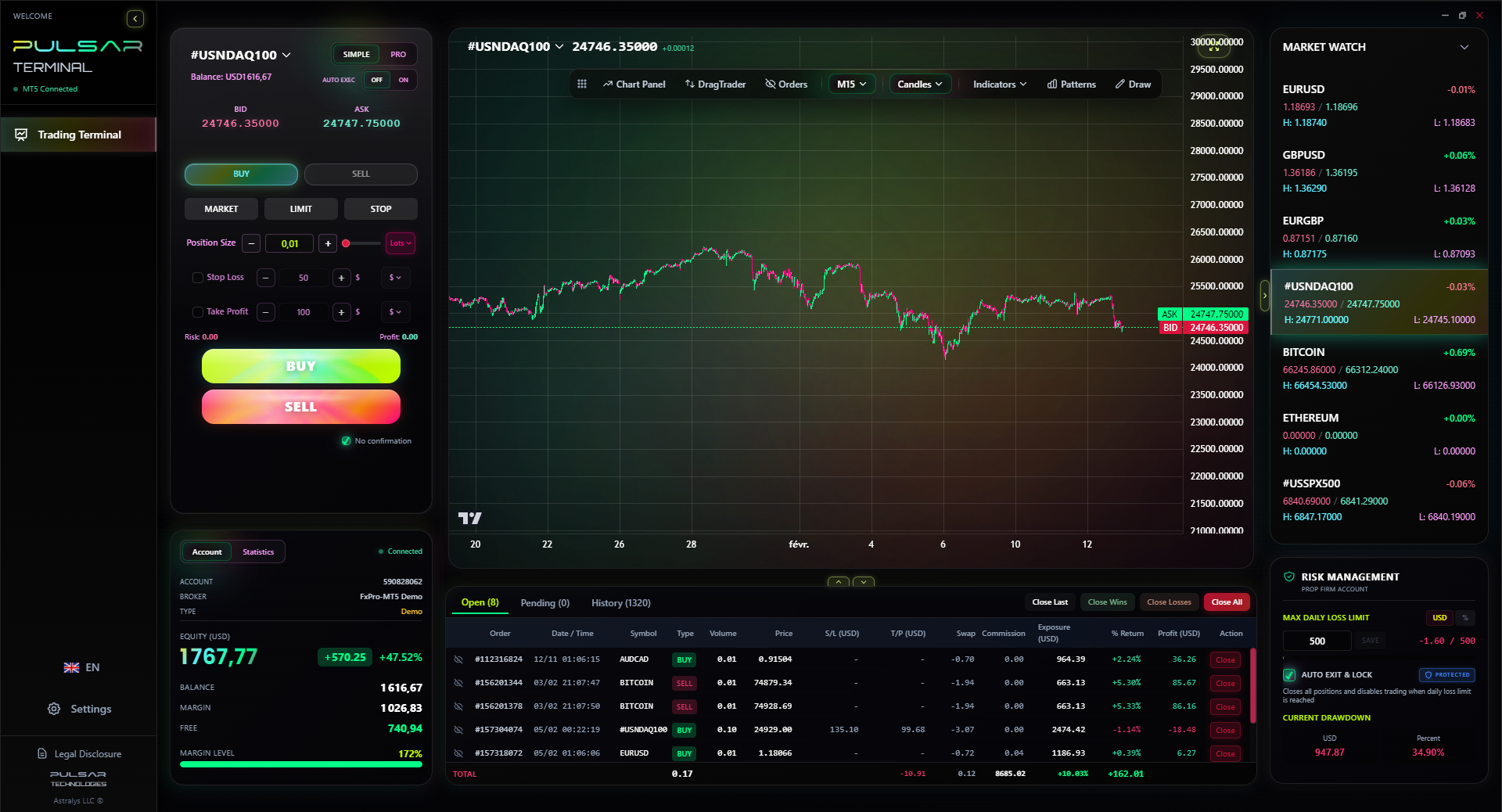
If you're exploring automated trade management, tools like Pulsar Terminal let you build and control your own grid or bracket orders directly on MT5, based on your rules, not a black box.
Pulsar Terminal
MT5オールインワンツール:ドラッグ&ドロップ注文、マルチTP/SL、トレーリングストップ、グリッドトレード、出来高プロファイル、プロップファーム保護。毎日1,000人以上のトレーダーが利用。
If you decide to proceed, you must use a licensed broker. Here are a few FSCA-regulated brokers that support Expert Advisors on MT4/MT5, which is what Odin requires:
| Broker | FSCA License No. | Min. Deposit (Approx.) | Key Point for EA Trading |
|---|---|---|---|
| Exness | FSP 51024 | R182 ($10) | Popular for EA traders, low minimum deposit. |
| Khwezi Trade | ODP License | R500 | Proudly South African, local support. |
| Tickmill | FSP 49464 | R1,700 ($100) | Good raw spreads + commission model. |
| AvaTrade | 45984 | R1,800 ($100) | Well-established, offers MT4 & MT5. |
| FxPro | 45052 | R1,800 ($100) | Offers cTrader and MT5, good for algo trading. |
You'll need to download the MT4/MT5 platform from your chosen broker, install the Odin .ex4 or .ex5 file, and configure it on your chart. Always test it first on a demo account with that specific broker for at least a month. Broker execution speeds, spreads, and slippage can drastically affect an EA's performance.
“Sustainable trading success comes from education and discipline. No robot can give you that.”
If you have R2,400-R40,000 to dedicate to trading, here’s how I’d suggest using it more effectively than buying Odin.
- Invest in Your Brain First: Spend R1,000 on a solid course on price action or risk management. The skill stays with you forever. A robot can become obsolete overnight after a MetaTrader update.
- Use a Demo Account Relentlessly: Practice manual trading for 6 months. Learn to identify support/resistance, and understand indicators like the RSI or MACD. This knowledge lets you evaluate a robot's trades, instead of blindly trusting it.
- Consider a Prop Firm Challenge: Some proprietary trading firms offer evaluation challenges. You pay a fee (often less than R2,400), trade a simulated account, and if you pass their profit/drawdown rules, you get to trade a larger funded account. This teaches you disciplined, rule-based trading. The catch? You usually can't use fully automated EAs, only tools that assist your execution.
- Build Your Own Simple Systems: Learn to code basic MT4 indicators or EAs. You don't need a 57% system. A simple, mechanical strategy with a 40% win rate and a solid risk-reward ratio, traded with perfect discipline, can be profoundly profitable. This is where a tool that helps you manage trades consistently becomes valuable.
- Start Small & Manual: Open a live account with R5,000 at a broker like IC Markets. Use micro-lots (0.01). Your goal for the first year isn't profit; it's to not blow up. This real-world experience is worth more than a dozen robots.
I made more consistent money once I stopped looking for robots and started building my own simple scalping strategy based on observing market flow. It wasn't glamorous, but it was mine, and I understood every single trade.
💡 ウィンストンのヒント
The best automation isn't a black-box robot. It's a tool that flawlessly executes *your* proven plan - managing stops, taking partial profits, keeping you disciplined. That's a force multiplier.
Here's my straight answer: No, I don't think a retail trader in South Africa should buy the Odin Forex Robot.
The primary reason is the FSCA's 1:30 use cap for retail clients. The robot's strategy and recommended settings are built around 1:100 use. Using it at 1:30 is like putting a V8 engine in a car but only allowing it to run on two cylinders - it won't perform as designed, and it might just seize up.
Combine that with the unregulated vendor, the historically risky nature of grid strategies in trending markets, and the high drawdown risk, and the odds are stacked against you. The promise of easy, automated money is a powerful lure, but it's almost always a mirage.
If you are absolutely determined to try automated trading, take the money you'd spend on Odin and use it with a broker that offers social trading or copy trading. Platforms like eToro or some MT4/MT5 plugins let you follow the real, verified trades of other humans. You can see their long-term performance, their drawdowns, and choose someone whose style matches your risk tolerance. It's not perfect, but it's more transparent than a black-box robot making wild claims.
, sustainable trading success comes from education, discipline, and personal experience. No robot can give you that. It's a tough journey, but trying to skip the hard parts with a $129 tool usually ends up being the most expensive lesson of all.
FAQ
Q1Is the Odin Forex Robot legal in South Africa?
Using the robot software itself isn't illegal. However, you must run it on an account with an FSCA-regulated broker (like Exness or AvaTrade) to trade legally. The company selling Odin is not FSCA-licensed, so you have no regulatory protection if the software fails or is a scam.
Q2Can I use the recommended 1:100 use with an FSCA broker?
No, not as a retail client. Since 2021, the FSCA has capped use for major forex pairs at 1:30 for retail traders. The Odin Robot's strategy is promoted using 1:100 use, which you cannot legally use, fundamentally changing its risk and potential performance.
Q3What is the real cost of the Odin Robot in Rands?
The robot costs $129, which is roughly R2,400. However, to use it as suggested, you need a minimum deposit of around $2,000 (R37,000). You also must account for ongoing brokerage costs like spreads and commissions, which can be significant with a grid-trading strategy.
Q4Does the Odin Robot guarantee a 57% yearly profit?
Absolutely not. No trading system can guarantee future profits. The 57% figure is a back-tested or simulated claim, often based on ideal past conditions. The FSCA repeatedly warns against schemes promoting unrealistic returns. In live trading, drawdowns, changing market volatility, and broker execution can lead to very different results, including losses.
Q5What is a grid trading strategy and what are its risks?
Grid trading places multiple buy and sell orders at predefined price intervals, aiming to profit from market swings. The major risk is a strong, sustained trend. If the price moves in one direction without reversing, the robot keeps opening losing counter-trend orders, leading to potentially large drawdowns that can wipe out your account.
Q6Are there any good FSCA brokers for running Expert Advisors like Odin?
Yes, several FSCA-regulated brokers support EAs on MT4/MT5. These include Exness, Tickmill, Khwezi Trade, AvaTrade, and FxPro. You must install the EA on the platform provided by your chosen broker and always test it on a demo account first.
Q7What's a better alternative for a beginner than buying a forex robot?
Invest in education first. Use a demo account to practice manual trading for several months. Learn basic technical analysis and risk management. Consider using a small amount of capital (e.g., R5,000) to trade micro-lots manually. This builds useful experience no robot can provide. Alternatively, look into regulated copy-trading platforms where you can follow transparent, verified traders.
ウィンストン教授のレッスン
重要ポイント:
- ✓FSCA retail use is 1:30, not 1:100.
- ✓Grid EAs can fail catastrophically in strong trends.
- ✓Vendor claims are not FSCA-regulated or guaranteed.
- ✓Real cost includes capital risk, not just the robot price.
- ✓Skills you learn are worth more than any software.
この記事はどれくらい役に立ちましたか?
星をクリックして評価
週刊トレーディングインサイト
無料の週刊分析&戦略。スパムなし。
著者について
David van der Merwe
新興市場トレーダー
ヨハネスブルグ拠点で新興市場通貨11年のトレーダー。ZARペア、FSCA規制下の取引、南アフリカ市場分析を専門とする。
コメント
リスク警告
金融商品の取引には大きなリスクが伴い、すべての投資家に適しているわけではありません。過去の実績は将来の結果を保証するものではありません。本コンテンツは教育目的のみであり、投資助言として解釈すべきではありません。取引前に必ずご自身で調査を行ってください。
こちらもおすすめ

Cara Trading Forex Sukses: 7 Prinsip dari Trader Profesional
Cara trading forex sukses dengan 7 prinsip trader pro: manajemen modal, disiplin, journal trading, backtest. Data nyata, bukan janji profit palsu.
Jam Trading Forex Terbaik untuk Trader Indonesia: Panduan Lengkap dengan Tabel Waktu
Panduan jam trading forex untuk trader Indonesia. Tabel 4 sesi dunia, jam emas 20:00-00:00, sesi mana yang harus dihindari. Data akurat + tips dari trader berpengalaman.
Top 5 Sàn Forex Uy Tín Nhất 2026: Review Jujur dari Trader Indonesia
Top 5 sàn forex uy tín 2026 untuk trader Indonesia. Review jujur: spread, deposit, withdraw, dukungan lokal. Exness, XM, IC Markets & lebih.
