


Here's a fact that'll sting: over 70% of Nigerian retail traders lose their first deposit within 90 days.

Olumide Adeyemi
西アフリカ・トレーディングの先駆者 ·  Nigeria
☕ 11 分で読める
学べること:
- 1What Exactly Are You Downloading?
- 2The MT4 vs. MT5 Debate: Nigeria Edition
- 3Features That Actually Matter (And Ones That Don't)
- 4The Broker Connection: Your Gateway to the Market
- 5The Real Cost of Trading: Spreads, Commissions, Slippage
- 6Trading From Your Phone: Necessity, Not a Gimmick
- 7Security, Scams, and Nigerian Regulations
- 8Your Action Plan: Choosing and Testing a Platform
Here's a fact that'll sting: over 70% of Nigerian retail traders lose their first deposit within 90 days. It's not just bad luck or poor strategy. A huge chunk of that failure starts with picking the wrong online forex trading platform. You're not just choosing software. You're choosing your execution speed, your costs, and , your odds of survival. I've blown accounts on clunky platforms and made my best returns on the right ones. Let's cut through the marketing nonsense.
Forget the fancy ads. An online forex trading platform is just the software that connects you to the market. It's your cockpit. You place orders, manage trades, and analyze charts through it. But here's the critical part: the platform itself doesn't hold your money. Your broker does. The platform is the interface to your broker's servers.
There are two main types. The first is a proprietary platform built by the broker themselves. These are often web-based or simple apps. They're usually basic, sometimes painfully slow during news events, and lock you into that broker's environment. The second type, and where the serious action is, is a multi-broker platform like MetaTrader 4 (MT4) or MetaTrader 5 (MT5). These are independent software packages that hundreds of brokers plug into. This is crucial for you. It means you can learn one platform inside out, and if your broker starts acting up, you can take your skills and custom indicators to another broker that also supports MT5. It gives you power and portability.

Warning: If a broker only offers their own proprietary platform and won't give you MT4/MT5 login details, be very suspicious. You're being locked in, and comparing their spreads or execution to the real market becomes impossible.
I learned this the hard way early on. I signed up with a flashy broker offering a 'next-gen' web platform. It was slick until the US NFP report hit. The platform froze, my stop-loss didn't trigger, and I watched a $500 loss balloon to over $2,000. The broker's response? 'Exceptional market volatility.' That was the last time I traded without a strong, industry-standard platform like MT5.

💡 ウィンストンのヒント
Your platform's 'Settings' menu is more important than any indicator. Master order defaults, hotkeys, and chart templates before you place a single live trade.
This argument is everywhere in trader forums. Let's settle it for the Nigerian context. MT4 is the old king. It's everywhere, most Expert Advisors (EAs) and custom indicators are built for it, and every broker supports it. MT5 is the newer, more powerful successor from the same company, MetaQuotes.
Why MT5 is the Smarter Choice Now
I was an MT4 die-hard for years. I switched to MT5 reluctantly and now I wouldn't go back. Here’s why it matters for you:
- More Timeframes: MT5 has 21 timeframes vs. MT4's 9. This includes the 2-hour and 3-hour charts, which are gold for certain swing trading strategies common in currency pairs like EUR/NGN crosses.
- Better Order Execution: MT5 uses a hedging accounting system by default, which is more flexible. More importantly, its netting system is faster. In a fast market, those milliseconds count.
- Economic Calendar Built-in: No more tabbing out to ForexFactory. It's right there on the platform.
- Depth of Market (DOM): You can see market depth, a huge advantage if you're trading large lots or need to gauge liquidity.
The only real holdout for MT4 is if you rely on very old, unsupported EAs that haven't been ported over. But for 95% of Nigerian traders, starting on MT5 in 2026 is the forward-looking move. The broker support is now universal among major international firms serving Nigeria.
“The best trading platform is the one that disappears into the background, letting you focus on the market, not the software.”
Platform ads will scream about 1000+ indicators and AI signals. Ignore the fluff. Focus on these core functionalities that impact your P&L directly.
Execution Speed & Reliability: This is non-negotiable. How fast does your market order get filled? During the London open, does the platform choke? You need a platform with a proven track record of stability. MT4/MT5 have this, provided your broker has good server infrastructure.
Charting Tools: You need clean, customizable charts. Can you easily plot support/resistance, Fibonacci retracements, and trendlines? Can you save templates? Good charting is the foundation of technical analysis. A platform with poor drawing tools is like a mechanic without a wrench.
Order Types: Beyond simple buy/sell. You must have:
- Pending Orders (Buy Limit, Sell Stop, etc.)
- Trailing Stops: To lock in profits as a trade moves your way.
- One-Click Trading: For scalping, this is essential.
Customization & Automation: Can you install custom indicators? Can you code or run Expert Advisors (EAs) for automated trading? This is where platforms like MT5 shine.

Pro Tip: Test the mobile app version rigorously. If you're not at your desk and news breaks, can you comfortably close a position or modify a stop-loss on your phone? If the mobile app is garbage, the platform is only half-useful.
Here’s what doesn’t matter: the number of pre-installed indicators (you'll use maybe 5), flashy social trading feeds, and 'free trading signals.' Those are distractions designed to keep you engaged, not profitable.
The platform is useless without a broker. In Nigeria, you have a critical choice: use a local broker/platform or an international one. Each has massive implications.
Local Nigerian Brokers/Platforms:
- Pros: Easier Naira deposits/withdrawals, local customer support, might offer CFDs on Nigerian stocks.
- Cons: This is the big one. They are often Market Makers. This means they take the other side of your trade. Your loss is their direct profit. This creates a fundamental conflict of interest. Spreads can be wildly inflated, and requotes (where your order price is rejected) are common during volatility.
International Brokers (like Exness, IC Markets):
- Pros: Typically operate on an STP/ECN model. They route your order to larger liquidity providers (big banks). Their profit is a small commission or mark-up on the spread. Tighter spreads, faster execution, less conflict of interest. They offer the real MT4/MT5 platforms.
- Cons: Funding can be trickier (you'll use cryptocurrencies or international bank transfers). Customer support might not be 24/7 in your timezone.
My advice? For serious trading, go international. The tighter spreads alone will save you a fortune over time. A 3-pip spread on EUR/USD vs. a 0.1-pip spread is the difference between starting a trade already $30 in the hole on a standard lot, or $1. Use our detailed Exness review and IC Markets review to see how they cater to Nigerian traders. I fund my international accounts with USDT (Tether). It's fast, and the fees beat international wire transfers hands down.
“In Nigeria, your phone isn't a secondary device for trading; it's your primary risk management tool.”
The platform is free. The trading is not. You pay in three main ways, and you must understand each.
1. The Spread: This is the difference between the buy (ask) and sell (bid) price. It's your primary cost. On major pairs like EUR/USD, a good raw spread from an ECN broker can be 0.0-0.3 pips. A market maker might charge 1.5-3 pips. Use a position size calculator to see the real cost. On a $10,000 position (0.1 lots), a 2-pip spread costs you $20 before the market even moves.
2. Commissions: ECN brokers often charge a commission per lot traded instead of marking up the spread. E.g., $3.50 per lot per side. This is usually cheaper than a wide spread for active traders. Do the math.
3. Slippage: This is when your order fills at a worse price than you requested. It happens during high volatility (news events). A good platform with fast execution minimizes slippage. A bad one exacerbates it.
A Real Trade Example: In January, I went long on GBP/USD via my IC Markets account (MT5 platform). Entry was 1.2700 with a 0.1 lot size. The spread was 0.2 pips (cost: ~$2). My stop-loss at 1.2680 was a market order. When price hit it, I had 0.5 pips of negative slippage due to a minor news spike. My exit was 1.2680.5, not 1.2680. That extra half a pip cost me $5. Total cost of the trade: $7 in spreads/slippage on a $200 loss. On a bad platform with a 2-pip spread and worse slippage, that cost could have been $40+.
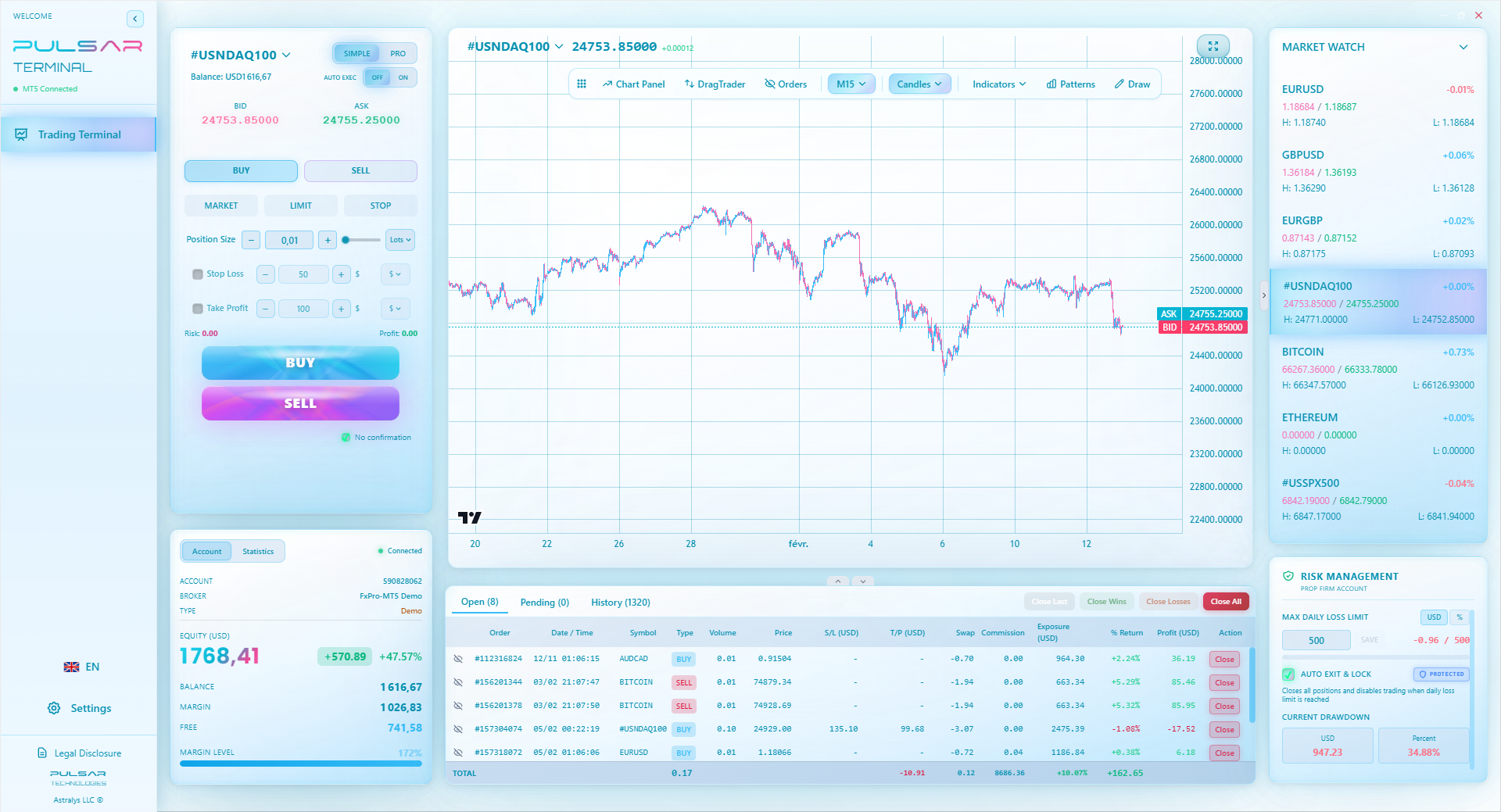
Manually calculating the cost of slippage and spread on every trade is a headache; Pulsar Terminal's advanced trade management shows your exact commission and slippage impact in real-time on your MT5 chart.
Pulsar Terminal
MT5オールインワンツール:ドラッグ&ドロップ注文、マルチTP/SL、トレーリングストップ、グリッドトレード、出来高プロファイル、プロップファーム保護。毎日1,000人以上のトレーダーが利用。
If you think mobile trading is just for checking your balance, you're wrong. In Nigeria, with unstable power and internet, your phone is your trading lifeline. A proper mobile trading app is essential for risk management.
You need to be able to:
- Monitor open positions in real-time.
- Place new market and pending orders.
- Modify existing orders (THIS IS CRITICAL). Moving your stop-loss to breakeven or trailing a profit must be possible.
- Set price alerts.
The official MT4 and MT5 mobile apps are excellent. They're stripped-down but have all the essential functions. Before you commit to a broker, download their mobile app and test it on your data connection. Can you do everything you need to in under 15 seconds? If not, it's a liability.
I once saved a $1,200 profit because of a good mobile app. I was in a long XAU/USD trade (gold) and had to leave my house during a power outage. Price was approaching a key resistance level on my XAU/USD guide framework. Using the MT5 app on my mobile data, I was able to set a trailing stop of 15 pips as price climbed. It triggered automatically, locking in gains, while I was literally in a danfo bus in Lagos traffic. Without that functionality, I'd have been sweating bullets.
💡 ウィンストンのヒント
If you wouldn't be comfortable closing a trade on the platform's mobile app during a NEPA outage, you're using the wrong platform. Test that scenario in demo.
“A 3-pip spread means you start a standard lot trade $30 in the hole. That's not a cost, it's a handicap.”
This is the most important section. The platform's security and the broker's regulatory status protect your capital.
Platform Security: MT4/MT5 connections are encrypted. Your login is secure. However, the weak link is often YOU. Never use the same password on your trading account as elsewhere. Enable two-factor authentication (2FA) if the broker offers it. I don't care if it's a hassle.
Broker Regulation: In Nigeria, the SEC provides some oversight, but for forex, the strongest consumer protections come from international regulators.
- Top Tier: UK's FCA, Australia's ASIC, Cyprus's CySEC (for EU brokers). These require client funds to be held in segregated accounts, offer compensation schemes, and have strict conduct rules.
- International Tier: Regulators from offshore financial centers like the Seychelles (FSA) or Vanuatu (VFSC). Many good STP brokers use these for their international entities. The protection is less strong than FCA, but it's better than nothing.
The Scam Red Flags:
- A platform that always shows you winning trades in demo but has 'execution issues' in live.
- Difficulty withdrawing profits. If it takes more than 5 business days and a dozen emails, you're in trouble.
- Promises of guaranteed returns or managed account services with sky-high profits.
- A broker that isn't transparent about who regulates them.
Your first line of defense is choosing a reputable broker with a real regulatory license. Your second is using a trusted platform like MT5 where you can verify execution independently. Read our XM review and Pepperstone review to see how established brokers handle regulation and client security.
Don't just sign up. Investigate. Here's your step-by-step.
- Shortlist Brokers: Pick 2-3 reputable international brokers known for serving Nigeria (see our broker reviews). Ensure they offer MT5.
- Open a Demo Account: Do this with ALL of them. Don't just trade. Test.
- The Stress Test:
- Spread Check: During the London session (2-5 PM Nigerian time), compare the live spreads on EUR/USD and your favorite pair. Write them down.
- Execution Test: Place a market order during a moderately busy period. Does it fill instantly? Or do you get a 'requote' message?
- News Reaction: Before a major news event (like US CPI), place a pending order close to the current price. See what happens when the news hits. Does the platform freeze? Does your order fill with massive slippage?
- Mobile Test: Download the app. Can you easily modify an order?
- Check Funding/Withdrawal: Look at their deposit methods for Nigeria. Crypto? Bank transfer? How long do withdrawals take according to user reviews?
- Start Small: Fund your chosen account with the minimum amount. Trade micro lots (0.01) for a month. Withdraw a small profit to test the process. If it's smooth, then consider scaling up.
Remember, the best online forex trading platform for you is the one that disappears into the background. It's fast, reliable, and lets you focus on your analysis and psychology, not fighting with software. Your platform should be a tool, not an adversary.
FAQ
Q1Is MetaTrader 4 or 5 banned in Nigeria?
No, absolutely not. MT4 and MT5 are not banned. The Central Bank of Nigeria (CBN) has issued warnings about unlicensed forex trading and the use of cryptocurrencies for speculation, but the trading platforms themselves are legal software tools. The issue is with the brokers and the funding methods. You can legally download and use MT4/MT5.
Q2What is the minimum deposit for forex trading platforms in Nigeria?
It varies wildly. Local market makers might ask for as little as ₦10,000. Reputable international brokers typically have minimums between $50 and $200 for their standard accounts. For their raw ECN accounts with lower spreads but commissions, the minimum might be $200-$500. My advice? Start with the minimum on a demo account, then the minimum on a live account. Never deposit more than you can afford to lose entirely.
Q3Can I use Bitcoin to fund my trading platform in Nigeria?
Yes, it's one of the most common and efficient ways to fund international broker accounts from Nigeria. Most major international brokers accept cryptocurrencies like Bitcoin (BTC) and Tether (USDT). You buy USDT from a local P2P exchange, then send it to your broker's provided crypto wallet address. Deposits are usually confirmed within an hour. Withdrawals work the same way in reverse. It bypasses the traditional banking restrictions.
Q4Why does my platform keep freezing or logging me out?
This is usually one of three problems: 1) A poor internet connection on your end (common in Nigeria). 2) An overloaded server on your broker's end (common with cheap brokers during high volatility). 3) An outdated version of the platform software. First, update your MT4/MT5. Second, contact your broker's support and ask if they have alternative server addresses you can connect to. If the problem persists, it's a strong sign you need a better broker.
Q5What is a VPS and do I need one for trading in Nigeria?
A VPS (Virtual Private Server) is a remote computer you rent that runs 24/7. You install your trading platform and EAs on it. For Nigerian traders with unreliable power or internet, a VPS is a game-saver. It ensures your trades and automated strategies run non-stop. Most serious brokers offer a free VPS if you maintain a certain account balance (e.g., $500) or trading volume. If you're running EAs or trade frequently, it's worth it.
Q6How do I know if my broker's platform prices are real?
Compare them. Open a demo account with two different brokers from your shortlist. Pull up the same currency pair, like EUR/USD, on the 1-minute chart. Watch the bid/ask prices side-by-side for 15 minutes. They should be nearly identical, with maybe a 0.1-0.2 pip difference. If one broker's prices are consistently several pips away from the other, or slow to react to clear price movements, their feed is likely manipulated. This is a major red flag.
ウィンストン教授のレッスン
重要ポイント:
- ✓Prioritize MT5 over MT4 for future-proofing and better features.
- ✓Choose international ECN/STP brokers for tighter spreads & fair execution.
- ✓Test platform execution during high volatility, not calm markets.
- ✓Use crypto (USDT) for efficient funding and withdrawals.
- ✓A stable mobile app is non-negotiable for Nigerian traders.
この記事はどれくらい役に立ちましたか?
星をクリックして評価
週刊トレーディングインサイト
無料の週刊分析&戦略。スパムなし。
著者について
Olumide Adeyemi
西アフリカ・トレーディングの先駆者
ナイジェリアで最もアクティブなFXトレーディング教育者の一人。ラゴスから8年のトレード経験。アフリカのトレーダー向けの少額資金戦略とプロップファームチャレンジを専門とする。
コメント
リスク警告
金融商品の取引には大きなリスクが伴い、すべての投資家に適しているわけではありません。過去の実績は将来の結果を保証するものではありません。本コンテンツは教育目的のみであり、投資助言として解釈すべきではありません。取引前に必ずご自身で調査を行ってください。
こちらもおすすめ

Cara Trading Forex Sukses: 7 Prinsip dari Trader Profesional
Cara trading forex sukses dengan 7 prinsip trader pro: manajemen modal, disiplin, journal trading, backtest. Data nyata, bukan janji profit palsu.
Jam Trading Forex Terbaik untuk Trader Indonesia: Panduan Lengkap dengan Tabel Waktu
Panduan jam trading forex untuk trader Indonesia. Tabel 4 sesi dunia, jam emas 20:00-00:00, sesi mana yang harus dihindari. Data akurat + tips dari trader berpengalaman.
Top 5 Sàn Forex Uy Tín Nhất 2026: Review Jujur dari Trader Indonesia
Top 5 sàn forex uy tín 2026 untuk trader Indonesia. Review jujur: spread, deposit, withdraw, dukungan lokal. Exness, XM, IC Markets & lebih.
