


Here's a number that should sober you up: roughly 7 out of every 10 South Africans who trade forex lose money.

David van der Merwe
新興市場トレーダー ·  South Africa
☕ 9 分で読める
学べること:
Here's a number that should sober you up: roughly 7 out of every 10 South Africans who trade forex lose money. That's the cold, hard truth from a 2020 study. While the market here is booming, with over 200,000 active traders and daily volumes in the billions, the percentage of profitable forex traders remains stubbornly low. This isn't a guide to get-rich-quick schemes. It's a raw look at why most fail, what the 15-20% who succeed actually do differently, and how you can tilt the odds in your favour. Forget the Instagram hype. Let's talk reality.
Let's cut through the noise. The global stats are grim: 70-90% of retail forex traders lose in the long run. For our region, Africa and the Middle East, the success rate for consistent profits sits between 15% and 20%. That means, at best, one in five.
But let's get local. A December 2020 study gave us a stark snapshot: 69% of South African forex-only traders lost money. Of those losers, 64% lost R9,999 or less. That's a lot of people burning through a month's salary or a decent bonus. The kicker? In the same study, stocks-only traders had a 69% chance of making money. That's a complete flip. It tells you something about the inherent difficulty and use-fuelled pitfalls of the forex game versus other markets.
Now, here's the glimmer of hope from that data: traders with more than two years of experience had a 63% chance of making money. Time and survival seem to be the greatest teachers. The initial percentage of profitable forex traders is tiny, but it grows for those who stick around and learn the right lessons.

Warning: Don't confuse a lucky streak with skill. I've seen guys make 50% in a month on pure adrenaline and use, only to blow their entire account the next. Consistency over years is the only metric that counts.

💡 ウィンストンのヒント
If you can't articulate the exact reason for your entry, stop-loss, and take-profit before clicking 'buy,' you're not trading. You're gambling. Write it down first.
It's easy to blame the market or your broker. The real reasons are usually closer to home.
The use Trap
South Africa's regulatory environment, governed by the Financial Sector Conduct Authority (FSCA), is solid for client protection but doesn't cap use like Europe or the US. You can get 1:500, even 1:1000. This is a double-edged sword sharper than a Rambo knife. A R10,000 account with 1:500 use controls R5 million. A 0.2% move against you wipes out your entire capital. Most newcomers don't respect this math. They see the buying power, not the risk. I learned this the hard way in 2015. I put on a USD/ZAR trade with too much size, convinced the Rand would weaken. A sudden, sharp rally triggered a margin call before I could blink. I lost R8,000 in minutes - a brutal but necessary lesson.
Chasing the 'Quick Fix' Mentality
There's a cultural allure to the 'smart ou' who beats the system. This leads to chasing 'sure thing' signals, martingale systems, or revenge trading after a loss. The market doesn't care about your ego or your need to get even before the braai fires up.
Ignoring the Real Cost of Trading
It's not just spreads. It's commissions, overnight swap fees (which can be massive on ZAR pairs), and slippage. Trading USD/ZAR with a 5-pip spread? You're down R50 on a standard lot before the trade even starts moving. You need the market to move in your favour just to break even. Most beginners don't factor this in, and it silently eats their account. Always use a position size calculator that includes costs.
“Your first R100,000 in trading shouldn't be about making money. It should be about *not losing it*.”
So, who are these people in the profitable minority? They aren't mystical geniuses. They follow a boring, disciplined checklist.
They Treat It Like a Business, Not a Casino. Every trade has a pre-defined plan: entry, stop-loss, take-profit. They know their risk per trade (usually 1-2% of capital) and never deviate. Their trading journal is their most important tool.
They Specialise. They don't trade 28 pairs. They might master two or three. Maybe they become experts in EUR/USD during the London session, or they understand the unique volatility of Gold (XAU/USD). They know their instrument's personality.
They Manage Risk First, Chase Profits Second. Their primary goal is survival. A winning trader I know in Cape Town aims for a 1:1.5 risk-to-reward ratio as a minimum. He's wrong more than he's right, but his winners are bigger than his losers. Over time, that's all that matters.
They Have Patience (and a Day Job). Many successful retail traders I've met don't rely on trading for income. It's a side hustle that grows over years. This removes the desperate, "I need to make rent" pressure that destroys rational decision-making.

Pro Tip: Your first R100,000 in trading shouldn't be about making money. It should be about not losing it. Consider that tuition fee well spent if you learn discipline and survive.
Trading from SA comes with its own quirks. You need to know the lay of the land.
Trading the ZAR: You'll be tempted to trade USD/ZAR or EUR/ZAR. Be warned: these are exotic pairs. Spreads are wide (5 pips on USD/ZAR, 14+ on EUR/ZAR is common). Liquidity can dry up, causing nasty slippage around local news or load-shedding announcements (seriously). I once got slipped 22 pips on a EUR/ZAR entry during a SARB announcement. My planned 1% risk became a 2.5% loss instantly.
Broker Choice is Critical. You want an FSCA-regulated broker for peace of mind - your funds are segregated. But look beyond regulation. Compare their raw costs on your preferred pairs.
| Broker Feature | What to Look For | Why It Matters for Profitability |
|---|---|---|
| Spreads on Majors | As low as possible (e.g., 0.0 - 0.3 pips on EUR/USD) | Lower costs mean less market movement needed to profit. Check reviews for Pepperstone or IC Markets. |
| Spreads on USD/ZAR | 5 pips or lower is competitive. | A huge factor if you trade the Rand. |
| Deposit/Withdrawal | Local bank transfer (EFT) with low/no fees. | You don't want your profits eaten by R200 withdrawal charges. |
| use Offered | Enough for your strategy, but don't use the max. | Just because you can get 1:500 doesn't mean you should. |
Tax Implications: Remember, SARS wants its share. Profits from trading are considered income tax, not capital gains. Keep careful records of all trades, wins, and losses.
💡 ウィンストンのヒント
Your first profitable month is your most dangerous period. That's when overconfidence creeps in and destroys all your rules. Stay small.
“The market doesn't care about your ego or your need to get even before the braai fires up.”
Want to move from the 80% to the 20%? Here's a no-BS starting plan.
Phase 1: Demo & Education (Months 1-3) Don't touch real money. Pick one major pair. Paper trade a simple strategy based on price action or one indicator like the RSI indicator or MACD indicator. Your goal is to execute your plan flawlessly 100 times, not to make fake money.
Phase 2: Micro-Live Trading (Months 4-6) Deposit the minimum - maybe R500 or R1000. Open a cent account or a nano lot account if your broker offers it. Your goal is to make 10 consecutive trades following your plan, risking no more than 2% per trade. The financial amount is irrelevant; the psychological pressure is real. This is where you learn about slippage, emotions, and execution.
Phase 3: Scaling & Specialisation (Month 6+) Once you have a proven, positive track record over at least 100 micro trades, you can consider adding capital. This is where you decide your path: are you a scalping strategy person who loves fast action, or a swing trading type who holds for days? Double down on that style.
My Personal Mistake: I skipped Phase 2. I went from demo to a R10,000 account. I was so focused on the Rand amount that I broke every rule. I turned a R1,500 loss into a R4,000 disaster by moving my stop-loss. That R2,500 was the cost of skipping the micro-trading lesson.
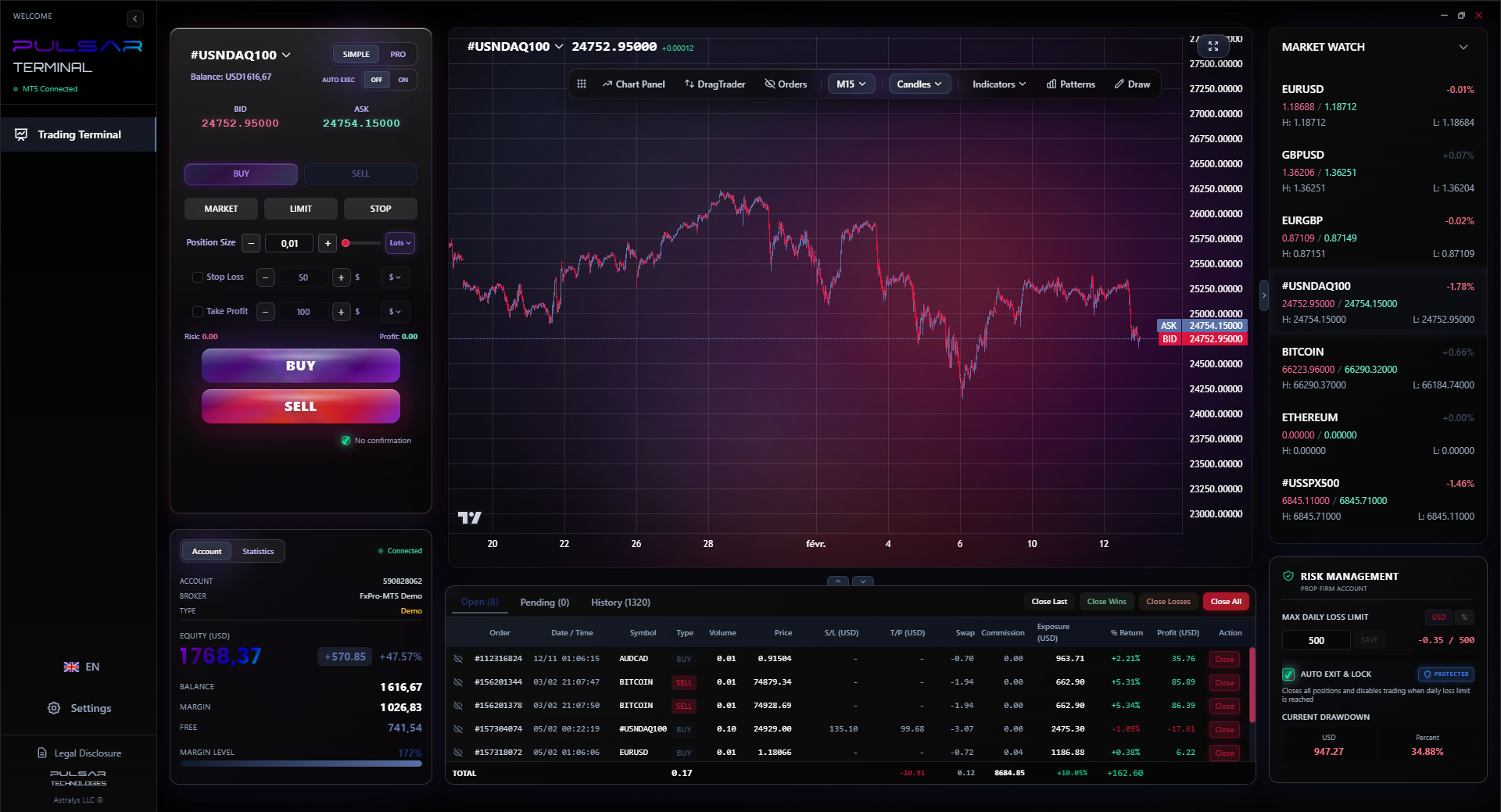
Executing a disciplined plan is hard when emotions run high, which is why automating risk management with tools like Pulsar Terminal can be a game-saver.
Pulsar Terminal
MT5オールインワンツール:ドラッグ&ドロップ注文、マルチTP/SL、トレーリングストップ、グリッドトレード、出来高プロファイル、プロップファーム保護。毎日1,000人以上のトレーダーが利用。
This is the final boss. Your strategy might be perfect, but your mind will sabotage you.
Fear of Missing Out (FOMO): You see USD/ZAR ripping higher. You jump in late, without a plan, near the top. It reverses, and you're stuck in a losing trade. The winning 15% wait for their setup, even if it means watching a move go by.
Revenge Trading: You take a loss. Your ego is bruised. You immediately jump into another trade to 'win it back,' usually with bigger size. This is the fastest route to a blown account. The pros have a rule: after two consecutive losses, walk away for the day.
Overconfidence After a Win: This is just as dangerous. You make a great 3% gain. You start thinking you're a legend. Your next trade is twice your normal size because 'you're on a roll.' The market humbles you quickly.
The solution is ritual and rules. Have a pre-market checklist. Use a trading journal to log not just trades, but your emotional state. "Felt anxious because of earlier loss, took trade anyway, broke risk rule." This feedback loop is priceless.

Example: You have a R20,000 account. Your risk per trade is 1% (R200). On USD/ZAR with a 5-pip spread, your risk (including spread) is, say, 25 pips. Your position size should be: R200 / (25 pips * R1 per pip per micro lot) = 8 micro lots (0.08 standard lots). Not 1 standard lot because 'it feels right.'
“A winning trader I know is wrong more than he's right, but his winners are bigger than his losers. Over time, that's all that matters.”
Look, the percentage of profitable forex traders is low for a reason. It's incredibly hard. It demands discipline most people simply don't have. It's a marathon of constant learning and emotional control.
For most South Africans, putting that time and energy into advancing your career or building a side business will yield a better, more predictable return. Forex trading is not a career path; it's a high-risk skill.
But if you're fascinated by markets, have a mathematical mind, and possess monk-like patience, you can learn the craft. Start with the expectation that you will pay to learn - not just with money, but with time and frustration. Your goal for the first year shouldn't be profitability. Your goal should be to still be in the game, with your capital intact, ready for Year Two. That alone would put you ahead of the vast majority.
The market doesn't owe you anything. It's just a mechanism. Your job is to build a system that can extract small, consistent edges from that mechanism, without letting your own brain get in the way. That's what the 15% have figured out.
💡 ウィンストンのヒント
The spread isn't just a cost; it's the market's head start against you. If your broker's spread on your chosen pair is consistently high, you're fighting an uphill battle before you even begin.
FAQ
Q1What is the actual percentage of profitable forex traders in South Africa?
Recent regional estimates put the percentage of consistently profitable retail forex traders in Africa and the Middle East between 15% and 20%. A 2020 South African study found 69% of forex-only traders lost money.
Q2Why is the success rate for forex traders so low compared to stock traders?
Forex often involves much higher use, operates 24/5 leading to overtrading, and has a culture geared towards short-term speculation. The 2020 SA study showed stocks-only traders had a 69% chance of profit, a complete reversal of the forex stats, highlighting the impact of these factors.
Q3What's the biggest mistake new South African forex traders make?
Misusing high use. With brokers offering 1:500 or more, a tiny move can wipe out an account. They see the buying power, not the existential risk. Combined with not understanding costs like the wide spreads on ZAR pairs, it's a recipe for quick losses.
Q4How much money do I need to start forex trading in South Africa?
You can start with very little - some brokers like XM allow $5 deposits. But realistically, to trade properly (using sensible risk management on micro lots), a starting capital of R2,000-R5,000 is more practical. Consider this tuition money you're willing to lose while learning.
Q5Does more experience increase my chances of being profitable?
Absolutely. The same SA study showed traders with more than two years of experience had a 63% chance of making money, a huge jump from the overall average. Survival and continuous learning are the key differentiators.
Q6Should I trade the South African Rand (USD/ZAR)?
Be cautious. It's an exotic pair with wider spreads (often 5+ pips) and can be volatile around local news. It's not a beginner-friendly pair. Most successful traders start with major pairs like EUR/USD where costs are lower and liquidity is higher.
Q7Is forex trading taxable in South Africa?
Yes. Profits from forex trading are considered income (from a trade) by SARS, not capital gains. You must declare this income and can deduct certain trading-related expenses. Keep detailed records of all your trades.
ウィンストン教授のレッスン
重要ポイント:
- ✓Only 15-20% achieve consistent long-term profits.
- ✓69% of SA forex traders lost money in a 2020 study.
- ✓Experience over 2 years raises profit chance to 63%.
- ✓Misusing high use is the #1 account killer.
- ✓Trade majors first; ZAR pairs have wide, costly spreads.
この記事はどれくらい役に立ちましたか?
星をクリックして評価
週刊トレーディングインサイト
無料の週刊分析&戦略。スパムなし。
著者について
David van der Merwe
新興市場トレーダー
ヨハネスブルグ拠点で新興市場通貨11年のトレーダー。ZARペア、FSCA規制下の取引、南アフリカ市場分析を専門とする。
コメント
リスク警告
金融商品の取引には大きなリスクが伴い、すべての投資家に適しているわけではありません。過去の実績は将来の結果を保証するものではありません。本コンテンツは教育目的のみであり、投資助言として解釈すべきではありません。取引前に必ずご自身で調査を行ってください。
こちらもおすすめ

Cara Trading Forex Sukses: 7 Prinsip dari Trader Profesional
Cara trading forex sukses dengan 7 prinsip trader pro: manajemen modal, disiplin, journal trading, backtest. Data nyata, bukan janji profit palsu.
Jam Trading Forex Terbaik untuk Trader Indonesia: Panduan Lengkap dengan Tabel Waktu
Panduan jam trading forex untuk trader Indonesia. Tabel 4 sesi dunia, jam emas 20:00-00:00, sesi mana yang harus dihindari. Data akurat + tips dari trader berpengalaman.
Top 5 Sàn Forex Uy Tín Nhất 2026: Review Jujur dari Trader Indonesia
Top 5 sàn forex uy tín 2026 untuk trader Indonesia. Review jujur: spread, deposit, withdraw, dukungan lokal. Exness, XM, IC Markets & lebih.
