


Here's a brutal truth: over 70% of Nigerian retail forex traders lose money.

Olumide Adeyemi
西アフリカ・トレーディングの先駆者 ·  Nigeria
☕ 11 分で読める
学べること:
- 1What Exactly Is a Pip? (It's Not What You Think)
- 2Calculating Pip Value in Naira (Your Survival Math)
- 3From Pips to Profit & Loss: Real Trade Examples
- 4How Spreads & use Turn Pips Against You
- 5Common Nigerian Trader Mistakes with Pips
- 6Practical Application: Building a Pip-Based Risk System
- 7Beyond Basics: Pipettes, CFDs, and Index Points

Here's a brutal truth: over 70% of Nigerian retail forex traders lose money. The single biggest reason isn't a bad strategy or market timing. It's a fundamental misunderstanding of the basic unit of measurement: the pip. If you don't know exactly what a pip is, how to calculate its value in Naira, and how it interacts with use, you're not trading. You're gambling with extra steps. This guide will strip away the confusion and show you how to use the concept of a pip to actually protect your capital.
A pip, short for 'Percentage in Point,' is the smallest price move a currency pair can make. It's the heartbeat of the market. For most pairs like EUR/USD or GBP/USD, that's a move at the fourth decimal place: 0.0001.
If EUR/USD moves from 1.1050 to 1.1051, that's a one-pip gain. Simple, right? Here's where Nigerians get tripped up. For pairs with the Japanese Yen (JPY), like USD/JPY, the pip is at the second decimal place: 0.01. A move from 154.01 to 154.02 is one pip.

Example:
- EUR/USD: 1.1050 → 1.1051 = +1 pip
- USD/JPY: 154.01 → 154.02 = +1 pip
Now, brokers show an extra digit, a 'pipette.' That's a tenth of a pip. So, EUR/USD moving from 1.10500 to 1.10501 is a 1-pipette move. Don't get lost in the decimals. For all your core calculations - profit, loss, risk - you work in full pips. The pipette just gives you a more precise entry or exit.
Why does this matter? Because your entire risk management framework, from your position size calculator to your stop-loss placement, is built on this foundation. Misplace a decimal, and you've just risked ₦100,000 instead of ₦10,000.
“If you don't know exactly what a pip is and how to calculate its value in Naira, you're not trading. You're gambling with extra steps.”
This is the most important math you'll do. Knowing a pip moved is useless if you don't know what it's worth in your pocket. The formula changes based on your account currency and the pair you're trading.
For Naira-Denominated Accounts
If you have a rare NGN account and are trading a pair where USD is the quote (second) currency, like EUR/USD:
- Standard Lot (100,000 units): (0.0001 / 1.0) * 100,000 = $10 per pip.
- Convert that $10 to Naira at the current rate. At ₦1,450/$, that's ₦14,500 per pip.
A one-pip move on a standard lot just swung your account by a decent civil servant's monthly salary. That's the power of use, and it's why people blow up.
For USD-Denominated Accounts (More Common)
Most Nigerians use USD accounts with brokers like Exness or IC Markets. The calculation is simpler for major pairs:
- Standard Lot: $10 per pip
- Mini Lot (0.10): $1 per pip
- Micro Lot (0.01): $0.10 per pip

Warning: Never, ever trade a standard lot with a $100 account. A 10-pip move against you wipes out 100% of your capital. That can happen in seconds during news. Start with micro lots. Always.
The NGN Pairs Quirk
If you're trading USD/NGN (which some brokers offer), remember the JPY rule. Because the Naira is a low-value unit, the pip is likely at the second decimal. A move from ₦1,450.00 to ₦1,450.01 is one pip. Its value would be massive. This is why trading the Naira directly is extremely risky and less common for retail.
The key takeaway? Before you click 'buy,' you must know: "If this trade goes 10 pips against me, how much Naira do I lose?" If you don't have that number, you have no business being in the trade. Use a position size calculator religiously.

💡 ウィンストンのヒント
A pip is a unit of measurement, not a unit of value. The rookie focuses on how many pips they can make. The pro focuses on how many Naira they can afford to lose per pip.
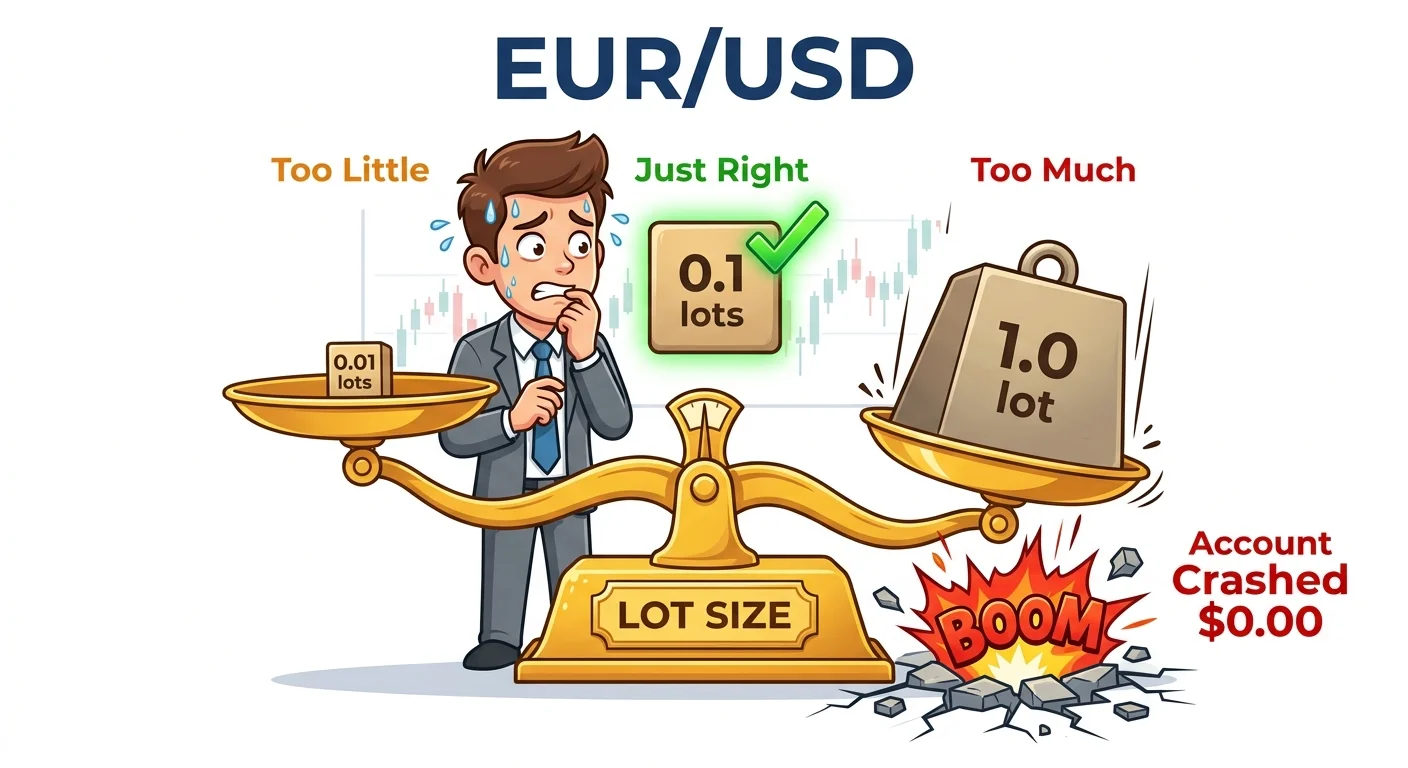
“That 10-pip move just made or lost 10% of your margin. This is how accounts evaporate.”
Let's make this real with numbers from my own journal. Theory is clean; the market is messy.
Trade 1: The Good (EUR/USD Scalp)
- Strategy: I was using a basic scalping strategy on a 5-minute chart.
- Entry: Bought EUR/USD at 1.0725.
- Stop Loss: 1.0715 (10 pips risk).
- Take Profit: 1.0740 (15 pips target).
- Position Size: 2 micro lots (0.02). Pip value = $0.20.
- Outcome: Price hit my take profit at 1.0740.
- Profit Calculation: 15 pips x $0.20 per pip = $3.00 profit.
At ₦1,450/$, that's about ₦4,350. Not life-changing, but it was a 1.5% gain on my $200 risk capital for that trade. The risk was predefined: 10 pips x $0.20 = $2.00 risk (₦2,900). I knew my exact downside before I entered.
Trade 2: The Bad (Gold Revenge Trade) I broke my rules. I lost a trade on XAU/USD (Gold) and got emotional. I re-entered without a clear plan.
- Entry: Sold Gold at $2,340.
- No stop loss. (First mistake).
- Position Size: 1 mini lot (0.10). On Gold, a 1-pip move (which is $0.10 for XAU/USD) on a mini lot is worth $1.
- Outcome: Gold rallied 50 points (pips) against me.
- Loss: 50 pips x $1.00 = $50 lost.
That was ₦72,500 gone in under an hour. Why? I didn't respect the pip. I didn't calculate my risk. I just saw the price moving and chased it. That $50 loss was over 5% of my entire account at the time. It took me two weeks of disciplined trading to earn that back.
The difference between these two trades wasn't luck. It was a cold, hard understanding of what each pip movement meant for my Naira balance.
“That 10-pip move just made or lost 10% of your margin. This is how accounts evaporate.”
Brokers and use aren't your friends. They're facilitators that make money when you trade. Understanding pips shows you the cost.
The Spread: Your Instant Loss The spread definition is the difference between the buy and sell price, measured in pips. If EUR/USD has a 1.2 pip spread, the price must move 1.2 pips in your favor just for you to break even.
Let's say you use XM with a 0.8 pip spread on EUR/USD, and you're scalping for 5-pip profits. That spread eats 16% of your target profit before you even start. If you're using a broker with a 3-pip spread, you're giving away 60% of your potential profit. You're fighting an uphill battle in quicksand. This is why choosing a broker with tight, reliable spreads is non-negotiable for active strategies like scalping.
use: The Double-Edged Sword use magnifies pip value. Nigerian brokers might offer 1:500 or even 1:1000.
- At 1:100 use: To control a 1 mini lot ($10,000 position), you need $100 in margin.
- Pip Value on that mini lot: $1.
- A 10-pip move: = $10 profit or loss.
That 10-pip move just made or lost 10% of your $100 margin. At 1:500 use, the same move would be 50% of your margin. This is how accounts evaporate. use doesn't change the pip value; it changes how much of your own money you're putting on the line to control that value. High use makes it easy to get a margin call from a very small adverse move.

Pro Tip: Use use to reduce your margin requirement, not to increase your trade size. If you'd normally risk ₦5,000 on a trade, use the same risk amount but with higher use to lock up less capital as margin. The risk (in Naira) should stay the same.
💡 ウィンストンのヒント
If you can't state your maximum loss in Naira before entering a trade, you haven't done your job. The market will decide the rest, but you must decide the cost of being wrong.
“The difference between a winning trade and a blown account is often just a misplaced decimal in a pip calculation.”
I've seen these destroy accounts time and again in our local trading communities.
1. Ignoring Conversion to Naira. Traders see a $50 profit and get excited. But when the Naira is at ₦1,450, that's ₦72,500. Conversely, a $100 loss is ₦145,000. You must think in your local currency to understand the real impact on your life. That "small" $5 loss on a micro lot is still a decent meal in Lagos.
2. Misplacing the Decimal on JPY/NGN Pairs. This is a classic blow-up move. Thinking USD/JPY moves in the fourth decimal and placing a stop loss 100 pips away when you meant 10. Your risk calculation just became 10x larger. Always double-check which decimal place is the pip for your specific pair.
3. Not Factoring in Spreads on Short-Term Trades. Trying to scalp 3-5 pips on a pair with a 2-pip spread is a losing game. You're paying the broker more than you're trying to make from the market. It's a tax on desperation.
4. Letting Profits Run (in Pips) Without a Target. You catch a 20-pip move, get greedy, and watch it retrace to breakeven. You just turned a winning trade into a waste of time and stress. Have a profit target based on your strategy, not your emotions. A tool that lets you set multiple take-profit levels can help lock in partial profits as the market moves, which is a core feature of professional trading software.
5. Using Standard Lots with Small Capital. This is the fastest path to zero. With a $500 account and a standard lot, a 5-pip move is $50 - a 10% account swing. The market noise will wipe you out before any trend has a chance to develop. Stick to micro and mini lots until your capital is substantial.
“The difference between a winning trade and a blown account is often just a misplaced decimal in a pip calculation.”
Here’s how to use the pip meaning in forex to build an unbreakable risk system. This is what saved my trading career after that gold disaster.
Step 1: Define Your Maximum Risk Per Trade. This is a percentage of your account. Never more than 1-2%. Let's say 1% of a ₦500,000 account = ₦5,000 max risk.
Step 2: Find Your Trade Setup and Stop Loss in Pips. You're looking at a GBP/USD swing trading setup. Your analysis says a logical stop loss is 25 pips away from your entry.
Step 3: Calculate the Pip Value in Naira That Keeps You Safe.
- Max Risk (Naira): ₦5,000
- Stop Loss Distance (Pips): 25
- Allowed Pip Value: ₦5,000 / 25 pips = ₦200 per pip
Step 4: Find the Lot Size That Matches This Pip Value.
- GBP/USD pip value on a 1 standard lot is roughly $10 ≈ ₦14,500 (too high).
- On a 1 mini lot (0.10): ~$1 ≈ ₦1,450 (still too high).
- On a 0.01 micro lot: ~$0.10 ≈ ₦145.
To get close to our ₦200 per pip target, we need a position size of about 0.014 lots. Most platforms let you enter this. So, you'd buy 0.014 lots of GBP/USD.
The Result: If your 25-pip stop loss is hit, you lose 25 pips x ₦200 = ₦5,000, which is exactly 1% of your account. You've controlled the disaster. The market can't take more from you than you agreed to give. This is the power of understanding pips. It transforms you from a gambler hoping for the best into a risk manager who plans for the worst.
Automating this process - where your position size is automatically calculated based on your stop-loss distance and predefined risk percentage - eliminates emotional math errors. It's one less thing to get wrong when the market is moving fast.
💡 ウィンストンのヒント
use is a margin tool, not a profit amplifier. Use it to keep your capital efficient, not to pretend you have more money than you do. The pip value tells the true story of your exposure.

Manually calculating position size for every trade is error-prone; Pulsar Terminal automates this based on your stop-loss distance and risk percentage directly on your MT5 chart.
Pulsar Terminal
MT5オールインワンツール:ドラッグ&ドロップ注文、マルチTP/SL、トレーリングストップ、グリッドトレード、出来高プロファイル、プロップファーム保護。毎日1,000人以上のトレーダーが利用。
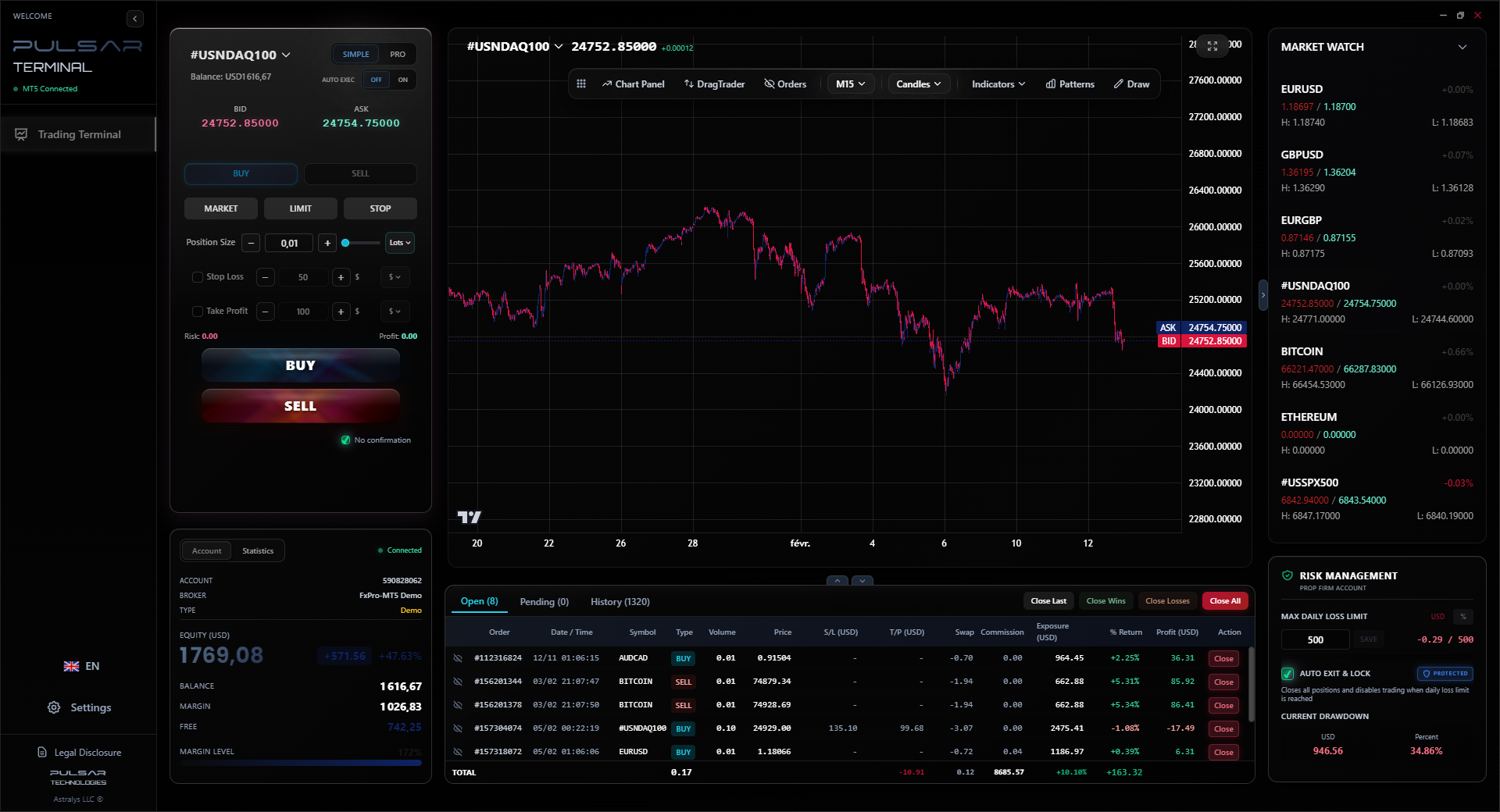
“You must think in your local currency to understand the real impact of a $50 loss on your life in Lagos or Abuja.”
Once you've mastered the standard pip, you'll encounter its cousins.
Pipettes: As mentioned, a pipette is 1/10th of a pip. It's shown in the fifth decimal for most pairs (e.g., 1.10501). It allows for tighter spreads and more precise order placement. When a broker advertises a spread of '0.6' on EUR/USD, they usually mean 0.6 pips, which is 6 pipettes. Don't let it confuse you. For your core risk math, still use full pips.
CFDs on Stocks & Indices: You're not trading pips here. You're trading the actual price movement of the asset.
- US Tech Stocks (e.g., Tesla): Movement is in dollars and cents. If you buy a Tesla CFD at $250.00 and it moves to $252.00, you've gained $2.00 per share.
- Indices (e.g., US30 for Dow Jones): Movement is in points. A move from 39,000 to 39,100 is a 100-point gain. The monetary value per point varies by broker and contract size. It's crucial to check your broker's specs. A 100-point move on the US30 could be worth $500 or $5, depending on your contract size - a massive difference.
The principle remains: Know the value of the smallest price movement before you trade. Whether it's a pip, a point, or a cent, you must know what it means for your Naira balance. Confusing a point for a pip on an index trade is another surefire way to incinerate your account. Always, always check the contract specifications or use a demo account to verify the value of a single unit of movement.
FAQ
Q1How much is 1 pip in Naira?
It depends entirely on the currency pair and your trade size. For a micro lot (0.01) on EUR/USD with a USD account, 1 pip is about $0.10. At an exchange rate of ₦1,450/$, that's roughly ₦145. For a standard lot, it would be ₦14,500. You must calculate it for each specific trade using a pip calculator or the formula in this guide.
Q2Is trading forex legal in Nigeria?
Yes, forex trading is legal for individuals in Nigeria. However, the Central Bank of Nigeria (CBN) does not provide forex for this purpose. Most Nigerian traders use international brokers regulated abroad (like FCA, ASIC). You are required to pay a 10% Capital Gains Tax on your profits to the Federal Inland Revenue Service (FIRS).
Q3What's the difference between a pip and a pipette?
A pipette is one-tenth of a pip. For most pairs, a pip is at the 4th decimal (1.1050), while a pipette is at the 5th (1.10500). Brokers use pipettes to quote tighter spreads. For your profit, loss, and risk calculations, you should primarily work in full pips to avoid confusion.
Q4How many pips should I aim for per day?
This is the wrong question. You should aim for consistent execution of your strategy, not a pip target. Some days the market gives 100 pips, some days it takes 50 back. Focusing on a daily pip target leads to overtrading and forcing bad trades. Focus on risk management (e.g., never lose more than 1% per trade) and let the profits come from your edge over many trades.
Q5Why did I make 20 pips but my profit is so small?
Two main reasons: 1) Your trade size was too small (e.g., you traded a micro lot where 1 pip = $0.10, so 20 pips = $2). 2) The spread was wide. If you paid a 3-pip spread, your 20-pip gain is effectively a 17-pip gain after costs. Always know your pip value and your broker's typical spread on that pair.
Q6Can I trade forex with 10,000 Naira?
Technically, yes. Some brokers have very low minimum deposits. But practically, it's extremely difficult. With ₦10,000 (about $6.90), even micro lots pose significant risk due to use. A 10-pip loss on a micro lot could be over 10% of your capital. It's better to save until you have at least ₦150,000-₦300,000 ($100-$200) to allow for proper position sizing and withstand normal market volatility without being margin called immediately.
Q7Do cryptocurrencies like Bitcoin use pips?
No. Cryptocurrencies are quoted in their full price (e.g., Bitcoin at $65,432.10). The smallest move is typically 0.01 (a cent) for most crypto CFDs. The concept is similar - you need to know the value of a $1 move in Bitcoin based on your position size - but the term 'pip' is not used. The value of a $1 move can be very large, so extreme caution is needed.
ウィンストン教授のレッスン
重要ポイント:
- ✓A pip is 0.0001 for most pairs, 0.01 for JPY & NGN pairs.
- ✓1 standard lot pip = ~$10 (₦14,500+). Never start here.
- ✓Calculate risk in Naira first, then work backwards to your lot size.
- ✓The spread, measured in pips, is your first and silent opponent.
- ✓High use magnifies pip value, turning small moves into account killers.
この記事はどれくらい役に立ちましたか?
星をクリックして評価
週刊トレーディングインサイト
無料の週刊分析&戦略。スパムなし。
著者について
Olumide Adeyemi
西アフリカ・トレーディングの先駆者
ナイジェリアで最もアクティブなFXトレーディング教育者の一人。ラゴスから8年のトレード経験。アフリカのトレーダー向けの少額資金戦略とプロップファームチャレンジを専門とする。
コメント
リスク警告
金融商品の取引には大きなリスクが伴い、すべての投資家に適しているわけではありません。過去の実績は将来の結果を保証するものではありません。本コンテンツは教育目的のみであり、投資助言として解釈すべきではありません。取引前に必ずご自身で調査を行ってください。
こちらもおすすめ

Cara Trading Forex Sukses: 7 Prinsip dari Trader Profesional
Cara trading forex sukses dengan 7 prinsip trader pro: manajemen modal, disiplin, journal trading, backtest. Data nyata, bukan janji profit palsu.
Jam Trading Forex Terbaik untuk Trader Indonesia: Panduan Lengkap dengan Tabel Waktu
Panduan jam trading forex untuk trader Indonesia. Tabel 4 sesi dunia, jam emas 20:00-00:00, sesi mana yang harus dihindari. Data akurat + tips dari trader berpengalaman.
Top 5 Sàn Forex Uy Tín Nhất 2026: Review Jujur dari Trader Indonesia
Top 5 sàn forex uy tín 2026 untuk trader Indonesia. Review jujur: spread, deposit, withdraw, dukungan lokal. Exness, XM, IC Markets & lebih.
