


Let's cut through the hype.

James Mitchell
シニアトレーディングアナリスト
☕ 10 分で読める
学べること:
- 1What Are 'Prop Firm Stocks' Anyway? (It's Not What You Think)
- 2The Real Cost: It's More Than Just the Challenge Fee
- 3Rules Designed For You To Fail (The Fine Print)
- 4A Better Path: Building Your Own 'Prop Firm' (Your Live Account)
- 5If You Insist on Trying Prop Firms: A Tactical Guide
- 6Tools & Instruments: What Actually Works
- 7The Psychological Warfare (This is the Real Battle)
- 8Final Verdict & Your Actionable Steps

Let's cut through the hype. You see those slick ads promising six-figure funded accounts to trade 'prop firm stocks.' The reality? It's a minefield. Most retail traders blow their evaluation accounts before they ever see a real dollar. I've been there, I've traded with real prop capital, and I've watched countless others fail. This isn't about gatekeeping; it's about saving you time, money, and a whole lot of frustration. We're going to break down what 'prop firm stocks' actually means, why the structure is stacked against you, and what you should really be focusing on.
First, let's clear up the terminology. When people say 'prop firm stocks,' they're usually talking about one of two things, and neither is you directly buying shares of a proprietary trading firm.
The Instrument: They mean the stocks you're allowed to trade once you get funded by a prop firm. Think Apple, Tesla, Microsoft – the usual liquid, high-volume names. These firms aren't letting you punt on penny stocks with their capital.
The Business Model: This is the real 'stock.' You're buying a very expensive, very restrictive option. You pay a fee (anywhere from $50 to $500+) for a 'challenge' or 'evaluation.' Pass their rules, and you get a simulated account with a large balance (e.g., $100k). Trade profitably under their constraints, and you may earn a split of the profits. You never own the capital; you're renting the right to try and perform.

Warning: The vast majority of these 'funded trader' programs make their money from the challenge fees, not from your trading profits. That should tell you everything about where their incentives lie.
I learned this the hard way early on. I paid for a $200 'challenge' to trade what they called 'prop firm stocks.' I was up $1,200 in the first two days trading NVIDIA. Got cocky. Then I broke their daily loss rule on a single bad Tesla swing and was instantly disqualified. Poof. $200 gone, and nothing to show for the profit. The house always wins that first bet.
Let's talk numbers, because this is where the dream meets a spreadsheet. That $100k 'account' they offer? It's phantom money. Your real risk is your challenge fee plus your time.
The Fee Structure Trap
You see a $100k account for a $299 challenge. Sounds like a great deal, right? 334-to-1 'use' on your fee! Except it's not. You need to hit a profit target (often 8-10%) while adhering to strict drawdown rules (usually 5-10% max, sometimes including daily loss limits). The statistical probability of a typical retail trader achieving this is brutally low. One study of public results from a major firm showed pass rates below 15%. You're playing a high-stakes video game where one 'Game Over' screen costs you hundreds.
The Hidden Opportunity Cost
This is the killer. The weeks or months you spend hyper-focused on passing a challenge, tweaking a strategy just to fit their arbitrary rules, is time you're NOT spending building your own capital and your own strong trading plan. I spent three months in 2020 jumping between challenges. Total cost in fees: around $900. Total earned: $0. The time I wasted? Priceless. I could have grown my own $5k account by 20% in that time with less pressure.

Example: Let's say you attempt four $250 challenges a year. You're risking $1,000 in hard cash. If your own live $10,000 account made a conservative 15% annual return, that's $1,500 in real, keepable profit. The prop firm path often has you chasing monopoly money while ignoring real money on the table.
Using a solid position size calculator based on your real capital is a far better use of your energy than trying to game a prop firm's simulated rules.

💡 ウィンストンのヒント
If you wouldn't risk $500 of your own money on a single trade idea, why would you risk a $500 challenge fee on that same idea? The money is real, even if the account balance isn't.

“The vast majority of 'funded trader' programs make their money from the challenge fees, not from your trading profits.”
Prop firms aren't charities. Their rulebooks are engineered to protect their capital and collect fees. Here's what they don't highlight in the promo videos.
The Daily Loss Limit: This is the silent account killer. It might be 5% of your initial balance, calculated at the end of each trading day (EST, CST, GMT – you better know which!). If you're in a losing trade at their snapshot time, even if it recovers an hour later, you're toast. This rule alone invalidates most swing trading strategies for these accounts.
Consistency Rules: Some firms require a minimum number of trading days. Others forbid making all your profit in one or two trades. They're forcing a style of trading that may not suit you, all while you're paying for the privilege.
The Scaling Plan Mirage: "We'll increase your capital!" Sure, after you've jumped through 50 more hoops. The goalposts keep moving. I once got a funded account, made the 10% profit target for the first payout. The payout was slow, and the pressure to not hit the daily loss limit before it arrived was immense. I felt handcuffed. It's not freedom; it's a stressful job with a terrible boss (their algorithm).
The mental tax is enormous. You're not trading the market; you're trading against their rulebook. This is the opposite of developing the disciplined intuition you need for the long haul.

Here's my controversial opinion: Skip the middleman. Treat your own trading account like a mini prop firm you own 100% of. The principles are the same, but the profits are all yours.
Start with Realistic Capital: You don't need $100k. You need $1,000 or $5,000 and a rock-solid risk management plan. Your first goal is to not blow it up. Your second goal is to make 2-5% a month consistently. That's how you build.
Write Your Own Rulebook: This is the powerful part. Your rules. Your daily loss limit (and yes, you should have one). Your profit targets. No one will close your trades because of a time-zone technicality. A tool like Pulsar Terminal can automate your rules - like a trailing stop or a breakeven trigger - instead of you obeying someone else's.
Focus on the Skill, Not the Simulation: The only metric that matters is your equity curve in a live, real-money environment. The psychological weight of real capital is the best teacher you'll ever have. Every pip definition matters when it's your money on the line. I turned a corner in my career when I stopped looking at funded account dashboards and started obsessing over my own brokerage statement from IC Markets.
Think of the challenge fee money as seed capital for your own firm. A $500 challenge fee could be the first $500 in your new dedicated trading account. That's a real asset you control.
💡 ウィンストンのヒント
The most valuable prop firm is the one you build yourself. Its rules are designed for your success, not its own fee collection.

“You're not trading the market; you're trading against their rulebook.”
Alright, I get it. The allure of 'trading with house money' is strong. If you're going to do it, be smart. Don't just pick the one with the flashiest ads.
Choosing a Firm: Look for transparency in rules and payouts. Read the reviews from actual traders who have been paid, not just affiliate marketers. Firms like FTMO (though not without their critics) have a long track record. Avoid the new pop-up firms with offers that seem too good to be true.
Strategy Adjustment: You must adapt. This means shorter timeframes, tighter stops, and an obsession with the daily loss clock. Scalping strategy becomes more appealing, as you can open and close positions within the same day, controlling your realized P&L before the daily snapshot. Forget about holding a trade through earnings or Fed announcements.
The One-Phase Challenge: Opt for firms offering a one-step evaluation over two-step ones if possible. Fewer stages, fewer fees, fewer hurdles.
Trade the Most Liquid Instruments: Stick to the major EUR/USD guide or big tech stocks. Avoid anything with a wide spread definition or potential for gapping. Your margin for error is zero.
Here’s a brutal truth: The skills that help you pass a prop challenge (extreme short-term discipline, rule adherence) are not the same as the skills that build long-term wealth (patience, conviction, strategic risk-taking). You're training for a sprint when the market is a marathon.

Managing a prop firm's daily loss limit is a constant headache, but Pulsar Terminal can automate your personal daily loss and drawdown rules directly on MT5, so you protect your own capital with the same rigor.
Pulsar Terminal
MT5オールインワンツール:ドラッグ&ドロップ注文、マルチTP/SL、トレーリングストップ、グリッドトレード、出来高プロファイル、プロップファーム保護。毎日1,000人以上のトレーダーが利用。
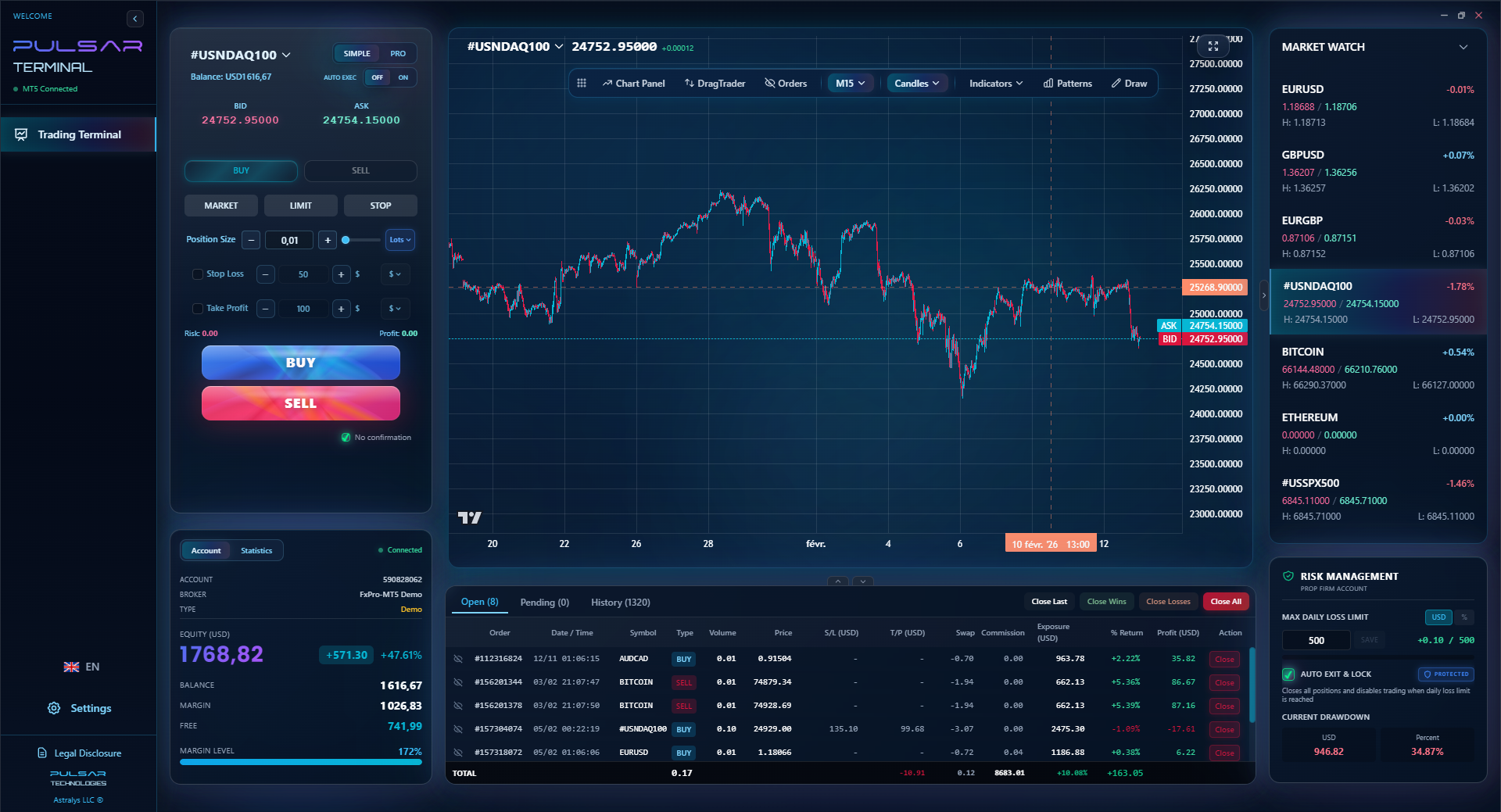
Whether you're going the prop route or building your own, your toolkit is what separates you from the gamblers.
For Analysis: Ditch the 10-indicator madness. Master price action and one or two key indicators. The RSI indicator for momentum and the MACD indicator for trend confirmation are classics for a reason. Use them on higher timeframes (4H, Daily) to find your bias, then drill down.
For Execution: This is critical. You need a broker with reliable execution and tight spreads. Slippage on your entry or exit can mean the difference between passing a daily loss limit or not. I've had good experiences with raw spread accounts at Pepperstone and Exness for forex. For stocks, you need direct market access, not a CFDs shop pretending to offer 'prop firm stocks.'
For Risk Management: This is non-negotiable. Automate it. Use tools that let you set stop-loss and take-profit orders the second you enter a trade. Calculate your position size so that your max loss on any trade is a tiny fraction of your capital (or their challenge account balance). Never wing it.

Pro Tip: If trading gold (XAU/USD) is part of your plan, understand it moves differently than stocks. Get specific knowledge from an XAU/USD guide before risking capital on it, especially in a high-pressure prop firm environment.
💡 ウィンストンのヒント
Spend 10 hours mastering a risk management calculator before you spend 10 minutes picking a prop firm. The former skill pays forever.
“The skills that help you pass a prop challenge are not the same as the skills that build long-term wealth.”
Trading is 80% psychology, 20% method. With prop firms, that ratio shifts to 95% psychology, and it's a toxic mix.
The Scarcity Mindset: You have 'one shot' at the challenge. This leads to overtrading, revenge trading, and abandoning your plan the second you're down a few hundred dollars. Fear becomes your primary motivator.
The Fake Money Mentality: Conversely, when you're up in the challenge, it feels like play money. This can lead to reckless decisions you'd never make with your own savings. You stop respecting the margin call concept because, well, it's not your margin.
The Comparison Trap: You'll see 'funded traders' on social media flaunting payouts. Remember, for every one of them, there are 50 who failed quietly. Comparing your Chapter 1 to someone else's Chapter 20 is a sure path to desperation and bad decisions.
I've felt all of this. The sweaty palms watching the clock tick toward the daily loss snapshot. The elation of a green day, followed by the dread of the next open. It's exhausting. Trading your own account has stress, but it's a clean stress. It's you versus the market. The prop firm game is you versus the market, the firm's rules, the clock, and your own sinking feeling that you're being played.

So, should you trade 'prop firm stocks'? For 95% of you reading this, my answer is a resounding no. Not yet.
Your Action Plan:
- Pause the Prop Dream. Cancel that challenge cart you have open.
- Audit Your Trading. Take your last 50 trades. What's your win rate? Your average win vs. average loss? Be brutally honest. If you're not consistently profitable with real money, a prop firm will incinerate your fees.
- Fund a Small Live Account. Start with an amount you can afford to lose completely. $500, $1000. Open an account with a reputable broker like XM or IC Markets.
- Trade Your Plan. Execute your strategy with real stakes. The goal is not to get funded; the goal is to grow this account by 1% this month. Then 2% next month.
- Re-evaluate in 6 Months. If you've built a steady, small equity curve for half a year, then maybe - maybe - consider a prop challenge as a side hustle. But by then, you might find you don't need it.
The path to being a professional trader isn't through a loophole or a hack. It's through grueling, consistent, disciplined practice with your own capital. Build your own track record. That's the only 'prop firm' that truly matters.
FAQ
Q1What are the best stocks to trade for a prop firm challenge?
The 'best' are the most liquid and predictable. Stick to mega-cap tech (AAPL, MSFT, NVDA, TSLA) and major ETFs like SPY. Avoid biotech, penny stocks, or anything around earnings dates. You need tight spreads and minimal gapping to survive their strict daily loss rules.
Q2Can you actually make a living trading prop firm stocks?
A tiny fraction of people do, but it's a terrible business model for most. The firms can withdraw your funding at any time for rule violations, payouts can be slow, and the constant pressure of evaluations is immense. Building your own account to a sustainable size is a far more reliable and controllable path to a living.
Q3How much money do I need to start with a prop firm?
You need the challenge fee, which can range from $50 to $500+ for a $100k simulated account. But your real 'investment' is the fee plus all your time. Statistically, you'll likely need to pay multiple fees before passing, so budget for failure. That money is often better used as seed capital for your own live account.
Q4What's the biggest mistake traders make with prop firms?
Treating the evaluation account like real money. They either get too scared and under-trade, or they get reckless because it 'isn't real.' Both fail. You must trade the challenge with the same discipline you'd use for your life savings, which is ironically harder to do when the stakes feel artificial.
Q5Are there any prop firms that are legit and trustworthy?
Some have better reputations than others based on longevity and trader payout reports. Firms like FTMO, The5%ers, and Audacity Capital are frequently discussed. However, 'legit' doesn't mean 'easy' or 'profitable for you.' Always read the latest terms and conditions and seek out independent user reviews, not just affiliate sites.
Q6Should I use use when trading a prop firm account?
Use extreme caution. The firms often provide high use (like 1:100). This is a trap for the inexperienced. A 1% move against you can be a 100% loss on your margin. Your position sizing should be so conservative that use is almost irrelevant. Focus on not hitting the drawdown limit, not on maximizing fake gains.
ウィンストン教授のレッスン
重要ポイント:
- ✓Prop firm pass rates are often below 15%.
- ✓Challenge fees are sunk costs, not investments.
- ✓Your own $5k account with a 15% return beats most prop firm outcomes.
- ✓Daily loss limits invalidate most swing trading strategies.
- ✓The psychological tax of prop trading is immense and counterproductive.
この記事はどれくらい役に立ちましたか?
星をクリックして評価
週刊トレーディングインサイト
無料の週刊分析&戦略。スパムなし。
著者について
James Mitchell
シニアトレーディングアナリスト
ニューヨーク拠点で9年以上のトレード経験を持つ。主要USDペア、プロップファームチャレンジ、米国の規制環境を専門とする。
コメント
リスク警告
金融商品の取引には大きなリスクが伴い、すべての投資家に適しているわけではありません。過去の実績は将来の結果を保証するものではありません。本コンテンツは教育目的のみであり、投資助言として解釈すべきではありません。取引前に必ずご自身で調査を行ってください。
こちらもおすすめ

Cara Trading Forex Sukses: 7 Prinsip dari Trader Profesional
Cara trading forex sukses dengan 7 prinsip trader pro: manajemen modal, disiplin, journal trading, backtest. Data nyata, bukan janji profit palsu.
Jam Trading Forex Terbaik untuk Trader Indonesia: Panduan Lengkap dengan Tabel Waktu
Panduan jam trading forex untuk trader Indonesia. Tabel 4 sesi dunia, jam emas 20:00-00:00, sesi mana yang harus dihindari. Data akurat + tips dari trader berpengalaman.
Top 5 Sàn Forex Uy Tín Nhất 2026: Review Jujur dari Trader Indonesia
Top 5 sàn forex uy tín 2026 untuk trader Indonesia. Review jujur: spread, deposit, withdraw, dukungan lokal. Exness, XM, IC Markets & lebih.
