


Here's a hard truth most trading 'gurus' won't tell you: over 90% of retail traders in India lose money, and a big chunk of that loss comes from chasing breakouts that fail.

Rajesh Sharma
シニアFXアナリスト ·  India
India
☕ 11 分で読める
学べること:
- 1What is Pullback Trading? (And Why It Fits India)
- 2Setting Up Pullback Trades on NSE & BSE
- 3The Brutal Math: Costs & Regulations in India
- 4Where to Trade: Best Instruments for Pullbacks in India
- 5Mistakes I've Made (So You Don't Have To)
- 6Brokers, Platforms, and Getting Filled
- 7The Mental Game: Patience is Your Currency

Here's a hard truth most trading 'gurus' won't tell you: over 90% of retail traders in India lose money, and a big chunk of that loss comes from chasing breakouts that fail. The pullback trading strategy in India offers a more patient, often more profitable alternative, but you have to get the local specifics right. I've seen too many students copy a generic YouTube strategy, only to get wrecked by STT charges and margin rules they didn't understand. This guide cuts through the nonsense. We'll look at how to actually identify and trade pullbacks on Indian stocks and indices, factoring in everything from SEBI regulations to the brutal reality of brokerage costs.
A pullback is simply a temporary reversal within a larger trend. Think of it as the market taking a breath. The price is in a solid uptrend, but it dips back slightly before resuming its climb. That dip is your potential entry. It's the opposite of breakout chasing, where you buy after a big move, often at the worst possible price.
Why does this approach suit the Indian markets? Frankly, because our markets can be noisy. News flow, FII/DII activity, and global cues cause constant minor reversals even in strong trends. A pure breakout strategy gets whipsawed to death. A pullback strategy lets you enter with a better risk-to-reward ratio, buying the 'sale' within the trend.

Pro Tip: Don't confuse a pullback with a reversal. A pullback respects the main trend's structure. A reversal breaks it. The difference is everything. I once lost ₹42,000 on a Tata Motors trade because I mistook a clear reversal for a 'shallow pullback'. The stock never looked back.
The core philosophy is simple: trade with the trend, but enter on a counter-trend move. Your job is to spot where that counter-trend move is likely to exhaust itself.
You can't just eyeball this. You need a clear, repeatable process. Here’s the framework I teach, and it works on everything from Nifty 50 stocks to the Bank Nifty index.
Step 1: Identify the Primary Trend
This is non-negotiable. Use the daily chart. Is the stock making higher highs and higher lows (uptrend) or lower highs and lower lows (downtrend)? A simple 20 or 50-period Exponential Moving Average (EMA) can help. Price above the EMA suggests an uptrend; below suggests a downtrend. Never, ever take a pullback trade against the primary trend on the higher timeframe.
Step 2: Wait for the Pullback
Switch to a lower timeframe, like the 1-hour or 30-minute chart. Watch for the price to move against the primary trend. In an uptrend, you're looking for a decline. The key is to gauge its character. A healthy pullback often has lower volume and doesn't violate major support levels from the daily chart.
Step 3: Spot the Entry Signal
This is where your edge comes in. You need a sign that the pullback is ending and the main trend is resuming. I primarily use two methods:
- Support & Trendline Bounce: The price pulls back to a clear support level (previous resistance turned support) or an ascending trendline and shows a rejection candle (like a hammer or bullish engulfing).
- Momentum Divergence: As the price makes a lower low on the pullback, an oscillator like the RSI indicator makes a higher low. This hidden bullish divergence is a powerful signal the downtrend is weak.

Example: Reliance Industries is in a daily uptrend. It pulls back on the 1-hour chart from ₹2,900 to ₹2,820, right to its 50-period EMA and a previous support zone. A strong bullish candle forms at that level with rising volume. That's your signal.
Step 4: Place Your Stop Loss and Target
Your stop loss goes below the low of the pullback (for a long trade). If that low is breached, your thesis that it was just a pullback is wrong. Your target should be at least 1.5 to 2 times your risk. Aim for the next logical resistance area on the daily chart. This discipline is what separates you from the 90% who lose. Use a position size calculator to figure out exactly how many shares you can buy based on your risk capital.

💡 ウィンストンのヒント
The Indian market's opening hour (9:15-10:15 AM) is often pure noise. Wait for it to settle. Your first clear pullback setup often appears after 10:30 AM.

“Your job isn't to be in the market; it's to be in the market when the odds are in your favour.”
This is where most generic strategies fail. You can have a perfect pullback setup, but if you don't account for Indian costs, you'll be profitable on paper and broke in reality.
Let's talk money. For equity intraday trading (which most pullback trades are), you pay:
| Charge | Typical Rate | Who Gets It | Impact on a ₹1 Lakh Trade |
|---|---|---|---|
| Brokerage | ₹20 per order or 0.03% | Your Broker (Zerodha, Upstox, etc.) | ~₹40 (entry & exit) |
| STT | 0.025% on sell side | Government | ₹25 |
| Exchange Charges | ~0.003% | NSE/BSE | ~₹3 |
| GST | 18% on brokerage+charges | Government | ~₹8 |
| SEBI Turnover Fee | ₹10 per crore | SEBI | Negligible |
| Stamp Duty | 0.003% on buy side | State Government | ₹3 |
Total Estimated Cost: ~₹79 per ₹1 Lakh turnover.
That means your trade needs to make at least 0.08% just to break even. On a ₹50,000 trade aiming for a 1% gain (₹500), nearly 16% of your potential profit is eaten by costs. This kills scalping strategy attempts with tiny targets. For a pullback strategy, your profit target must be meaningfully larger than this cost hurdle.
Regulatory Realities:
- Margin: You get roughly 5x intraday use (varies by broker). A ₹1 lakh margin can let you buy ₹5 lakhs worth of shares. This amplifies both gains AND losses. A 2% move against you wipes out 10% of your margin. A margin call is a real risk.
- T+1 Settlement: Since 2023, shares settle in 1 day. For intraday, it doesn't matter - you must square off by 3:25 PM. If you hold a pullback trade overnight hoping for more, it becomes a delivery trade with higher STT (0.1%). Plan your exits.

Warning: I see traders use fancy multi-target strategies. With our cost structure, taking partial profits too early can leave the remainder of the trade struggling to cover costs. Sometimes, one clear target is cleaner.

Not all charts are created equal. You want liquidity and clean trends.
1. Nifty 50 & Bank Nifty Index Stocks: These are the kings. HDFC Bank, ICICI Bank, Reliance, Infosys, TCS. High liquidity means tight bid-ask spreads (reducing hidden costs) and your orders get filled smoothly. Their trends, driven by institutional money, are often more reliable than penny stocks.
2. The Indices Themselves (via Futures & Options): Trading Nifty or Bank Nifty futures is a pure play. The trends are clear, and you're trading one instrument, not picking a stock. But be warned: Futures have a different cost structure (no STT on most futures trades, but higher margins) and are inherently more volatile. A pullback in a futures contract can be violent. Don't start here.
3. Sector Leaders: Stocks like Bharti Airtel (telecom), Asian Paints (consumer), or Larsen & Toubro (infra). When their sector is in favour, they trend beautifully.
What to Avoid (as a beginner):
- Low-volume small-caps: The pullback might be real, but getting out can be a nightmare. The spread alone can kill your profit.
- Highly volatile stocks subject to rumours: You want a technical pullback, not a price move caused by an unconfirmed Twitter rumour.
My personal favourite playground for this strategy has always been Bank Nifty stocks. I caught a beautiful pullback in Kotak Bank in 2023. Daily uptrend, pulled back to the 20-day EMA on the hourly chart. Entered at ₹1,815, stop at ₹1,785, target ₹1,880. Risk: ₹30. Target: ₹65. Booked full profit. The 2:1 reward-to-risk worked because the trend was strong. You can learn more about trading key instruments in our EUR/USD guide, though the principles differ from equities.
💡 ウィンストンのヒント
Always calculate your break-even point *after* all charges. If your target is only 0.5% away, the trade isn't worth taking. The math must work before the chart does.
“A perfect setup means nothing if you don't account for STT, brokerage, and GST. That's the Indian reality.”
Let's get vulnerable. I've blown up an account. Here's exactly where pullback trading in India goes wrong.
Mistake 1: Trading Every Wiggle. Not every dip is a pullback. Sometimes it's the start of a reversal. I used to see a two-candle drop in an uptrend and jump in. Result: I'd get caught in a deeper correction. Now I wait for the pullback to reach a confluence zone - like the 50% Fibonacci retracement level and a moving average and a prior support. The more reasons the price should bounce, the better.
Mistake 2: Ignoring the Market Context. Trying to go long on a stock pullback when the Nifty is crashing is suicide. The broader market trend overrides individual stock setups most of the time. Check the Nifty chart first. Is it in a range, trend, or sell-off? This is a step most amateurs skip.
Mistake 3: Tight Stops That Get Hunted. Indian markets, especially around opening, can have wild spreads. Placing a stop loss 5 rupees below your entry on a ₹2000 stock is asking for it to be triggered by noise. Place your stop based on the chart structure, not an arbitrary rupee amount. Give the trade room to breathe, but size your position so that wider stop still respects your total capital risk (use that position size calculator!).
Mistake 4: Forgetting You're in India. This was my most expensive lesson. I took a perfect pullback trade in Yes Bank (before its collapse, obviously). The setup was textbook. What wasn't textbook was a sudden SEBI circular that came out at 2 PM that day, causing a sector-wide panic. The 'technical pullback' turned into a fundamental avalanche. Always be aware of earnings dates, SEBI announcements, and major economic data releases. The charts don't know about them, but the price does.

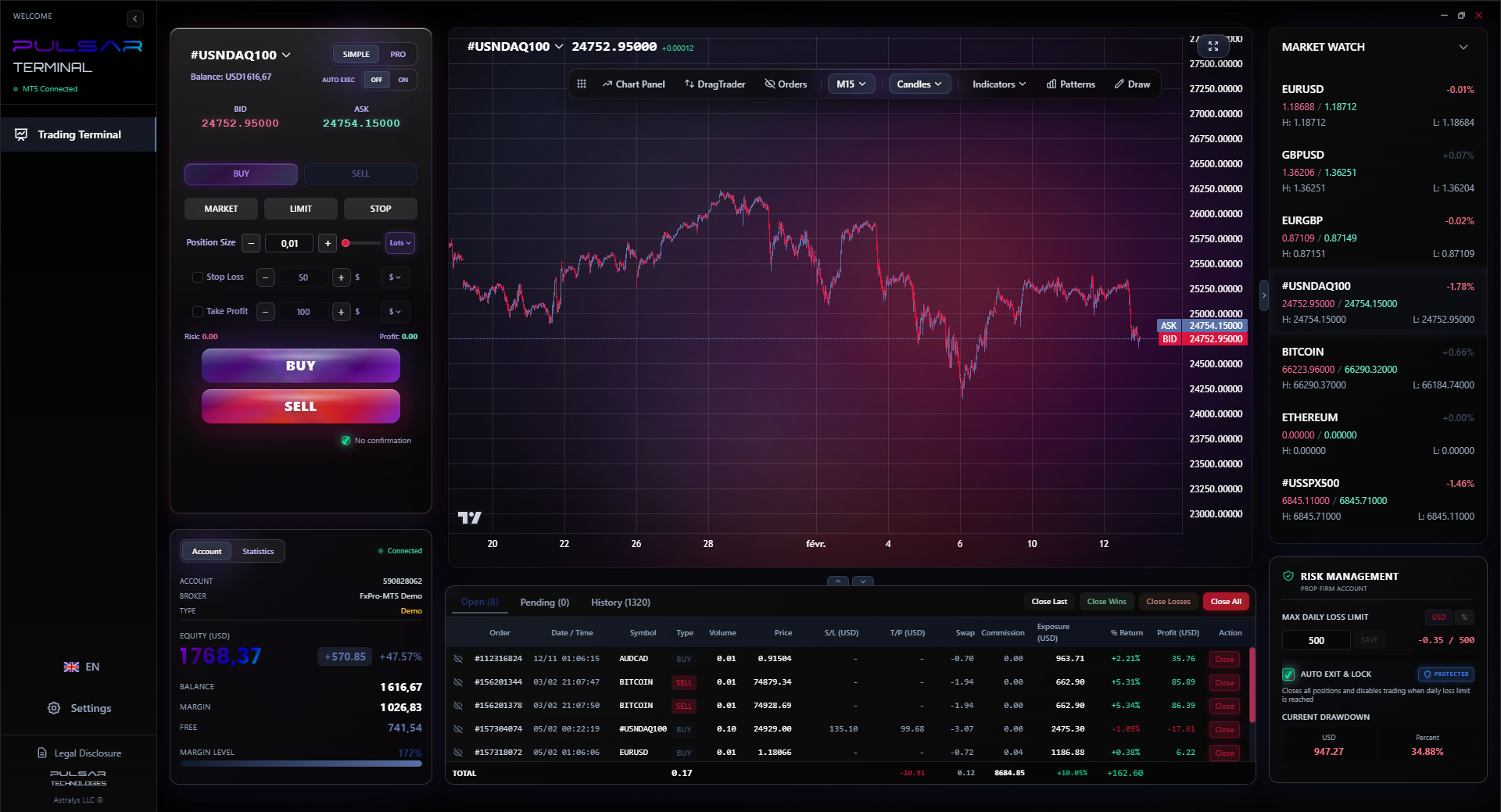
Managing multiple trades and setting precise stops for pullback entries is complex, but tools like Pulsar Terminal automate this directly on your MT5 platform.
Pulsar Terminal
MT5オールインワンツール:ドラッグ&ドロップ注文、マルチTP/SL、トレーリングストップ、グリッドトレード、出来高プロファイル、プロップファーム保護。毎日1,000人以上のトレーダーが利用。
Your broker is your lifeline. In India, you need three accounts: Trading, Demat, and Bank. For active pullback trading, focus on:
1. Discount Brokers: Zerodha, Upstox, Angel One. They're cheap, which is critical given our cost structure. Zerodha's Kite platform is excellent for technical analysis. Their brokerage of ₹20/order is standard. These are perfect for starting out.
2. Advanced Platforms & International Brokers: If you graduate to trading indices or currencies, you might look at international brokers with MT4/MT5 access, like IC Markets review or Pepperstone review. They offer instruments like XAU/USD guide (Gold), but remember, trading complex FX/CFD products with international brokers carries significant risk and may not be suitable for all Indian residents due to regulatory restrictions. Always check SEBI/FEMA guidelines first.
Execution is Key: When your pullback signal triggers, you need to get in. Use a limit order to buy at the pullback level, not a market order. A market order during low liquidity (like early morning) can get you a terrible fill. If the price races past your entry level without you, let it go. There will be another pullback. Revenge-entering at a worse price is a guaranteed path to losses.
Most Indian discount brokers have strong mobile apps. You can trade from anywhere. But for serious chart analysis, use a desktop. The bigger screen lets you see multiple timeframes and draw your trendlines properly.
💡 ウィンストンのヒント
If you're constantly getting stopped out, move to a higher timeframe. The 'noise' that triggers your tight stop on the 15-minute chart is often meaningless on the 1-hour.

“I've blown up an account. Here's exactly where pullback trading in India goes wrong.”
Pullback trading is 80% waiting, 15% managing, and 5% executing. It tests your patience like nothing else.
You will watch perfect trends unfold where you have no position because a clean pullback never came. That's okay. Your job isn't to be in the market; it's to be in the market when the odds are in your favour. Sitting on your hands is a skill.
The Two Big Psychological Traps:
- Fear of Missing Out (FOMO): The stock is rising. You missed the initial pullback entry. The urge to chase it higher is immense. Fight it. Chasing turns a planned trade into an emotional one. I've broken this rule and watched a ₹10,000 profit turn into a ₹5,000 loss in minutes.
- Hope During a Failed Trade: Your stop loss is hit. The chart says 'get out.' But you think, 'It's just a wider pullback, it'll come back.' This is how small losses become account-killers. Respect your stop. It's there because you were wrong about the market's intention. Be wrong small.
This strategy aligns well with swing trading mindsets, holding for days or weeks. It's less frantic than scalping. You need the temperament to let your winners run to your target and cut your losers immediately. No averaging down. No moving stops further away.
One final thought: track every trade. Not just P&L, but why you took it. Was it a true pullback to confluence, or were you just bored? Your trade journal will tell you more about yourself than any indicator ever will.

FAQ
Q1Is pullback trading profitable in India?
It can be, but not because the strategy is magical. It's profitable if you combine it with strict risk management, a deep understanding of Indian transaction costs (STT, brokerage, GST), and the patience to wait for high-probability setups. Most traders fail by ignoring costs and taking low-quality trades.
Q2What is the best timeframe for pullback trading in Indian stocks?
Use multiple timeframes. Identify the primary trend on the Daily chart. Then, look for the pullback and entry signal on the 1-hour or 30-minute chart. This gives you the context of the larger trend and the precision of a shorter-term entry. Never use a timeframe below 15 minutes for this strategy; the noise and costs will destroy you.
Q3How much capital do I need to start pullback trading in India?
You need enough so that position sizing makes sense. With a typical intraday margin of 5x, a ₹50,000 trading capital can control ~₹2.5 lakhs worth of shares. However, you must risk only 1-2% of your capital per trade. For a ₹50,000 account, that's ₹500-1000 risk per trade. After accounting for India's costs, you need a broker with low fees, and you must trade liquid stocks to ensure your stop loss can be placed logically.
Q4What are the biggest risks of pullback trading?
The two biggest risks are misidentifying a reversal as a pullback (your stop loss saves you here) and the unique structural risks of the Indian market: sudden regulatory changes (SEBI circulars), gap-up/gap-down openings due to global news, and the cumulative impact of transaction taxes eating into your profits on smaller moves.
Q5Can I use this strategy for Bank Nifty or Nifty options?
Yes, but cautiously. The principles are the same - identify trend, wait for pullback. However, options add the dimensions of time decay (theta) and implied volatility. A correct directional call on a pullback can still lose money if the option expires or volatility crashes. It's an advanced application. Start with equities or futures to master the price action first.
Q6Which indicator is best for spotting the end of a pullback?
Price action is king. Look for a bullish reversal candle pattern (like a hammer or engulfing) at a key support level. For confirmation, I use the RSI indicator looking for bullish divergence (price makes lower low, RSI makes higher low) or the MACD indicator showing a loss of momentum on the pullback. No indicator is a crystal ball; they just help assess probability.
ウィンストン教授のレッスン
重要ポイント:
- ✓Define trend on Daily, enter on 1-hour pullbacks.
- ✓Add 0.08% to every target for Indian transaction costs.
- ✓Place stops below pullback lows, not at arbitrary prices.
- ✓Trade only high-liquidity Nifty 50 stocks.
- ✓If you miss the entry, do not chase.
この記事はどれくらい役に立ちましたか?
星をクリックして評価
週刊トレーディングインサイト
無料の週刊分析&戦略。スパムなし。
著者について
Rajesh Sharma
シニアFXアナリスト
インド・南アジア市場で10年以上のトレード経験。NSEの通貨デリバティブからキャリアをスタートし、国際FXへ転向。USD/INRと新興国通貨ペアを専門とする。
コメント
リスク警告
金融商品の取引には大きなリスクが伴い、すべての投資家に適しているわけではありません。過去の実績は将来の結果を保証するものではありません。本コンテンツは教育目的のみであり、投資助言として解釈すべきではありません。取引前に必ずご自身で調査を行ってください。
こちらもおすすめ

Cara Trading Forex Sukses: 7 Prinsip dari Trader Profesional
Cara trading forex sukses dengan 7 prinsip trader pro: manajemen modal, disiplin, journal trading, backtest. Data nyata, bukan janji profit palsu.
Jam Trading Forex Terbaik untuk Trader Indonesia: Panduan Lengkap dengan Tabel Waktu
Panduan jam trading forex untuk trader Indonesia. Tabel 4 sesi dunia, jam emas 20:00-00:00, sesi mana yang harus dihindari. Data akurat + tips dari trader berpengalaman.
Top 5 Sàn Forex Uy Tín Nhất 2026: Review Jujur dari Trader Indonesia
Top 5 sàn forex uy tín 2026 untuk trader Indonesia. Review jujur: spread, deposit, withdraw, dukungan lokal. Exness, XM, IC Markets & lebih.
