


You're looking at the Reliance Gold Exchange Traded Fund, but the ticker symbol says 'Nippon India ETF Gold BeES'.

Rajesh Sharma
シニアFXアナリスト ·  India
India
☕ 13 分で読める
学べること:
- 1What Is This Thing, Really? (It's Not Just Gold)
- 2The Real Cost of Owning It: Fees That Eat Your Returns
- 3How to Trade It: From SIP to Swing Trading
- 4Performance: The Stunning Numbers & The Cold Reality
- 5Gold BeES vs. The Alternatives: Futures, Bonds & Physical
- 6The Risks Nobody Talks About (Including Me)
- 7Getting Started: How to Buy Your First Unit
- 8Final Verdict: Should You Buy Nippon India Gold BeES Today?
You're looking at the Reliance Gold Exchange Traded Fund, but the ticker symbol says 'Nippon India ETF Gold BeES'. What gives? And more importantly, is this thing a buy, a hold, or a trap for the unwary? I've traded this instrument for years, back when it actually was the Reliance Gold ETF. The name changed, but the game didn't. This is your no-BS guide to understanding what you're really buying, how to trade it without getting scalped by fees, and whether it belongs in your portfolio right now. Forget the marketing fluff. Let's talk price action, spreads, and real returns.
First, let's clear up the confusion. The Reliance Gold Exchange Traded Fund doesn't exist anymore. When Nippon Life bought Reliance Mutual Fund, they rebranded everything. So, Nippon India ETF Gold BeES (ticker: GOLDBEES on NSE/BSE) is the exact same fund, just with a new paint job. It's the granddaddy of Indian Gold ETFs, launched way back in 2007.
Here's the core mechanic: The fund holds physical gold bars in a vault. Each unit you buy is supposed to represent one gram of 99.5% pure gold. When you buy GOLDBEES, you're not buying a promise on gold's price; you're buying a sliver of actual metal sitting in a secure location. This structure is regulated by SEBI, which mandates that at least 95% of the fund's assets must be in physical gold or approved gold instruments.

Warning: Don't confuse this with a Gold Fund of Fund (FoF) or sovereign gold bonds. A Gold ETF trades on the exchange like a stock, with real-time prices. A Gold FoF is a mutual fund that invests in this ETF, adding another layer of fees. Know what you're buying.
The recent SEBI rule change, effective April 1, 2026, is a big deal. They've moved the valuation benchmark from the London (LBMA) price to domestic Indian exchange (MCX) spot prices. This aims to reduce 'tracking error' - the difference between the ETF's price and the actual value of the gold it holds. In theory, it should make the NAV more transparent and aligned with what you see on Indian commodity screens. As a trader, less tracking error means the price on your chart is a purer reflection of gold demand, not administrative quirks.

💡 ウィンストンのヒント
When a fund gets a new name, check the ISIN, not the marketing. The ISIN (INF204KB17I5) stayed the same. That's the fund's real fingerprint.
This is where most investors get blindsided. The glitter of gold distracts from the fees slowly draining your account. The headline expense ratio for Nippon India ETF Gold BeES is 0.80% per annum. That doesn't sound like much, right? Think again.
That 0.80% is taken daily from the fund's Net Asset Value (NAV). Over a year, it directly reduces your returns. If gold goes up 15% in a year, the fund's return before fees might be 15%. After that 0.80% drag, you're looking at roughly 14.2%. It's a silent leak.
Brokerage and the Bid-Ask Spread
You don't just pay the expense ratio. You need a Demat and trading account. When you execute a trade, you face two costs:
- Brokerage: Many discount brokers offer 'zero brokerage' for delivery trades (buying and holding). But always check the fine print. Intraday or futures-style trading on the ETF will incur charges.
- The Spread: This is the killer for active traders. The bid-ask spread is the difference between the price you can buy at (ask) and the price you can sell at (bid) at any given moment. For GOLDBEES, the spread is usually tight because it's highly liquid - often just a few paisa. But during volatile market opens or low-volume periods, it can widen. I've seen it stretch to 0.1% or more. If you're in and out frequently, these tiny spreads add up to a significant cost.

Example: Let's say you invest ₹1,00,000. The 0.80% expense ratio costs you ₹800 per year, whether gold moves up, down, or sideways. If you trade four times a year with a 0.05% spread cost each way (buy and sell), that's another ₹400 in friction. Your gold needs to rally just to break even on these costs.
There's no exit load if you hold for over 15 days. But if you panic-sell within that window, they'll hit you with a 1% charge. It's a penalty for being impulsive, which, in my experience, most retail traders are.
“The expense ratio is a silent leak, draining your returns whether gold moves up, down, or sideways.”
You can approach this ETF in a few ways, depending on whether you're an investor or a trader. I've tried most of them, with mixed results.
The Long-Term Investor (SIP Route): You can't do a traditional SIP directly into the ETF on the exchange. The workaround is through its Fund-of-Fund sibling, the Nippon India Gold Savings Fund, which allows SIPs as low as ₹100. But remember, you're adding another layer of management fees on top of the ETF's fees. It's convenient, but costlier. For a pure ETF approach, you manually buy a fixed rupee amount each month in your trading account. Set an alert, place the order, and forget it. This is a hedge against inflation and rupee depreciation, not a get-rich-quick scheme.
The Swing Trader's Playground: This is where it gets interesting. Gold often moves in clear trends driven by real yields, dollar strength, and global fear. GOLDBEES lets you ride these waves.
-
My Failed Mean Reversion Trade: In early 2024, I got cute. Gold had run up hard, and the RSI on the daily chart was pegged above 80. I thought, 'It's overbought, time to short.' I sold short around ₹5,800 per unit. I ignored the fundamental driver: massive central bank buying. It didn't reverse. It consolidated and then broke higher. I took a 3% loss at ₹5,974. The lesson? With a macro asset like gold, overbought can stay overbought. Don't fight the central bank tide.
-
A Winning Trend Follow: Later in 2025, after the geopolitical flare-up, gold broke above a key consolidation zone on huge volume. Using a simple MACD indicator crossover on the weekly chart as confirmation, I went long at ₹6,450. I used a position size calculator to risk only 1% of my capital. I rode the trend for months, using a trailing stop, and exited at ₹7,100 for a roughly 10% gain. The trend was your friend.
Scalping? Forget it. The combination of the expense ratio drag (which works against you on a daily basis) and the bid-ask spread makes this a poor instrument for scalping strategy. You're fighting an uphill battle from the get-go.
The new allowance for fund managers to use gold futures (up to 50% of assets) could, in theory, lead to minor tracking errors or provide slightly better liquidity in times of stress, but for a trader, it's a background detail. Focus on the price chart of GOLDBEES itself.
💡 ウィンストンのヒント
The 0.80% fee seems small. Do the math: on a ₹10 lakh investment, that's ₹8,000 a year for a vault you never see. Is the convenience worth that price? For trading, often not. For long-term holding, maybe.
The recent numbers are eye-popping. Let's be blunt: they're also a potential trap. Performance chasing is the quickest way to lose money in finance.
As of April 2026, the trailing returns are:
- 1 Year: +58.65%
- 3 Years: +33.14% (annualized)
- 5 Years: +25.24% (annualized)
That 1-year number is insane. It reflects a perfect storm of geopolitical fear, central bank buying, and a weakening rupee. The key question you have to ask yourself is: "Am I buying the past, or am I buying the future?" Buying after a 58% rally is a very different proposition from buying after a 58% crash.
The AUM tells the story of the herd. From ₹58,323 crore in February 2026, with record monthly inflows of nearly ₹24,000 crore in January 2026 alone. This ETF was the 6th largest in the world by inflows. When something gets this popular, this fast, the easy money has often been made. I'm not saying it can't go higher - the World Gold Council thinks another 15-30% is possible in 2026 - but the risk/reward profile shifts.
The long-term CAGR since 2007 is about 14.35%. That's a more realistic expectation for a buy-and-hold investor over a full market cycle, not the recent parabolic move. Your job is to manage expectations. Don't extrapolate 58% returns into infinity.
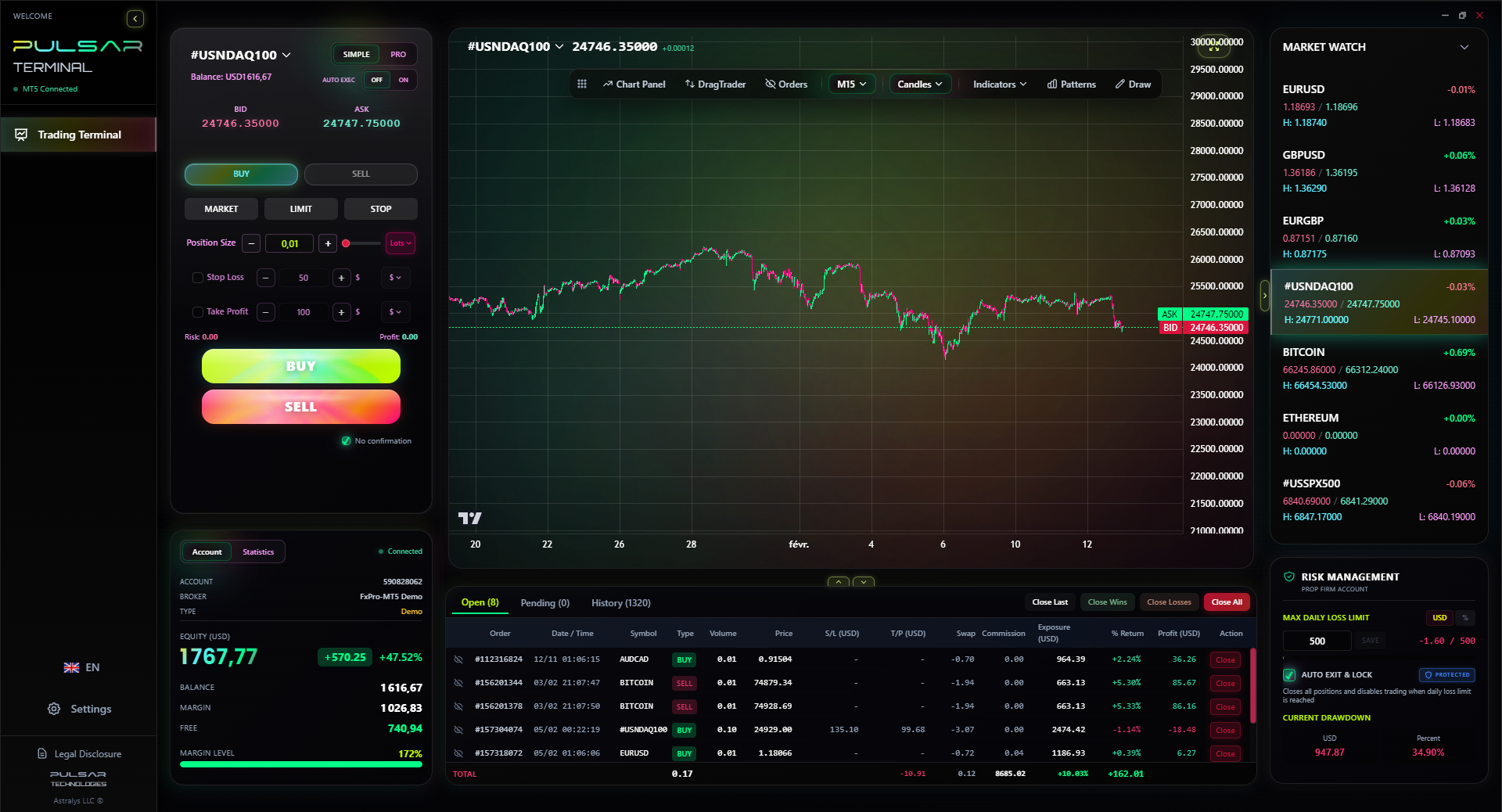
Swing trading a trending Gold ETF requires managing partial profits and trailing stops, which Pulsar Terminal automates seamlessly on your MT5 platform.
Pulsar Terminal
MT5オールインワンツール:ドラッグ&ドロップ注文、マルチTP/SL、トレーリングストップ、グリッドトレード、出来高プロファイル、プロップファーム保護。毎日1,000人以上のトレーダーが利用。
“For trading, the ETF is the safer, saner vehicle. For investing, Sovereign Gold Bonds are mathematically superior if you can stomach the lock-in.”
GOLDBEES isn't the only way to play gold in India. Choosing the right tool matters. Here’s a blunt comparison.
| Instrument | What It Is | Key Advantage | Key Disadvantage | Best For... |
|---|---|---|---|---|
| Nippon India ETF Gold BeES | ETF holding physical gold. | Liquidity, convenience, can hold in Demat. | Expense ratio (0.80%), not ideal for ultra-short term. | Long-term investors & medium-term swing trading. |
| MCX Gold Futures | Derivative contract for future delivery. | High use, pure price play, no management fee. | High risk of margin call, contract expiry, complexity. | Experienced, risk-tolerant speculators. |
| Sovereign Gold Bonds (SGBs) | Government bond linked to gold price. | 2.5% annual interest, no storage cost, tax-free on maturity. | 8-year lock-in for full benefit, limited liquidity on secondary market. | Absolute long-term holders (8+ years). |
| Physical Gold (Jewellery/Coins) | Actual metal you hold. | Tangible, no counter-party risk. | High making charges (jewellery), storage/insurance risk, poor liquidity for sale. | Cultural purchases, extreme crisis hedging. |
My take? For trading, it's between the ETF and futures. If you know how to manage use and risk, futures give you more bang for your buck. But you can blow up your account in a day. The ETF is the safer, saner trading vehicle. For investing, SGBs are mathematically superior if you can stomach the lock-in. The 2.5% interest is a huge tailwind physical gold or an ETF doesn't have.
Brokerages and fund houses sell the dream. I'll give you the nightmare scenarios.
Tracking Error Risk: Even with the new domestic pricing rule, the ETF price can deviate from the value of its underlying gold. It usually trades close to NAV, but during a market crash or a liquidity squeeze, the discount can widen. You might be right about gold going up, but the ETF could lag. I saw this briefly during the 2020 COVID crash - the ETF sold at a 2% discount to NAV for a few days. It was a buying opportunity for the brave, but terrifying if you were trying to sell.
Liquidity Illusion: GOLDBEES is hugely liquid on average. But liquidity isn't a constant. At 3:15 PM on a quiet Friday, the order book can get thin. If you have a large position and need to exit in a hurry during off-peak hours, your market sell order could walk down the bid ladder, costing you more than you planned. Always use limit orders.
Regulatory Risk: SEBI changed the valuation rule. They allowed gold futures in the portfolio. They could change something else. The regulatory framework is stable, but it's not set in stone. This is a low-probability but high-impact risk.
The Biggest Risk: You. The psychological risk is paramount. Gold is a 'fear' asset. You'll be tempted to buy when headlines are screaming (often near a top) and sell when it's boring and consolidating (often before a breakout). My earlier failed short trade is a proof to that. You need a system and the discipline to follow it, not the news. Using a tool that helps automate stops and take-profits can remove emotion. Managing a swing trading position in a trending market is where discipline pays.
💡 ウィンストンのヒント
Record inflows (₹24,039 crore in Jan '26) are a sentiment indicator, not a timing signal. Extreme popularity often precedes a period of consolidation or correction. Be greedy when others are fearful, and fearful when others are greedy. They're greedy right now.
“The biggest risk isn't tracking error or regulation. It's you, and your tendency to buy the headline and sell the boredom.”
Let's make this concrete. Here's exactly how you get a piece of this, assuming you're starting from zero.
- Open a Demat & Trading Account: This is non-negotiable. You can't buy an ETF without one. Go with a reputable, low-cost broker. Do your due diligence. The process is fully online now; you'll need your PAN, Aadhaar, and bank details.
- Fund Your Account: Transfer money from your bank to your trading account's linked bank detail. Use UPI or net banking. The money usually settles in a few hours.
- Log In and Find the Ticker: On your broker's trading platform (website or app), search for "GOLDBEES" or "NIPPONINDIAETFGB". The official ticker on the NSE is GOLDBEES. Confirm it's the ETF, not the mutual fund.
- Place Your Order:
- Order Type: For your first few trades, use a LIMIT ORDER. Don't use a market order. A limit order ensures you won't pay more than your specified price.
- Price: Look at the current 'bid' and 'ask'. Place your buy limit order somewhere between them, or at the current best ask if you want immediate execution.
- Quantity: The minimum is 1 unit. As of this writing, that's about ₹7,000-₹8,000. You can buy any whole number of units.
- Duration: Select 'Day' if you want the order to cancel if not filled by market close. Or use 'IOC' (Immediate or Cancel) for a fill-right-now-or-never approach.
- Execute and Confirm: Hit submit. Once filled, the units will appear in your Demat holding by T+2 days (settlement date). The cash will be debited.

Pro Tip: Before you risk real money, practice this entire process in your broker's 'virtual trading' or 'practice' mode if they have one. Get comfortable with the platform. There's no prize for figuring out the wrong button with live cash on the line.
So, after all that, is it a buy? I can't give you a signal, but I can give you a framework.
If you are a long-term investor looking for a 5-10 year rupee hedge and gold exposure, and you find the SGB lock-in unattractive, then yes, systematically accumulating units of GOLDBEES on market dips is a perfectly sound, boring strategy. Accept the 0.80% fee as the cost of convenience and security. Don't even look at the price daily.
If you are a trader, the picture is different. The massive inflows and stellar 1-year return are a yellow flag (pun intended). It's crowded. The trade is well-known. This doesn't mean it can't go up, but it does mean the volatility might increase and sharp, painful corrections are more likely. I wouldn't be backing up the truck here for a new long trade. I'd be waiting for a pullback to a significant support level, with momentum confirmation, before considering an entry. The risk is to the downside in the short-to-medium term.
For me, personally? I have a small, core holding I never touch. My trading capital is currently on the sidelines for this ETF, waiting for a better setup. The EUR/USD guide and XAU/USD guide offer more direct, liquid, and fee-efficient ways to trade the global gold story for those with international broker access. But for a pure India-centric, physically-backed gold play, Nippon India ETF Gold BeES remains the benchmark. Just know what you're buying, respect the costs, and for god's sake, have a plan before you click 'buy'.
FAQ
Q1What happened to the Reliance Gold Exchange Traded Fund?
It was rebranded. After Nippon India Mutual Fund acquired Reliance Mutual Fund, the fund was renamed Nippon India ETF Gold BeES. It's the same fund with the same underlying assets (ISIN: INF204KB17I5), just a new name. The ticker symbol on the NSE is GOLDBEES.
Q2What is the minimum investment amount for Nippon India ETF Gold BeES?
The minimum investment is the price of 1 unit, which you buy on the stock exchange. As of April 2026, that's roughly ₹7,000 to ₹8,000. There's no minimum SIP for the ETF directly; for systematic investing, you'd look at its Fund-of-Fund variant which allows SIPs from ₹100, but with added fees.
Q3How does the expense ratio affect my returns?
The 0.80% annual expense ratio is deducted daily from the fund's Net Asset Value (NAV). It's a direct drag on performance. If the gold price is flat for a year, your investment value would still decrease by approximately 0.80%. It's a cost you pay for management, custody, and administration.
Q4Can NRIs invest in this Gold ETF?
Yes, Non-Resident Indians (NRIs) can invest through their PIS (Portfolio Investment Scheme) account linked to their NRE or NRO bank account. You need to ensure your Demat/trading account is enabled for NRI status.
Q5Is it better than Sovereign Gold Bonds (SGBs)?
It depends on your goal. For a strict long-term hold of 8+ years, SGBs are financially superior due to the 2.5% annual interest and tax-free status on maturity gains. For liquidity, trading flexibility, or a holding period of less than 8 years, the Gold ETF is better. The ETF is for trading and medium-term holds; SGBs are for committed, long-term investment.
Q6What is the new SEBI valuation rule for Gold ETFs?
Effective April 1, 2026, SEBI mandated that Gold ETFs must value their physical gold holdings using polled spot prices from Indian exchanges (like MCX) for physically delivered derivatives, instead of the London (LBMA) benchmark. This aims to reduce tracking error and align the ETF's NAV more closely with domestic gold prices.
Q7Can the fund manager invest in gold futures instead of physical gold?
Yes, but with limits. Since June 2024, SEBI allows Gold ETFs to use gold-backed Exchange Traded Commodity Derivatives (futures) for up to 50% of their mandatory gold allocation. This is meant for liquidity management, not as a permanent replacement for physical gold. The primary holding remains physical metal.
ウィンストン教授のレッスン
重要ポイント:
- ✓The 0.80% expense ratio costs ₹8,000 annually on a ₹10 lakh hold.
- ✓Record ₹24,039 crore monthly inflows signal crowded, high-sentiment trade.
- ✓New SEBI rules use MCX spot prices, not London, for NAV from April 2026.
- ✓SGBs pay 2.5% interest; ETFs don't. Choose based on time horizon.
- ✓Always use limit orders, not market orders, to control entry/exit price.
この記事はどれくらい役に立ちましたか?
星をクリックして評価
週刊トレーディングインサイト
無料の週刊分析&戦略。スパムなし。
著者について
Rajesh Sharma
シニアFXアナリスト
インド・南アジア市場で10年以上のトレード経験。NSEの通貨デリバティブからキャリアをスタートし、国際FXへ転向。USD/INRと新興国通貨ペアを専門とする。
コメント
リスク警告
金融商品の取引には大きなリスクが伴い、すべての投資家に適しているわけではありません。過去の実績は将来の結果を保証するものではありません。本コンテンツは教育目的のみであり、投資助言として解釈すべきではありません。取引前に必ずご自身で調査を行ってください。
こちらもおすすめ

Cara Trading Forex Sukses: 7 Prinsip dari Trader Profesional
Cara trading forex sukses dengan 7 prinsip trader pro: manajemen modal, disiplin, journal trading, backtest. Data nyata, bukan janji profit palsu.
Jam Trading Forex Terbaik untuk Trader Indonesia: Panduan Lengkap dengan Tabel Waktu
Panduan jam trading forex untuk trader Indonesia. Tabel 4 sesi dunia, jam emas 20:00-00:00, sesi mana yang harus dihindari. Data akurat + tips dari trader berpengalaman.
Top 5 Sàn Forex Uy Tín Nhất 2026: Review Jujur dari Trader Indonesia
Top 5 sàn forex uy tín 2026 untuk trader Indonesia. Review jujur: spread, deposit, withdraw, dukungan lokal. Exness, XM, IC Markets & lebih.
