


Every other WhatsApp broadcast has a story about some 'richest forex trader in Nigeria' who made billions overnight.

Olumide Adeyemi
西アフリカ・トレーディングの先駆者 ·  Nigeria
☕ 8 分で読める
学べること:
Every other WhatsApp broadcast has a story about some 'richest forex trader in Nigeria' who made billions overnight. It's a dangerous fantasy. The truth is, sustainable wealth from trading here is built on boring discipline, not viral screenshots. I've seen more accounts blown up chasing that dream than I've seen succeed. Let's cut through the noise and talk about the real path, the hard numbers, and the regulatory minefield you actually have to navigate.
When Nigerians ask about the richest forex trader, they're usually picturing private jets and fleets of Range Rovers. Let's get real. Real trading wealth is quiet. It's the guy pulling a consistent 2-3% per month, compounding over years, not the one posting a 500% gain from a wild gamble.
Here's the math that kills the fantasy. Start with a N5,000,000 account (about $3,300, a serious sum for most). A 20% annual return, which is exceptional for a retail trader, gives you N1,000,000 profit before tax. After the 10% capital gains tax, you keep N900,000. That's life-changing money, sure, but it's not 'richest in Nigeria' money. It's solid upper-middle-class supplemental income. The viral stories never show the 10 losing trades that came before the one screenshot.
I learned this the hard way early on. I chased the 'home run' trade, risking 10% of my account on a single EUR/USD idea. It worked twice, tripling a small account. I felt like a genius. Then the third trade went against me. I lost 60% of my capital in a week because my position size calculator was gathering dust. That loss taught me more than all the wins combined.

Warning: Any 'guru' showing you only massive wins is selling you a dream, not a strategy. Consistent, smaller gains funded by a proper day job or business are the real foundation of trading wealth here.

💡 ウィンストンのヒント
If you can't articulate the exact reason for your stop-loss and take-profit levels in one sentence before entering, you're gambling, not trading.
“Real trading wealth is quiet. It's the guy pulling a consistent 2-3% per month, compounding over years.”
You can't talk about making money trading in Nigeria without understanding the battlefield. The rules have changed, and if you ignore them, you'll lose before you even place a trade.
The Regulatory Shift (ISA 2025)
The biggest change is the Investments and Securities Act (ISA) 2025. It's now illegal for any online forex platform to operate here without SEC registration. This is a double-edged sword. It aims to protect you from outright scams, but it also means your favorite international broker might be in a gray area. You must do your homework. A broker's international license (like from CySEC or ASIC) is good, but check their Nigerian status.
The Funding Headache
This is where dreams meet reality. The CBN has made it clear: you cannot use official FX windows to fund trading accounts. Your Nigerian bank card will likely fail on an international broker's deposit page. So how do you fund? You're looking at:
- Broker-provided local bank transfer options (NGN to their local partner).
- Peer-to-Peer (P2P) crypto transfers (carrying its own volatility and risk).
- Some brokers like Exness and XM have built strong local payment channels for this exact reason.
The friction and fees here eat into your returns. A 1.5% fee on every deposit and withdrawal is a huge drag on compounding.
The Tax Man Cometh
Forget hiding it. That 10% capital gains tax on gross profits applies. If you make N1,000,000, you owe FIRS N100,000. Period. Factor this into your profit targets. A trade that nets you 5% before tax is really 4.5% after. It changes your risk-reward math.
“You can't use official FX windows to fund trading accounts. Your Nigerian bank card will likely fail.”
So, if the get-rich-quick myth is dead, what's the real blueprint? It's a system, not a secret.
Start with Survival, Not Lamborghinis
Your first goal is to not lose money. Sounds simple, right? It's not. This means risk management is your bible. Never risk more than 1-2% of your capital on a single trade. Use stop-losses on every single position, no exceptions. I've had trades where my stop-loss saved me from a 50-pip move that would have wiped out a week's profits. It hurts to get stopped out, but it hurts a lot less than a margin call.
Find Your Timeframe and Stick to It
Are you a scalping machine, in and out in minutes? Or a swing trading patient hunter? You can't be both. I'm a swing trader. I found I was terrible at scalping; the noise drove me crazy and I overtraded. My most profitable year came when I limited myself to 2-3 swing setups a week on majors like EUR/USD or XAU/USD. Fewer trades, higher conviction.
The Toolbox: Keep It Simple
You don't need 20 indicators. You need to master a few. My core setup for years has been:
- Price Action & Support/Resistance: The foundation. Everything else is just confirmation.
- RSI Indicator: For spotting overbought/oversold conditions within a trend.
- MACD Indicator: For trend confirmation and momentum shifts.

Pro Tip: Backtest your strategy on at least 200 trades before risking real money. If it doesn't show a positive expectancy in simulation, it will destroy your live account. I paper-traded my swing strategy for 6 months before going live.
💡 ウィンストンのヒント
The most Nigerian thing you can do for your trading career is to be aggressively patient. Our markets reward hustle, but forex punishes it.
“Trade the chart, not your bills.”
Choosing where to trade in Nigeria isn't just about the lowest spread. It's about accessibility and stability.
The Broker Checklist for Naija Traders
- Local Deposits/Withdrawals (NGN): Non-negotiable. Can you fund your account in Naira without jumping through P2P hoops?
- Regulation: Prefer brokers with strong international oversight (FCA, ASIC) who also understand the Nigerian market.
- Spreads & Fees: Compare the typical spread on the pairs you trade. A 0.8 pip spread on EUR/USD vs. a 1.5 pip spread makes a massive difference over 100 trades.
- Platform: MT4/MT5 is the standard. Ensure it runs smoothly on your phone and laptop.
A Quick Comparison
| Feature | Priority for Nigerian Trader | Why It Matters |
|---|---|---|
| NGN Deposits | Critical | Avoids FX funding bottlenecks and extra fees. |
| Local Support | High | When you have a withdrawal issue at 10 PM, you want someone who understands your bank. |
| MT4/MT5 | High | The environment of tools, indicators, and experts is built on it. |
| Raw Spreads | Medium | Important, but not as important as being able to get your money in and out reliably. |
Brokers like IC Markets and Pepperstone are renowned for tight spreads and raw pricing, but you must solve the funding puzzle. Others, like the ones mentioned earlier, have invested in the local payment rails.
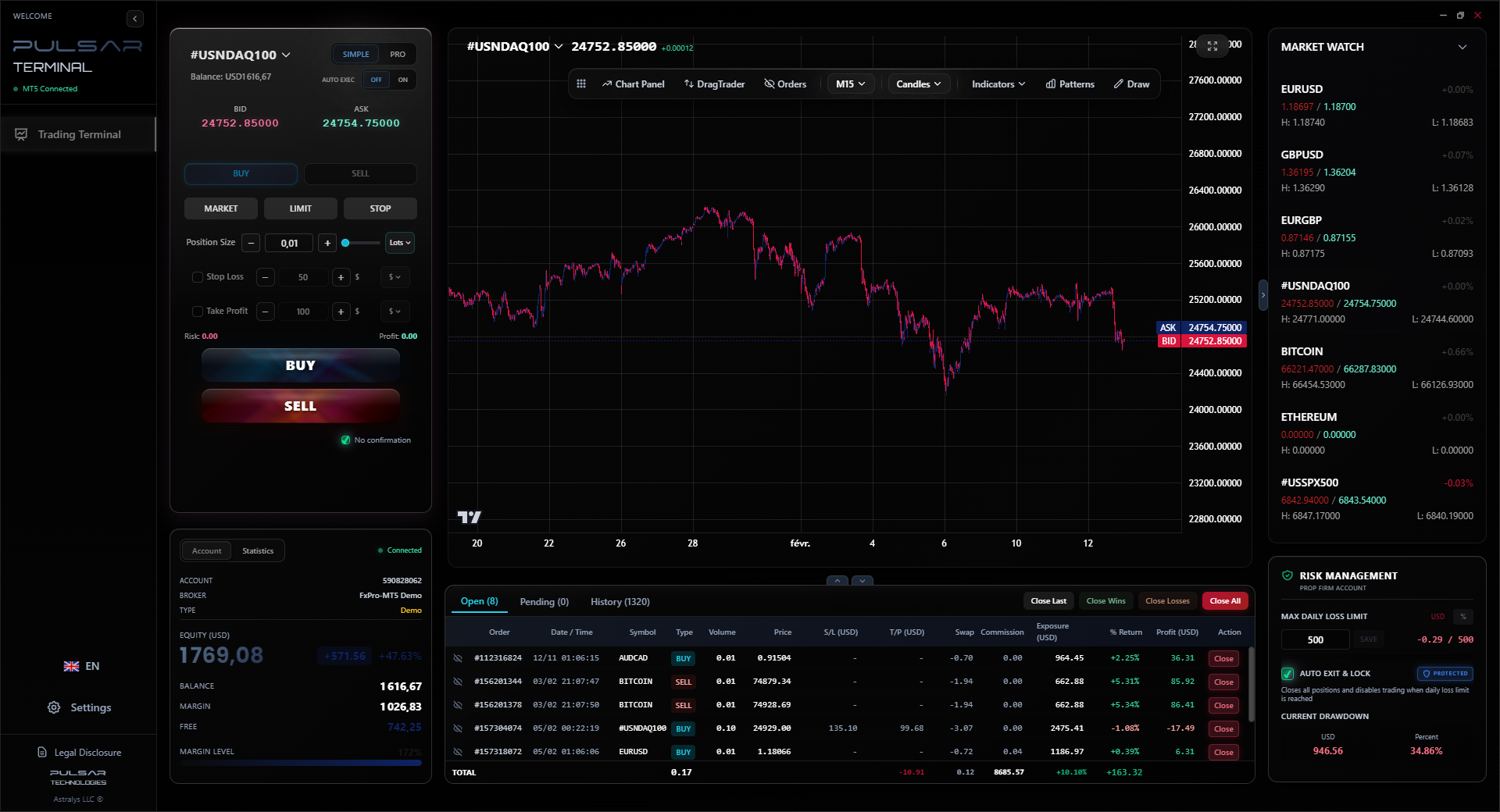
Managing multiple trades and protecting profits in a volatile market is exhausting, which is why tools like Pulsar Terminal automate advanced order types and risk management directly on your MT5 platform.
Pulsar Terminal
MT5オールインワンツール:ドラッグ&ドロップ注文、マルチTP/SL、トレーリングストップ、グリッドトレード、出来高プロファイル、プロップファーム保護。毎日1,000人以上のトレーダーが利用。
“Trade the chart, not your bills.”
The market doesn't care about your rent or your family pressure. The unique social and economic pressures in Nigeria make psychological discipline even harder, and even more important.
Fighting the 'Quick Fix' Mentality
When the naira is volatile and salaries are stagnant, the temptation to use trading as a lifeline is huge. This is poison. You start forcing trades, widening your stops, hoping for a miracle. I once took a trade on USD/NGN (on a non-deliverable forward) out of frustration with local prices, not analysis. I lost. Trade the chart, not your bills.
Dealing with Noise & 'Gurus'
Your uncle will send you a signal from a 'prophet of forex.' Your group chat will be flooded with can't-lose opportunities. You have to build a mental firewall. My rule: I never take a trade idea from anyone else unless I can independently see the setup on my own charts. This saved me from a famous 'guru's' gold short call that blew up dozens of accounts in 2023.
Embracing the Grind
A profitable month looks boring. It's executing your plan, taking small losses when you're wrong, and riding winners when you're right. The 'richest forex trader in Nigeria' you never hear about is probably sitting in a quiet office in Lekki, checking his charts twice a day, and focusing on his other businesses. The flashy ones are usually spending their last withdrawal.
💡 ウィンストンのヒント
Your P&L is not a scoreboard. It's a report card on your decision-making. Review the losses twice as long as you celebrate the wins.
“The 'richest forex trader in Nigeria' you never hear about is probably sitting in a quiet office in Lekpi.”
Forget finding the richest forex trader. Focus on becoming a competent one. Here's your brutal, step-by-step guide.
- Education with a Deadline: Spend 3 months learning pure price action and risk management. Not indicators, not magic systems. Then stop. Analysis paralysis is a career killer.
- Open a Demo Account: Trade it for 6 months with a realistic amount (e.g., $10,000). Your goal is consistency, not 1000% returns. Track every trade in a journal.
- Start Absurdly Small: Your first live account should be money you can afford to lose without changing your life. For most, that's N50,000 - N100,000. The goal is to learn the emotional weight of real money, not to get rich.
- Scale Only After Proof: Only add more capital after you have 6 consecutive months of live, profitable trading following your rules. Not demo. Live.
- Automate Your Discipline: Use tools to enforce your rules. Set your stop-loss and take-profit the second you enter the trade. Don't give yourself the chance to 'hope.'
The journey is long. You will have losing months. Your strategy will stop working and you'll need to adapt. But if you approach this as a professional skill to be mastered over years, not a lottery ticket, you give yourself a real fighting chance. That's the only secret the truly successful traders know.
FAQ
Q1Who is actually the richest forex trader in Nigeria?
No one knows for sure, and that's the point. Genuinely wealthy traders don't advertise it on social media. They value privacy and avoid the scrutiny and scams that come with fame. The real wealth is built quietly over decades, not flaunted in monthly Porsche giveaways.
Q2Is forex trading illegal in Nigeria?
No, trading for individuals is legal. However, the landscape changed in 2025. The new ISA law requires online forex trading platforms to register with the SEC. You must ensure your broker is compliant. The Central Bank of Nigeria (CBN) also restricts using official banking channels to fund international trading accounts, which is a major operational hurdle.
Q3How much do I need to start forex trading in Nigeria?
You can technically start with as little as $5 (about N7,500) with some brokers. But realistically, to properly practice risk management and not get wiped out by a few bad trades, a starting capital of N100,000 - N500,000 ($65 - $330) is more sensible. Remember, your starting capital should be money you can afford to lose completely while you learn.
Q4How do I fund my forex trading account from Nigeria?
Direct international card payments are often blocked. Your main options are: 1) Using a broker's local deposit option (transferring Naira to a Nigerian bank account they provide), or 2) Using Peer-to-Peer (P2P) crypto transfers. Always check your broker's specific funding page for Nigeria-supported methods.
Q5Do I pay tax on forex trading profits in Nigeria?
Yes. The Federal Inland Revenue Service (FIRS) considers forex trading profits as capital gains, taxable at a rate of 10% on your gross profits. You are responsible for declaring and paying this tax.
Q6What is the best trading strategy for beginners in Nigeria?
There is no universal 'best' strategy. However, beginners should focus on simplicity. Start with swing trading on major currency pairs (like EUR/USD or GBP/USD) using support/resistance and one or two indicators like the RSI. Avoid day trading and scalping at first - they require faster reactions and more experience. The goal is to learn the process, not chase quick money.
Q7Can forex trading replace my full-time job in Nigeria?
Almost certainly not, especially not for years. View it as a high-skill side hustle that requires years of consistent, profitable results before it can generate reliable income. The vast majority of successful traders have other primary sources of income that fund their lives and their trading accounts, removing the desperate pressure to perform.
ウィンストン教授のレッスン
重要ポイント:
- ✓Wealth is built on 2-3% monthly gains, not 500% viral screenshots.
- ✓The ISA 2025 means your broker must be SEC-registered.
- ✓Factor the 10% capital gains tax into every profit target.
- ✓Never risk more than 1-2% of your capital on a single trade.
- ✓Funding via local broker Naira deposits is critical for smooth operations.
この記事はどれくらい役に立ちましたか?
星をクリックして評価
週刊トレーディングインサイト
無料の週刊分析&戦略。スパムなし。
著者について
Olumide Adeyemi
西アフリカ・トレーディングの先駆者
ナイジェリアで最もアクティブなFXトレーディング教育者の一人。ラゴスから8年のトレード経験。アフリカのトレーダー向けの少額資金戦略とプロップファームチャレンジを専門とする。
コメント
リスク警告
金融商品の取引には大きなリスクが伴い、すべての投資家に適しているわけではありません。過去の実績は将来の結果を保証するものではありません。本コンテンツは教育目的のみであり、投資助言として解釈すべきではありません。取引前に必ずご自身で調査を行ってください。
こちらもおすすめ

Cara Trading Forex Sukses: 7 Prinsip dari Trader Profesional
Cara trading forex sukses dengan 7 prinsip trader pro: manajemen modal, disiplin, journal trading, backtest. Data nyata, bukan janji profit palsu.
Jam Trading Forex Terbaik untuk Trader Indonesia: Panduan Lengkap dengan Tabel Waktu
Panduan jam trading forex untuk trader Indonesia. Tabel 4 sesi dunia, jam emas 20:00-00:00, sesi mana yang harus dihindari. Data akurat + tips dari trader berpengalaman.
Top 5 Sàn Forex Uy Tín Nhất 2026: Review Jujur dari Trader Indonesia
Top 5 sàn forex uy tín 2026 untuk trader Indonesia. Review jujur: spread, deposit, withdraw, dukungan lokal. Exness, XM, IC Markets & lebih.
