


You've seen the Instagram flexes, the rented supercars, and the motivational quotes.

Olumide Adeyemi
西アフリカ・トレーディングの先駆者 ·  Nigeria
☕ 10 分で読める
学べること:
You've seen the Instagram flexes, the rented supercars, and the motivational quotes. You're probably asking yourself: are the richest forex traders in Africa for real, or is it all just smoke and mirrors? I've been in this game for over a decade, and I can tell you the truth is more complicated than a simple yes or no. There are genuine success stories, but they're built on boring discipline, not flashy signals. Let's cut through the noise and look at what it actually takes, especially here in Nigeria where the rules are changing fast.
Before we talk about millions, we need to talk about the ground rules. Trading forex in Nigeria is legal, but it's not the wild west anymore. The Central Bank of Nigeria (CBN) and the SEC are tightening things up. The new Nigeria Foreign Exchange Code that kicked in late 2024 is a big deal. It's meant to clean up the market, which is good for everyone in the long run.
Here's the practical stuff you need to know. First, taxes. If you make a profit, the Federal Inland Revenue Service (FIRS) wants 10% as capital gains tax. You have to factor that into your calculations. Second, funding your account is a headache now. The CBN has made it clear: you can't use the official FX window (the cheaper rate) to fund a trading account. They call it economic sabotage. On top of that, most Nigerian banks have blocked or limited Naira cards for international payments. Getting money to a broker like IC Markets or Exness often requires creative solutions like crypto or specialized payment processors.

Warning: Ignoring the 10% capital gains tax is a fast track to serious problems with the FIRS. Keep careful records of every trade, win or lose.
The market is growing, though. Turnover shot up by 56.4% to $8.6 billion in 2025. And get this, a survey showed 93.7% of traders here are between 18 and 35. The energy is incredible, but youth often comes with a lack of patience. That's the gap where most dreams get wrecked.

💡 ウィンストンのヒント
The market doesn't care about your rent. Trade your plan, not your bills. Emotional capital is more valuable than financial capital.
“High use is a trap for new traders. It amplifies losses just as fast as gains.”
Let's name some names you might have heard. Ashish George? He's Kenyan, not Nigerian, but his story is often shared here. He turned $500 into over $100,000, but he did it through consistent swing trading over years, not in a month. In Nigeria, you have people like Uyi, the founder of The Trading Mentor. He's built a real business around education. Then there's Ray, a prop firm trader who consistently passes challenges. These aren't the guys with the loudest social media; they're the ones with the steadiest results.
The common thread isn't a secret indicator. It's risk management. The richest forex traders in Africa who have lasted more than two years treat every trade like a business transaction. They know their position size down to the cent before they even think about clicking buy or sell. They have a maximum daily loss limit (often 2-3% of their account) and they stick to it, even when their gut is screaming to revenge trade.
I learned this the hard way early on. In 2015, I had a great run on EUR/USD. I turned $1,000 into $3,200 in a few weeks. I got cocky. I put 50% of my account on one gold trade, convinced it would bounce. It didn't. I watched it drop, refused to use my stop-loss because 'I knew it would come back,' and got a margin call. I lost $1,700 in a single afternoon. That humiliation taught me more than any winning streak ever could. The real wealth is built by protecting what you have.
“The real wealth is built by protecting what you have.”
Where you trade matters almost as much as how you trade. Nigerian traders have access to many international brokers. You'll see crazy use offers – 1:500, 1:2000, even 'unlimited' with some. Here's my blunt opinion: high use is a trap for new traders. It amplifies losses just as fast as gains.
Let's talk real numbers. The spreads you pay are a silent tax. Here’s a quick comparison of what you might actually see:
| Currency Pair | Average Spread (pips) | Raw Spread + Commission Model |
|---|---|---|
| EUR/USD | 0.6 pips | 0.0 pips + ~$6 per lot |
| GBP/USD | 0.9 pips | 0.1 pips + commission |
| XAU/USD (Gold) | Often 25-40 pips | Varies widely |
If you're a high-volume scalping trader, those fractions of a pip add up fast. You need a broker with tight, reliable execution. I've had good experiences with the raw accounts from Pepperstone and FP Markets for this style.
Minimum deposits are all over the place. You can start with $0 at XTB, $10 at Exness, or NGN 30,000 at OctaFX. My advice? Start with the smallest amount you can that still lets you trade sensible position sizes. Don't deposit $5,000 because a broker says it's the 'premium' account. That money is for trading, not for feeling important.

Pro Tip: Always test a broker's execution with a small, real-money account before funding fully. Watch for slippage on news events and see if their spreads blow out when volatility hits. Demo accounts don't show you this real-world behavior.
“The real wealth is built by protecting what you have.”
This is the biggest mindset shift. The goal isn't to be right on a trade. The goal is to have a profitable system over hundreds of trades. The richest forex traders in Africa think in probabilities, not certainties.
Your Trading Business Plan
You need a written plan. It should answer:
- What markets do I trade? (Stick to 2-3 major pairs like EUR/USD to start)
- What's my daily and weekly loss limit? (e.g., 2% daily, 5% weekly)
- What's my profit target per month? (Be realistic, 5-10% is excellent)
- What specific setup gets me into a trade? (e.g., MACD crossover + price at key support)
- Where is my stop-loss and take-profit on every single trade?
Without this, you're just gambling.
The Prop Firm Path
This has become a huge route for Nigerian traders. Firms like FTMO or The5%ers give you a funded account if you pass their challenge. It's attractive because you're risking their capital, not yours. But the rules are strict. You have a daily drawdown limit, often 5%. This is where tools become critical. A platform that can automatically enforce your daily max loss can be the difference between passing and blowing the account.
I used a manual spreadsheet for years to track my daily P&L. I failed two prop firm challenges because on a bad day, I'd ignore my own red line and take 'one more trade' to dig myself out. The third time, I used software that physically prevented new trades after my daily loss was hit. I passed. Sometimes you need to automate your discipline.

Example: You have a $10,000 challenge account with a 5% ($500) daily loss limit. You lose $300 on your first two trades. Your available risk for the rest of the day is now $200, not $500. A good tool will show you this live and lock you out if you hit it.
💡 ウィンストンのヒント
A 30-pip loss on a well-planned trade is a better outcome than a 100-pip win on a reckless gamble. One is repeatable, the other is luck.
“Discipline is a currency.”
Your edge won't come from a fancier indicator. It comes from better execution and stricter risk control. MetaTrader 5 (MT5) is the standard platform, but it has limitations. This is where companion apps come in.
Think about order management. Placing a trade with a stop-loss, take-profit, and a trailing stop in MT5 can be several clicks. In a fast market, that's too slow. A tool that lets you drag-and-drop an order with all those parameters attached in one motion saves time and reduces error.
Partial closures are a game... a massive advantage for managing winners. Say you're in a great gold trade (XAU/USD). Price hits your first target. Instead of closing the whole trade, you close half, bank that profit, and move your stop-loss to breakeven on the remainder. Now you're playing with 'house money' and can let the runner go for a bigger move. Doing this manually is clunky. Automating it removes emotion.
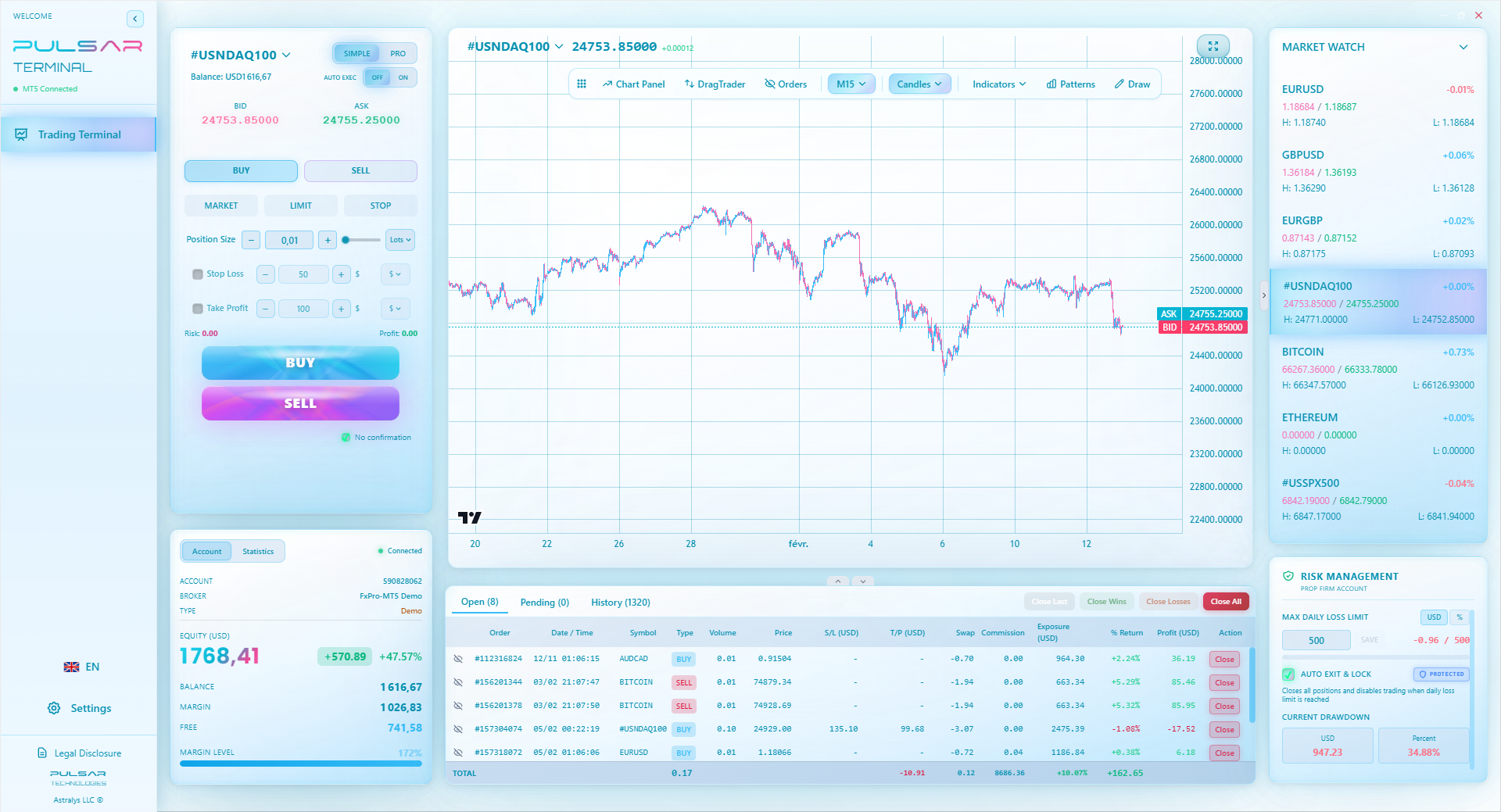
For prop firm traders, the daily loss protection feature is non-negotiable. It automatically calculates your running loss and will close all positions and prevent new ones if you hit your limit. It stops you from emotional self-destruction. Grid trading tools can also help automate more complex strategies, though I'd advise beginners to master simple directional trading first.
Managing prop firm daily loss limits and executing complex order strategies are manual headaches that Pulsar Terminal automates directly on your MT5 platform.
Pulsar Terminal
MT5オールインワンツール:ドラッグ&ドロップ注文、マルチTP/SL、トレーリングストップ、グリッドトレード、出来高プロファイル、プロップファーム保護。毎日1,000人以上のトレーダーが利用。
“Discipline is a currency.”
Let me get vulnerable with you. I told you about my big gold loss. Here are two more specific trades that defined my approach.
The Good (But Flawed) Win: In 2018, I shorted GBP/USD on a Brexit headline. Entry at 1.3020. My plan was a 50-pip target. It crashed 180 pips in hours. I was up over $900 on a single mini lot. Greed took over. I moved my stop-loss down, but not to breakeven. I kept thinking 'more.' It reversed sharply, hit my trailing stop, and I exited at 1.2920. Final profit: $500. I left $400 on the table because I didn't have a clear multi-target exit plan. I celebrated the win, but I knew I'd messed up. Today, I'd use a tool to automatically close 50% at +50 pips and trail the rest.
The Disciplined Loss: Just last year, I went long on EUR/USD at 1.0750 based on a RSI divergence and a key support level. I risked 0.5% of my account, stop at 1.0720 (30 pips). It immediately went against me. It hovered around 1.0730 for an hour, teasing me. The old me would have moved the stop 'just a little wider.' The current me walked away from the screen. It hit my stop-loss exactly. Loss: $30. It then plummeted another 100 pips. By sticking to my plan, I lost $30 instead of $130. That felt like a bigger victory than many wins. Discipline is a currency.
“The flashy Instagram trader today might be begging for a signal subscription next year.”
So, can you join the ranks of the richest forex traders in Africa? Maybe. But you need to redefine what 'rich' means. It's not about a single Lamborghini purchase. It's about generating consistent, manageable returns that compound over time. It's about building a skill that can't be taken from you.
Start small. Use a position size calculator for every trade. Focus on one strategy and one pair. Keep a trade journal - not just entries and exits, but your emotional state. Were you scared, greedy, bored? That data is gold.
Embrace the regulations. Pay your taxes. Operate like a professional. The market is maturing, and the traders who treat it like a serious business will be the ones left standing when the hype cycles end. The flashy Instagram trader buying champagne today might be the one begging for a signal subscription next year. The quiet trader following his plan, protecting his capital, and grinding out 5-10% a month? He's the one building real, lasting wealth. That's the only leaderboard that matters.
💡 ウィンストンのヒント
Your first profit target should always be to get to breakeven. Moving your stop to entry after a favorable move turns a risky bet into a free ride.
FAQ
Q1Is forex trading legal in Nigeria?
Yes, forex trading is legal for individuals in Nigeria. It's regulated by the Central Bank of Nigeria (CBN) and the Securities and Exchange Commission (SEC). However, you cannot use the official CBN foreign exchange window to fund your trading account, and you must pay a 10% capital gains tax on your profits to the FIRS.
Q2Who is the richest forex trader in Nigeria?
There's no publicly verified 'richest' trader, as most trade privately. Real wealth in trading is built discreetly through consistent returns over years. Be wary of anyone publicly claiming the title - often, their income comes from selling courses, not trading. Focus on the principles of risk management and discipline, not chasing a single person's story.
Q3What is a realistic monthly return from forex trading?
A realistic and sustainable target for a skilled retail trader is between 5% and 10% per month on their trading capital. Promises of 50% or 100% monthly returns are almost always scams or extremely high-risk strategies destined to fail. Consistency over time is what builds real wealth.
Q4How much money do I need to start forex trading in Nigeria?
You can start with very little. Some brokers like XTB have a $0 minimum, while others like Exness start at $10. However, you need enough to trade sensible position sizes. A good starting point is $100-$300. This lets you practice real money management without risking a life-changing amount. Remember, the goal is to learn and preserve capital first.
Q5Can I use a Nigerian bank card to fund my forex account?
It's become very difficult. Most Nigerian banks have restricted or suspended the use of Naira debit cards for international transactions, including deposits to offshore forex brokers. Traders now often use alternative methods like cryptocurrency (USDT), specialized international payment processors, or bank wire transfers, though wires can be expensive and slow.
Q6What is the best broker for Nigerian forex traders?
There's no single 'best' broker. It depends on your style. For tight spreads and raw pricing, look at IC Markets or Pepperstone. For very high use, some use Exness or HFM. For lower minimum deposits, consider XTB or Capital.com. Always prioritize strong regulation, reliable withdrawals, and a platform that suits your strategy. Check our detailed XM review and others for comparisons.
Q7How do I avoid forex trading scams in Nigeria?
Avoid any 'mentor' or signal seller who guarantees profits, shows off extravagant wealth, or pressures you to deposit more money. Legitimate educators teach you how to fish; they don't sell you magic fish. Only use well-known, internationally regulated brokers. If an offer sounds too good to be true (e.g., 'double your money in a week'), it is.
ウィンストン教授のレッスン
重要ポイント:
- ✓10% capital gains tax applies to all Nigerian trading profits.
- ✓Sustainable monthly returns are 5-10%, not 50%.
- ✓Use a position size calculator for every single trade.
- ✓Maximum daily loss should be 2-3% of your account.
- ✓Fund your account with $100-$300 to start learning seriously.
この記事はどれくらい役に立ちましたか?
星をクリックして評価
週刊トレーディングインサイト
無料の週刊分析&戦略。スパムなし。
著者について
Olumide Adeyemi
西アフリカ・トレーディングの先駆者
ナイジェリアで最もアクティブなFXトレーディング教育者の一人。ラゴスから8年のトレード経験。アフリカのトレーダー向けの少額資金戦略とプロップファームチャレンジを専門とする。
コメント
リスク警告
金融商品の取引には大きなリスクが伴い、すべての投資家に適しているわけではありません。過去の実績は将来の結果を保証するものではありません。本コンテンツは教育目的のみであり、投資助言として解釈すべきではありません。取引前に必ずご自身で調査を行ってください。
こちらもおすすめ

Cara Trading Forex Sukses: 7 Prinsip dari Trader Profesional
Cara trading forex sukses dengan 7 prinsip trader pro: manajemen modal, disiplin, journal trading, backtest. Data nyata, bukan janji profit palsu.
Jam Trading Forex Terbaik untuk Trader Indonesia: Panduan Lengkap dengan Tabel Waktu
Panduan jam trading forex untuk trader Indonesia. Tabel 4 sesi dunia, jam emas 20:00-00:00, sesi mana yang harus dihindari. Data akurat + tips dari trader berpengalaman.
Top 5 Sàn Forex Uy Tín Nhất 2026: Review Jujur dari Trader Indonesia
Top 5 sàn forex uy tín 2026 untuk trader Indonesia. Review jujur: spread, deposit, withdraw, dukungan lokal. Exness, XM, IC Markets & lebih.
