


My screen was a blur of green and red.
James Mitchell
シニアトレーディングアナリスト
☕ 11 分で読める
学べること:

My screen was a blur of green and red. It was October 2014, and the EUR/USD was in a frenzy, whipping up and down 30 pips every few minutes. I was trying to scalp, clicking furiously, convinced I could catch every move. By the end of the hour, I was up $87... and completely exhausted. I’d made twelve trades. The stress was immense, and I realized this wasn't sustainable. That day forced me to honestly ask: am I a scalper or a swing trader? It's not just about technique; it's about who you are. Let's figure out which battle you're built for.
This is the heart of the scalp trading vs swing trading debate. It's a fundamental difference in how you view the market and your place in it.
Scalping is about precision and frequency. You're a market sniper. You believe there's consistent, small-scale inefficiency in price movement - little wobbles, liquidity grabs, order flow imbalances - that you can exploit over and over. Your goal isn't to predict a big trend; it's to be right about the next 5 to 10 pips, dozens of times a day. You take many small wins, hoping they add up to a large one, while accepting that many small losses are part of the game. It's a volume business.
Swing trading is about patience and conviction. You're a surfer waiting for the right wave. You believe in identifying and capitalizing on broader market moves that play out over days or weeks. You're looking for shifts in sentiment, reactions to economic data, or breaks of key technical levels. You give your trades room to breathe, accepting wider stops for the potential of a much larger reward. A few good swings a month can outperform a hundred frantic scalps.

Warning: Don't try to mix these mindsets in a single trade. A scalper who gets greedy and tries to 'swing' a losing position will get destroyed. A swing trader who panics at a 5-pip retracement will never catch a move.
I learned this the hard way. I once entered a long swing trade on Gold (XAU/USD) at $1785, targeting $1820. A few hours later, I saw a small dip and, thinking like a scalper, I tried to 'add' by shorting it for a quick 5-pip profit. I just ended up complicating my position and closing the entire thing for a net loss when my short got stopped. I violated my own plan. If you want a deeper look at trading gold swings, our XAU/USD guide breaks down its unique rhythms.

“Scalping is a volume business; swing trading is a conviction business.”
This is the deal-breaker for most people. Your choice here dictates your daily life.
The Scalper's Grind
Scalping is a job. You need to be glued to the screen during your chosen session (London open, US open, etc.). You can't walk away for 30 minutes. You need intense focus, quick reflexes, and a setup with ultra-low latency. A slow internet connection or platform lag is a career-ender. It's mentally draining. I used to scalp the EUR/USD during the London/New York overlap, and after 3 hours, I was spent. You're trading not just against the market, but against your own stamina.
The Swing Trader's Rhythm
Swing trading is more like managing a portfolio. You might spend an hour each night analyzing charts, setting alerts, and planning for the next day. Once a trade is on, you check in a few times a day to manage it, but you're not chained to your desk. This allows for a normal job, family time, and less overall stress. Your enemy isn't latency; it's impatience. The hard part is sitting on your hands and letting your thesis play out.

Pro Tip: Be brutally honest about your schedule. If you have a 9-to-5 job, scalping is nearly impossible unless you trade very early or late. Swing trading is almost always the better fit for part-time traders.
The brokers you choose also reflect this. For scalping, you need a broker like IC Markets or Pepperstone known for razor-thin spreads and fast execution. For swing trading, while good execution still matters, you might prioritize other features like swap rates or instrument variety, which you can find in our XM review.

💡 ウィンストンのヒント
Your first 100 trades in any style are tuition, not income. Pay attention.
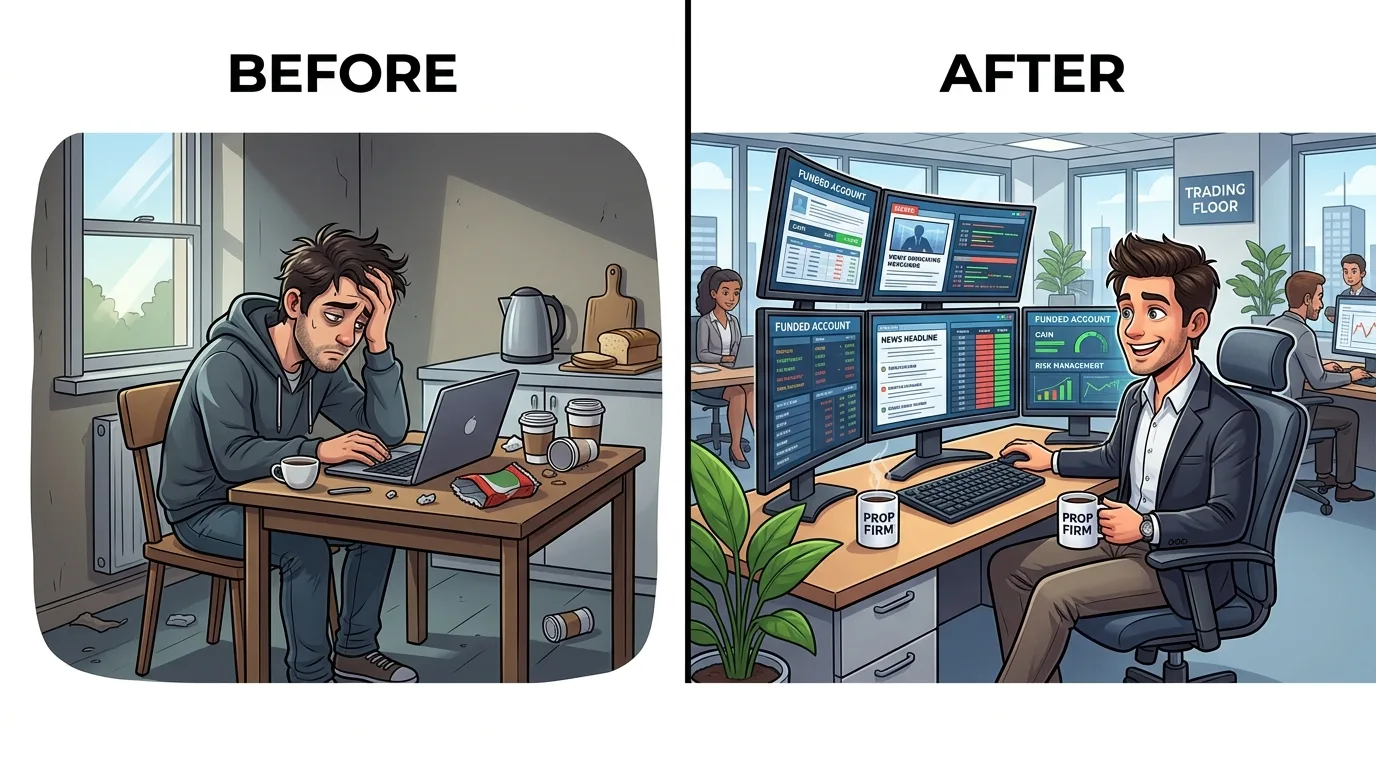
“Profitability isn't inherent to the style; it's inherent to the trader's skill and fit.”
The financial and technical setups for these styles are worlds apart. Getting this wrong is a fast track to a margin call.
| Requirement | Scalp Trading | Swing Trading |
|---|---|---|
| Typical Stop-Loss | 5-15 pips | 30-100+ pips |
| Typical Take-Profit | 10-25 pips | 100-300+ pips |
| Risk Per Trade | 0.25% - 0.5% of account | 1% - 2% of account |
| Position Size | Much Larger (due to small stop) | Smaller (due to wide stop) |
| Key Broker Feature | Lowest possible spread, ECN/RAW account | Overnight financing (swap) rates |
| Capital Minimum | $500+ (to handle larger size & costs) | $2,000+ (to absorb wider stops) |
The Scalper's Math: Because your stop is tiny (say, 10 pips), you need a large position size to make a meaningful profit. If you risk 0.5% on a 10-pip stop, a 20-pip win is a 1% gain. But that large size means a 20-pip loss against you also hurts. Commission and spread costs are critical. Paying a 2-pip spread on a 10-pip target is a 20% tax on your profit. Always use a position size calculator.
The Swinger's Math: Your stop is wide, so your position size must be smaller to keep risk in check. If you risk 1.5% on a 50-pip stop, a 200-pip win is a 6% gain. The spread is less of a factor (2 pips on a 200-pip target is 1%). Your main cost is swap if you hold positions overnight for days.
From my experience: I once tried to swing trade with a scalper's position size. I went long on the GBP/USD with a 40-pip stop, but sized my trade as if it were a 10-pip stop. A normal 25-pip retracement against me felt catastrophic and I panicked out. I hadn't adjusted my psychology for the larger dollar volatility.
“Profitability isn't inherent to the style; it's inherent to the trader's skill and fit.”
You see different markets on different timeframes. A scalper sees a raging river; a swing trader sees the river's overall course.
Scalping View (M1, M5, M15):
- Primary Tools: Order flow, price action, momentum indicators (like a fast RSI indicator), and support/resistance on the micro level.
- Focus: Immediate supply and demand. Where are the buy/sell orders stacked? Is price stalling at a round number? You're looking for the next candle's direction.
- The Noise: You have to learn to ignore 'meaningless' volatility. A 3-pip spike on the 1-minute chart is just noise to a swing trader, but it might be your entry signal.
Swing Trading View (H4, D1, W1):
- Primary Tools: Higher-timeframe support/resistance, trend lines, moving averages, and slower momentum indicators like the MACD indicator.
- Focus: The overall story. Is the trend intact? Are we approaching a major weekly level? Has there been a fundamental shift?
- The Patience: You use lower timeframes (like H1) primarily for refining entry points, not for making trading decisions.

Example: A swing trader sees the EUR/USD bounce off a major daily support at 1.0750 and starts looking for a long entry. A scalper doesn't care about the daily chart. They're watching the 5-minute chart for a break above a minor consolidation at 1.0762 to go long for 8 pips.
My biggest early mistake was using swing trading analysis to justify scalp entries. I'd see a great weekly setup, then jump in on the 1-minute chart at the worst possible price, get stopped out by noise, and miss the actual weekly move that played out perfectly. The setups are different. If you're interested in the fast-paced approach, our scalping strategy guide dives into specific entry techniques.
💡 ウィンストンのヒント
If you feel the urge to constantly check a swing trade, your position size is too big. Reduce it until you can sleep.

“A scalper sees a raging river; a swing trader sees the river's overall course.”
This is the most important section. You can learn techniques, but you can't easily change your core temperament.
The Ideal Scalper:
- Thrives on action and quick feedback. Gets bored waiting.
- Disciplined and robotic. Can execute a plan 50 times a day without emotion.
- Accepts being wrong frequently. A 50% win rate is fine if risk/reward is managed.
- Handles stress well. Doesn't get flustered by a string of 3-4 small losses.
- Detail-oriented. Spots tiny patterns and inefficiencies.
The Ideal Swing Trader:
- Patient and comfortable with uncertainty. Can wait days for a setup.
- Has strong conviction. Won't be shaken out by normal retracements.
- Thinks in probabilities over a series of trades, not about each individual trade's outcome.
- Is okay with missing moves. Understands there will always be another opportunity.
- Analytical and big-picture. Can synthesize fundamental and technical themes.
I am, by nature, more of a swing trader. I learned that the hard way after my early scalping attempts left me anxious and burned out. I'm too prone to overthinking a 5-pip move. My friend, however, is a born scalper. He gets a thrill from the rapid-fire action and gets impatient when a trade of his lasts more than an hour. Knowing this about yourself saves years of pain and lost money. For a deeper look at the swing trading mindset, check out our guide on swing trading fundamentals.

“A scalper sees a raging river; a swing trader sees the river's overall course.”
Everyone asks this, and the answer is frustrating: it depends entirely on the trader.
Profitability isn't inherent to the style; it's inherent to the trader's skill and fit.
A skilled scalper with a strong edge, perfect discipline, and the right technology can make a consistent living. Their equity curve might be a steady, smooth upward slope made of hundreds of tiny wins and losses.
A skilled swing trader can also make a fantastic living, often with less screen time. Their equity curve will be more stair-step: periods of flat or small drawdowns, punctuated by large winning trades.
The reality check: The attrition rate for new scalpers is astronomically high. The combination of high transaction costs (spreads + commissions), the need for perfect execution, and psychological pressure weeds out over 90% of people within months.
Swing trading has a higher survival rate for beginners because the pace is slower, allowing more time to think and learn. However, the emotional challenge of holding through drawdowns and the need for patience takes out many as well.
Warning: No style is an 'easy money' secret. Both require years of screen time, journaling, and losing real money to learn. Anyone selling you a 'guaranteed' scalping robot or swing trading signal service is selling a fantasy.
In my own track record, my swing trading has been far more profitable and sustainable. My scalping phase was basically a break-even education with a ton of stress. My best swing trade last year was in Nasdaq, riding a 1200-point move over three weeks for a 22% account gain. That one trade made more than my entire scalping output for a previous quarter.
💡 ウィンストンのヒント
The spread is the scalper's mortal enemy. If your target is less than 3x the spread, find a new broker or a new pair.
“Knowing your psychological fit saves years of pain and lost money.”
Don't just guess. Use this process.
- Paper Trade BOTH Styles: Seriously. Open two demo accounts. For one month, dedicate one to strict scalping (5-15 pip targets) on the M5 chart. Dedicate the other to swing trading (50+ pip targets) on the H4/D1 charts. Trade them exactly as if they were real. This isn't about making fake profit; it's about discovering which process feels natural and which one you hate.
- Audit Your Personality & Schedule: Re-read the psychology section. Look at your calendar. Be mercilessly honest.
- Start Small with Real Money: Once you choose, fund a small live account with money you can afford to lose. The goal for the first 6 months is not profit. The goal is to execute your plan consistently and survive. Trade micro lots (0.01).
- Specialize: If you pick scalping, master one or two currency pairs during one specific session. If you pick swing trading, pick 3-5 instruments across different asset classes (e.g., one major FX pair, one index, one commodity).
- Journal Relentlessly: For every trade, note: entry/exit reasoning, emotional state, outcome. After 100 trades, patterns will emerge. You'll see if you're cutting winners short (a swing trader flaw) or letting losers run (a scalper flaw).
I recommend almost all new traders start by learning on higher timeframes (swing perspective) to understand market structure, even if they eventually want to scalp. It gives you context. Jumping straight to the 1-minute chart with no context is like trying to read a novel one random letter at a time.
Finally, the right tools make execution easier. Managing multiple take-profit levels on a swing trade, for instance, is clunky in a standard platform.

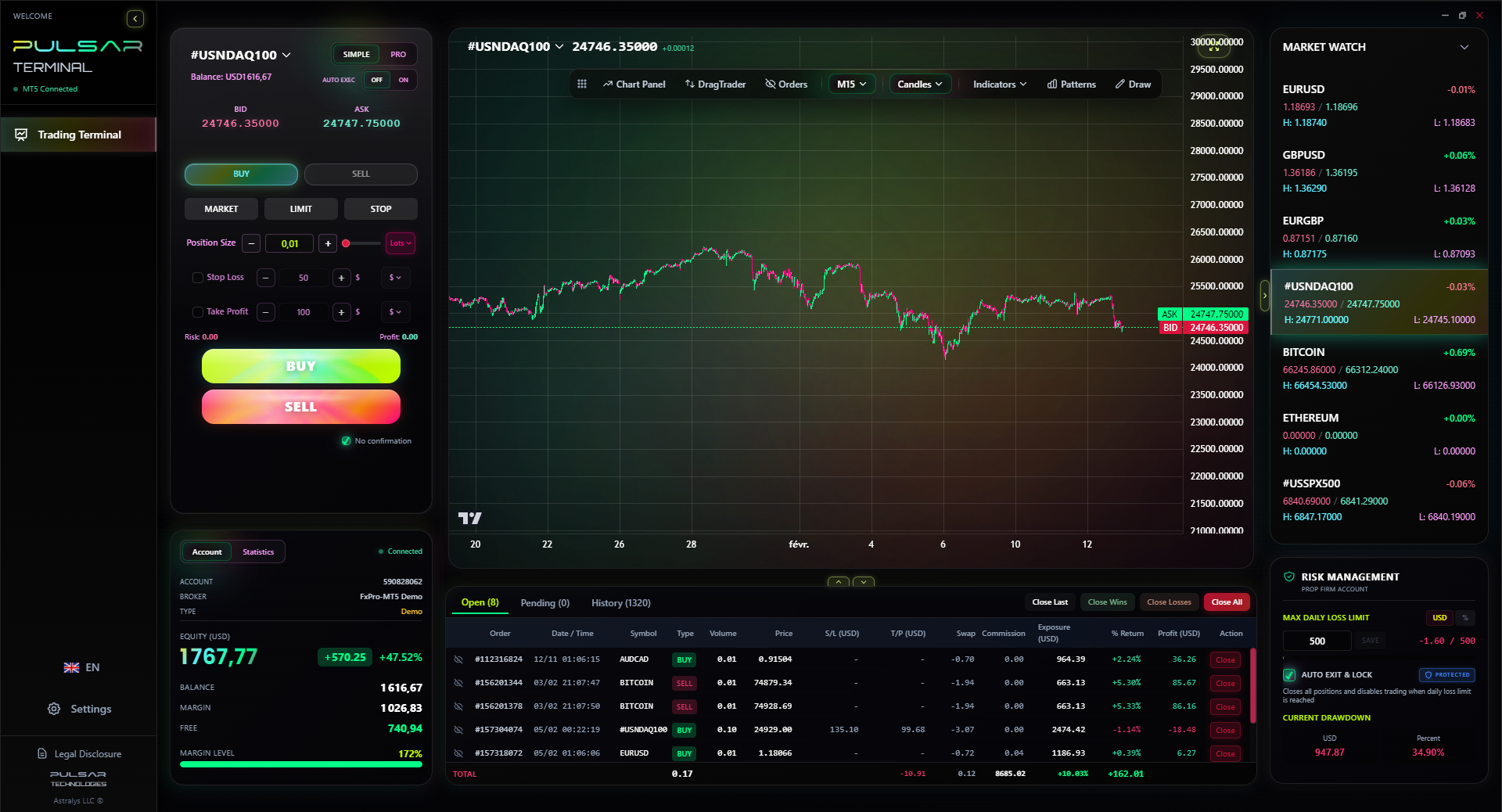
Managing complex swing trades with multiple take-profit levels is where a tool like Pulsar Terminal shines, letting you set and automate your entire exit strategy with a single drag-and-drop.
Pulsar Terminal
MT5オールインワンツール:ドラッグ&ドロップ注文、マルチTP/SL、トレーリングストップ、グリッドトレード、出来高プロファイル、プロップファーム保護。毎日1,000人以上のトレーダーが利用。
FAQ
Q1Can I be both a scalper and a swing trader?
Not simultaneously in the same account, and I strongly advise against it as a beginner. It confuses your mindset and risk parameters. An experienced trader might have separate accounts or strategies - scalping during high-volatility events and swing trading the rest of the time - but this requires mastered discipline in both styles first.
Q2How much money do I need to start scalp trading?
Technically, you can start with a few hundred dollars on a micro account. Realistically, I'd suggest a minimum of $1,000. This allows you to use sensible position sizes (e.g., 0.1 lots) to where the profit from a 10-pip win ($10) isn't completely erased by the spread and commission, and it can withstand a string of small losses without a margin call.
Q3Is swing trading safer than scalping?
Not necessarily 'safer,' but it's often more forgiving for beginners. The lower frequency means fewer decisions and lower transaction costs, which reduces the number of ways you can mess up. However, the risk per trade in dollar terms can be larger due to wider stops, so proper position sizing is absolutely critical.
Q4Which style has a higher win rate?
Scalping often aims for a higher win rate (60-80%) because the profit targets are very close to the entry. Swing trading typically has a lower win rate (40-60%) because you're aiming for larger moves and will get stopped out by normal market noise more often. Profitability comes from the risk/reward ratio, not the win rate alone.
Q5What are the best indicators for scalp trading vs swing trading?
For scalping: VWAP, fast-moving averages (like EMA 9/21), and the RSI indicator on a low setting (like 7) for overbought/oversold signals on low timeframes. For swing trading: Moving averages (SMA 50/200), the MACD indicator, and Volume Profile to identify key high-timeframe support/resistance zones.
Q6Can I swing trade with a full-time job?
Absolutely. In fact, swing trading is the classic style for people with day jobs. You can do your analysis in the evenings or on weekends, set your orders with stop-loss and take-profit, and just check in briefly during the day or once a day after work. It doesn't require constant screen monitoring.
ウィンストン教授のレッスン
重要ポイント:
- ✓Scalping requires 5-15 pip stops; swing trading uses 30-100+.
- ✓Transaction costs can consume 20% of a scalper's profit.
- ✓Start with a demo to test your psychological fit first.
- ✓Swing trading is far more compatible with a day job.
この記事はどれくらい役に立ちましたか?
星をクリックして評価
週刊トレーディングインサイト
無料の週刊分析&戦略。スパムなし。
著者について
James Mitchell
シニアトレーディングアナリスト
ニューヨーク拠点で9年以上のトレード経験を持つ。主要USDペア、プロップファームチャレンジ、米国の規制環境を専門とする。
コメント
リスク警告
金融商品の取引には大きなリスクが伴い、すべての投資家に適しているわけではありません。過去の実績は将来の結果を保証するものではありません。本コンテンツは教育目的のみであり、投資助言として解釈すべきではありません。取引前に必ずご自身で調査を行ってください。
こちらもおすすめ

Cara Trading Forex Sukses: 7 Prinsip dari Trader Profesional
Cara trading forex sukses dengan 7 prinsip trader pro: manajemen modal, disiplin, journal trading, backtest. Data nyata, bukan janji profit palsu.
Jam Trading Forex Terbaik untuk Trader Indonesia: Panduan Lengkap dengan Tabel Waktu
Panduan jam trading forex untuk trader Indonesia. Tabel 4 sesi dunia, jam emas 20:00-00:00, sesi mana yang harus dihindari. Data akurat + tips dari trader berpengalaman.
Top 5 Sàn Forex Uy Tín Nhất 2026: Review Jujur dari Trader Indonesia
Top 5 sàn forex uy tín 2026 untuk trader Indonesia. Review jujur: spread, deposit, withdraw, dukungan lokal. Exness, XM, IC Markets & lebih.
