


How many times have you watched a trade reverse, praying it'll come back, only to see it wipe out a week's profits? If you're trading from South Africa without a solid stop loss forex plan, you're basically driving on the N1 with no brakes.

David van der Merwe
新興市場トレーダー ·  South Africa
☕ 10 分で読める
学べること:
- 1What a Stop Loss Actually Is (And Isn't)
- 2Calculating Your Stop: The 2% Rule & Volatility Reality
- 3Where to Place the Damn Thing: Technicals vs. Psychology
- 4South African Broker Execution: Slippage & Guaranteed Stops
- 5Moving Up the Ladder: Trailing Stops & Breakeven
- 6Mistakes I've Made (So You Don't Have To)
- 7Your South African Stop Loss Action Plan
How many times have you watched a trade reverse, praying it'll come back, only to see it wipe out a week's profits? If you're trading from South Africa without a solid stop loss forex plan, you're basically driving on the N1 with no brakes. It's not a matter of if you'll crash, but when. I've blown accounts ignoring this, and I've saved countless more by getting it right. Let's talk about how you actually use a stop loss to survive and profit in our unique market.
A stop loss isn't a suggestion. It's a pre-programmed exit order that says, "If the market moves X amount against me, get me out immediately." Full stop. It's an admission that you don't know the future and a contract with yourself to limit losses.
Many new traders see it as a target for the market to hunt. Sometimes it feels that way, especially with exotic pairs. But more often, not having one is what gets you hunted. The FSCA doesn't mandate you use one, but their 1:30 use cap for retail traders (with a planned move to 1:200 for majors) is a loud hint: manage your risk, or we'll help manage it for you.
Think of it as insurance. You pay a small premium (the potential loss if the stop is hit) to avoid a catastrophic claim (a margin call). The real cost isn't the stop loss itself; it's the spread, commission, and the dreaded slippage when it triggers. On a volatile day around a SARB repo rate announcement, that slippage can be brutal.

Warning: A stop loss is NOT a "set and forget" magic bullet. Placing it too close to your entry because you're scared guarantees you'll get stopped out by normal market noise. You must give your trade room to breathe.

💡 ウィンストンのヒント
Your first loss is often your best loss. Taking a small, planned hit keeps you in the game. Letting a loser run turns a setback into a catastrophe.
“A stop loss isn't a sign of weakness; it's your strategic retreat line.”
Forget random numbers. Your stop loss distance should be a function of two things: how much you're willing to lose on the trade, and the market's current volatility. The old-school 2% rule is a good starting point: never risk more than 2% of your trading capital on a single trade.
Here’s how it works in Rands. Say you have a R50,000 account. Two percent of that is R1,000. That R1,000 is your maximum risk per trade. Now, let's say you're buying EUR/USD at 1.0850. You've done your analysis and decide your stop needs to be at 1.0820 - a 30-pip risk.
How many lots can you trade? A standard lot (100,000 units) move of 1 pip is roughly $10. With EUR/USD at 1.0850, that’s about R185 (depending on the USD/ZAR rate). To risk R1,000 with a 30-pip stop, you'd calculate: R1,000 / (30 pips * R185 per pip) = roughly 0.18 lots. That’s your position size. I strongly recommend using a dedicated position size calculator for this; doing it manually while the market moves is a recipe for error.
Why Volatility Matters More for ZAR Pairs
This is the South African twist. The USD/ZAR can easily move 200-300 pips on a busy day. Placing a 30-pip stop on that is suicide. You need to measure the Average True Range (ATR) of the pair. If the ATR(14) is 250 pips, your stop needs to be at least 250 pips away, maybe 300, just to account for the normal daily swing. That changes your position size dramatically. A R1,000 risk on a 300-pip stop means a much smaller lot size. This is why trading majors like EUR/USD or XAU/USD is often easier for beginners - the volatility is more predictable.

Example: Trading USD/ZAR with a R50k account.
- Account Risk: R1,000 (2%)
- USD/ZAR ATR: 250 pips
- Safer Stop Distance: 300 pips
- Pip Value (mini lot): ~R0.75
- Position Size: R1,000 / (300 pips * R0.75) = 4.44 mini lots. Trade any bigger, and a normal daily move will take you out.
“The real cost of a stop loss isn't the loss itself; it's the spread, commission, and the dreaded slippage when it triggers.”
This is the art. You can use the 2% rule to get your size, but where you place the stop is a tactical decision. There are three main schools of thought, and I use a blend.
- Technical Levels: This is the cleanest method. Place your stop just beyond a clear technical barrier. For a long trade, put it below the recent swing low, or below a key support trendline or Fibonacci level. The market has to genuinely break the structure to prove your idea wrong. I once shorted GBP/ZAR at R23.50, placing my stop at R23.85, just above a weekly resistance level. It got within 20 pips of my stop before collapsing to R22.90. Had my stop been based on a random dollar amount, I'd have been gone.
- Volatility-Based Stops: As discussed, use the ATR. A common method is 1.5x to 2x the ATR. If the ATR(14) on EUR/USD is 70 pips, place your stop 105-140 pips away. This objectively measures the market's "noise" and keeps you out of it.
- The Mental Stop (Just Kidding, Don't Do This): A "mental stop" is a promise you make to yourself that you'll close the trade at a certain price. It's worthless. When the price is plunging and your heart is in your throat, that mental stop evaporates. You'll move it, then move it again. I have a graveyard of trades that prove this. Use a physical, submitted order.
Remember, your broker's platform matters. The spread can affect your fill. If you place a stop at 1.0820 on EUR/USD and the spread is 2 pips, you'll actually be filled around 1.0818. Factor that in. This is one reason I prefer brokers with consistently tight spreads, like IC Markets or Pepperstone on their Raw accounts.
“The real cost of a stop loss isn't the loss itself; it's the spread, commission, and the dreaded slippage when it triggers.”
Here's a critical local lesson. When your stop loss triggers, it becomes a market order. It says "sell at the best available price." In a calm market with a broker like XM or Exness, you'll usually get filled at or very near your price. But during high volatility - like when a US Fed decision hits at 8pm our time, or local political news drops - liquidity dries up. The price can jump over your stop. This is slippage.
On USD/ZAR, I've seen slippage of 50+ pips during a sudden load-shedding announcement that spooked markets. My stop was at R18.4000, but the next available price was R18.4550. That extra 55 pips came straight out of my pocket.
Some brokers offer Guaranteed Stop Loss Orders (GSLOs). For a small premium or wider spread, they promise to fill you exactly at your stop price, no matter what. In South Africa, with our unique volatility, these can be worth their weight in gold for news trades. The catch? They're not always available on all pairs, and if the market gaps right through your stop at the open, you might still get a worse fill. Always read the fine print.
Your choice of account type matters too. An ECN/RAW account might have a tighter spread but add a commission. When your stop hits, you pay the commission. A standard account bakes the cost into the spread. Do the math on your typical trade size to see which is cheaper for your scalping strategy or swing trading style.
💡 ウィンストンのヒント
If you're constantly getting stopped out only to see the price reverse and hit your target, your stops are too tight. You're trading noise, not signal. Walk away from the chart and come back with a longer timeframe.
“A 'mental stop' is a promise you make to yourself that you'll close the trade at a certain price. It's worthless.”
Once a trade moves in your favor, your job is to protect profits. A static stop loss does nothing for you here. This is where trailing stops and breakeven orders come in.
A trailing stop is a dynamic stop loss that follows the price at a fixed distance (in pips or a percentage). If you buy EUR/USD at 1.0800 with a 30-pip trailing stop, your stop starts at 1.0770. If price rises to 1.0830, your stop moves up to 1.0800. If it then hits 1.0850, your stop moves to 1.0820. It locks in profit as the trend runs. The key is setting the trail distance wide enough not to get whipped out in a pullback. Using the ATR for this distance is again your best bet.
A breakeven stop is simpler. Once the trade is in profit by a certain amount (say, the size of your original risk), you move your stop loss to your entry price. This eliminates the risk of a loss on the trade. It’s a psychological win, but it can also get you stopped out right before a big move continues. I use it selectively, often after a key level has been breached.
Doing this manually on MT4/MT5 is a pain. You're glued to the screen. This is where automation tools or advanced platforms shine. Managing these dynamically is what separates consistent traders from hopeful ones.
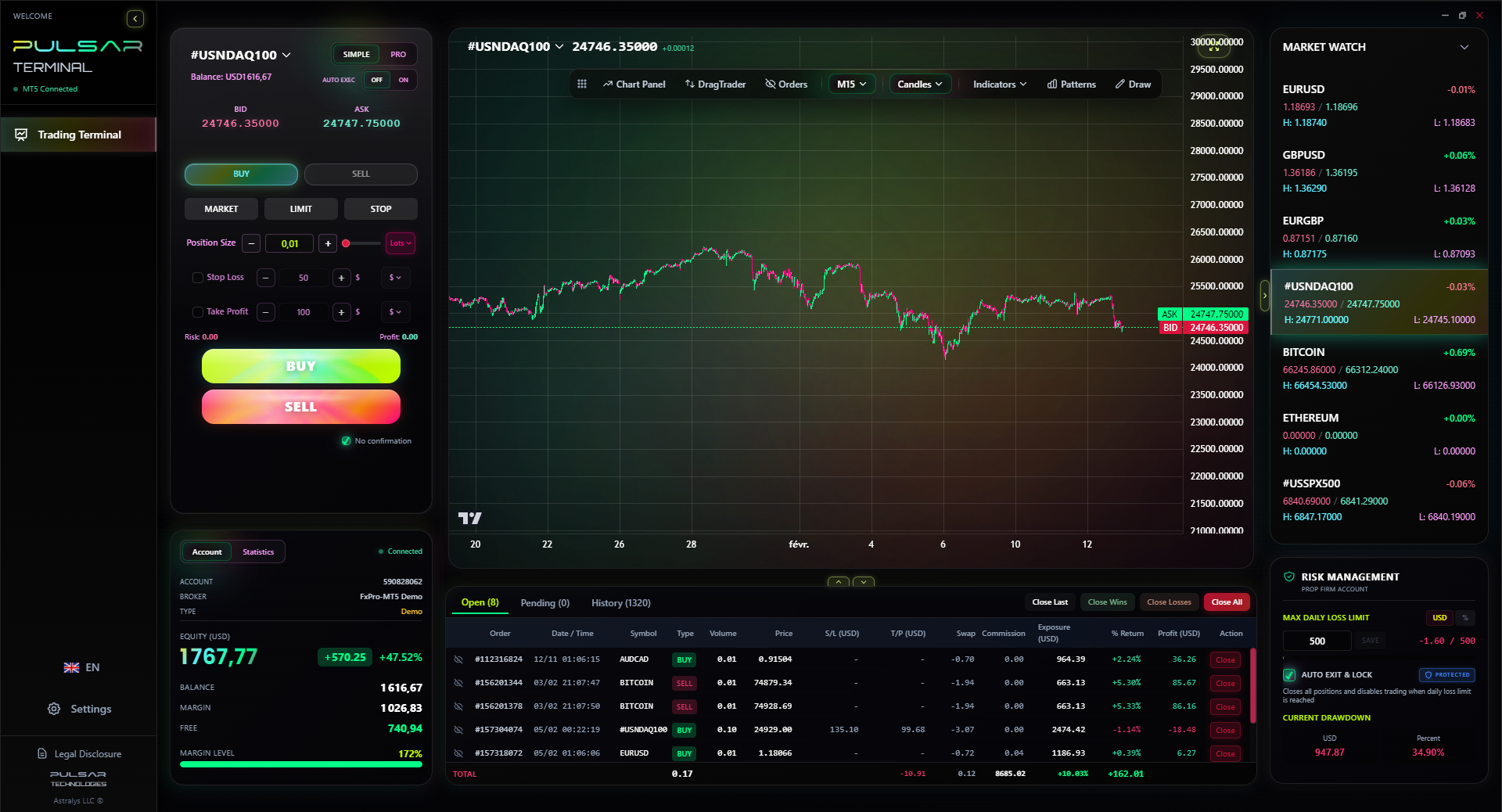
Manually trailing stops and moving to breakeven is a hassle, but Pulsar Terminal automates it directly on your MT5 chart, letting you lock in profits without babysitting the screen.
Pulsar Terminal
MT5オールインワンツール:ドラッグ&ドロップ注文、マルチTP/SL、トレーリングストップ、グリッドトレード、出来高プロファイル、プロップファーム保護。毎日1,000人以上のトレーダーが利用。
“A 'mental stop' is a promise you make to yourself that you'll close the trade at a certain price. It's worthless.”
Let's get honest. I've screwed this up every way possible.
- Placing Stops Too Close: Early on, I'd risk 10 pips to make 20. I was right about direction maybe 60% of the time, but the spreads and tiny noise wiped me out. My win rate was high, but my losers were frequent and demoralizing. I was over-leveraged, trying to make big money from small moves. It's a trap.
- Moving Stops Further Away ("Doubling Down"): This is the account killer. The trade goes -20 pips. "The level is just ahead," you think, and move the stop to -40 pips. Then to -80. You've just doubled or quadrupled your risk on a losing trade. You're no longer trading your plan; you're praying. I turned a R2,000 loss into a R12,000 loss on a single GBP/JPY trade doing this. It felt like a slow-motion car crash.
- Ignoring Economic Calendars: Placing a tight stop right before the US Non-Farm Payrolls or our own Budget Speech is asking for punishment. The spread will widen, and slippage is almost guaranteed. Either use a wider stop, a guaranteed stop, or just don't be in the trade.
- Not Accounting for Swap: If you're holding a swing trading position for days, the overnight swap/rollover fees can eat into your buffer. Make sure your stop isn't placed so that, after a week of swaps, you're effectively stopped out at a worse price.
The core lesson? Your stop loss defines your trade. If you don't respect it, you don't respect your capital. And the market has zero respect for you.
💡 ウィンストンのヒント
Write your stop loss level and your reason for it in your trading journal *before* you enter the trade. If you later want to move it, you must write a new, defensible reason. This creates accountability.
“Your stop loss defines your trade. If you don't respect it, you don't respect your capital.”
Here's your checklist before hitting the buy or sell button:
- Check the News: Is there major SA or global news in the next few hours? If yes, reconsider the trade or plan for a much wider stop.
- Determine Your Risk: What is 2% of your current account balance in Rands? That's your max risk (e.g., R1,000 on R50k).
- Analyze the Chart: Find a logical technical level for your stop (beyond swing high/low, key S/R). Measure that distance in pips.
- Check Volatility: Pull up the ATR(14) indicator. Is your technical stop distance at least 1x the ATR? If not, reconsider the entry or use the ATR distance.
- Calculate Position Size: Use your max risk (Step 2) and your stop distance in pips (Step 3 or 4) to calculate your lot size. (Risk in Rands) / (Pips * Pip Value in Rands). Use a calculator.
- Set the Orders: Enter your trade, and immediately set your physical stop loss and take-profit orders. Consider if a trailing stop makes sense for your strategy.
- Walk Away: Once set, do not move the stop further away. You can only move it to lock in profit (trail or breakeven).
This process turns emotion into mechanics. It's boring. It's repetitive. And it's the only thing that keeps you in the game long enough in a market with over 200,000 active traders all trying to take money from each other. Your stop loss isn't a sign of weakness; it's your strategic retreat line. Use it, and you might just live to trade another day.
FAQ
Q1Is a stop loss mandatory for forex trading in South Africa?
No, the FSCA doesn't force you to use one. But given their retail use caps (1:30, moving to 1:200 for majors), it's the regulator's way of telling you that uncontrolled risk is a fast track to blowing your account. Not using one is professional suicide.
Q2What's a good stop loss percentage for a beginner?
Don't think in percentages of the trade; think in percentages of your account. The universal rule for beginners is 1-2% of your total capital per trade. For the stop loss distance itself, it should be based on market volatility (use the ATR indicator), not a random percentage like 5%.
Q3Why did my stop loss get filled at a worse price than I set?
That's slippage. Your stop becomes a market order. If the price gaps or moves very fast (high volatility), the next available price might be several pips away. This is common on ZAR pairs during news events. Using a broker with good liquidity and considering Guaranteed Stops for high-risk trades can help.
Q4Should I use a fixed stop loss or a trailing stop?
Start with a fixed stop based on your technical analysis. Once the trade is in a healthy profit (e.g., 1.5x to 2x your initial risk), you can consider switching to a trailing stop to let profits run. Never start a trade with a trailing stop from entry; it gives the trade no room to develop.
Q5How do I calculate stop loss pips?
You don't calculate pips in a vacuum. First, find a logical technical level on the chart that invalidates your trade idea. Measure the distance from your entry to that level in pips. That's your stop distance. Then, use that distance with your account risk percentage to calculate your position size.
Q6What's the difference between a stop loss and a margin call?
A stop loss is an order you set to close a specific trade at a loss. A margin call is a broker's warning that your account equity has fallen too low relative to your open positions. If you don't add funds, the broker will start forcibly closing your trades, often at the worst possible time. A proper stop loss helps you avoid a margin call.
Q7Are stop losses on MT4/MT5 reliable in South Africa?
The reliability depends more on your broker's execution and market conditions than the platform itself. MT4/MT5 will send the order. During stable conditions with a reputable FSCA-regulated broker, they are very reliable. During high volatility or low liquidity (like on exotic crosses), expect potential slippage.
ウィンストン教授のレッスン
重要ポイント:
- ✓Risk a maximum of 2% of your account per trade.
- ✓Set stop distance using ATR, not random pips.
- ✓Use physical orders, never mental stops.
- ✓Move stops only to lock in profit, never to increase risk.
この記事はどれくらい役に立ちましたか?
星をクリックして評価
週刊トレーディングインサイト
無料の週刊分析&戦略。スパムなし。
著者について
David van der Merwe
新興市場トレーダー
ヨハネスブルグ拠点で新興市場通貨11年のトレーダー。ZARペア、FSCA規制下の取引、南アフリカ市場分析を専門とする。
コメント
リスク警告
金融商品の取引には大きなリスクが伴い、すべての投資家に適しているわけではありません。過去の実績は将来の結果を保証するものではありません。本コンテンツは教育目的のみであり、投資助言として解釈すべきではありません。取引前に必ずご自身で調査を行ってください。
こちらもおすすめ

Cara Trading Forex Sukses: 7 Prinsip dari Trader Profesional
Cara trading forex sukses dengan 7 prinsip trader pro: manajemen modal, disiplin, journal trading, backtest. Data nyata, bukan janji profit palsu.
Jam Trading Forex Terbaik untuk Trader Indonesia: Panduan Lengkap dengan Tabel Waktu
Panduan jam trading forex untuk trader Indonesia. Tabel 4 sesi dunia, jam emas 20:00-00:00, sesi mana yang harus dihindari. Data akurat + tips dari trader berpengalaman.
Top 5 Sàn Forex Uy Tín Nhất 2026: Review Jujur dari Trader Indonesia
Top 5 sàn forex uy tín 2026 untuk trader Indonesia. Review jujur: spread, deposit, withdraw, dukungan lokal. Exness, XM, IC Markets & lebih.
