


It was late 2018, and the USD/ZAR was screaming higher past R14.50.

David van der Merwe
新興市場トレーダー ·  South Africa
☕ 11 分で読める
学べること:
- 1The Myth vs. The Market: Cutting Through the Hype
- 2The Rulebook: Trading Legally in South Africa
- 3The Real Price of Admission: Costs & Fees in ZAR
- 4Where to Trade: Brokers That Accept South Africans
- 5Beyond the Hype: Strategies That Actually Work Here
- 6Potholes on the Road: Common SA Trader Pitfalls
- 7The Endgame: Building Wealth, Not Just Taking Trades
It was late 2018, and the USD/ZAR was screaming higher past R14.50. My phone was buzzing with messages from a group of local traders, half of them panicking, the other half boasting about their massive short Rand positions. One guy, let's call him Piet, kept posting screenshots of a six-figure account. 'Easy money,' he wrote. Six months later, he was gone - wiped out by a margin call when the tide turned. That's the thing about the hunt for the richest forex trader in South Africa: for every legendary success story, there are a hundred quiet failures. The real question isn't just who has the biggest number, but how they got it and, more importantly, kept it.
Let's be brutally honest right up front. Pinpointing the single richest forex trader in South Africa is like trying to catch smoke with your bare hands. Real wealth from trading is intensely private. The guys with nine and ten-figure portfolios aren't posting their monthly P&L on Instagram. The names you hear tossed around - Ref Wayne, Sandile Shezi, Jabulani 'Cashflow' Ngcobo - are public figures because they've built brands, education companies, and media presences. Their reported net worths (anywhere from a few million to, allegedly, billions) are almost always estimates that blend trading profits with income from seminars, book sales, and other businesses.
That doesn't make their achievements less real. Sandile Shezi famously used his university tuition to start trading. That takes a level of conviction (or madness) most of us don't have. But focusing solely on 'who is the richest' misses the point entirely. It's a distraction. The real lesson isn't in their bank balance, but in their approach: they treat trading like a serious business, not a lottery. They understood risk long before they understood reward. I learned that the hard way early on, blowing a R15,000 account because I was chasing a 'get rich quick' story instead of building a sustainable process. The market doesn't care about your dreams, only your discipline.

Warning: Be deeply skeptical of any 'guru' whose primary evidence of wealth is luxury cars and watches in social media posts. These are easily leased or borrowed for content. Real trading wealth is quiet.

💡 ウィンストンのヒント
The Rand is a moody beast. Trade it when you have a clear fundamental reason, not just because the chart 'looks' good. A strong US Dollar and local political uncertainty is a more reliable combo than any indicator.
If you want to build lasting wealth here, you start by playing within the rules. South Africa has a strong regulatory framework, and ignoring it is the fastest way to lose everything, even if your trades are winning.
The main watchdog is the Financial Sector Conduct Authority (FSCA). They took over from the FSB and they don't mess around. An FSCA license is your first and most important filter when choosing a broker. It means client funds must be kept in segregated accounts (so the broker can't use your deposit for their office party), and the firm has to maintain minimum capital levels.
Why Regulation Matters to You
I once nearly signed up with an offshore 'broker' offering insane 500:1 use and 'guaranteed' signals. The website was flashy, the account manager was persuasive. A quick check showed they had no FSCA license, just a dubious registration in some remote island jurisdiction. I walked away. A friend didn't. He made a few profitable trades, then couldn't withdraw his 'profits'. The website vanished. The FSCA exists to prevent that. Always verify your broker's FSP number on the FSCA's official website. It's a two-minute check that can save you a lifetime of regret.
This regulated environment also shapes your trading costs. FSCA brokers must be transparent about fees. You'll encounter spreads, overnight swap fees, and sometimes commissions. Knowing these costs down to the cent is part of your job. For example, a seemingly small difference in spread - like 1.2 pips vs. 0.9 pips on the USD/ZAR - adds up massively over hundreds of trades. I keep a simple spreadsheet to track this, and it's saved me thousands in hidden costs over the years. You can use our position size calculator to factor in spreads and commissions before you even place a trade.
“The real lesson from the richest traders isn't in their bank balance, but in their approach: they treat trading like a serious business, not a lottery.”
Let's talk numbers, because this is where dreams get a reality check. Trading isn't free, and these costs directly attack your bottom line. You need to know them cold.
First, the spread. This is the broker's cut. On major pairs like EUR/USD with a top-tier broker like IC Markets or Pepperstone, you can get raw spreads under 0.1 pips on an ECN account (but you pay a commission). For the USD/ZAR, the spread is your local reality. It's typically wider due to lower liquidity - expect 80-150 pips during active hours. That means the pair needs to move in your favor by that amount just for you to break even. It changes how you approach entries and stop-losses.
Then come the commissions and fees. Here’s a breakdown of what actually comes out of your pocket:
| Fee Type | Typical Cost (ZAR Approx.) | What It Means For You |
|---|---|---|
| Commission (ECN Accounts) | R70 - R150 per standard lot | A direct cost per trade. Tighter spreads offset this. |
| Overnight Financing (Swap) | Variable, can be +/- R100+ per lot | Cost or credit for holding a position past 5 PM NY time. Check rates daily. |
| Inactivity Fee | ~R180 per month after 3-12 months | Charged if you don't trade. Close accounts you're not using. |
| Bank Wire Withdrawal | R250 - R500 (Capitec/Standard Bank) | Your bank's fee for sending money internationally. Often the broker's side is free. |
A personal lesson: I used to ignore swap fees, thinking they were trivial. I held a long AUD/JPY position for three weeks during a quiet market. The trade was marginally up, but the negative swap fees ate over R1200 of the potential profit. I now factor swap into my profit target calculations, especially for swing trading strategies.

Example: Trading 1 standard lot of USD/ZAR with a 100 pip spread. Each pip is worth roughly R67. So, 100 pips x R67 = R6,700. The market needs to move R6,700 in your favor before you're at breakeven on the trade. This is why understanding pip definition value is non-negotiable.
You have two main paths: locally regulated brokers or international brokers that welcome SA clients. Your choice depends on your goals.
FSCA-Regulated Brokers: This is the safest bet for most. You get local support, ZAR-based accounts, and direct recourse via the FSCA. Exness and XM have strong local presences. The trade-off can sometimes be slightly higher costs or fewer instrument options compared to global giants.
Top International Brokers: Many of the world's best brokers happily accept South Africans. They offer cutting-edge platforms, razor-thin spreads, and massive asset selections. IC Markets, Pepperstone, and FP Markets are consistently popular for good reason. They are regulated by top-tier authorities like ASIC (Australia) or CySEC (Cyprus). You'll typically deposit in USD, EUR, or GBP, so factor in that currency conversion.
My setup? I use two. A major international broker (Pepperstone) for most of my forex trading, especially on majors and gold (XAU/USD guide), for their superb execution and low latency. I also keep an account with a local FSCA broker for trading the ZAR pairs and as a operational backup. Diversifying your broker risk is a professional habit, not paranoia.
A critical note on use: The FSCA has proposed caps (like 20:1 for retail clients). Some international brokers still offer higher use to SA clients. More use is not better. It's a tool that amplifies both gains and losses. I never use more than 10:1 on my main account, period. Chasing high use is a rookie mistake that has ended more trading careers than any bad trade.
💡 ウィンストンのヒント
Your first profitable year is a fluke. Your second is luck. Your third is the beginning of a career. Don't confuse a good month with skill. The market is very good at giving back 'easy' money.
“More use is not better. It's a tool that amplifies both gains and losses. I never use more than 10:1 on my main account, period.”
The trading strategies of the richest forex trader in South Africa aren't magical secrets. They're adaptations of proven methods to local conditions. The South African market has unique rhythms.
1. Trading the USD/ZAR with Macro News: The Rand is a risk-sensitive, commodity currency. It reacts violently to SARB interest rate decisions, political news (load-shedding announcements, cabinet reshuffles), and global commodity prices. I don't trade these events directly (that's gambling), but I watch for the sustained momentum after the initial spike settles. A structured news trading plan is essential.
2. Gold (XAU/USD) as a ZAR Hedge: Many successful local traders I know are gold experts. When global uncertainty hits, gold often rises. If the ZAR is weakening simultaneously, the XAU/ZAR pair can see explosive moves. Understanding the XAU/USD driver gives you an edge on this cross.
3. Time Zone Arbitrage: Johannesburg time (SAST) puts you in a sweet spot. You can catch the tail end of the Asian session, the full London session overlap, and the first few hours of New York. I found my edge in the London open (10 AM SAST) on the EUR/USD, using a simple breakout strategy from the first hour's range. It's not glamorous, but it was consistent.
4. Risk Management as Your Primary Strategy: This is the universal truth. Every wealthy trader I've met has an iron-clad risk rule. Mine is simple: never risk more than 1% of my account on a single trade. On a R100,000 account, that's R1,000. If my stop-loss is 50 pips away, my position size is calculated so that a 50-pip loss equals R1,000. This single rule has kept me in the game through brutal drawdowns. Tools that help you visualize and manage this risk are useful.

Pro Tip: Don't try to trade every session. Pick one - like the London session - and master its personality. The market is open 24/5, but your brain isn't. Quality over quantity always wins.
I've made these mistakes so you don't have to. The local scene has specific traps.
The 'Black Tax' Trading Mentality: This is a tough one. There's immense pressure to provide for extended family quickly. This leads traders to see the market as a solution to immediate cash flow problems. You start overtrading, taking oversized risks, and forcing setups that aren't there. The market exploits desperation mercilessly. Separate your trading capital from your living expenses absolutely.
Chasing Prop Firm Payouts Blindly: Prop firms are huge here. They're a fantastic way to trade with larger capital, but many traders see the challenge payout as a lottery ticket. They use extreme, unsustainable strategies to pass the evaluation, only to blow the funded account in days. I passed a $100k challenge with a boring, low-risk scalping strategy focusing on 5-10 pip gains. The goal was consistency, not a hero trade. Managing the daily loss limit is the real challenge, not the profit target.
Ignoring Tax Implications: SARS is not your friend in this. Profits from trading are generally considered revenue (if you trade frequently) and are taxable. Keep careful records of every trade, deposit, and withdrawal. Consult a tax professional who understands trading. An unexpected tax bill can wipe out a year of careful profits.
Underestimating the Psychological Toll: Trading in isolation, staring at screens while load-shedding hits, dealing with the volatility of your own currency... it's mentally exhausting. The richest forex trader in South Africa didn't get there alone. They have mentors, peer groups, or coaches. Find your community, even if it's just a small Discord group of serious traders. It makes all the difference.
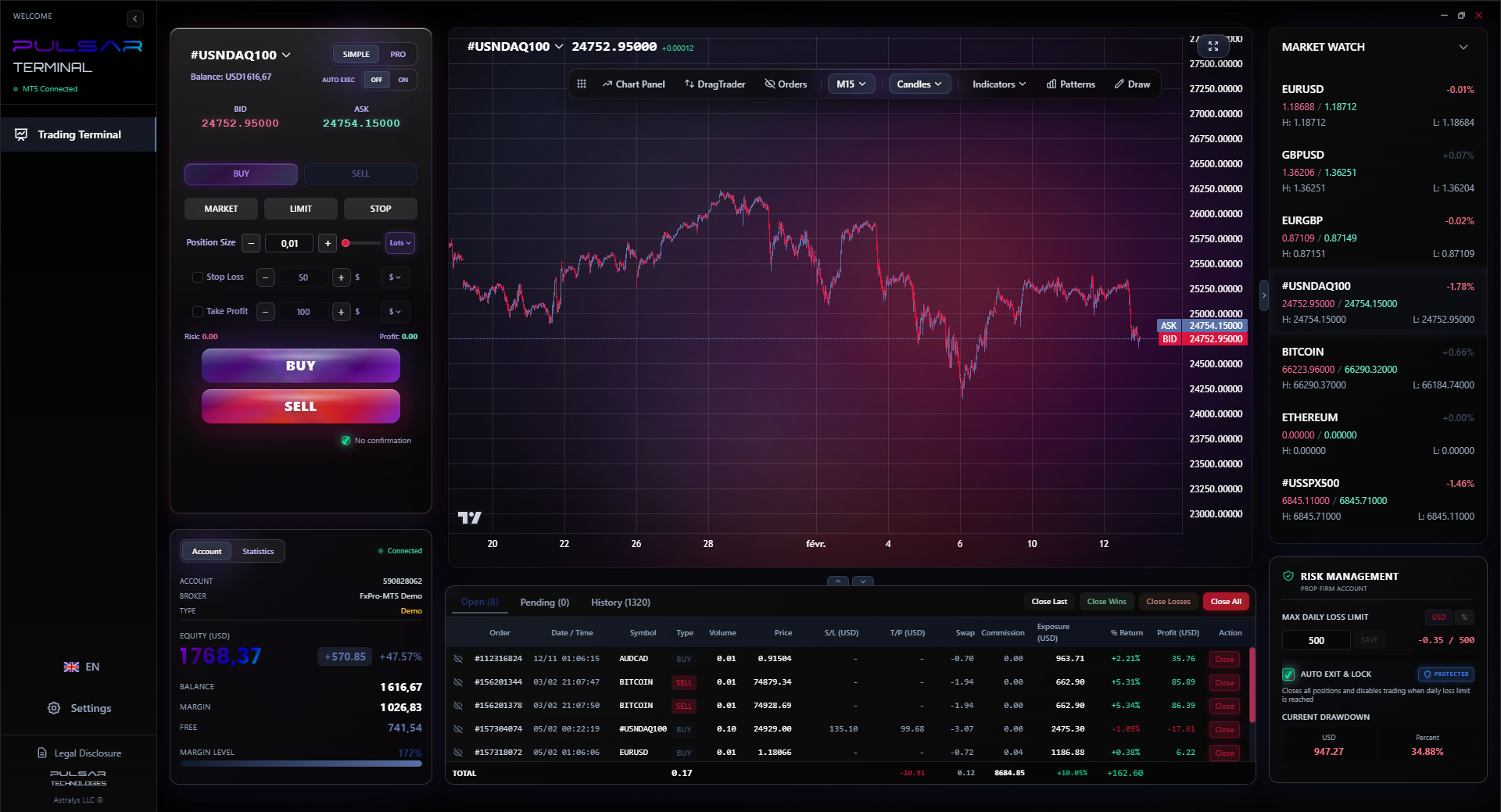
Managing the strict daily loss limits of a prop firm challenge is where most fail, but a tool like Pulsar Terminal can automate this protection directly on your MT5 platform, turning a psychological hurdle into a systematic rule.
Pulsar Terminal
MT5オールインワンツール:ドラッグ&ドロップ注文、マルチTP/SL、トレーリングストップ、グリッドトレード、出来高プロファイル、プロップファーム保護。毎日1,000人以上のトレーダーが利用。
“The goal isn't a 1000% return in a year. It's a consistent 10-20% annual return, compounded. That's boring, and that's why it works.”
Making a great trade is a thrill. Building lasting wealth is a boring, systematic process. The individuals often named as the richest forex trader in South Africa didn't stop at trading. They systematized and scaled.
1. Compounding, Not Chasing: The goal isn't a 1000% return in a year. It's a consistent 10-20% annual return, compounded. A R100,000 account growing at 15% per year becomes over R400,000 in 10 years. That's without adding more funds. I track my returns quarterly, not daily. It keeps me focused on the process, not the daily noise.
2. Creating Multiple Income Streams: This is the big leap. Trading profits can seed other investments - property, bonds, a small business. It also means monetizing your knowledge ethically. Maybe you start a small signal service for a few trusted clients, or write about your methods. This diversifies your income away from pure market dependence.
3. The Infrastructure of Success: The pros don't just have a laptop. They have redundant internet connections (fibre + LTE backup), UPS systems for load-shedding, dedicated trading journals, and advanced tools. They treat their trading desk like the cockpit of a plane. Every variable is controlled. Investing in your own infrastructure is a sign you're serious.
, the title of the richest forex trader in South Africa is less important than the principles they embody: discipline over emotion, process over prediction, and risk management over everything. That's the real treasure map. Start following those principles today, with your very next trade.
💡 ウィンストンのヒント
If you can't explain your trade setup in one simple sentence ('I'm buying because price bounced at the weekly support with bullish RSI divergence'), you shouldn't be in the trade. Complexity is the enemy of execution.
FAQ
Q1Is Ref Wayne really the richest forex trader in South Africa?
Ref Wayne (Refiloe Nkele) is certainly one of the most famous and successful, often called the 'forex king.' His estimated net worth is around $500 million, which likely combines trading profits with his ventures like Pipcoin and his education brand. He's a legitimate success story, but remember, exact wealth from trading is private. His public influence is undeniable.
Q2What is the minimum amount I need to start forex trading in South Africa?
You can open an account with as little as R500 or even less with some brokers. But let's be practical. With a tiny account, costs (spreads) eat a huge percentage of your capital, and proper risk management is almost impossible. I recommend a minimum of R10,000 to start seriously. This allows you to risk small amounts (1-2%) per trade and survive the inevitable learning-curve losses without blowing up.
Q3Do I pay tax on my forex trading profits in South Africa?
Yes. SARS views frequent trading as generating revenue, which is taxable. It's not a 'hobby' if you're doing it regularly for profit. Keep detailed records of all trades, statements, and bank records. It's crucial to consult with a tax advisor who understands financial trading to ensure you're compliant and claiming allowable deductions correctly.
Q4Are international forex brokers safe for South African traders?
Many are extremely safe, provided they are regulated by a reputable authority like ASIC (Australia), FCA (UK), or CySEC (EU). Always check their license number on the regulator's website. These brokers offer excellent platforms and pricing. However, using an international broker means your funds are held offshore, and dispute resolution is through that foreign regulator, not the FSCA.
Q5Why is the spread on USD/ZAR so high compared to EUR/USD?
Liquidity. The EUR/USD is the most traded pair in the world, with billions traded every minute. This massive volume creates fierce competition, driving spreads down. The USD/ZAR has far less liquidity. Fewer buyers and sellers mean brokers take on more risk to hold the price, which they offset with a wider spread. It's the cost of trading an emerging market currency.
Q6Can I really make a living from forex trading in South Africa?
It's possible, but it's a marathon, not a sprint. Don't expect to quit your job in 6 months. You need a substantial, risk-protected capital base (I'd say at least R500,000 to generate a modest living wage sustainably), a proven and disciplined strategy, and the emotional resilience to handle drawdowns. Most successful full-time traders spent years building their skills and capital part-time.
Q7What's the biggest mistake new South African traders make?
Using excessive use. They see brokers offering 500:1 or 1000:1 and think it's free money. It's a debt trap. A 1% move against you with 500:1 use wipes out 500% of your margin - you lose more than you deposited. This leads directly to a margin call. Start with use under 10:1 until you have a proven, profitable strategy.
ウィンストン教授のレッスン
重要ポイント:
- ✓Verify your broker's FSCA FSP number. Every time.
- ✓Never risk more than 1% of your capital on a single trade.
- ✓USD/ZAR spreads are wide (80-150 pips). Factor this in first.
- ✓Trading profits are taxable revenue. Keep immaculate records.
- ✓Compounding 15% annually beats chasing 100% once.
この記事はどれくらい役に立ちましたか?
星をクリックして評価
週刊トレーディングインサイト
無料の週刊分析&戦略。スパムなし。
著者について
David van der Merwe
新興市場トレーダー
ヨハネスブルグ拠点で新興市場通貨11年のトレーダー。ZARペア、FSCA規制下の取引、南アフリカ市場分析を専門とする。
コメント
リスク警告
金融商品の取引には大きなリスクが伴い、すべての投資家に適しているわけではありません。過去の実績は将来の結果を保証するものではありません。本コンテンツは教育目的のみであり、投資助言として解釈すべきではありません。取引前に必ずご自身で調査を行ってください。
こちらもおすすめ

Cara Trading Forex Sukses: 7 Prinsip dari Trader Profesional
Cara trading forex sukses dengan 7 prinsip trader pro: manajemen modal, disiplin, journal trading, backtest. Data nyata, bukan janji profit palsu.
Jam Trading Forex Terbaik untuk Trader Indonesia: Panduan Lengkap dengan Tabel Waktu
Panduan jam trading forex untuk trader Indonesia. Tabel 4 sesi dunia, jam emas 20:00-00:00, sesi mana yang harus dihindari. Data akurat + tips dari trader berpengalaman.
Top 5 Sàn Forex Uy Tín Nhất 2026: Review Jujur dari Trader Indonesia
Top 5 sàn forex uy tín 2026 untuk trader Indonesia. Review jujur: spread, deposit, withdraw, dukungan lokal. Exness, XM, IC Markets & lebih.
