


Here's a number that stings: the average trader spends over $4,270 on prop firm evaluation fees before they ever see a funded account.

James Mitchell
シニアトレーディングアナリスト
☕ 10 分で読める
学べること:
Here's a number that stings: the average trader spends over $4,270 on prop firm evaluation fees before they ever see a funded account. I know, because I was part of that statistic. After 12 years and burning through my fair share of challenge fees, I've learned that finding the right prop firm isn't about the biggest profit split promise. It's about finding a partner whose rules fit your strategy and whose platform won't get in your way. This guide cuts through the hype to show you the top 10 best prop firms for forex traders in the US right now, based on what actually works when real money is on the line.
Before we get to the list, you need to understand the playing field. Trading forex is legal here, but the rules are different. The CFTC and NFA keep a tight leash on retail brokers, capping use at 1:50 for majors and enforcing the FIFO rule (you close your oldest trade first). No hedging either.
Here's the twist: most prop firms you'll see advertised aren't regulated like your standard broker. They're often structured as companies trading their own capital, or simulated capital during evaluations. This lets them offer higher use and different rules. But it's a gray area that's getting more scrutiny.
By 2026, expect stricter rules. The CFTC is already asking if firms charging evaluation fees should be classified as investment advisors. Mandatory licensing and tougher KYC checks are on the horizon. This isn't just bureaucracy. It means the firms that are already transparent and compliant today are the ones likely to survive tomorrow. When choosing from the top 10 best prop firms forex, their approach to these coming rules is a huge factor in long-term stability.

Warning: Don't confuse a prop firm's internal rules with US law. Their 1:100 use offer doesn't override NFA rules for your personal brokerage account. You're playing in their sandbox, with their tools.
Anyone can make a list. I'm giving you my methodology, born from expensive mistakes. I once failed a challenge because the firm's "5% max drawdown" was calculated on equity, not balance, and a single volatile swing wiped me out. Lesson learned.
Here’s what I weigh heavily now:
Rule Clarity & Fairness: No hidden traps. Is the drawdown based on starting balance or trailing equity? Can I hold over weekends? The rules must be crystal clear before you pay a cent.
Platform & Execution: I need MT4/MT5, cTrader, or TradingView. Spreads matter. I got stung early on with a firm boasting "tight spreads" that widened to 15 pips on GBP/USD during the London open. I check real broker data now.
Profit Split & Scaling: 90% of nothing is nothing. I look for realistic profit targets and a clear, attainable path to scale up. A 50% split on a $500k account is often better than 90% on a $10k account you can't grow.
US Trader Viability: This is critical. Some firms quietly restrict US clients or only offer them futures products. I only include firms that actively and reliably onboard US-based forex traders.
Payout Proof & Consistency: I look for a track record. Have they been paying for years? Is there community verification? A high profit split is worthless if the checks don't clear.
Using this scorecard has saved me thousands in wasted fees. It turns the search for the top 10 best prop firms forex from a marketing puzzle into a due diligence exercise.

💡 ウィンストンのヒント
Your first prop firm goal isn't to pass. It's to learn their rulebook without going broke. Buy the smallest challenge they offer. Consider that fee tuition, not a ticket.
“The average trader spends over $4,270 on evaluation fees before they ever see a funded account.”
1. The5ers
My pick for long-term career builders. Established in 2016, they feel less like a challenge mill and more like a talent incubator. Their scaling plan can take you to $4 million, and they offer a 100% profit split at the highest levels. The key for me? Unlimited time on evaluations and support for all strategies - news trading, weekend holds, even algo trading on MT5. They understand that real trading isn't a 30-day sprint.
2. FTMO
The industry benchmark. They've paid out over half a billion dollars. That longevity matters. Their two-step evaluation is tough but fair, with no time pressure in the first phase. Their scaling plan is one of the best structured, and their spreads on majors are genuinely competitive. They set the standard others follow.
3. OneFunded
Transparency champions. They have no time limits on challenges and their fee is 100% refundable with your first payout. It removes the psychological pressure. They offer up to 90% splits on TradeLocker and cTrader. For traders who hate feeling rushed, this is a fantastic option.
4. FXIFY
Value and flexibility. Challenge fees start at just $39, and they offer on-demand payouts once funded. Up to 90% splits, support for TradingView, and no time limits. They're a solid, no-nonsense choice for traders who want to get started without a huge upfront cost.
5. DNA Funded
Best for tight spreads. Being broker-backed (with DNA Markets), they offer raw spreads starting from 0.0 pips. If you're a scalper or a high-frequency trader, this is a massive edge. They offer flexible evaluations, including instant funding, with profit splits of 80-90% and allocations up to $600k.
6. BrightFunded
The unlimited potential play. Their scaling plan has no hard ceiling - your growth is limited by your performance. They also have a unique "Trade2Earn" loyalty program. Very crypto-friendly, which is a plus if you trade those pairs alongside forex.
7. FundedNext
Community and scaling focus. They have multiple funding paths and really emphasize growing with you. They support MT4, MT5, and cTrader. I appreciate their focus on trader development, not just collecting evaluation fees.
8. Funding Pips
Fast and efficient. Known for low-cost evaluations (from $85), quick scaling, and straightforward rules. Spreads from 0.0 pips. They're a great choice if you want a streamlined process without a lot of extra fluff.
9. City Traders Imperium (CTI)
Education-focused. Founded in 2018, they blend funding with learning. They offer up to a 100% profit share, have no minimum trading days, and process payouts quickly. A good fit for developing traders who want more than just capital.
10. RebelsFunding
Community and perks. They offer up to a 200% fee refund on some programs and are known for incredibly responsive support. Their community is one of the most active and supportive out there, which can be a huge asset.

Example: Let's compare two approaches. Firm A has a $99 challenge, 10% profit target, 5% max drawdown, 80% split. Firm B has a $299 challenge, 8% profit target, 6% max drawdown (balance-based), 90% split. Firm B's higher fee buys you more forgiving rules and a bigger share. For a consistent swing trading strategy, Firm B's structure is often cheaper in the long run.
Let's talk numbers, because this is where dreams get budgeted. That $4,270 average loss I mentioned earlier? It comes from not understanding the fee structure.
Challenge Fees: This is your ticket to play. It ranges wildly:
- FXIFY, RebelsFunding: From ~$39
- DNA Funded: From $49
- Funding Pips: From $85
- FTMO: From $155
The Profit Target: Usually 5%-10% of your starting balance. Hitting a 10% target requires a different risk profile than a 5% target. Always use a position size calculator based on the firm's specific drawdown rules.
The Drawdown: Your leash. Daily loss limits are typically 3-5%. Maximum drawdown is 5-10%. Crucially: Is it based on starting balance or trailing equity? A trailing 5% equity drawdown is far stricter than a 5% balance drawdown. This detail has ended more challenges than bad trades.
The Profit Split: 80% to 90% is standard. Some, like The5ers and CTI, offer paths to 100%. Remember, this split is usually on profits after you've crossed a minimum threshold each period.
The Hidden Cost: Your time and psychology. A two-phase evaluation with a 10% total target might take months of perfect trading. That's months of mental capital spent. Sometimes, a slightly higher fee for a simpler, one-step challenge is worth every penny for your sanity. I learned this after failing three complex challenges in a row; switching to a simpler rule set was the key.

Pro Tip: Treat your total evaluation budget like a trading account. Don't blow it all on one high-stakes challenge. Start with a smaller, cheaper account from a firm like FXIFY to learn their system and platform. A $50 loss is a lesson. A $500 loss is a tragedy.
💡 ウィンストンのヒント
Drawdown math is non-negotiable. If you can't explain the firm's drawdown rule to another trader using simple numbers, you haven't done your homework. This is where 70% of challenges fail.
“Size amplifies everything, especially fear. I should have started with a $10k account to learn the process.”
I've failed more challenges than I've passed. Here's the raw list of my blunders.
Mistake 1: Chasing the Biggest Account. I once saved up for a $200k challenge. The pressure was immense. I over-traded, violated my own rules, and blew the daily loss limit in a week. I should have started with a $10k account to learn the process. Size amplifies everything, especially fear.
Mistake 2: Ignoring the Platform. I passed a challenge with a firm that used a proprietary platform. It was clunky, orders lagged, and my scalping strategy was impossible. I made my first payout and quit. Always test the platform with a demo first.
Mistake 3: Misunderstanding the Drawdown. My most expensive lesson. The rule said "5% Max Drawdown." I assumed it was from the starting balance. It was a trailing drawdown based on peak equity. After making 4%, a 2% loss didn't just bring me to +2%. It breached the trailing rule and failed the account. Read the FAQ. Twice.
Mistake 4: Underestimating the Psychological Toll. Trading a prop challenge is different. That fee is on the line. It creates a fear of missing out (on the target) and a fear of loss (of the fee). I became rigid, missing great setups because they weren't "perfect" according to my challenge-obsessed mind.
Mistake 5: Not Planning for the Funded Stage. I celebrated passing a challenge... then realized the funded account had different, stricter rules on news events. I got caught in a EUR/USD spike during an ECB announcement and got a margin call. The fight isn't over when you get funded. It just changes.
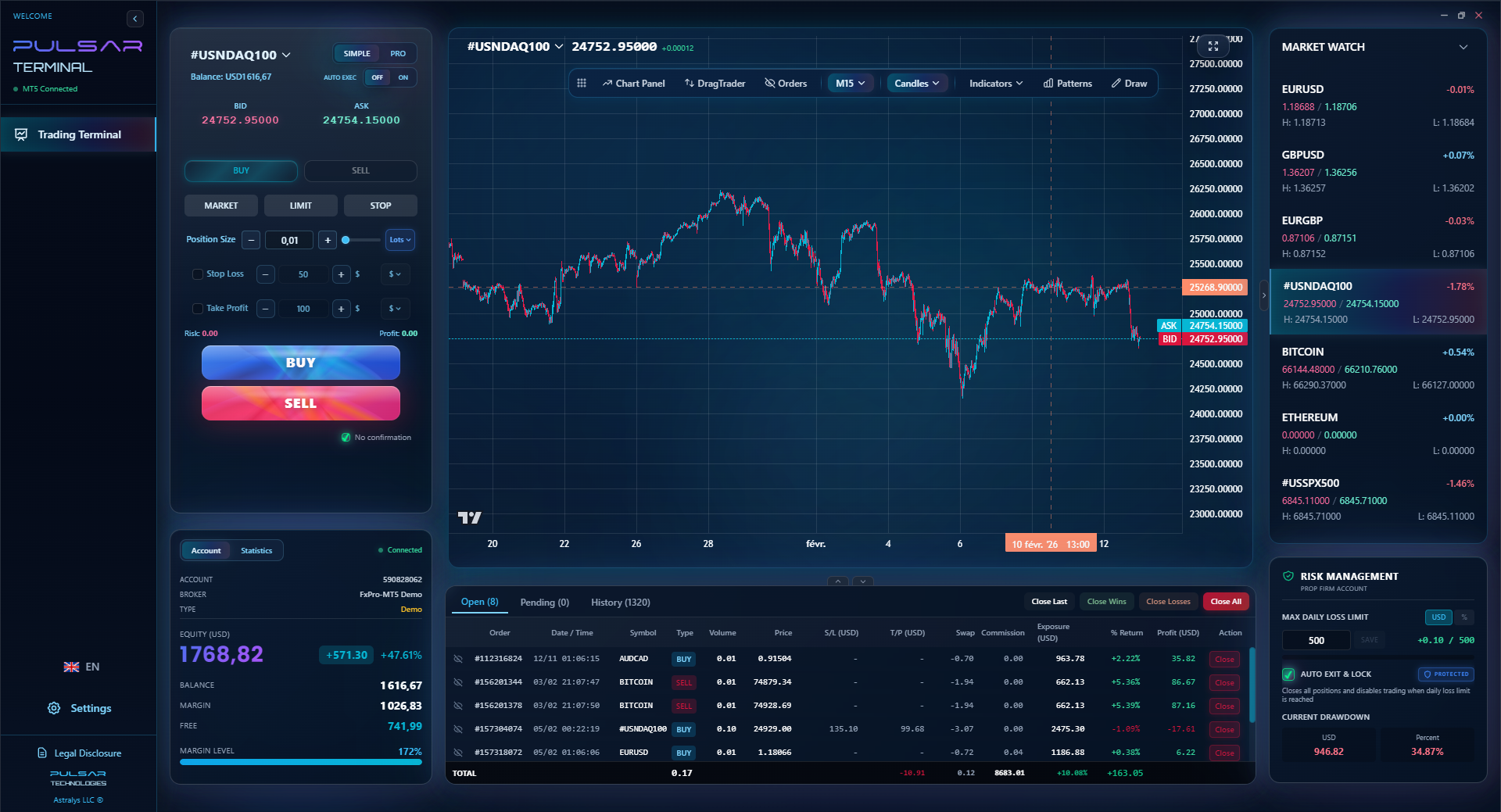
Managing a prop firm's strict daily loss limit is a constant pressure, but a tool like Pulsar Terminal can automate that protection directly on your MT5 chart, so you can focus on trading instead of mental math.
Pulsar Terminal
MT5オールインワンツール:ドラッグ&ドロップ注文、マルチTP/SL、トレーリングストップ、グリッドトレード、出来高プロファイル、プロップファーム保護。毎日1,000人以上のトレーダーが利用。
Don't just pick the #1 name on the list. Match the firm to your personality and strategy.
For the New or Cautious Trader:
- Prioritize: Lower fees, forgiving rules (balance-based drawdown, no time limits).
- Look at: OneFunded (refundable fee), FXIFY (low cost).
- Goal: Learn the prop firm process without bankrupting yourself.
For the Scalper or High-Frequency Trader:
- Prioritize: Raw spreads, fast execution, platform choice (MT4/MT5).
- Look at: DNA Funded (0.0 pip spreads), Funding Pips.
- Goal: Minimize transaction costs that eat into small, frequent gains.
For the Long-Term Swing or Algorithmic Trader:
- Prioritize: No time limits, weekend holding allowed, scaling potential, algo support.
- Look at: The5ers, FTMO's Scaling Plan.
- Goal: Build a sustainable career with growing capital.
For the Strategy Diversifier:
- Prioritize: Wide instrument selection (forex, crypto, indices).
- Look at: BrightFunded (crypto pairs), FTMO (broad CFD offering).
Final Step: Before you buy, join their Discord or Telegram community. Lurk. Are people complaining about payout delays? Are the mods helpful? The community vibe is a real-time due diligence tool you can't ignore. Then, when you're ready, pick the smallest account size and prove you can navigate their specific maze. That's how you build a real funded career.
💡 ウィンストンのヒント
The best firm for you is the one whose rules best accommodate your natural trading rhythm. A scalper forced into a 30-day challenge is a fish in a tree.
FAQ
Q1Are prop firms legal in the United States?
Yes, but it's a complex area. Most prop firms catering to US traders are not regulated like retail brokers (e.g., by the NFA). They operate as companies trading their own capital. This structure is currently legal but exists in a regulatory gray area that is under increasing scrutiny. Always ensure the firm accepts clients from your specific state.
Q2What's the single most important rule to check in a prop firm challenge?
The drawdown calculation. You must know if it's based on your starting balance or trailing equity. A trailing equity drawdown is significantly more restrictive. A 5% max trailing drawdown means after you make 4% profit, your new high-water mark is +4%. A 1% loss from there puts you at +3%, but your drawdown from the peak is now 1% - you're still fine. But a second 1% loss breaches the 5% trail from your +4% peak and fails the account. This catches countless traders off guard.
Q3How much money do I need to start with a prop firm?
You need enough for the evaluation fee, which can be as low as $39 for a micro account. However, you should not invest money you cannot afford to lose. The statistical reality is that most traders fail multiple challenges before passing. Budget for at least 3-5 attempts, and always start with the smallest, cheapest account to learn the firm's specific rules and platform.
Q4Can I use expert advisors (EAs) or automated trading?
It depends entirely on the firm. Some, like The5ers, explicitly allow and support algorithmic trading. Others may prohibit it or have rules against high-frequency trading. This information is always in the firm's terms and conditions. Never assume; always verify before purchasing a challenge if you plan to use an EA.
Q5How often do prop firms pay out?
Most operate on a bi-weekly or monthly payout cycle. Some, like FXIFY, offer on-demand payouts after a certain period. Always check the minimum payout threshold and processing time. Reputable firms like FTMO and The5ers have consistent, documented payout schedules.
Q6What happens if I pass the challenge but then have a losing period?
You get to keep your funded account as long as you don't breach the funded account's risk rules (like the daily or maximum drawdown). Having a losing month is normal. However, you typically only get a profit split on periods where you end with a net profit above their threshold. If you blow the funded account's drawdown, the account is usually terminated.
Q7Is the profit split really 80-90%?
Yes, but remember it's a split of profits, not revenue. If you make $1,000 in a payout period and have an 80% split, you get $800. The firm keeps $200. Also, there is almost always a minimum profit threshold you must exceed before a split is calculated (e.g., first $500 of profit goes to the firm, then you split 80/20 on anything above that). Read the profit split clause carefully.
ウィンストン教授のレッスン
重要ポイント:
- ✓Drawdown type (balance vs. equity) is more important than profit target.
- ✓Start with the smallest account size to learn the rules.
- ✓Budget for 3-5 failed challenges as part of the cost.
- ✓The platform's execution can make or break a strategy.
この記事はどれくらい役に立ちましたか?
星をクリックして評価
週刊トレーディングインサイト
無料の週刊分析&戦略。スパムなし。
著者について
James Mitchell
シニアトレーディングアナリスト
ニューヨーク拠点で9年以上のトレード経験を持つ。主要USDペア、プロップファームチャレンジ、米国の規制環境を専門とする。
コメント
リスク警告
金融商品の取引には大きなリスクが伴い、すべての投資家に適しているわけではありません。過去の実績は将来の結果を保証するものではありません。本コンテンツは教育目的のみであり、投資助言として解釈すべきではありません。取引前に必ずご自身で調査を行ってください。
こちらもおすすめ

Cara Trading Forex Sukses: 7 Prinsip dari Trader Profesional
Cara trading forex sukses dengan 7 prinsip trader pro: manajemen modal, disiplin, journal trading, backtest. Data nyata, bukan janji profit palsu.
Jam Trading Forex Terbaik untuk Trader Indonesia: Panduan Lengkap dengan Tabel Waktu
Panduan jam trading forex untuk trader Indonesia. Tabel 4 sesi dunia, jam emas 20:00-00:00, sesi mana yang harus dihindari. Data akurat + tips dari trader berpengalaman.
Top 5 Sàn Forex Uy Tín Nhất 2026: Review Jujur dari Trader Indonesia
Top 5 sàn forex uy tín 2026 untuk trader Indonesia. Review jujur: spread, deposit, withdraw, dukungan lokal. Exness, XM, IC Markets & lebih.
