


Most new traders think trading on forex is about predicting the news or finding a magic indicator.
James Mitchell
シニアトレーディングアナリスト ·  Canada
☕ 10 分で読める
学べること:
- 1What Is Forex Trading, Really?
- 2The Canadian Rulebook: What's Different Here
- 3Core Strategies That Actually Work (For Canadians)
- 4Risk Management: The Only Non-Negotiable
- 5The Trader's Mind: Conquering Your Biggest Enemy
- 6Picking Your Partner: A Canadian Broker Checklist
- 7Your Blueprint: Building a Simple Trading Plan
- 8Your First Steps to Trading on Forex

Most new traders think trading on forex is about predicting the news or finding a magic indicator. They're wrong. The real game is about risk management, psychology, and understanding the unique rules that apply to us here in Canada. I've blown up an account, I've had winning streaks, and I've learned the hard way what actually works. Let's cut through the hype and talk about what trading on forex really looks like from a Canadian perspective.
At its core, trading on forex is simply speculating on the price movement of one currency against another. You're buying and selling currency pairs, like EUR/USD or USD/CAD. It's the largest financial market in the world, open 24 hours a day from Sunday evening to Friday afternoon. That sounds exciting, but here's the practical truth: that 24/5 schedule is a double-edged sword. It offers flexibility, but it can also tempt you to overtrade.
For us in Canada, it's not just about the US dollar. The Loonie (CAD) is a major commodity currency. Its value is heavily tied to oil prices, lumber, and other natural resources. When oil rallies, CAD often strengthens against currencies like the Japanese Yen (JPY). This isn't just trivia, it's a fundamental driver you can watch. I learned this the hard way early on, ignoring the weekly crude oil inventory reports while trading USD/CAD. A surprise build in oil inventories once sent USD/CAD shooting up 80 pips against me in minutes because CAD weakened. That was a $400 lesson on paying attention to home-field economics.

Warning: Don't confuse the forex market's size with easy opportunity. High liquidity means big players (banks, funds) can move prices fast. Your job is to flow with that, not fight it.

💡 ウィンストンのヒント
The market doesn't care about your opinion. Trade what you see on the chart, not what you think *should* happen. I lost a lot of money being 'right' about the direction while being wrong about the timing.
This is the stuff most generic guides miss. Trading on forex in Canada comes with specific regulations you must know. First, use. The Canadian Securities Administrators (CSA) have set a maximum use limit of 50:1 for major currency pairs for retail traders. That's lower than what's offered in some offshore jurisdictions. It's a protective measure, and honestly, a good one. I used to chase 500:1 use early in my career, thinking it was the key to big profits. It was actually the key to a faster margin call.
Broker Choice is Critical
You need a broker registered with a Canadian provincial authority (like the IIROC) or one that is appropriately licensed internationally and accepts Canadian clients. This affects your fund security. I've had smooth experiences with brokers like IC Markets for their raw spreads, but always, always check their regulatory status first. Tax implications are another big one. Profits from trading are considered business income or capital gains, and you need to keep careful records of every trade for the CRA.

Pro Tip: Open a separate bank account just for your trading funds. It makes tracking deposits, withdrawals, and overall P&L for tax time infinitely easier. My accountant thanked me for this.

“High use is not a shortcut to wealth, it's a shortcut to a margin call.”
Forget the complicated systems you see online. Successful trading on forex boils down to a few timeless approaches, adapted for our market hours and currency focus.
Price Action & Support/Resistance: This is my bread and butter. It's about reading the raw price movement on the chart, identifying key levels where price has historically reversed or stalled (support/resistance), and making trades based on how price reacts there. Trading the EUR/USD guide around London and New York session overlaps using this method has provided my most consistent setups.
Trend Following: The old saying 'the trend is your friend' exists for a reason. Using a simple combination of moving averages (like a 50 and 200-period) to identify the broader direction, then looking for pullbacks to enter, can be very effective. This works beautifully on a pair like USD/CAD during sustained trends in oil prices.
Carry Trade Considerations: This involves buying a high-interest-rate currency and selling a low-interest-rate one to collect the daily swap difference. For CAD traders, this often looks at pairs like AUD/CAD or NZD/CAD. However, with current global rates, the classic carry trades have been less prominent. It's a strategy to understand, but not one I actively employ right now.
Whether you're interested in scalping strategy for quick moves or swing trading over days, these core concepts are the foundation. I made the mistake of jumping between 10 different indicator-based strategies before realizing that mastering one simple price-action method was far more profitable.
This is the chapter that saves your account. Trading on forex without strict risk management is gambling. Period. Here’s the simple math I live by.
The 1% Rule: Never risk more than 1% of your total trading capital on a single trade. If you have a $10,000 account, your maximum risk per trade is $100. This protects you from a string of losses wiping you out. Use a position size calculator for every single trade to enforce this.
Stop-Losses Are Your Best Friend: Every trade must have a predetermined stop-loss order before you enter. It's not a suggestion, it's a life jacket. Place it at a level that, if hit, proves your trade idea wrong. My biggest historical loss came from moving a stop-loss further away, 'hoping' the market would turn. It didn't. I turned a $150 loss into a $900 loss. Never again.
Risk-to-Reward Ratio: Aim for trades where your potential profit (reward) is at least 1.5 to 2 times greater than your potential loss (risk). If you risk $100, look for a setup where you can realistically make $150-$200. This means you can be wrong more than you're right and still be profitable. A 40% win rate with a 1:2 risk-reward is a winning system.
| Concept | My Rule | Why It Matters |
|---|---|---|
| Per-Trade Risk | Max 1% of capital | Survives a 10-trade losing streak. |
| Stop-Loss | Always set before entry | Removes emotion, defines failure point. |
| Risk/Reward | Minimum 1:1.5 | Makes profitability possible with a <50% win rate. |
💡 ウィンストンのヒント
Your first profit target should often be to get to breakeven. Move your stop-loss to your entry point once the trade has moved favorably by 1.5 times your initial risk. This turns a risky bet into a free roll.
“Your trading plan is a promise you make to yourself before the market opens. Breaking it is how you lose trust in your own system.”
You are your own worst enemy in trading on forex. The charts just show price, your brain adds the story. Here are the mental traps I've fallen into (and how to climb out).
Fear of Missing Out (FOMO): You see a pair rocketing up, you jump in late near the top, and it reverses. You're now holding a losing trade born of panic. I've done this with XAU/USD guide (gold) more times than I care to admit. The solution? Have a daily plan. If you miss a move, let it go. There's always another trade tomorrow.
Revenge Trading: After a loss, you immediately jump back in with a larger size to 'make it back fast.' This is how accounts get destroyed. My rule now: after two consecutive losses, I shut down the platform for the day. Go for a walk. The market will still be there.
Overconfidence: A few winning trades can make you feel invincible. You start increasing position size recklessly, ignoring your rules. That's when the market humbles you. Stick to your system, especially when it's working. Consistency beats heroics every time.
The tools you use can help or hurt your psychology. Cluttered charts with 20 indicators create confusion and doubt. I now use a clean chart, maybe with a couple of key tools like the RSI indicator for spotting potential reversals from overbought/oversold zones, or the MACD indicator to confirm momentum shifts. Less is more for a clear mind.
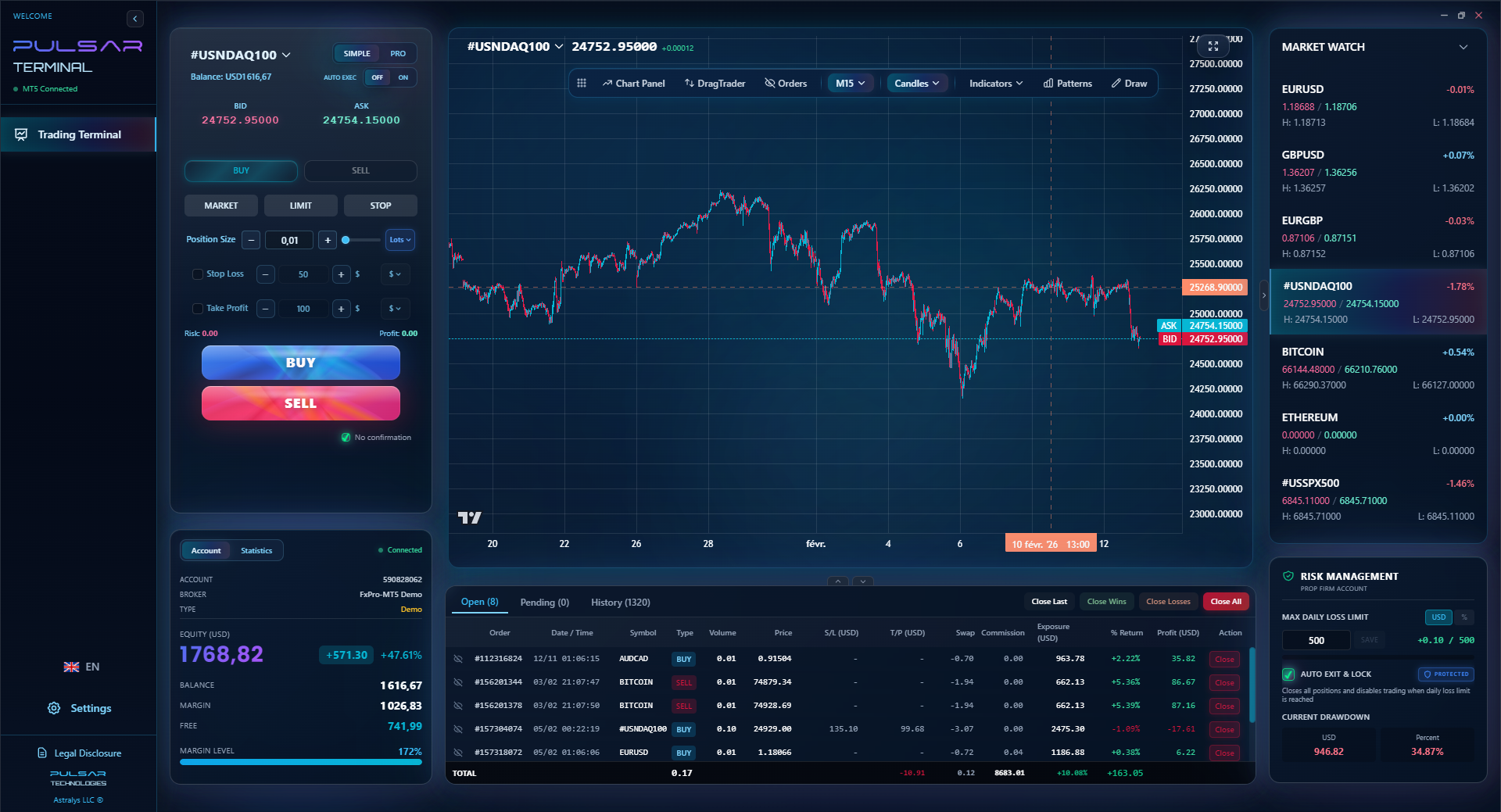
Managing multiple trades and emotions is easier with tools that automate risk rules, like setting a trailing stop or partial take-profits directly on your MT5 chart.
Pulsar Terminal
MT5オールインワンツール:ドラッグ&ドロップ注文、マルチTP/SL、トレーリングストップ、グリッドトレード、出来高プロファイル、プロップファーム保護。毎日1,000人以上のトレーダーが利用。
Your broker is your gateway to the market. A bad choice can cost you money through poor execution, hidden fees, or worse. Here’s what to look for, beyond just the sign-up bonus.
Regulation & Safety: This is priority #1. Ensure they are regulated by a reputable body (IIROC, ASIC, FCA, CySEC). This protects your segregated funds. I lean towards brokers with strong international oversight.
Trading Costs: Look at the spread definition (the difference between buy and sell price), especially on the pairs you'll trade most. For major pairs like EUR/USD, a tight spread under 1 pip is good. Also check for commissions. Some brokers offer raw spreads plus a commission per lot, which can be cheaper for active traders. Compare brokers like Pepperstone (known for tight spreads) and XM review (known for flexible accounts) to see what fits your style.
Trading Platform: Most use MetaTrader 4 or 5 (MT4/MT5). Ensure it's stable and has the tools you need. Test their demo account thoroughly. Withdrawal process is also key, how easily and quickly can you get your money out in CAD? Read reviews specifically from other Canadian traders.

Example: Let's say Broker A has a 1.2 pip spread on EUR/USD with no commission. Broker B has a 0.1 pip spread but charges a $7 commission per standard lot ($100k trade). On a standard lot, a 1.2 pip spread costs you $12. Broker B's cost is $7 + ($0.10 pip cost * 1 pip? Wait, need to calculate)... Actually, the commission is fixed. For active trading, Broker B's model is often cheaper. Always do the math!
“The goal isn't to be right on every trade. The goal is to make more on your winning trades than you lose on your losing ones.”
A trading plan is your business plan. It removes emotion and creates consistency. Yours doesn't need to be 100 pages, but it must answer these questions:
- What do I trade? Be specific. "I trade EUR/USD and USD/CAD during the London and New York overlap, focusing on 1-hour and 4-hour charts." Don't try to trade every pair.
- How do I enter? Define your exact setup. "I enter a long trade when price pulls back to a key support level on the 4H chart and shows a bullish rejection candle (like a hammer or bullish engulfing) on the 1H chart."
- How do I exit? This is even more important. "My stop-loss is placed 20 pips below the support level. My take-profit target is at the next resistance level, providing a minimum 1:2 risk-to-reward ratio."
- How much do I risk? "I risk 0.5% of my $5,000 account ($25) per trade. I use my position size calculator to determine the correct lot size."
- When do I stop trading? "I stop live trading for the day if I hit a loss of 2% of my account ($100) or after 3 consecutive losing trades."
Write this down. Keep a trading journal where you record every trade, the reason for it, the outcome, and most importantly, how you felt. Review it weekly. This feedback loop is how you improve. My first profitable year came only after I started journaling religiously.
💡 ウィンストンのヒント
Spend 80% of your time analyzing your losing trades, not your winners. The losses teach you where your edge failed. The winners often just mean you got lucky.

Feeling overwhelmed? Good, that means you're taking it seriously. Here's a sane, step-by-step path to get started without lighting money on fire.
Step 1: Educate Yourself for Free. Read articles like this, watch webinars from reputable sources (not 'get rich quick' gurus), and understand the basic terminology like what a pip definition really means.
Step 2: Open a Demo Account. Pick a broker from your research, like Exness review or IC Markets, and open a practice account. Trade with virtual money for at least 3 months. Your goal isn't to make fake millions, it's to test your plan and achieve consistent demo profitability.
Step 3: Develop & Test Your Plan. Use your demo time to build and refine the trading plan from the previous section. Backtest your strategy on historical data. Does it hold up?
Step 4: Start Small with Real Money. Once you're consistently profitable on demo for a few months, fund a live account with money you can afford to lose completely. Start with a micro or cent account if possible. Your first goal is to preserve capital, not to buy a yacht.
Step 5: Scale Slowly. Only increase your position sizes or risk per trade gradually as your account grows. This is a marathon, not a sprint. Trading on forex is a skill that takes years to hone. Be patient with yourself. I didn't see consistent yearly profits until my third year. The journey is the point.
FAQ
Q1Is forex trading legal in Canada?
Yes, forex trading is completely legal in Canada. However, it is regulated. Retail traders must use brokers that comply with Canadian Securities Administrators (CSA) rules, which include a maximum use limit of 50:1 for major currency pairs. Always verify a broker's regulatory status before depositing funds.
Q2How much money do I need to start trading forex in Canada?
You can start with a few hundred dollars thanks to micro and cent accounts offered by many international brokers. However, to practically apply proper risk management (like the 1% rule) and withstand normal market fluctuations, I'd suggest a minimum of $1,000 to $2,000 CAD. This allows for meaningful position sizing without being stopped out by every tiny market move.
Q3What is the best time to trade forex in Canada?
The most active and liquid sessions for a Canadian trader are the overlap of the London and New York sessions, from about 8:00 AM to 12:00 PM Eastern Time. This is when the majority of price movement often occurs on major pairs like EUR/USD and GBP/USD. The Asian session (evening in Canada) is typically quieter.
Q4How are forex trading profits taxed in Canada?
The CRA views trading profits as either business income (if you trade frequently and actively) or capital gains. Business income is 100% taxable at your marginal rate. Capital gains are only 50% taxable. The classification depends on the frequency, duration, and intent of your trades. You must keep detailed records of all trades. Consult a Canadian accountant familiar with trading.
Q5Can I trade USD/CAD as a Canadian?
Absolutely, and you should pay close attention to it. USD/CAD (the "Loonie") is directly influenced by factors relevant to Canada: oil prices, interest rate differentials between the Bank of Canada and the US Federal Reserve, and broader economic data from both countries. It's often less volatile than pairs like GBP/JPY, which can be a good thing for newer traders.
Q6What's the biggest mistake new Canadian forex traders make?
Using too much use. Just because a broker might offer 50:1 (the Canadian max) doesn't mean you should use it all. I rarely use more than 10:1 or 20:1. High use amplifies both gains and losses, and losses happen faster than you think. The second biggest mistake is not having a written trading plan with strict risk management rules.
ウィンストン教授のレッスン
重要ポイント:
- ✓Never risk more than 1% of capital per trade.
- ✓USD/CAD moves with oil. Watch WTI crude.
- ✓Use a demo account for 3+ months minimum.
- ✓CSA limits use to 50:1 for retail.
- ✓Journal every trade, especially the losers.
この記事はどれくらい役に立ちましたか?
星をクリックして評価
週刊トレーディングインサイト
無料の週刊分析&戦略。スパムなし。
著者について
James Mitchell
シニアトレーディングアナリスト
ニューヨーク拠点で9年以上のトレード経験を持つ。主要USDペア、プロップファームチャレンジ、米国の規制環境を専門とする。
コメント
リスク警告
金融商品の取引には大きなリスクが伴い、すべての投資家に適しているわけではありません。過去の実績は将来の結果を保証するものではありません。本コンテンツは教育目的のみであり、投資助言として解釈すべきではありません。取引前に必ずご自身で調査を行ってください。
こちらもおすすめ

Cara Trading Forex Sukses: 7 Prinsip dari Trader Profesional
Cara trading forex sukses dengan 7 prinsip trader pro: manajemen modal, disiplin, journal trading, backtest. Data nyata, bukan janji profit palsu.
Jam Trading Forex Terbaik untuk Trader Indonesia: Panduan Lengkap dengan Tabel Waktu
Panduan jam trading forex untuk trader Indonesia. Tabel 4 sesi dunia, jam emas 20:00-00:00, sesi mana yang harus dihindari. Data akurat + tips dari trader berpengalaman.
Top 5 Sàn Forex Uy Tín Nhất 2026: Review Jujur dari Trader Indonesia
Top 5 sàn forex uy tín 2026 untuk trader Indonesia. Review jujur: spread, deposit, withdraw, dukungan lokal. Exness, XM, IC Markets & lebih.
