


Let's be blunt: most US forex prop firms are selling you a dream while setting you up to fail.

James Mitchell
シニアトレーディングアナリスト
☕ 10 分で読める
学べること:
- 1What Exactly Is a US Forex Prop Firm? (It's Not What You Think)
- 2The Three Biggest Hurdles for US Traders
- 3Reviewing the Realistic US Prop Firm Options
- 4How to Adjust Your Trading for a US Prop Firm
- 5Getting Paid: The Payout Process and Tax Reality
- 6The Mistakes That Will Blow Your Account (I Made #3)
- 7So, Are US Forex Prop Firms Worth It?

Let's be blunt: most US forex prop firms are selling you a dream while setting you up to fail. The shiny ads promise six-figure accounts, but they don't mention the IRS waiting for its cut or the insane drawdown rules designed to make you blow up. I've traded with them, passed challenges, and had payouts. I've also lost money to their fine print. This isn't a hype piece. It's a reality check. I'll show you exactly how these firms work, which ones might be worth your time, and the critical mistakes that will cost you everything.
Forget the Instagram glamour. A prop firm in the US isn't giving you their money to play with. You're paying for a simulated performance test. If you pass, you get to trade a simulated account where they track your profits. If you lose, you're out your challenge fee. If you win, they pay you a share of the simulated profits. It's a performance-based fee structure, not a traditional loan or investment.
The big twist for US traders? Regulatory gray areas. The CFTC and NFA have strict rules about who can solicit forex trading from the public. To avoid being labeled a 'fund manager,' most US forex prop firms structure themselves as educational evaluators. You're not a client; you're a 'student' or 'trainee' being evaluated. This legal dance impacts everything from your profit splits to your tax forms.

Warning: Don't confuse US prop firms with offshore ones. Firms based in the UK or Caribbean often offer better use and rules, but they come with their own risks, like unclear regulatory oversight and potential withdrawal issues. For a US resident, sticking with a domestic entity, even with stricter rules, often means safer payouts.
I learned this the hard way early on. I passed a challenge with an offshore firm, made a $8,300 simulated profit in my first month, and then spent 11 weeks chasing a withdrawal. The support tickets went into a black hole. That $8,300 never materialized. My first lesson: jurisdiction matters more than the profit split percentage.
1. The use Ceiling
This is the killer. While traders in other countries might get 1:100 or even 1:500 use on forex pairs, US retail traders are capped at 1:50 on major pairs due to CFTC rules. Prop firms must follow this. It changes your entire position size calculator math. A $100,000 simulated account with 1:50 use feels very different from the same account with 1:100. You need more capital per trade to move the needle, which makes hitting profit targets slower and managing risk trickier.
2. The Tax Nightmare (1099 vs. Proprietary Trading)
This is where they get you. Most US forex prop firms will issue you a 1099-MISC or 1099-NEC for your profit splits. The IRS sees this as miscellaneous income. It's taxed at your ordinary income tax rate, which could be 22%, 32%, or higher depending on your bracket. There's no lower capital gains rate here. I once had a $15,000 payout from a firm. Come tax season, I owed over $5,000 in federal and state taxes I hadn't fully set aside. It was a brutal lesson in after-tax profitability.

Pro Tip: Set aside 30-40% of EVERY prop firm payout immediately for taxes. Open a separate savings account and transfer the tax portion the day the money hits your bank. Do not touch it.
3. The Drawdown Trap
US firms often use 'trailing drawdown' or 'balance-based drawdown' during their evaluation challenges. It's a moving target. If you start a $100,000 challenge with a 5% max daily loss and 10% max total loss, your starting max loss is $10,000. But if you make $2,000, your new loss limit might trail up to $92,000. A few losing trades can quickly slam you into a violation. This style forces ultra-conservative trading, which is the opposite of what you need to hit aggressive profit targets. It's a psychological grind.

💡 ウィンストンのヒント
The use cap is a feature, not a bug. It forces you to develop a strategy that doesn't rely on excessive borrowing to win. That's a hallmark of a mature trader.

“US forex prop firms are a tough, expensive, but potentially viable path to scaling your trading. They are not a shortcut. They are a filter.”
Let's cut through the marketing. Here are the main players accessible to US residents, with the unvarnished truth.
| Firm Name | Key Feature for US Traders | The Catch | My Experience |
|---|---|---|---|
| Topstep | Well-established, clear rules, focused on futures. | Their 'Forex Trading Combine' is really just major forex futures (like /6E). Not spot forex. Different beast. | I passed their futures combine. The platform is solid, payouts were on time (1099 issued). Good for futures traders. |
| FTMO | the world's most famous prop firm. | They do NOT accept US traders directly. Zero. You'll see ads, but you can't sign up from a US IP address. | N/A. Tried. Blocked at registration. |
| The5%ers | Offers a 'Bootcamp' model with scaling plans. | use is low (1:30 for US), and their profit targets are relatively high for the use given. | Funded on their $100k account. The scaling is real, but growth is slow due to US use caps. Payout was smooth. |
| City Traders Imperium | Accepts US traders, offers monthly challenges. | Less known, so community feedback is thinner. Rules can be complex. | Currently in a challenge with them. So far, platform (MT4/5) is stable. Jury's out on final payout. |
| Audacity Capital | Profit-share starts at 50% and can scale to 90%. | High challenge fees. Their 'dynamic drawdown' is confusing at first glance. | Never traded with them personally. Known for high fees, but also high potential splits if you succeed. |
The landscape changes fast. A firm that's great today might change its rules tomorrow. Always, always read the latest version of their legal agreement and FAQ before paying a cent. Your scalping strategy that worked elsewhere might be impossible under their specific minimum trade time rules.
You can't just port over your usual strategy. The constraints demand adaptation.
Focus on Swing Trades, Not Scalping: With 1:50 use, trying to scalp 10 pips on the EUR/USD for a meaningful gain requires a huge position size, which then violates max daily loss rules. It's a trap. Swing trading over days or weeks, aiming for 100-200 pip moves, becomes more viable. You use smaller positions, which keeps you safe from daily drawdown limits, and you're playing for bigger rewards per trade.
Risk Management is Your #1 Skill: Forget fancy indicators. Your survival depends on strict risk per trade. I never risk more than 0.5% of the account's starting balance on any single trade in a challenge phase. After funding, I might go to 1%. This is non-negotiable. The drawdown rules are so tight that two or three 2% losses can end your challenge. Use a stop-loss on every single trade, no exceptions. A margin call in a prop account is an instant failure.
Instrument Selection: Major currency pairs like EUR/USD, GBP/USD, and USD/JPY have the tightest spreads and most liquidity, which is crucial when trading larger simulated positions. Avoid exotics. Also, consider trading gold (XAU/USD) as it often trends well and can provide good swing opportunities, but remember it's more volatile.
My Personal Adjustment: I was a recovering scalper. My first two prop challenges failed because I was taking 8-10 trades a day. The spread and commission costs ate me alive, and one bad hour would wipe out a day's profits. I forced myself to switch to a 4-hour chart, using the MACD indicator and simple support/resistance. I took one, maybe two trades a week. My third challenge passed. It was boring. It was also profitable.

“Set aside 30-40% of EVERY prop firm payout immediately for taxes. Open a separate savings account and transfer the tax portion the day the money hits your bank.”
You passed. You're funded. You made a simulated $10,000 in your first month. Now what?
Most firms have a monthly payout cycle. You request a withdrawal, they process it, and it hits your bank account via ACH or wire. The speed varies. Top-tier firms pay within 3-5 business days. The first payout can take longer for verification.
Then comes the form. You will get a 1099. This is critical: The number on the 1099 is your GROSS profit split, not your net. Let's say you made $10,000 in simulated profits, and your split is 80%. You receive $8,000. The firm will likely issue a 1099 for $8,000. They do NOT subtract your initial challenge fee, your monthly data/platform fees, or anything else.

Example: You paid a $500 challenge fee and $100 in monthly fees. You get an $8,000 payout and a 1099 for $8,000. For tax purposes, your net business income is $8,000. You can then, on your Schedule C, deduct the $500 and $100 as business expenses. But you're still paying self-employment tax (about 15.3%) on the net business profit. Your effective tax rate is high.
You must track all your expenses: challenge fees, software subscriptions, internet, a portion of your home office. This turns trading from a hobby into a business in the eyes of the IRS. It's a headache, but it's the only way to improve your after-tax returns. Consider talking to a CPA who understands trading income. The $300 consultation saved me thousands.
💡 ウィンストンのヒント
Your pre-tax profit split is meaningless. Always calculate your strategy's return on capital *after* estimated taxes and fees. That's the number that pays your bills.

- Over-Trading to Hit a Target: The profit target is a deadline, not a sprint. Trying to force trades to hit an 8% monthly target in the first week is a surefire path to a 10% drawdown. Let the trades come to you.
- Ignoring the 'Consistency Rule': Many firms require a certain number of trading days or have rules against making all your profit on one trade. You need to understand these before you place trade #1.
- Not Accounting for Fees: This was my mistake. I passed a challenge, got funded, and traded for a month. I made a 4% gain, which was above the minimum. But after the firm's monthly performance fee was deducted from the simulated profits, my share was below the payout threshold. I traded for a month and got $0 because I didn't understand the fee structure. Read. The. Fee. Schedule.
- Changing Strategy After a Loss: You have a plan. A trade hits your stop-loss. That's the system working. Don't jump to a new indicator or double your position size on the next trade to 'get it back.' Emotional revenge trading is the #1 account killer in prop challenges. Stick to your tested plan. A tool that can help enforce discipline is a trading journal or a platform add-on that automates your rules, preventing impulsive decisions.

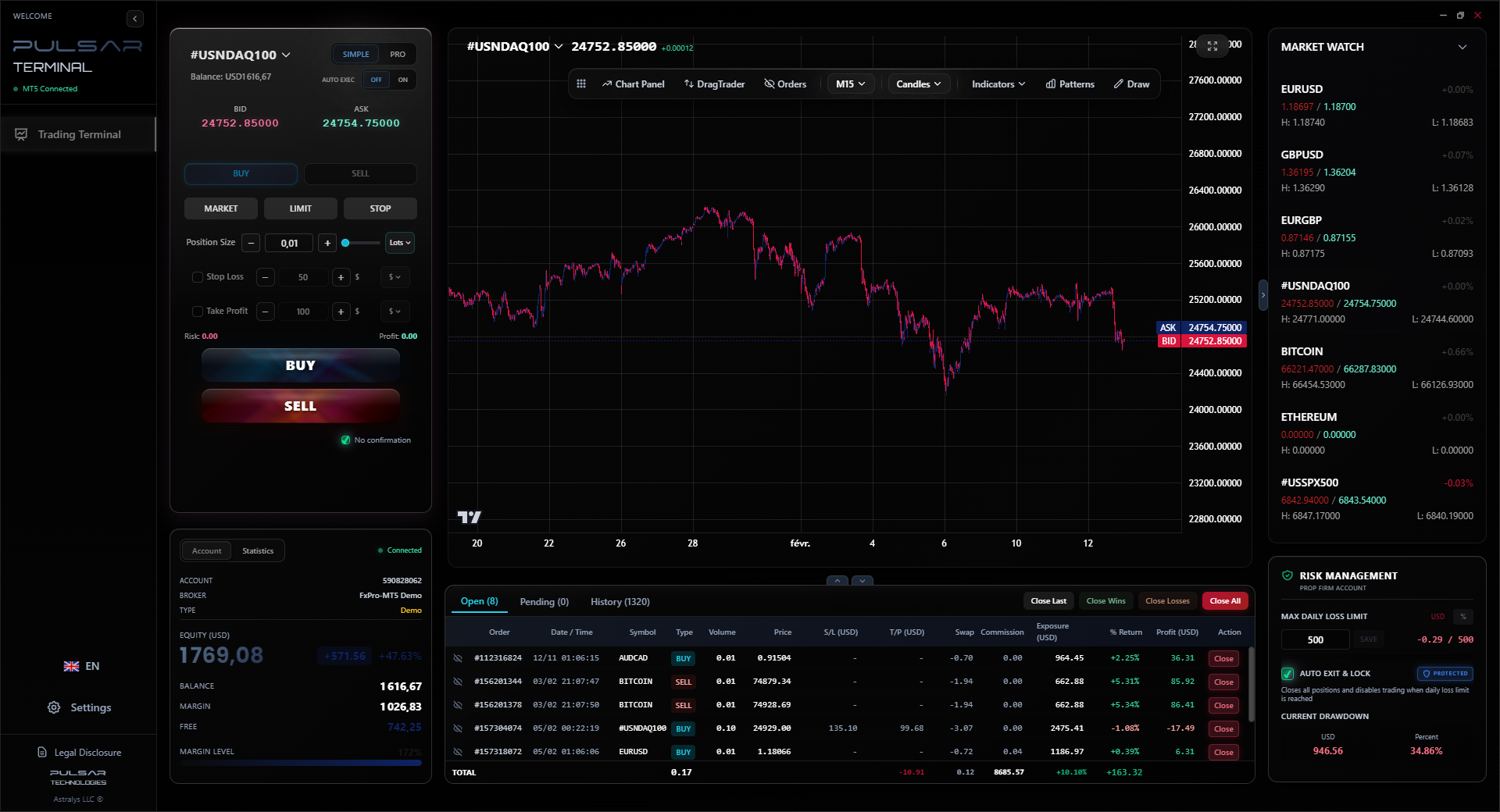
Sticking to your plan under pressure is the key to passing a prop challenge, and Pulsar Terminal's drag-and-drop order system lets you set your entire trade with TPs and SLs in seconds, removing hesitation.
Pulsar Terminal
MT5オールインワンツール:ドラッグ&ドロップ注文、マルチTP/SL、トレーリングストップ、グリッドトレード、出来高プロファイル、プロップファーム保護。毎日1,000人以上のトレーダーが利用。
“The number on the 1099 is your GROSS profit split, not your net. They do NOT subtract your initial challenge fee.”
It depends entirely on your profile.
Maybe YES if:
- You have a proven, disciplined swing trading strategy with a solid risk/reward ratio (think 1:3 or better).
- You have at least $500-$1000 you can afford to lose on challenge fees (plan for multiple attempts).
- You treat it as a serious business, with proper tax planning.
- You want the psychological test and structure of trading 'someone else's' capital, even if simulated.
Probably NO if:
- You are a beginner still learning what a pip is.
- You rely on high use (above 1:50) for your strategy to work.
- You cannot control your emotions after a losing trade.
- You're looking for a get-rich-quick scheme.
For me, the value wasn't just the potential money. It was the extreme pressure test. Trading a prop challenge forced a level of discipline I never had with my personal account. It made me a better trader. But I went in with my eyes wide open, expecting the rules to be stacked against me. I budgeted for multiple attempts, and I kept my day job until the payouts were consistent.
The final truth? US forex prop firms are a tough, expensive, but potentially viable path to scaling your trading. They are not a shortcut. They are a filter. They filter out the impatient, the under-capitalized, and the undisciplined. If you can get through that filter, you might just have what it takes to succeed long-term in this brutal business.

FAQ
Q1Can I use a VPN to join a prop firm that doesn't accept US traders?
Absolutely not. This violates their terms of service and likely constitutes fraud. If they discover it, they will freeze your account and keep any fees or profits. Also,, for tax and legal protection, you want to be dealing with a firm that officially operates with US traders.
Q2What's the best prop firm for a complete beginner?
Honestly, none of them. Prop firms are for traders with a proven, profitable strategy. A beginner should use a demo account, then a small live account with a reputable retail broker like Pepperstone or IC Markets to gain real experience without the intense pressure and restrictive rules of a prop challenge.
Q3How much money do I need to start with a US prop firm?
You need enough for the challenge fee, which can range from $150 for a small account to over $500 for a $100k+ evaluation. You should budget for at least 3 attempts, as most traders don't pass on their first try. So, have $1,000 - $1,500 set aside specifically for this purpose, money you can afford to lose.
Q4Do prop firms report to the IRS?
Yes, any legitimate US-based prop firm will issue you a 1099 form if your annual earnings exceed a minimal threshold (often $600). They are required by law to report this income to the IRS.
Q5Can I trade cryptocurrencies with a US forex prop firm?
Extremely unlikely. Most US forex prop firms stick to traditional forex pairs and sometimes indices or commodities. Cryptocurrency trading introduces massive regulatory and custody complexities that most prop firms want to avoid, especially under US regulations.
Q6What happens if I pass the challenge but then blow the funded account?
Most firms have a 'second chance' or 'discounted renewal' option. You won't have to pay the full challenge fee again, but you will pay a reduced fee to restart from a funded account level. However, you'll have to pass their rules again from the start. It's not a free reset.
ウィンストン教授のレッスン
重要ポイント:
- ✓Calculate returns after 35% for taxes.
- ✓Never risk >0.5% in challenge phase.
- ✓Swing trade, don't scalp, on 1:50 use.
- ✓Budget for 3 challenge attempts minimum.
この記事はどれくらい役に立ちましたか?
星をクリックして評価
週刊トレーディングインサイト
無料の週刊分析&戦略。スパムなし。
著者について
James Mitchell
シニアトレーディングアナリスト
ニューヨーク拠点で9年以上のトレード経験を持つ。主要USDペア、プロップファームチャレンジ、米国の規制環境を専門とする。
コメント
リスク警告
金融商品の取引には大きなリスクが伴い、すべての投資家に適しているわけではありません。過去の実績は将来の結果を保証するものではありません。本コンテンツは教育目的のみであり、投資助言として解釈すべきではありません。取引前に必ずご自身で調査を行ってください。
こちらもおすすめ

Cara Trading Forex Sukses: 7 Prinsip dari Trader Profesional
Cara trading forex sukses dengan 7 prinsip trader pro: manajemen modal, disiplin, journal trading, backtest. Data nyata, bukan janji profit palsu.
Jam Trading Forex Terbaik untuk Trader Indonesia: Panduan Lengkap dengan Tabel Waktu
Panduan jam trading forex untuk trader Indonesia. Tabel 4 sesi dunia, jam emas 20:00-00:00, sesi mana yang harus dihindari. Data akurat + tips dari trader berpengalaman.
Top 5 Sàn Forex Uy Tín Nhất 2026: Review Jujur dari Trader Indonesia
Top 5 sàn forex uy tín 2026 untuk trader Indonesia. Review jujur: spread, deposit, withdraw, dukungan lokal. Exness, XM, IC Markets & lebih.
