


You're watching EUR/USD coil up below a key resistance level.

David van der Merwe
新興市場トレーダー ·  South Africa
☕ 12 分で読める
学べること:
- 1The Buy Stop Order: A Simple Definition
- 2How It Works: A Local Example with USD/ZAR
- 3Primary Use: Breakout & Momentum Trading
- 4Secondary Use: Hedging a Short Position
- 5The Risks & Pitfalls: Where Traders Get Burned
- 6How to Place a Buy Stop Order on MT4/MT5
- 7The South African Context: FSCA & Local Broker Notes
- 8Advanced Tips & Integrating into a Strategy
You're watching EUR/USD coil up below a key resistance level. You're convinced that if it breaks higher, it's going to run. But you can't sit glued to the screen all day waiting for the move. What's the professional way to enter that trade automatically? That's exactly what a buy stop order is for. It's not just a button you click; it's a critical tool for executing a specific, disciplined strategy. In South Africa's volatile market, where the ZAR can swing wildly on a mining report, understanding this order type is non-negotiable. I've used it to catch major moves and, just as importantly, I've seen it trigger into false breakouts that wiped out my position. Let's break down what it is, how to use it properly, and the local broker specifics you need to know.
A buy stop is a pending order you place with your broker to buy a currency pair at a price above the current market price. Think of it as an automated 'go' signal. You set the trigger price, walk away, and if the market rallies up to that price, your order is activated and becomes a market order to buy.
It's the opposite of a limit order. A buy limit is placed below the market to try and buy a dip. A buy stop is placed above to buy a breakout. The most common use is for a breakout strategy. You identify a resistance level on your chart, place a buy stop just above it, and if the price breaks out with conviction, you're in the trade.
Here's a crucial detail many new traders miss: once triggered, it's a market order. You're not guaranteed your exact stop price. In fast-moving markets, you might get filled a few pips higher (or lower). This is called slippage. On a major news event, that slippage can be significant, which is a key risk we'll discuss later.

Warning: Never confuse a Buy Stop with a Stop-Loss. A Stop-Loss is an order to exit a trade to limit a loss. A Buy Stop is an order to enter a new trade. Mixing these up can lead to catastrophic, instant losses.

💡 ウィンストンのヒント
A buy stop order is a liability on your account. It's a promise to buy high. Only make that promise when the chart structure demands it, not because you're feeling bullish.
Let's make this real with South Africa's favourite volatile pair: USD/ZAR. Say the current market price is R18.50. You've been analysing the chart and see a strong resistance level at R18.80. Your analysis tells you that if USD/ZAR can crack through R18.80, it could run towards R19.20.
You don't want to buy at R18.50 and hope. You want proof of the breakout. So, you place a buy stop order at R18.82. You're giving it a 2-cent buffer above resistance to avoid being whipsawed by a tiny spike. You also set your stop-loss order at R18.65 and a take-profit at R19.15.
Now, you wait. If the price drifts down to R18.30, nothing happens. Your order just sits there, pending. But if bullish momentum builds and the price ticks up to R18.82, your broker's system automatically executes a market buy order. You are now long USD/ZAR, riding the breakout you anticipated.
The Role of Your South African Broker
Your broker's technology and liquidity are key here. When your buy stop at R18.82 is triggered, your broker sends a market order into the liquidity pool. On a major pair like EUR/USD with a broker like IC Markets, fills are usually instant and tight. On USD/ZAR, which can be less liquid, you might see more slippage, especially during local market hours or around SARB announcements. This is why checking your broker's execution policy is part of your job as a trader.
I learned this the hard way in 2020. I had a buy stop on GBP/JPY above a weekly resistance. A Brexit headline hit, and the pair gapped through my order level. My buy stop was triggered nearly 40 pips above where I set it. I was in a losing trade from the very first second. It was a brutal lesson in the difference between a theoretical order and real-world execution during an event risk.
“A buy stop isn't a strategy; it's a tool for executing one. The strategy is what happens in your analysis before you ever click 'place'.”
This is the bread and butter for buy stop orders. The logic is pure trend-following: consolidation leads to expansion. You're waiting for the market to show its hand and commit to a direction before you commit your capital.
The Classic Breakout Setup:
- Identify a clear consolidation pattern: a horizontal resistance, the high of a trading range, or a trendline.
- Place your buy stop order 3-5 pips above the identified level. Why not exactly at the level? To filter out false, intra-bar spikes that tap resistance and immediately reverse.
- Set your stop-loss. This should be placed below the recent structure - often just below the consolidation range or a recent swing low.
- Set your take-profit based on a measured move. A common technique is the height of the consolidation pattern.

Example: EUR/USD trades between 1.0850 and 1.0900 for three days (a 50-pip range). You place a buy stop at 1.0905. Your stop-loss goes at 1.0845 (below the range). Your take-profit target could be 1.0955 (the 50-pip range added to the breakout point).
This strategy works well with instruments known for strong trends. For a deeper look at a classic breakout pair, check out our EUR/USD guide. The danger, especially for South African traders watching the Rand, is fakeouts. USD/ZAR is notorious for punching above a level, triggering all the buy stops, and then reversing sharply to trap those new longs. This is why confirmation (like a strong closing candle above the level) and proper position sizing with a position size calculator are critical. You will be wrong on many breakouts. Your risk management decides if you survive.
This is a more advanced use, but it's important to understand. Imagine you've shorted XAU/USD (gold) because you believe it's topping out. However, you're aware of a major US inflation report due later in the week that could spark a gold rally. You want to keep your short open, but you need catastrophic protection.
You can place a buy stop order above your entry point as a hedge. This isn't a stop-loss; it's a separate, pending order to go long if the market moves violently against you. The idea is that if your analysis is utterly wrong and gold rockets higher, your buy stop triggers, opening a long position that offsets losses on your short. It's a form of insurance.
Frankly, I don't recommend this for most retail traders. It complicates your P&L, doubles your margin use, and often leads to confusion. In my early days, I tried hedging a USD/ZAR short during a SARB meeting. The volatility was insane, and both my short and my hedging buy stop got hit, locking in a loss on both sides due to spread costs and panic. A simple, well-placed stop-loss is almost always cleaner. For those trading gold, understanding its unique drivers is key, which we cover in our XAU/USD guide.
💡 ウィンストンのヒント
Your buffer above resistance isn't arbitrary. For USD/ZAR, I use a minimum of 0.15%. For EUR/USD, 0.03%. Volatility dictates your safety margin.
“The #1 killer of the buy stop strategy isn't slippage - it's the false breakout. Your risk management decides if you survive them.”
If you only learn one thing from this guide, let it be this: a buy stop is a liability until it's triggered. It's an open invitation to the market to take your money if your analysis is wrong. Here are the main dangers:
1. False Breakouts (The Whipsaw): This is the #1 killer. The price spikes above resistance, triggers your buy stop and every other trader's order, then immediately reverses. You're now long at the worst possible price as the market falls. This happens constantly. Your defence is a wider confirmation buffer and accepting that many signals will fail.
2. Slippage & Gapping: As mentioned, a buy stop becomes a market order. In fast markets (like during a US jobs report or a sudden shift in commodity prices affecting the ZAR), the price can jump from your trigger level to a much worse fill. With volatile pairs, your broker's spread can also widen dramatically at these moments, adding to your entry cost.
3. Forgetting the Order is There: This sounds silly, but it's a real problem. You place a buy stop on USD/ZAR, then go about your week. The order stays active. A month later, some global risk-off event triggers a rush into the USD, spikes ZAR pairs, and your ancient, forgotten order gets filled. You might not even notice until you get a margin call alert. Always, always manage your pending orders.
4. Poor Placement Relative to Structure: Placing your buy stop too close to resistance makes you vulnerable to noise. Placing it too far away means you give up a huge chunk of potential profit on the trade. There's no perfect answer, but backtesting your chosen buffer (e.g., 5 pips, 10 pips) on the specific pair and time frame you trade is essential.
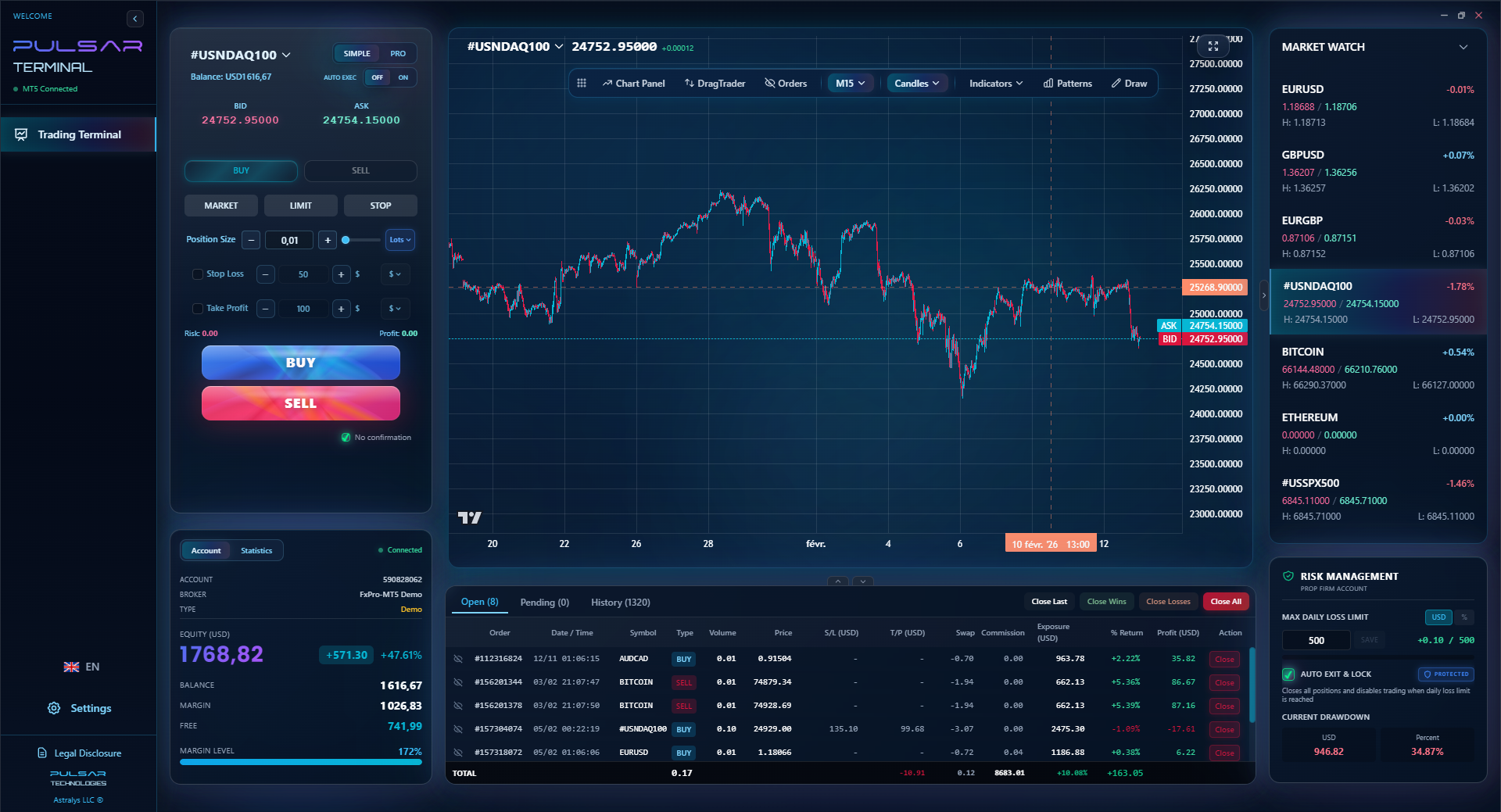
Manually moving stop-losses on multiple trades is a chore; Pulsar Terminal lets you set and manage trailing stops across all your positions with a single click directly on MT5.
Pulsar Terminal
MT5オールインワンツール:ドラッグ&ドロップ注文、マルチTP/SL、トレーリングストップ、グリッドトレード、出来高プロファイル、プロップファーム保護。毎日1,000人以上のトレーダーが利用。
Let's get practical. Here’s how you do it on MetaTrader, the platform used by probably 90% of South African retail traders.
- Right-click on the chart of the pair you want to trade.
- Select "Trading" and then "New Order" (or just press F9).
- The order window pops up. Ensure the correct symbol and volume (lot size) are selected.
- In the "Type" dropdown, change it from "Market Execution" to "Pending Order".
- Another dropdown will appear. Select "Buy Stop".
- Now, set your "At price" field. This is your trigger price (e.g., R18.82 for USD/ZAR).
- Set your "Stop Loss" and "Take Profit" prices. Do this now. Don't be the trader who enters and then forgets to set stops.
- Choose an Expiry if you want the order to cancel automatically after a certain date/time (useful for event-based trades).
- Click "Place".
You'll now see a horizontal line on your chart at your trigger price, usually in a different colour (like blue) to distinguish it from other lines. You can modify or delete it by right-clicking on the line.

Pro Tip: Before you click "Place," double-check the direction. A terrifying mistake is setting a "Sell Stop" when you mean "Buy Stop," or vice-versa. I've done it. You'll be betting on a crash when you meant to bet on a rally, and your brain will struggle to comprehend the losing trade on your screen.
“In South Africa's market, a buy stop on USD/ZAR is a bet on momentum overcoming structural selling. It's a high-stakes, high-reward tool.”
Trading in South Africa isn't just about charts; it's about operating within a regulated framework designed to protect you (somewhat). The Financial Sector Conduct Authority (FSCA) is our watchdog. Using an FSCA-licensed broker is your first line of defence. It means they must segregate client funds, adhere to conduct standards, and provide a legal recourse channel.
When placing buy stop orders, your choice of broker directly impacts your experience. Here’s a quick comparison of some FSCA-regulated brokers relevant to this topic:
| Broker | FSCA License | Min. Deposit (Approx.) | Key Point for Buy Stops |
|---|---|---|---|
| IG | Yes | £250 / ~R6,000 | strong platform, but higher minimums. Good for serious traders. |
| AvaTrade | Yes (No. 45984) | $100 / ~R1,800 | Offers fixed spreads. Your entry cost is more predictable on trigger. |
| Tickmill | Yes | $100 / ~R1,800 | Raw spreads + commission. Excellent for scalping strategies where precise entry is key. |
| XM Group | Yes | $5 / ~R90 | Very low barrier to entry. Good for practicing order placement. |
| Exness | Yes | $10 / ~R180 | Known for very low spreads. Can help minimise slippage cost on entry. |
| Khwezi Trade | Yes | ZAR 500 | Local broker. Support and deposits in Rands without conversion. |
Local Payment & Costs: Funding your account will likely involve an EFT or card payment. Remember, converting ZAR to USD (or EUR) to fund an international account incurs a bank fee and a less-than-ideal exchange rate, often a 1-3% hidden cost. Also, be mindful of swap rates if your buy stop triggers and you hold the trade overnight. These rates are based on the interest rate differential between the two currencies. With the SARB repo rate a key factor, holding ZAR pairs overnight has a tangible cost or credit.
💡 ウィンストンのヒント
If you're constantly getting whipsawed by buy stop entries, move to a higher time frame. The 1-hour chart lies more than the 4-hour.
A buy stop order isn't a strategy. It's a tool for executing one. To use it effectively, you need a plan.
Combine with Confluence: Don't place a buy stop just because price is near a horizontal line. Wait for confluence. Is that resistance level also a 61.8% Fibonacci retracement? Is the MACD indicator showing bullish divergence on the 4-hour chart? Is there a bullish chart pattern like a flag completing? The more reasons the level should hold, the better your breakout odds.
Use for Partial Entries: In a strong swing trading setup, you might buy half your position on a pullback (with a buy limit) and the other half on a breakout (with a buy stop). This averages your entry and confirms momentum before committing full capital.
Trailing Your Stop: Once your buy stop is triggered and you're in a profitable trade, your job isn't over. A static take-profit is fine, but using a trailing stop can let winners run. This moves your stop-loss up as the price moves in your favour, locking in profits.
The Psychological Edge: The biggest benefit of a buy stop is it removes emotion from the entry. You've predefined your entry, stop, and target based on your cold, hard analysis. When the market is screaming and that level is being tested, you're not frantically clicking buttons. You've already made the decision. This discipline is what separates consistent traders from gamblers. It forces you to wait for the market to come to you, to prove your idea right, before you risk a cent.
FAQ
Q1What's the difference between a Buy Stop and a Stop-Loss?
A Buy Stop is an order to enter a new long trade when the price rises to a certain level. A Stop-Loss is an order to exit an existing trade (usually to limit a loss) when the price moves against you. Confusing them can lead to immediate, significant losses.
Q2Can I place a Buy Stop order on any forex pair in South Africa?
Yes, if your FSCA-regulated broker offers that currency pair for trading, you can place a buy stop order on it. This includes majors like EUR/USD, crosses like EUR/GBP, and local pairs like USD/ZAR or EUR/ZAR.
Q3What happens if the market gaps above my Buy Stop price?
Your buy stop order will be triggered at the first available price after the gap. This is known as a 'gap fill' and often results in significant slippage. You could be entered into the trade much higher (worse) than your intended price, which is a major risk when trading around high-volatility events like news releases.
Q4How far above resistance should I set my Buy Stop order?
There's no magic number. A common practice is to set it 3-5 pips above a clear technical level for major pairs like EUR/USD. For more volatile pairs like USD/ZAR, you might need 10-20 pips to avoid being stopped in by a false spike. The goal is to confirm the breakout, not catch the absolute first tick above a line. Backtest different buffers to see what works on your chosen time frame.
Q5Do I pay the spread when a Buy Stop order is triggered?
Yes. When your buy stop triggers and becomes a market order, you buy at the current Ask price. The spread (difference between Bid and Ask) is your immediate cost of entering the trade. This is why low-spread brokers can be advantageous for breakout strategies.
Q6Is using a Buy Stop considered a good strategy for beginners?
It's a good tool for beginners to learn, as it teaches discipline and planning entries. However, the breakout strategy itself is challenging because false breakouts are very common. Beginners should start with very small position sizes, use a position size calculator, and understand that many of their initial buy stop orders will result in small losses from failed breakouts.
Q7Can I modify or cancel a Buy Stop order after placing it?
Absolutely, and you should. In MT4/MT5, right-click on the pending order line on your chart and select "Modify or Delete Order." You can change the trigger price, stop-loss, take-profit, or cancel it entirely. Always review your pending orders regularly.
ウィンストン教授のレッスン
重要ポイント:
- ✓A Buy Stop enters a long trade ABOVE the market price.
- ✓It's for breakouts, not for buying dips or setting stop-losses.
- ✓Once triggered, it's a market order subject to slippage.
- ✓False breakouts will wreck you without strict 2% risk limits.
- ✓Always set your SL and TP when you place the pending order.
この記事はどれくらい役に立ちましたか?
星をクリックして評価
週刊トレーディングインサイト
無料の週刊分析&戦略。スパムなし。
著者について
David van der Merwe
新興市場トレーダー
ヨハネスブルグ拠点で新興市場通貨11年のトレーダー。ZARペア、FSCA規制下の取引、南アフリカ市場分析を専門とする。
コメント
リスク警告
金融商品の取引には大きなリスクが伴い、すべての投資家に適しているわけではありません。過去の実績は将来の結果を保証するものではありません。本コンテンツは教育目的のみであり、投資助言として解釈すべきではありません。取引前に必ずご自身で調査を行ってください。
こちらもおすすめ

Cara Trading Forex Sukses: 7 Prinsip dari Trader Profesional
Cara trading forex sukses dengan 7 prinsip trader pro: manajemen modal, disiplin, journal trading, backtest. Data nyata, bukan janji profit palsu.
Jam Trading Forex Terbaik untuk Trader Indonesia: Panduan Lengkap dengan Tabel Waktu
Panduan jam trading forex untuk trader Indonesia. Tabel 4 sesi dunia, jam emas 20:00-00:00, sesi mana yang harus dihindari. Data akurat + tips dari trader berpengalaman.
Top 5 Sàn Forex Uy Tín Nhất 2026: Review Jujur dari Trader Indonesia
Top 5 sàn forex uy tín 2026 untuk trader Indonesia. Review jujur: spread, deposit, withdraw, dukungan lokal. Exness, XM, IC Markets & lebih.
