


The screen was a sea of red.
Sarah Collins
トレーディングストラテジスト ·  United Kingdom
☕ 11 分で読める
学べること:
- 1The Absolute Basics: It's Just Buying and Selling Money
- 2The UK's Legal Framework: Your FCA Safety Net
- 3The Real Costs: Spreads, Commissions, and Hidden Fees
- 4Choosing a Broker & Platforms in the UK
- 5Trading the Majors: A Focus on GBP/USD (Cable)
- 6The Graveyard of Mistakes (I've Made Most of Them)
- 7How to Start Trading Forex in the UK: Your First Steps
- 8Final Reality Check: Is Forex Trading For You?
The screen was a sea of red. It was September 2022, and the pound was in freefall. GBP/USD had just crashed through 1.10, a level I hadn't seen in my entire career. My phone was buzzing with margin alerts. That day, I learned what a forex trading really is: a brutally efficient machine that can vaporise sentiment and capital in minutes. But it's also the most accessible, liquid, and frankly, fascinating market on the planet. Let's strip away the jargon and look at what you're actually getting into, especially here in the UK where the rules of the game are written by the FCA.
Forget the complex definitions. What is a forex trading? At its core, you're betting on the value of one currency against another. You buy a currency pair if you think the first one will get stronger, or sell it if you think it'll get weaker. That's it.
The market quotes pairs like EUR/USD or GBP/JPY. The first currency is the 'base', the second is the 'quote'. If EUR/USD is 1.0850, it means 1 Euro buys you 1.0850 US Dollars. If you think the Euro will strengthen, you buy. Simple.
What makes it unique is the sheer scale. We're talking over $7 trillion changing hands every single day. That liquidity means you can get in and out of positions fast, often with razor-thin transaction costs compared to other markets. But that liquidity is a double-edged sword - it also means moves can be violent and unforgiving.

Warning: Don't confuse liquidity with stability. The forex market is a beast driven by global interest rates, geopolitics, and pure speculation. A 'liquid' market can gap against you overnight just as easily as a illiquid one.

💡 ウィンストンのヒント
Your first £1000 in the market is tuition fees, not investment capital. Expect to learn, not to earn.

Trading forex in the UK is completely legal, but it's governed by one of the world's toughest regulators: the Financial Conduct Authority (FCA). This isn't some bureaucratic nuisance; it's your primary line of defence. I've seen what happens in less regulated jurisdictions, and it ain't pretty.
Here’s what the FCA rules mean for you, a retail trader:
Client Money Protection: This is the big one. FCA-regulated brokers must keep your money in segregated bank accounts. If the broker goes bust (it happens), your funds are separate and should be returned to you. This isn't just a suggestion; it's law.
Negative Balance Protection: You cannot lose more than you deposit. In the old days, a bad trade could leave you owing the broker money. Now, your loss is capped at your account balance. After the 2015 Swiss Franc shock, this rule saved countless traders from financial ruin.
use Caps: The FCA doesn't trust you with too much rope, and frankly, they're right. For major pairs like GBP/USD, your use is capped at 30:1. For minors and exotics, it's 20:1. This might feel restrictive, but it's designed to stop you blowing up your account in two trades. If you think you need 500:1 use, you're not trading, you're gambling.
The £85,000 Safety Net: The Financial Services Compensation Scheme (FSCS) protects you up to £85,000 per firm if your broker fails. It's the final backstop. Always, and I mean always, check your broker is FCA-authorised on the official register. No authorisation? No trade.

Pro Tip: A sure sign of a dodgy outfit? They offer you a 'welcome bonus'. The FCA bans these for forex and CFD brokers in the UK. If you see one, run.
“Your first job isn't to beat the market; it's to not let the market beat you.”
Let's talk about what it actually costs to play. This is where most new traders get mugged. Your profit starts only after you've covered these costs.
The Spread: This is the difference between the buy (ask) and sell (bid) price. It's how many brokers make their money. A 'tight' spread on EUR/USD might be 0.1 pips on a raw account, while a standard account might be 1.0 pip. That 0.9 pip difference is your immediate loss on entry.
Commissions: Some brokers offer 'raw' spreads but charge a commission per lot. For example, Pepperstone's Razor account charges around £2.25 per lot per side. You need to do the maths: tight spread + commission vs. wider spread + no commission.
Here’s a quick comparison of typical costs from major UK brokers (as of recent data):
| Broker | Account Type | Avg. EUR/USD Spread | Commission (per lot, per side) | Key Feature |
|---|---|---|---|---|
| Pepperstone | Razor | 0.10 pips | ~£2.25 | Raw spreads, top-tier execution |
| Pepperstone | Standard | 1.0 pip | £0.00 | Simpler, commission-free |
| IG | Standard CFD | 0.6 pips | £0.00 | Huge product range, trusted brand |
| OANDA | Standard | ~1.3 pips | £0.00 | No minimum deposit, strong history |
The Hidden Bites:
- Currency Conversion: If your account is in GBP but you trade USD pairs, you'll pay a fee, often around 0.5%.
- Inactivity Fees: Leave your account dormant for a year? Some brokers, like AvaTrade, will charge you £50 a month.
- Withdrawal Fees: Not all brokers charge these, but some do. TabTrade, for instance, has a flat $5 fee.
My own mistake? I once traded a GBP/JPY position on a broker with a 3-pip spread without realising. The pair needed to move 3 pips just for me to break even. I got stopped out for a loss before the trade even had a chance to breathe. Always know your total cost per trade. Use a position size calculator that factors in spread.
Your broker is your gateway. Your platform is your cockpit. Get this choice wrong, and you're fighting with one hand tied behind your back.
The Broker Checklist
- FCA Authorisation: Non-negotiable. Check the register.
- Trading Costs: Look at the all-in cost for your style. A scalping strategy needs ultra-tight spreads. A swing trading approach can tolerate slightly wider ones.
- Platform Offering: Do they offer MT4, MT5, cTrader, TradingView? I'm a MetaTrader dinosaur, but TradingView's charting is superb.
- Deposit/Withdrawal: How easy is it to get your money in and, more importantly, out? Bank transfer, PayPal, Skrill?
- Customer Service: Call them. Ask a technical question. See how they respond.
I've had accounts with most of them. My primary is with Pepperstone for their Razor account execution. I keep a secondary with IG Group for their research and wider markets. XM and Exness have global reach, but ensure you're on their UK-regulated entity.
The Platform War
- MetaTrader 4/5: The industry standard. MT4 is rock-solid for forex. MT5 offers more timeframes and instruments. Millions of indicators and EAs (Expert Advisors) are available.
- cTrader: Clean, modern, and loved by many for its transparency and order execution.
- TradingView: The best charting software, period. More brokers are offering direct trading integration.
- Proprietary Platforms: Brokers like IG and OANDA have their own. They're often user-friendly but can lack the depth of MT4/5.
Your platform should feel like an extension of your brain. If you're fighting the software, you'll lose.
💡 ウィンストンのヒント
If you can't explain your trade setup in one simple sentence, you don't understand it well enough to risk money on it.
“With 30:1 use, a mere 3.33% move against you wipes out your account.”
In the UK, you'll naturally gravitate towards pairs involving the Pound. GBP/USD – 'Cable' – is our home game. It's liquid, volatile, and reacts fiercely to UK politics and Bank of England chatter.
I remember shorting Cable at 1.2550 in late September 2022, just as the 'mini-budget' chaos began. I had a tight stop at 1.2620. The pair spiked to 1.2619 before collapsing. I closed at 1.2050 for a 500-pip gain. That trade worked because I understood the driver: a loss of confidence in UK fiscal policy. I also got lucky my stop wasn't triggered by a whisker.
What Moves Cable?
- Bank of England vs. Federal Reserve: Interest rate differentials are king.
- UK Economic Data: CPI inflation, GDP, employment figures.
- Political Stability: Elections, referendums, budget announcements.
- Global Risk Sentiment: The Pound is a 'risk' currency; it often falls when global markets panic.
Trading It:
- Volatility: Don't use the same stop-loss you would on EUR/USD. Cable moves more. A 50-pip stop on EUR/USD might need to be 80-100 pips on Cable.
- Session Overlap: The London-New York overlap (1pm - 4pm UK time) is often when the biggest moves happen.
- Spread Awareness: The spread on GBP/USD is usually wider than on EUR/USD. Factor that in.
For a deeper look at other key pairs, check out our EUR/USD guide. And if you want real volatility, look at XAU/USD (Gold).
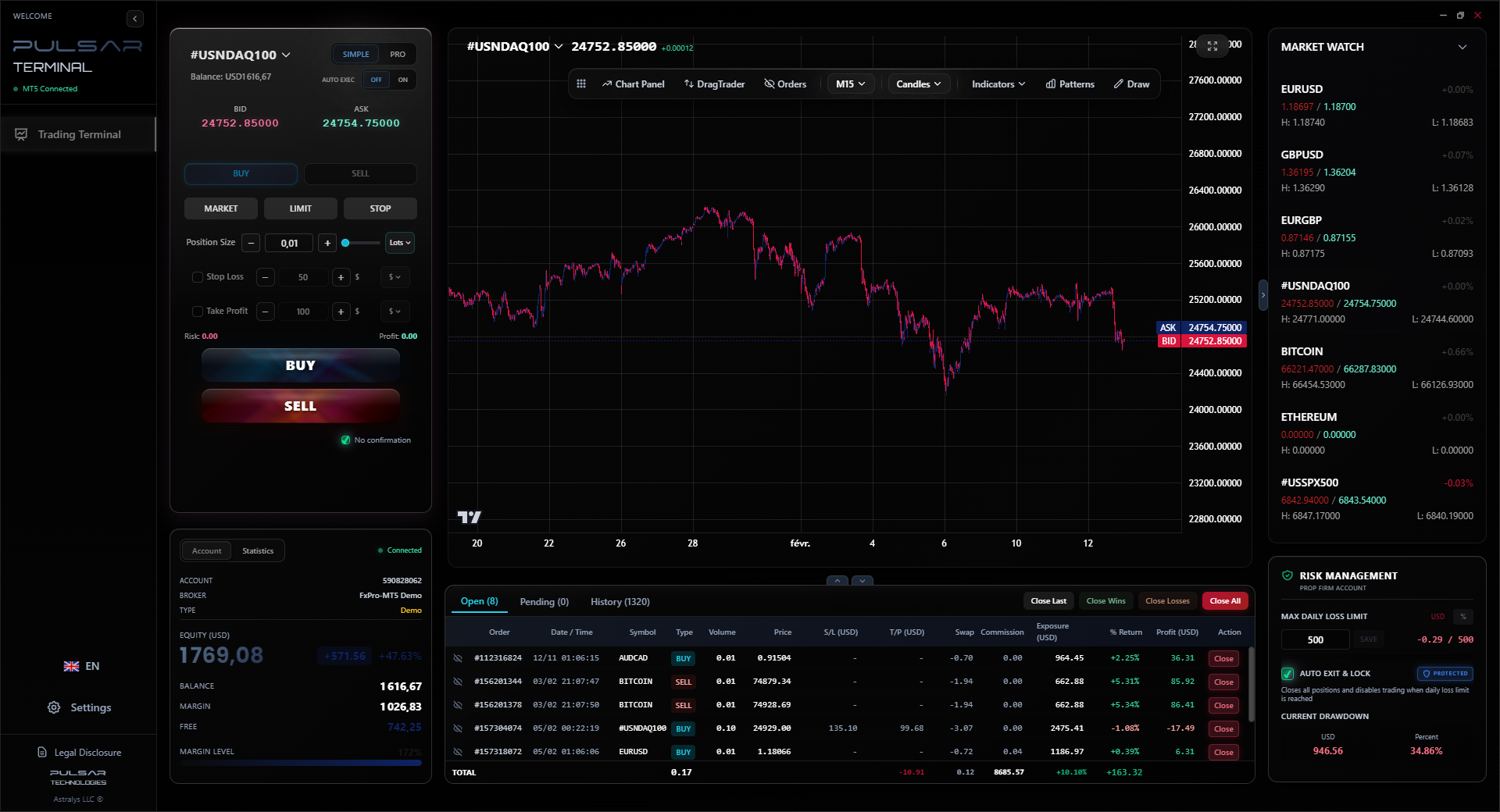
Managing multiple trades on volatile pairs like GBP/USD is a headache, but tools like Pulsar Terminal let you set multi-level take-profits and trailing stops directly on your MT5 charts.
Pulsar Terminal
MT5オールインワンツール:ドラッグ&ドロップ注文、マルチTP/SL、トレーリングストップ、グリッドトレード、出来高プロファイル、プロップファーム保護。毎日1,000人以上のトレーダーが利用。
Let's be brutally honest. Most people lose money. Here's how they do it, so you don't have to.
1. Over-leveraging: This is the number one killer. With 30:1 use, a mere 3.33% move against you wipes out your account. I once put 10% of my account on a single EUR/USD trade with high use. A rogue news spike hit my stop. I lost 15% of my capital in 30 seconds. Stupid. Now, I rarely risk more than 1-2% per trade.
2. Chasing Losses: You lose £100. Your brain says, "Double up to get it back fast." That's how you turn a £100 loss into a £500 loss. I've done it. It feels awful.
3. Ignoring the Economic Calendar: Trading blind during a CPI release or Fed announcement is Russian roulette. I learned this the hard way getting stopped out of a perfectly good position by NFP volatility.
4. No Trading Plan: "I'll just wing it." This isn't a hobby. You need rules for entry, exit, and risk. Write it down.
5. Misunderstanding the Spread: As mentioned, entering a trade with a 3-pip spread means you're already losing. It's like starting a race three meters behind the starting line.
6. Fear of Pulling the Trigger (or Pulling it Too Fast): Analysis paralysis is real. So is impulsive revenge trading after a loss.
The market is a mirror. It shows you your greed, fear, and impatience. Your first job isn't to beat the market; it's to not let the market beat you. Managing your risk and psychology is 80% of the game. Understanding what a margin call is and how to avoid it is part of that foundation.
💡 ウィンストンのヒント
The best trade you'll ever make is the one you don't take. Patience isn't a virtue in trading; it's a weapon.
“Preserving your capital is always priority number one. Everything else is secondary.”
Right, you're still reading. Good. Here's a practical, step-by-step path that doesn't involve setting your money on fire.
Step 1: Education (Paper Trading) Don't deposit a penny yet. Open a demo account with an FCA broker. Play with virtual money for at least three months. Test strategies. Get used to the platform. Learn what a pip really means in monetary terms. Experience losing virtual money. It should feel bad, even when it's not real.
Step 2: Develop a Simple Strategy Start stupidly simple. Maybe price action around a key moving average, or basic support/resistance. Learn one or two indicators inside out, like the RSI indicator or MACD indicator, instead of cluttering your chart with ten. Backtest it on your demo account.
Step 3: The Live Account (Small!) Start with an amount you can afford to lose completely. I'm talking a few hundred pounds, max. The goal of this first deposit is not to make money. The goal is to survive. To execute your plan under real psychological pressure. The position size calculator is your best friend here.
Step 4: Keep a Trading Journal Record every trade. Entry, exit, reason, emotional state. Review it weekly. This is how you learn from your mistakes. My journal from 2015 is a cringe-worthy catalogue of errors, but it's the reason I'm still here today.
Step 5: Gradual Scaling Only add more capital once you have at least six months of consistent, profitable results from your small account. Consistency is key. Anyone can get lucky on one trade.
This is a marathon, not a sprint. The traders who last are the ones who manage risk, keep learning, and don't get arrogant after a few wins.
So, what is a forex trading career really like? It's lonely. It's stressful. It's filled with self-doubt. For every day you feel like a genius, there will be a week where you feel like an idiot.
It's not a get-rich-quick scheme. It's a skilled profession that requires continuous study, iron discipline, and emotional resilience. The market doesn't care about your mortgage, your dreams, or your analysis.
The UK offers you a safe, regulated environment to learn this craft. The FCA rules protect you from the worst broker abuses. But they can't protect you from yourself.
If you're fascinated by global economics, enjoy deep analysis, and can handle significant financial risk without panicking, then maybe, just maybe, it's for you. Start slow. Start small. Respect the market. And remember, preserving your capital is always priority number one. Everything else is secondary.
FAQ
Q1Is forex trading legal and safe in the UK?
Yes, it's completely legal. Its safety depends almost entirely on using an FCA-authorised broker. These brokers must segregate client funds, offer negative balance protection, and adhere to strict conduct rules. Trading itself is high-risk, but the regulatory framework in the UK is designed to make the environment as safe as possible from fraud and malpractice.
Q2How much money do I need to start forex trading in the UK?
Technically, some brokers like OANDA have no minimum deposit. Realistically, you should start with a small, risk-capital amount you can afford to lose - think a few hundred pounds. The key isn't the starting amount, but the risk per trade (typically 1-2% of your account). A £500 account risking 2% per trade means a maximum loss of £10 per trade. This allows you to learn without catastrophic loss.
Q3What's the most traded forex pair in the UK?
Globally, it's EUR/USD. In the UK, GBP/USD ('Cable') is of particular importance and is heavily traded due to its direct link to the UK economy. It's known for its volatility, especially during London trading hours and around UK economic data releases.
Q4Can I trade forex tax-free in the UK?
No, there's no specific 'tax-free' status for forex trading for retail traders. Profits from trading are generally subject to Capital Gains Tax (CGT). You have an annual CGT allowance (£3,000 for the 2024/25 tax year). Profits above this may be taxed. It's crucial to keep detailed records of all your trades for tax purposes. Always consult a qualified accountant.
Q5What's the difference between a spread and a commission?
A spread is the built-in cost represented by the difference between the buy and sell price. A commission is a separate fee charged per lot traded. Some accounts have tight spreads but charge a commission (e.g., Pepperstone Razor). Others have wider spreads but no commission (e.g., Pepperstone Standard). You must calculate the total cost of a round-turn trade to compare fairly.
Q6Can I become a full-time forex trader?
It's possible, but extremely difficult. It requires a substantial, proven track record of consistent profitability over years (not months), a significant capital base to generate meaningful income, and the discipline to treat it like a business. Most successful retail traders I know have other sources of income; forex is a supplement. Don't quit your day job prematurely.
ウィンストン教授のレッスン
重要ポイント:
- ✓FCA regulation is your shield, not a barrier.
- ✓Know your all-in cost: spread + commission + fees.
- ✓Risk a maximum of 1-2% of your capital per trade.
- ✓Trade the demo until boredom turns to consistency.
- ✓GBP/USD moves require wider stops than EUR/USD.
この記事はどれくらい役に立ちましたか?
星をクリックして評価
週刊トレーディングインサイト
無料の週刊分析&戦略。スパムなし。
著者について
Sarah Collins
トレーディングストラテジスト
ロンドン拠点のトレーディングストラテジスト、金融市場で12年の経験。シティ・オブ・ロンドンの証券会社で元アナリスト。GBPペア、欧州市場、FCA規制下の取引を担当。
コメント
リスク警告
金融商品の取引には大きなリスクが伴い、すべての投資家に適しているわけではありません。過去の実績は将来の結果を保証するものではありません。本コンテンツは教育目的のみであり、投資助言として解釈すべきではありません。取引前に必ずご自身で調査を行ってください。
こちらもおすすめ

Cara Trading Forex Sukses: 7 Prinsip dari Trader Profesional
Cara trading forex sukses dengan 7 prinsip trader pro: manajemen modal, disiplin, journal trading, backtest. Data nyata, bukan janji profit palsu.
Jam Trading Forex Terbaik untuk Trader Indonesia: Panduan Lengkap dengan Tabel Waktu
Panduan jam trading forex untuk trader Indonesia. Tabel 4 sesi dunia, jam emas 20:00-00:00, sesi mana yang harus dihindari. Data akurat + tips dari trader berpengalaman.
Top 5 Sàn Forex Uy Tín Nhất 2026: Review Jujur dari Trader Indonesia
Top 5 sàn forex uy tín 2026 untuk trader Indonesia. Review jujur: spread, deposit, withdraw, dukungan lokal. Exness, XM, IC Markets & lebih.
