


Here's a fact that might surprise you: about 70% of all forex volume happens during just 8 hours of the day.

Olumide Adeyemi
西アフリカ・トレーディングの先駆者 ·  Nigeria
☕ 11 分で読める
学べること:
Here's a fact that might surprise you: about 70% of all forex volume happens during just 8 hours of the day. If you're trading at the wrong time in Nigeria, you're basically fighting for scraps when the big players aren't even at the table. Getting the timing right isn't just a suggestion, it's the difference between catching a proper move and watching your chart flatline for hours. Let's break down the exact West Africa Time (WAT) windows that matter, how the new 2025 regulations change the game, and how you can structure your day around real opportunity, not just hope.
When I first started, I thought I could just log in whenever I had free time - maybe after work around 7 PM WAT - and find good trades. I was wrong. The market doesn't care about your schedule. It cares about liquidity: the amount of money being traded at any given moment. More money means tighter spreads, cleaner price action, and a higher chance your trade will go where you expect.
The big moves are driven by the major financial centers: London, New York, and Tokyo. When these hubs are active, especially when their trading hours overlap, the market comes alive. Trading during quiet periods, like the Asian session late at night for us, is like trying to swim in a puddle. The spreads widen, the price can be jerked around by a single large order, and your stop-loss becomes much more vulnerable. I learned this the hard way, getting stopped out on a USD/JPY trade at 2 AM WAT by a spike that vanished minutes later. The chart looked nothing like it did during the London session.

Warning: Trading during low-liquidity sessions (like late Asian session) significantly increases your risk of slippage and widens your effective spread, eating into potential profits before you even start.
So, the best time to trade forex isn't a personal preference. It's a logistical reality based on global capital flow. Your job is to align your Nigerian trading schedule with these global power hours.
Let's translate the global forex clock into West Africa Time (GMT+1). This is the practical schedule you can set your watch by.
The London Session (The Engine Room)
Approx. 8:00 AM – 5:00 PM WAT This is where the day really gets going. London is the world's largest forex hub. Volume picks up steadily from 8 AM WAT. The most reliable action for pairs like EUR/USD, GBP/USD, and EUR/GBP often starts around 9:30 AM WAT, once all the major European banks and funds are online. This session offers strong, directional trends. It's my personal favorite for swing trading setups because the moves have conviction.
The London-New York Overlap (The Power Hours)
Approx. 1:00 PM – 5:00 PM WAT This is the answer to what is the best time to trade forex for most active traders. For about four hours, both London and New York are fully open. Liquidity is at its absolute peak. This is when you see the biggest news releases (like US CPI data at 2:30 PM WAT) and the most explosive price movements. It's perfect for day trading and capturing quick, volatile moves. The EUR/USD guide shows how this pair specifically comes alive during this window.

Example: On a typical Tuesday, the average hourly range for EUR/USD might be 15 pips. During the 2-3 PM WAT overlap, that can easily jump to 30-40 pips, doubling your potential profit (and risk) in the same time frame.
The New York Session (The Afternoon Wave)
Approx. 1:00 PM – 10:00 PM WAT The first half (1-5 PM WAT) is part of the overlap. After London closes at 5 PM WAT, the New York session continues but liquidity slowly drains. There can be a second wind around 3:30 PM WAT (9:30 AM EST) when the US stock market opens. This session is good for trading USD pairs like USD/CAD or USD/CHF.
The Asian Session (The Quiet Watch)
Approx. 12:00 AM – 9:00 AM WAT This is the overnight session for us. It's generally quiet, with lower volatility. The main action is on JPY pairs (like USD/JPY) and sometimes AUD/USD. It's not ideal for beginners. Some traders use this time to analyze charts and plan for the London open. I used to try scalping here, but the thin volume made it more frustrating than profitable.

💡 ウィンストンのヒント
The market pays you for being patient, not busy. If you can't find a high-quality setup during the London or overlap sessions, the correct trade is to do nothing. Forced action is the enemy.
“The London-New York overlap isn't just a good time to trade; it's the only time that matters for serious intraday movement.”
The game changed in March 2025. The old, grey area where forex brokers operated is gone. The new Investments and Securities Act (ISA) 2025 gives the Securities and Exchange Commission (SEC) Nigeria clear power to regulate online forex trading platforms. This is huge.
Before, the Central Bank of Nigeria (CBN) was the main authority, focused on currency controls. The SEC now says operating a platform without formal registration is an offense. For you, the trader, this means two things:
- Broker Safety is Paramount: You must now check if your broker is actively seeking or has obtained SEC registration. This isn't just about a CBN license anymore. A regulated broker under the new act is less likely to be a scam, and your funds have a higher degree of protection. Always check our updated reviews, like the Exness review or IC Markets review, for the latest on their regulatory status in Nigeria.
- Tax Clarity: The law reinforces that trading profits are subject to Capital Gains Tax, generally at 10%. If you're trading full-time, it's considered business income. Keep clear records. The 10% hit is real, so factor it into your profit targets.

Pro Tip: Don't wait for a broker to advertise their "SEC registration." Go to the SEC Nigeria website and search their registry. Your due diligence is your first line of defense.
This shift towards regulation is actually good for serious traders. It weeds out the shady operators and creates a more stable environment. It also means the advice on timing and strategy becomes even more critical, because you're playing on a more legitimate, but equally competitive, field.
Not every strategy works in every session. You need to match your tool to the job.
- Scalping & High-Frequency Day Trading: You need the London-New York overlap (1-5 PM WAT). The high liquidity keeps spreads razor-thin, which is essential when you're targeting 5-10 pips per trade. Trying to scalp during the Asian session is a fast track to having your profits swallowed by the spread definition.
- Swing Trading & Position Trading: The London session open (from 9 AM WAT) is excellent for entering swings. You get the initial momentum of the European day. You can also find good entries in the late New York session (after 7 PM WAT) as things settle, setting up for the next London open. These strategies care less about hourly volatility and more about the daily or weekly trend.
- News Trading: Your clock is set to economic calendars. Major US data (like NFP) drops at 2:30 PM WAT. UK and EU data often hits between 9 AM and 11 AM WAT. Your entire session revolves around these 15-minute windows. Never hold a position through major news unless that's your specific, risk-managed strategy. I once got greedy holding a GBP/USD trade into UK inflation data, thinking the trend would continue. A surprise figure wiped out a 40-pip gain and turned it into a 60-pip loss in seconds.
Think of it like this: you wouldn't use a sledgehammer to put in a tiny screw. Don't use a slow, swing-trading mindset during the hyper-active overlap, and don't try to scalp in a dead market.
💡 ウィンストンのヒント
Always know the next high-impact news event and its WAT time. If you're in a trade, decide *before* it hits: are you closing, holding, or adjusting stops? Indecision during the news volley is how accounts get blown up.
“The new SEC rules don't make trading harder; they make the environment safer for those who do their homework.”
Let's get practical. How do you make this work with life in Nigeria?
For the 9-5 Worker: Your golden hour is the London-New York overlap, starting at 1 PM WAT. That's lunchtime and early afternoon. Use your break to check charts you analyzed earlier. Set alerts for key levels so you don't have to stare at the screen. The last hour of London (4-5 PM WAT) can also offer good setups as you wrap up work.
For the Full-Time Trader: Structure your day. Use the Asian session (very early morning) for analysis and planning, not trading. Be ready and focused for the London open at 8 AM WAT. The overlap from 1 PM is your main event. After 5 PM WAT, review, journal, and prepare for the next day. Discipline with your time is as important as discipline with your trades.
Risk Management is Time-Specific: Your position size calculator inputs should change with volatility. A 20-pip stop-loss during the quiet Asian session might be reasonable, but during the overlap, that same stop could be too tight and get taken out by normal noise. Widen your stops during high-volatility periods, or reduce your position size to account for the larger swings.
I keep a simple table on my wall:
| Session (WAT) | Volatility | Best For | My Action |
|---|---|---|---|
| 12 AM - 8 AM | Low | Analysis, JPY pairs | Plan, Sleep |
| 8 AM - 1 PM | Medium-High | Swing entries, EUR/GBP | Trade actively |
| 1 PM - 5 PM | Very High | Day trading, news, all majors | Focused trading |
| 5 PM - 10 PM | Medium | USD pairs, review | Wind down, review trades |
This simple grid stops me from forcing trades when the market is asleep.
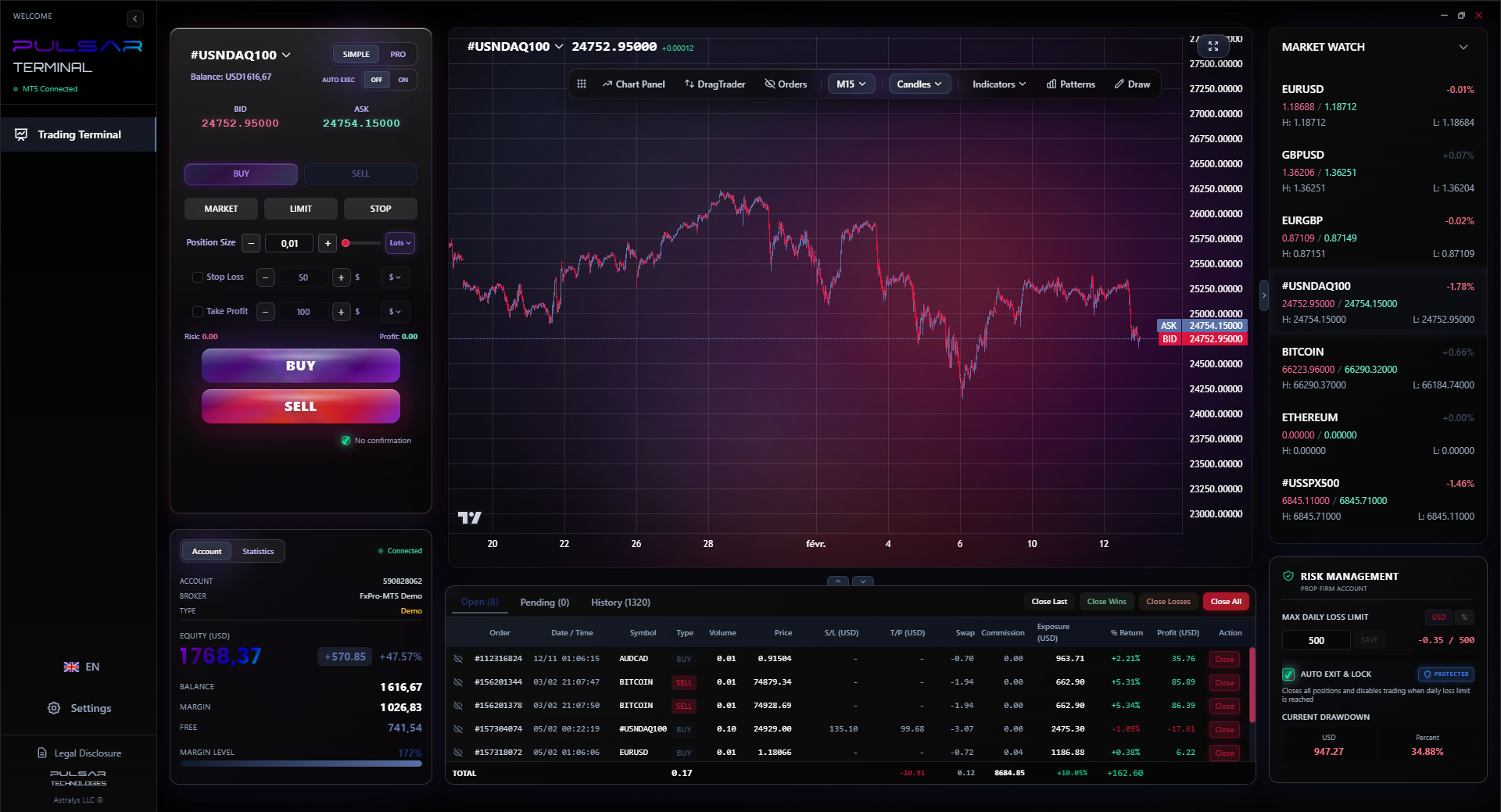
Managing multiple trades and adjusting stops across different sessions is complex, but tools like Pulsar Terminal automate partial closures and trailing stops directly on your MT5, letting you focus on timing the market, not just the mechanics.
Pulsar Terminal
MT5オールインワンツール:ドラッグ&ドロップ注文、マルチTP/SL、トレーリングストップ、グリッドトレード、出来高プロファイル、プロップファーム保護。毎日1,000人以上のトレーダーが利用。
You don't have to do this manually. Use technology.
- Economic Calendars: Sites like Forex Factory or Investing.com. Set the clock to WAT. Mark high-impact news events in red on your own calendar.
- Market Session Indicators: Most platforms have free indicators that shade the chart for different sessions. Seeing a shaded London-New York overlap bar on your chart visually reinforces where the volume is.
- Price Alerts: Set alerts at key support/resistance levels you identify in the morning. When the market hits them during the active session, you get a ping. This means you don't have to be glued to the screen.
- Volume Indicators: While not perfect in forex (which is decentralized), tools like the Volume Profile in advanced platforms can show you where the most trading activity occurred at certain price levels. This is a more sophisticated way to confirm liquidity. Combining session times with volume analysis is a powerful edge.
Remember, an indicator like the RSI indicator or MACD indicator can give you a signal, but if that signal occurs at 3 AM WAT, it's probably weaker than the same signal at 2 PM WAT. The tool tells you what, but the session time tells you how much to trust it.
💡 ウィンストンのヒント
Your first job after a losing trade isn't to revenge trade. It's to check what session you were in. More losses than you'd expect happen simply because you traded against the market's natural liquidity cycle.
“A perfect chart pattern at 3 AM WAT is a trap. A mediocre one at 2 PM WAT is often a goldmine.”
Let me save you some pain and lost Naira.
Mistake 1: Overtrading the Dead Zones. Boredom is not a trading signal. Just because you're awake at 11 PM doesn't mean you should trade. I funded my account with 150,000 NGN and blew nearly 30,000 NGN in a week trading USD/CAD late at night out of sheer boredom. The charts looked active on the 5-minute, but it was all noise.
Mistake 2: Ignoring the Session Context. A perfect pin bar or engulfing candle during the Asian session does not have the same weight as one formed during the London open. The money behind it is different. Learn to grade your signals based on the time they appear.
Mistake 3: Forgetting About Daylight Saving Time (DST). This is a big one! The UK and US switch to DST on different dates. For a few weeks in March and October, the overlap shifts by one hour. If your trading seems "off" in spring, check the global clocks. Your 1 PM WAT overlap might temporarily become 2 PM WAT.
Mistake 4: Not Adjusting Stops for Volatility. This ties into risk management. A 15-pip stop on GBP/USD during the power hour is a gamble. That pair can move 15 pips in a minute easily. You're likely to get margin call fears or stopped out prematurely. Give your trades room to breathe during active times.
The core lesson? Respect the market's rhythm. It's a force of nature. You can't control it, but you can absolutely choose when to swim with the current.
FAQ
Q1What is the single best hour to trade forex in Nigeria?
For maximum action, focus on 2:00 PM to 3:30 PM WAT. This is the heart of the London-New York overlap, often when major US economic data is released, creating the peak volatility and liquidity of the entire day.
Q2Is forex trading legal in Nigeria?
Yes, it is legal for individuals. However, the regulatory landscape changed in 2025. The new Investments and Securities Act (ISA) 2025 now requires online forex platforms to register with the SEC Nigeria. Always verify your broker's regulatory status with both the CBN and the SEC.
Q3Can I trade forex successfully in the evening in Nigeria?
It depends. The pure New York session (after 5 PM WAT) has lower liquidity than the overlap. It can work for specific USD pairs or longer-term swing trades, but the explosive, high-probability day trading opportunities drop off significantly after London closes.
Q4What is the worst time to trade forex in Nigeria?
The worst time is typically between 10 PM and 5 AM WAT. This covers the late New York and the bulk of the Asian session. Liquidity is lowest, spreads are widest, and price action is often slow and erratic, making consistent profits very difficult.
Q5How does the new SEC regulation affect my choice of broker?
It makes due diligence critical. Prioritize brokers who are transparent about their SEC registration process in Nigeria. It's a strong sign of legitimacy and commitment to the market. Our broker reviews, like the XM review and Pepperstone review, track these developments.
Q6Do I pay tax on my forex trading profits in Nigeria?
Yes. Profits are generally subject to a 10% Capital Gains Tax. If you trade full-time, it may be considered business income. You are responsible for declaring this to the Federal Inland Revenue Service (FIRS).
Q7Can I trade Gold (XAU/USD) using these same session times?
Absolutely. Gold is a dollar-denominated asset and follows similar liquidity patterns. The London-New York overlap (1-5 PM WAT) is also the best time to trade gold, as it sees its highest volume and most decisive moves. Check our XAU/USD guide for more specifics.
ウィンストン教授のレッスン
重要ポイント:
- ✓The 4-hour London-New York overlap (1-5 PM WAT) generates over 70% of daily opportunities.
- ✓Adjust your position size for volatility: wider stops or smaller lots during Power Hours.
- ✓The new ISA 2025 law mandates SEC registration for platforms - verify your broker.
- ✓10% Capital Gains Tax applies to your net annual trading profits.
- ✓Never trade a major pair during the Asian session (12-8 AM WAT) expecting a trend.
この記事はどれくらい役に立ちましたか?
星をクリックして評価
週刊トレーディングインサイト
無料の週刊分析&戦略。スパムなし。
著者について
Olumide Adeyemi
西アフリカ・トレーディングの先駆者
ナイジェリアで最もアクティブなFXトレーディング教育者の一人。ラゴスから8年のトレード経験。アフリカのトレーダー向けの少額資金戦略とプロップファームチャレンジを専門とする。
コメント
リスク警告
金融商品の取引には大きなリスクが伴い、すべての投資家に適しているわけではありません。過去の実績は将来の結果を保証するものではありません。本コンテンツは教育目的のみであり、投資助言として解釈すべきではありません。取引前に必ずご自身で調査を行ってください。
こちらもおすすめ

Cara Trading Forex Sukses: 7 Prinsip dari Trader Profesional
Cara trading forex sukses dengan 7 prinsip trader pro: manajemen modal, disiplin, journal trading, backtest. Data nyata, bukan janji profit palsu.
Jam Trading Forex Terbaik untuk Trader Indonesia: Panduan Lengkap dengan Tabel Waktu
Panduan jam trading forex untuk trader Indonesia. Tabel 4 sesi dunia, jam emas 20:00-00:00, sesi mana yang harus dihindari. Data akurat + tips dari trader berpengalaman.
Top 5 Sàn Forex Uy Tín Nhất 2026: Review Jujur dari Trader Indonesia
Top 5 sàn forex uy tín 2026 untuk trader Indonesia. Review jujur: spread, deposit, withdraw, dukungan lokal. Exness, XM, IC Markets & lebih.
