


Most Nigerian traders I meet get the London open time wrong.

Olumide Adeyemi
西アフリカ・トレーディングの先駆者 ·  Nigeria
☕ 10 分で読める
学べること:
- 1The Exact London Open Time in Nigeria (WAT)
- 2Why This Session is a Goldmine for Nigerian Traders
- 33 Costly Mistakes Nigerian Traders Make at the Open
- 4Practical Strategies for the London Open (From Lagos)
- 5The Nigerian Context: Regulations, Tax, and Getting Paid
- 6Essential Tools & Platforms to Get an Edge
- 7A Sample London Open Routine for a Nigerian Trader
Most Nigerian traders I meet get the London open time wrong. They think it's 7 AM, or maybe 9 AM. This simple mistake costs them the best moves of the day. The truth is, knowing the exact London open in West Africa Time (WAT) is your first step to catching the big moves in EUR/USD and GBP/USD. I'll show you not just the clock time, but what actually happens in that first hour, which pairs to watch, and how to avoid the common trap Nigerian traders fall into right at the open.
Let's clear this up once and for all. The London Interbank Forex Market opens at 8:00 AM West Africa Time (WAT). It closes at 5:00 PM WAT.
This is because London operates on Greenwich Mean Time (GMT) or British Summer Time (BST) when applicable. The core trading session is 8 AM to 5 PM GMT. Since Nigeria is GMT+1 year-round (we don't do daylight saving), you simply add one hour. So 7 AM GMT becomes 8 AM WAT.
I can't tell you how many times I've seen traders log in at 9 AM, frustrated they 'missed the move.' The biggest volume and most decisive breaks often happen in that first 60-90 minutes. If you're serious about trading majors like the EUR/USD, your day starts at 8 AM, not 9.

Warning: Don't confuse the interbank open (8 AM WAT) with when your specific broker's liquidity is fully loaded. Some international brokers catering to Nigerians might show increased spreads or slower execution for the first 5-10 minutes. Give it a moment to settle.

💡 ウィンストンのヒント
The market's first move at the open is often a liar. It's the second move, after the initial liquidity rush, that shows the real intent. Patience isn't just a virtue; it's a profit center.
London isn't just another session. It's the heavyweight champion, accounting for over 35% of all global forex volume. For you in Nigeria, this translates to three concrete advantages you don't get during the quiet Asian session.
First, liquidity. This is the big one. More banks, funds, and institutions are trading, which means the bid/ask spread on major pairs tightens up. You can get in and out of trades with less slippage. I remember a specific trade on GBP/USD where during the Asian session the spread was 1.8 pips. At 8:15 AM WAT, it dropped to 0.9 pips. That might not sound like much, but on a standard lot, that's $9 saved just on entry. Over a year, that adds up.
Second, volatility. Price actually moves with conviction. During the Asian session, price often just meanders in a range. When London kicks in, you get real breakouts and trends. This is where your swing trading or breakout strategies actually have a chance to work.
Third, overlaps. The sweet spot is from 1:00 PM to 5:00 PM WAT. This is when both London and New York desks are fully active. Volume spikes, volatility increases, and you often see the day's strongest trends. If you only have a few hours to trade, this 4-hour window is it.
The Pairs to Watch (And Ones to Avoid)
Not all pairs are created equal at the London open. Focus on the ones with 'GBP' and 'EUR' in them. They are most sensitive to news and flow coming out of Europe.
- GBP/USD & EUR/USD: Your bread and butter. Expect the most movement. Check out our deep dive on EUR/USD for specific strategies.
- EUR/GBP: A pure European cross. Can be great for range trading during the session.
- USD/CHF & GBP/JPY: Also get good volume.
Avoid exotic pairs that involve the Naira or other low-liquidity currencies at this time. The spreads will be wild and the moves unpredictable.
“Knowing the exact London open in West Africa Time is your first step to catching the big moves.”
I've made these myself, and I see clients do it every week. Let's save you the money.
1. Jumping in at the First Tick. The market doesn't just open and rocket in one direction. There's often an initial 'faux' move as early orders get filled, then a pullback. I used to chase that first 5-minute candle, only to get stopped out when price reversed 15 pips. Now, I wait 15-30 minutes for the market to find its feet. Let the initial volatility settle, then look for your setup.
2. Ignoring the Economic Calendar. London open is prime time for UK and Eurozone data releases. If a high-impact news event like UK CPI or a European Central Bank announcement is scheduled for 8:30 AM WAT, the open will be chaotic. I got caught in a 40-pip whipsaw on EUR/USD once because I forgot German ZEW Economic Sentiment was due. Always check the calendar the night before.
3. Using the Wrong Broker. If your broker has poor liquidity feeds or slow execution, you'll get murdered at the open. You'll see a price, click, and get a terrible fill. I strongly prefer brokers with strong European regulation and proven technology for this reason. My experience with IC Markets and Pepperstone has been solid during the London rush. Their spreads hold up.

Pro Tip: Don't place pending orders too close to the market right before the open. The opening 'gap' or surge can trigger them instantly at a bad price. Give the market 100-150 pips of breathing room for stop and limit orders until after 8:30 AM WAT.
💡 ウィンストンのヒント
Your most important tool isn't an indicator. It's the economic calendar. Trading the London open without it is like driving in Lagos at night with your headlights off.
Okay, so it's 7:55 AM WAT. You're at your desk in Lagos, Abuja, or Port Harcourt. What's the plan? Here are two approaches I use, depending on my mood.
The Breakout Strategy (My Go-To) This works because the London open often breaks the range established during the Asian session.
- Identify the Range: Between 6 AM and 8 AM WAT, mark the clear high and low.
- Wait for the Break: After 8 AM, wait for price to cleanly break above the high or below the low with a solid candle closing outside the range.
- Enter on Retest: Instead of chasing, wait for price to pull back and retest the broken range level (now acting as support/resistance). Enter there.
- Manage the Trade: Place your stop loss just on the other side of the range. Take profit can be a 1:1.5 or 1:2 risk-reward ratio.
I used this on USD/JPY on March 12th. Asian range high was 151.85. Price broke above at 8:20 AM WAT. It pulled back to 151.90 at 8:45 AM. I entered long, stopped at 151.70, and took profit at 152.30. A clean 40-pip move.
The News Fade Strategy (For the Brave) Sometimes, the market overreacts to news at the open. If there's a big data release at 8:00 AM WAT that causes a huge, immediate spike (like 30+ pips in a minute), I might look for a fade. I wait for the RSI indicator to show extreme overbought (>80) or oversold (<20) on the 5-minute chart, then look for a reversal candle pattern. This is higher risk, so my position size is half my usual.
Regardless of strategy, always use a position size calculator. The increased volatility means your stops are more likely to get hit if you're over-leveraged.
“If you only have a few hours to trade, the 1:00 PM to 5:00 PM WAT overlap is it.”
Trading the London open is one thing. Getting your profits back to your Nigerian bank account is another. Let's talk local realities.
Forex trading is legal for individuals in Nigeria. The main regulators are the Central Bank of Nigeria (CBN) and the Securities and Exchange Commission (SEC). However, here's the critical point: the CBN prohibits you from funding an international forex broker account using your local Naira debit/credit card via the official CBN window. They cracked down on this years ago to protect foreign reserves.
So how do you fund your account? You use alternative payment methods:
- Cryptocurrency (USDT): This is the most popular method now. Fast and relatively low cost.
- E-wallets: Skrill and Neteller are widely accepted by brokers like Exness and XM.
- Bank Transfer to a Broker's Local Partner: Some brokers have arrangements with Nigerian payment processors. You transfer Naira to a local account, and it's converted and credited to your trading account.
What about Tax? Yes, you have to pay. The Federal Inland Revenue Service (FIRS) expects a 10% Capital Gains Tax on your gross trading profits. It's your responsibility to declare and pay this. Keep detailed records of all your trades, deposits, and withdrawals. I set aside 10% of every withdrawal into a separate account, so I'm never scrambling at tax time.

Example: You make a gross profit of ₦5,000,000 from trading in a year. Your Capital Gains Tax liability would be ₦500,000 (10% of ₦5M).
Choosing a broker that offers smooth Naira withdrawals is crucial. Test their withdrawal process with a small amount first. My experience with brokers offering local bank transfer options has been mixed - sometimes it takes 24 hours, sometimes 3 days. Plan your finances accordingly.
💡 ウィンストンのヒント
If you can't explain your exact entry, stop, and target logic by 7:55 AM, you have no business placing a trade at 8:05 AM. Preparation is the trade you make before the market opens.
To truly capitalize on the London open, you need more than just MT5 on your phone. You need the right setup.
Platforms:
- MetaTrader 4/5: The universal standard. Every broker offers it. You need to be proficient with it.
- TradingView: For superior charting and analysis before the open. I use TradingView to analyze the Asian session and plan my levels, then execute on MT5.
Critical Tools:
- Economic Calendar: Integrated into TradingView or sites like ForexFactory. Non-negotiable.
- Volume Indicator: The default Volume indicator on MT4/5 is tick volume, not true volume, but it's still useful to see relative activity spikes at 8 AM.
- Session Indicator: A simple tool that shades the chart for the London, New York, and Asian sessions. It helps you visualize overlaps instantly.
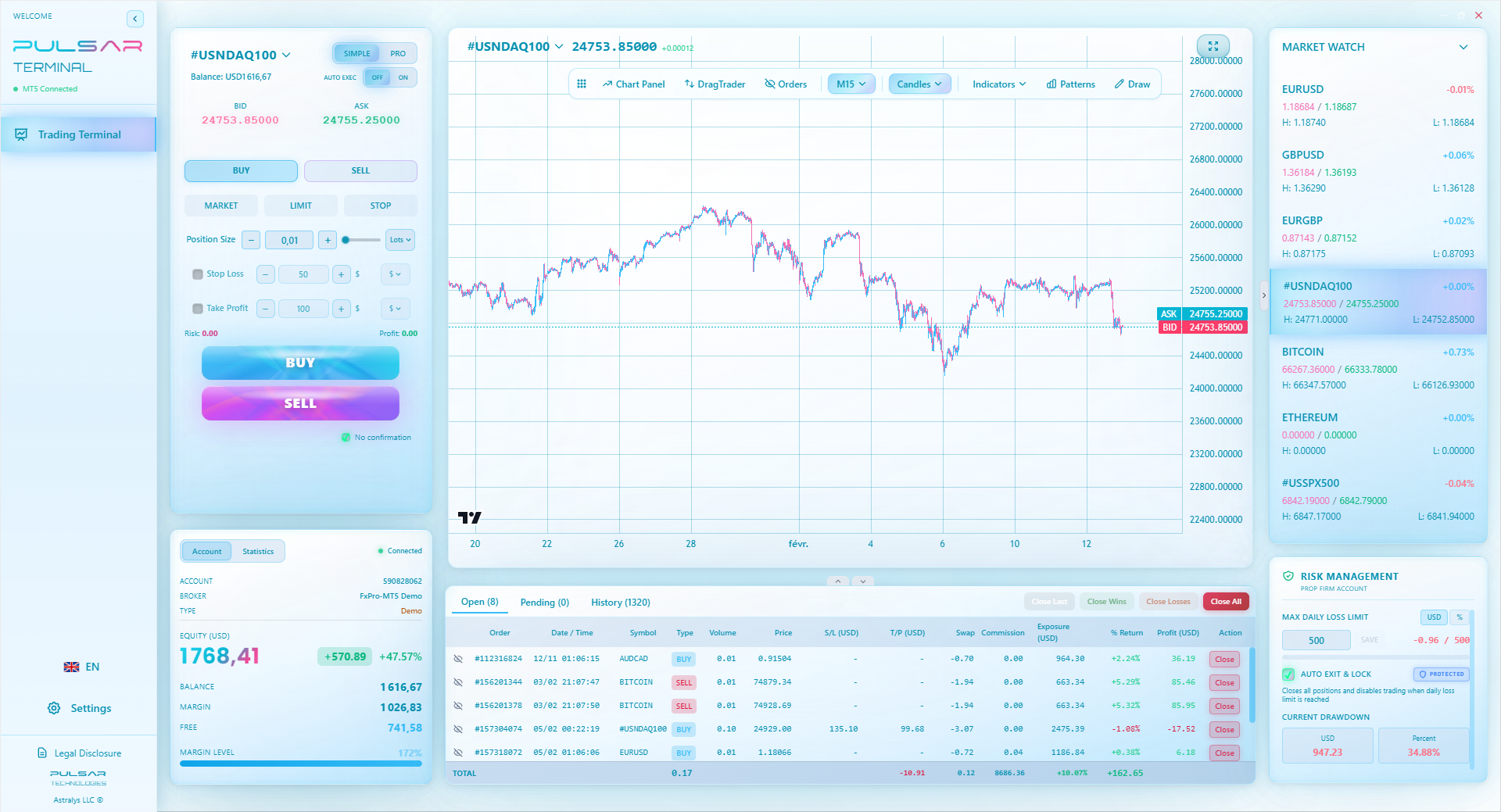
The Execution Problem (And a Solution) A huge pain point on MT5 is managing complex orders. Setting multiple take-profits, moving stops to breakeven, or setting a trailing stop requires multiple clicks and focus - things you don't have during a volatile open.
This is where external tools that plug into MT5 can be a game-saver. Imagine being able to drag a line on your chart to set a stop-loss, or having a single button that moves your stop to breakeven when you're 10 pips in profit. This kind of automation protects you from your own emotions and slow fingers when the market is moving fast.
Managing fast-moving trades during the volatile London open is stressful, but tools like Pulsar Terminal automate complex order management directly on your MT5 platform.
Pulsar Terminal
MT5オールインワンツール:ドラッグ&ドロップ注文、マルチTP/SL、トレーリングストップ、グリッドトレード、出来高プロファイル、プロップファーム保護。毎日1,000人以上のトレーダーが利用。
“The market's first move at the open is often a liar. Patience is a profit center.”
Here's what my typical morning looks like. Discipline here is everything.
7:00 AM WAT: Wake up. Check the economic calendar on my phone. Any high-impact news at 8:00 AM or 8:30 AM WAT? I note it.
7:30 AM: At my desk. I open TradingView and look at the daily and 4-hour charts for my watchlist (EUR/USD, GBP/USD, Gold). Where are the key support/resistance levels? What did the Asian session do? I draw my lines.
7:45 AM: I log into my MT5 platform with my broker (Pepperstone). I check that my internet is stable. I calculate my position size for the day using my position size calculator, based on my account balance and where I'd place my stop loss.
8:00 AM - 8:15 AM: I WATCH. I don't trade. I let the initial frenzy pass. I'm observing which of my key levels are being tested. Is there a surge in volume on my indicator?
8:15 AM Onwards: Now I'm active. I look for my predefined setups - the breakout retest, or a rejection at a daily level. I place my order with a strict stop loss. If I get in, I set my take-profit levels and I walk away for 15 minutes. Staring at it causes panic.
1:00 PM WAT: I check back in. This is the London-New York overlap. If my trade is in profit, I might use a trailing stop to lock in gains. If I haven't traded, this is my second major opportunity window.
This routine removes emotion and guesswork. You're trading a plan, not the chaos.
FAQ
Q1Does the London Forex market open time change in Nigeria?
No, the London market open is consistently 8:00 AM WAT year-round. Nigeria does not observe daylight saving time. London switches to British Summer Time (BST, GMT+1) in spring, which would technically align its 8 AM open with 8 AM WAT, but the trading activity you care about still begins at the same local Nigerian time.
Q2What is the best currency pair to trade during the London session in Nigeria?
EUR/USD and GBP/USD are the best. They have the highest liquidity and tightest spreads during the London session, as European banks are most active. You can find specific strategies for the EUR/USD pair in our dedicated guide.
Q3Can I trade forex legally in Nigeria?
Yes, individual retail forex trading is legal. However, the Central Bank of Nigeria (CBN) restricts how you fund international accounts. You cannot use your Naira debit/credit card via the official window. You must use methods like cryptocurrency (USDT), e-wallets (Skrill, Neteller), or broker-arranged local bank transfers.
Q4Do I pay tax on forex trading profits in Nigeria?
Yes. The Federal Inland Revenue Service (FIRS) requires you to pay a 10% Capital Gains Tax on your gross trading profits. It is your responsibility to keep records and declare this income.
Q5Is the London-New York overlap the best time to trade?
For many strategies, yes. This overlap from 1:00 PM to 5:00 PM WAT typically has the highest volume and volatility of the day. It's an excellent time for trend-following strategies, but also requires careful risk management due to faster moves.
Q6What broker should I use in Nigeria for the London session?
Choose a broker with strong international regulation (like FCA, ASIC), proven fast execution, and deposit/withdrawal methods that work in Nigeria (e.g., crypto, e-wallets). Brokers like IC Markets, Pepperstone, and Exness are popular choices among experienced Nigerian traders for their reliability during active sessions.
Q7Why are spreads high sometimes at the London open?
In the first 5-10 minutes, liquidity providers are gauging the market. This temporary imbalance can cause spreads to widen. It's a protective measure by brokers. The solution is to wait 10-15 minutes after 8:00 AM WAT for spreads to normalize before entering trades.
ウィンストン教授のレッスン
重要ポイント:
- ✓London opens at 8:00 AM WAT, not when you feel like logging in.
- ✓Wait 15 mins after the open for spreads to settle and fake moves to pass.
- ✓The 1 PM - 5 PM WAT overlap is the most volatile trading window.
- ✓You owe 10% Capital Gains Tax on gross profits to FIRS.
- ✓Fund your account via crypto or e-wallets, not Naira cards.
この記事はどれくらい役に立ちましたか?
星をクリックして評価
週刊トレーディングインサイト
無料の週刊分析&戦略。スパムなし。
著者について
Olumide Adeyemi
西アフリカ・トレーディングの先駆者
ナイジェリアで最もアクティブなFXトレーディング教育者の一人。ラゴスから8年のトレード経験。アフリカのトレーダー向けの少額資金戦略とプロップファームチャレンジを専門とする。
コメント
リスク警告
金融商品の取引には大きなリスクが伴い、すべての投資家に適しているわけではありません。過去の実績は将来の結果を保証するものではありません。本コンテンツは教育目的のみであり、投資助言として解釈すべきではありません。取引前に必ずご自身で調査を行ってください。
こちらもおすすめ

Cara Trading Forex Sukses: 7 Prinsip dari Trader Profesional
Cara trading forex sukses dengan 7 prinsip trader pro: manajemen modal, disiplin, journal trading, backtest. Data nyata, bukan janji profit palsu.
Jam Trading Forex Terbaik untuk Trader Indonesia: Panduan Lengkap dengan Tabel Waktu
Panduan jam trading forex untuk trader Indonesia. Tabel 4 sesi dunia, jam emas 20:00-00:00, sesi mana yang harus dihindari. Data akurat + tips dari trader berpengalaman.
Top 5 Sàn Forex Uy Tín Nhất 2026: Review Jujur dari Trader Indonesia
Top 5 sàn forex uy tín 2026 untuk trader Indonesia. Review jujur: spread, deposit, withdraw, dukungan lokal. Exness, XM, IC Markets & lebih.
