


Most traders get the New York open time wrong.

David van der Merwe
新興市場トレーダー ·  South Africa
☕ 9 分で読める
学べること:
Most traders get the New York open time wrong. They think it's a single, precise moment when a bell rings and volatility explodes. That's a dangerous myth. The truth is, the New York session is a process, not an event, and understanding its true rhythm is the difference between catching a trend and getting stopped out by fake moves. I learned this the hard way, losing money on what I thought were 'sure thing' breakouts. In this guide, I'll show you the real timeline, the best pairs to trade from South Africa, and how to use this knowledge to build a concrete edge.
Officially, the New York forex market opens at 8:00 AM Eastern Standard Time (EST). For us in South Africa, that's 3:00 PM SAST during our standard time, and 2:00 PM SAST when the US is on Daylight Saving Time (roughly mid-March to early November).
But here's the critical part traders miss: the market doesn't wait for 8 AM. The real influx of liquidity and institutional orders begins trickling in from around 7:30 AM EST (2:30 PM SAST). This is when London traders are wrapping up and New York desks are coming online, starting their pre-market analysis and positioning.

Warning: Don't place major trades right at 3:00 PM SAST expecting a magic surge. The initial 15-30 minutes can be choppy as orders are absorbed. The cleanest trends often develop between 3:30 PM and 5:00 PM SAST.
I used to set an alarm for 2:55 PM, ready to pounce on the first big candle. More often than not, I'd get whipsawed. The market needs time to find consensus. Now, I watch the initial 30-minute range and look for a break after that consolidation, which has improved my win rate significantly on session-open plays.

💡 ウィンストンのヒント
The market's first move after the New York liquidity arrives is often a fake-out. Patience in the first 30 minutes is not inaction, it's strategic positioning.
“The New York session is a process, not an event. Trading it like the latter will cost you money.”
For South African traders, the New York overlap is our prime trading window. It's when we have the best of both worlds: access from our afternoon until late evening, and the highest market activity of the day.
The Liquidity Overlap
The most important period is the first 2-3 hours, where New York overlaps with the closing hours of London (from 8 AM to 12 PM EST, or 3 PM to 7 PM SAST). This creates the day's peak trading volume. More volume means tighter spreads, cleaner price action, and a lower chance of your stop being hunted by random noise. It's the best time for strategies that rely on momentum, like scalping or breakout trading.
Trading with Your Timezone
Our timezone is a hidden advantage. We can trade this high-volatility session fully alert, without having to wake up at 3 AM like an Asian-based trader would. You can finish your day job, have lunch, and then sit down as the world's biggest financial players are most active. I structure my entire trading day around this window. My morning is for analysis and planning, and my execution is focused between 3 PM and 8 PM SAST.
“For South African traders, the New York overlap is our prime trading window. It's our structural advantage.”
Not all pairs are created equal during the New York session. You want to focus on pairs where the USD is a counterparty, as that's where the volume and directional moves will be.
Top Tier (Highest Liquidity & Movement):
- EUR/USD: Always the king. Expect defined trends and reactions to US data. I've had my most consistent swing trading results here during New York hours.
- USD/JPY: Reacts strongly to US Treasury yields and risk sentiment. Moves can be sharp and sustained.
- GBP/USD: Great for volatility, but be wary of sudden spikes around UK news that may hit late in the London session.
Second Tier (Good Opportunities):
- USD/CAD & AUD/USD: These "commodity dollars" are highly sensitive to oil and metals prices, which are heavily traded from New York. Watch for correlations breaking down.
- XAU/USD (Gold): While not a forex pair, it's a must-watch. Gold is priced in USD and sees massive volume from New York commodity traders. Its moves often telegraph USD strength or weakness. I keep a chart of XAU/USD open at all times as a sentiment gauge.
Pairs to Avoid (Generally):
- Cross pairs like EUR/GBP or AUD/JPY. Spreads widen, and moves can be erratic without the direct USD flow. I learned this after a frustrating trade on EUR/CHF where the spread ate half my projected profit before the price even moved.
“For South African traders, the New York overlap is our prime trading window. It's our structural advantage.”
Knowing what time does the New York forex market open is useless if you don't know what happens after it opens. Scheduled news is the session's heartbeat.
The Big One: US Economic Data (8:30 AM & 10:00 AM EST) This is non-negotiable. At 3:30 PM SAST, major US data drops: Non-Farm Payrolls (first Friday of the month), CPI, Retail Sales, GDP. Volatility is extreme. I don't recommend trading the initial 60-second spike unless you're a seasoned news trader. The smarter play is often to wait for the initial panic to settle and trade the reaction to the reaction over the next hour.
Federal Reserve Speeches & FOMC Meetings Speeches by the Fed Chair or other officials can happen throughout the afternoon (US time). FOMC meetings (every 6-8 weeks) cause market-wide paralysis followed by violent moves. On these days, my only rule is: reduce position size by 50%. The extra volatility isn't worth blowing up your account for a slightly bigger gain.
The "Quiet" Danger Zone After about 12:00 PM EST (7:00 PM SAST), liquidity starts to drain as Europe goes to sleep and New York heads out for lunch. This is when odd, thin-market moves can occur. I make it a rule to close or trail stops on any short-term trades by 7:30 PM SAST. Getting caught in a false move with no volume to get you out is a terrible feeling.
💡 ウィンストンのヒント
Your most important tool during the New York session is not an indicator, it's the economic calendar. Trade around it, not through it.
“Waiting for the first 30-minute range to form is the difference between catching a trend and getting whipped.”
Here’s how I structure my trading week around the New York open. This isn't theoretical, it's my actual routine.
2:00 PM - 2:45 PM SAST (Prep Time)
- Check economic calendar for US data due at 3:30 PM.
- Review overnight price action from Asia and London. Has a key level been established?
- Set price alerts on my watchlist pairs (EUR/USD, USD/JPY).
- Use my position size calculator to pre-determine my risk for the session.
2:45 PM - 3:30 PM SAST (The Pre-Open)
- Markets are active from London, but I'm not entering new trades. I'm watching the 15-minute and 1-hour charts for the initial range setting up.
- I'm looking for consolidation. A tight range before the US data or open is a good sign.
3:30 PM - 5:00 PM SAST (Prime Execution Window)
- If there's news, I wait 5-10 minutes for the initial chaos to pass.
- I look for breaks of the pre-3:30 PM range with increasing volume. This is where I place most of my day's trades.
- My stop-losses are wider here to account for volatility, but my position size is adjusted down to keep my rand risk the same.
5:00 PM - 8:00 PM SAST (Management & Late Plays)
- I'm managing open trades, moving stops to breakeven, taking partial profits.
- I might look for one last setup if a clear trend is still in force, but I'm very selective. After 7 PM, I'm basically done.
One personal rule: I never hold a new, short-term trade past 10:00 PM SAST. That's when the New York session is dead and the Asian session hasn't found its footing. It's the wilderness.
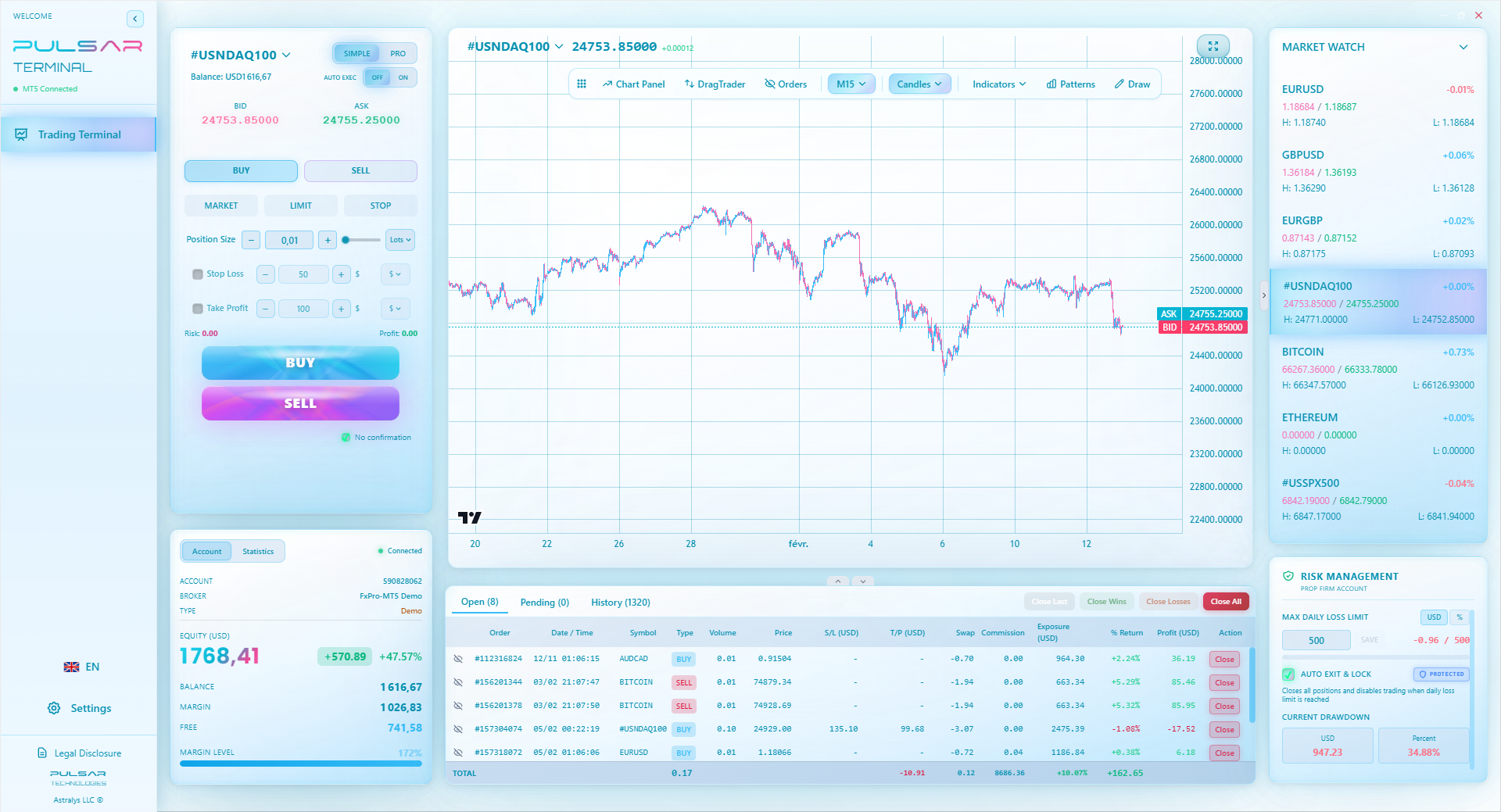
Managing multiple trades and moving stops to breakeven during the fast-paced New York session is much easier with a tool that lets you drag and drop orders directly on your MT5 chart.
Pulsar Terminal
MT5オールインワンツール:ドラッグ&ドロップ注文、マルチTP/SL、トレーリングストップ、グリッドトレード、出来高プロファイル、プロップファーム保護。毎日1,000人以上のトレーダーが利用。
“Waiting for the first 30-minute range to form is the difference between catching a trend and getting whipped.”
I've made most of these. Learn from my losses.
Mistake 1: Chasing the Open Spike. You see a huge green candle on EUR/USD at 3:02 PM and FOMO in. Often, that's a liquidity grab that reverses. Fix: Wait for a pullback and retest of a broken level, or wait for the first 30-minute candle to close.
Mistake 2: Ignoring the London Close. Around 5:00 PM SAST (London 3 PM close), there's often a flurry of last-minute position squaring. This can cause temporary, sharp reversals. Fix: If you're in a profitable trade, consider taking partial profit just before this window, or use a trailing stop.
Mistake 3: Trading with a Local Broker During High Vol. Some local brokers have terrible slippage and widened spreads during news events. I once entered a trade on Exness during NFP and got slipped 3 pips against me before it even filled. Fix: Use a reputable international broker known for tight spreads and fast execution during volatile times, like IC Markets or Pepperstone. The difference in fill quality is real money.
Mistake 4: Forgetting About Your Own Fatigue. Trading from 3 PM to 10 PM is a long shift. Your focus wanes. Fix: Schedule a break. Get up, walk around at 6 PM. Don't make your most important trade decision when you're mentally tired. I've broken this rule and over-traded late at night, giving back all my afternoon profits.
💡 ウィンストンのヒント
Fatigue is a silent portfolio killer. If you wouldn't make a crucial decision at work after a 5-hour shift, don't make a trade after 8 PM SAST.
“The smartest play after major news is often to trade the reaction to the reaction.”
You don't need a dozen fancy indicators. For the New York session's momentum-driven moves, simplicity wins.
Volume is King: Since high volume defines the session, I have volume bars on my chart at all times. I want to see volume expanding in the direction of the break. A breakout on low volume is suspect.
The 1-Hour and 15-Minute Chart Combo: This is my sweet spot. The 1-hour chart shows me the broader trend established from London. The 15-minute chart gives me my precise entry during the New York momentum. I almost never look at the 5-minute chart after 3 PM SAST, it's too noisy.
Key Indicators:
- Moving Averages: A simple 20-period and 50-period EMA on the 1-hour chart. During the session, price respecting the 20 EMA is a strong trend signal.
- RSI: I use it not for overbought/oversold signals, but for divergence. If price makes a new high but RSI doesn't (bearish divergence) during the New York push, it's a strong warning the move is exhausted.
- MACD: Great on the 1-hour chart for confirming trend direction and momentum. A MACD crossover coinciding with the New York session start can be a powerful signal.

Pro Tip: Clear your charts before the session. Too many lines and indicators cause paralysis. Have a clean chart with your key support/resistance levels drawn from the London session, and maybe one or two indicators. More isn't better.
FAQ
Q1What time does the New York forex market open in South Africa?
It opens at 3:00 PM South Africa Standard Time (SAST) when the US is on Standard Time (roughly November to March). When the US is on Daylight Saving Time (March to November), it opens at 2:00 PM SAST. Always confirm the US timezone status.
Q2Is the New York session the best time to trade forex from South Africa?
For most retail traders, yes. It offers the highest liquidity and volatility during our convenient afternoon/evening hours. The overlap with the end of the London session (3 PM - 5 PM SAST) is typically the most active and predictable period of the entire trading day.
Q3What is the most volatile hour after the New York open?
The first hour after major US economic data releases (3:30 PM SAST) is the most volatile. In the absence of data, volatility usually peaks in the second hour of the session (4:00 PM - 5:00 PM SAST) as the market finds its direction.
Q4Can I trade the Asian session from South Africa instead?
You can, but it's less ideal. The Asian session (our early morning, 2 AM - 8 AM SAST) has lower volatility and is often range-bound. It's better for specific strategies like range trading on USD/JPY, but the moves are generally smaller than during the New York/London overlap.
Q5Why do spreads widen sometimes at the New York open?
Spreads can widen momentarily due to the sudden influx of orders and initial volatility, especially on less liquid pairs or if a major news event coincides with the open. This is why brokers like XM or IC Markets, which offer raw spreads, are advantageous for session traders.
Q6Should I trade right at the opening bell (3 PM SAST)?
Generally, no. The first 15-30 minutes can be chaotic. It's often wiser to observe the initial range and trade the breakout or breakdown that occurs after that initial period of consolidation, around 3:30 PM - 4:00 PM SAST.
Q7What happens if I get a margin call during the New York session?
A margin call is most likely during high volatility if you're over-leveraged. Due to the fast moves, your position can be liquidated quickly. Always use sensible use (like 1:10 or 1:20) during this session and ensure your account equity is well above the required margin.
ウィンストン教授のレッスン
重要ポイント:
- ✓Real liquidity starts 30 mins before the official 8 AM EST open.
- ✓Focus on USD pairs (EUR/USD, USD/JPY) for cleanest moves.
- ✓US economic data at 3:30 PM SAST dictates session volatility.
- ✓Avoid new trades after 7:30 PM SAST due to thinning liquidity.
- ✓Use the 1-hour chart for trend, 15-minute for New York session entries.
この記事はどれくらい役に立ちましたか?
星をクリックして評価
週刊トレーディングインサイト
無料の週刊分析&戦略。スパムなし。
著者について
David van der Merwe
新興市場トレーダー
ヨハネスブルグ拠点で新興市場通貨11年のトレーダー。ZARペア、FSCA規制下の取引、南アフリカ市場分析を専門とする。
コメント
リスク警告
金融商品の取引には大きなリスクが伴い、すべての投資家に適しているわけではありません。過去の実績は将来の結果を保証するものではありません。本コンテンツは教育目的のみであり、投資助言として解釈すべきではありません。取引前に必ずご自身で調査を行ってください。
こちらもおすすめ

Cara Trading Forex Sukses: 7 Prinsip dari Trader Profesional
Cara trading forex sukses dengan 7 prinsip trader pro: manajemen modal, disiplin, journal trading, backtest. Data nyata, bukan janji profit palsu.
Jam Trading Forex Terbaik untuk Trader Indonesia: Panduan Lengkap dengan Tabel Waktu
Panduan jam trading forex untuk trader Indonesia. Tabel 4 sesi dunia, jam emas 20:00-00:00, sesi mana yang harus dihindari. Data akurat + tips dari trader berpengalaman.
Top 5 Sàn Forex Uy Tín Nhất 2026: Review Jujur dari Trader Indonesia
Top 5 sàn forex uy tín 2026 untuk trader Indonesia. Review jujur: spread, deposit, withdraw, dukungan lokal. Exness, XM, IC Markets & lebih.
