


Over 190,000 South Africans are estimated to be trading forex, chasing a slice of a market worth billions of dollars daily.

David van der Merwe
新興市場トレーダー ·  South Africa
☕ 9 分で読める
学べること:
- 1The South African Forex Reality Check
- 2What Actually Makes a Good Forex Education?
- 3The Real Costs of Trading in South Africa
- 4Choosing a Broker: Why FSCA Regulation is Non-Negotiable
- 5Moving Beyond the Academy: Developing Your Own Edge
- 6Red Flags to Avoid (In Academies and Brokers)
- 7Putting It All Together: Your Action Plan
Over 190,000 South Africans are estimated to be trading forex, chasing a slice of a market worth billions of dollars daily. Yet, the vast majority lose money, often before they even understand what a pip is. If you've heard the name 'Yahweh Forex Academy' floating around, you're likely looking for a path into this world. Let's cut through the noise. This isn't a review of that specific academy - honestly, solid public info on them is scarce. Instead, this is a straight-talking guide to the South African forex landscape, so you can judge any education, including theirs, with a trader's eyes wide open.
Trading from South Africa comes with unique advantages and some serious pitfalls you need to know upfront. Our market is regulated, but that doesn't make it a safe playground.
The Financial Sector Conduct Authority (FSCA) is the main watchdog. Since 2021, they've capped use for retail traders at 30:1. That's a good thing. It stops you from blowing up your account in seconds with crazy 500:1 use some offshore brokers dangle. Any legit broker operating here needs an FSP license. You can and should check this on the FSCA's website. If a 'broker' or 'academy' can't provide that number, walk away.
The ZAR is our home game. Pairs like USD/ZAR are incredibly liquid but notoriously volatile. I remember a trade in 2022 where USD/ZAR moved 500 pips in a single session on a political rumor. I was short, caught on the wrong side, and took a R 4,200 loss because my stop-loss was too tight. Volatility is a double-edged sword.

Warning: The FSCA regularly fines and debars individuals for offering unlicensed financial services, like trading signals. In 2024, someone was fined over R1 million and debarred for 10 years for this. If an 'academy' promises guaranteed signals or managed accounts, verify their license status immediately. It's your money on the line.
When you're evaluating any course, including something called Yahweh Forex Academy, you need a checklist. The flashy cars and screens full of green profits are marketing. The real value is in the boring details.
The Foundation is Everything
A proper education must start with absolute basics: what is a bid/ask price, how the spread works as a cost, how to calculate position size (never skip this), and what a margin call actually feels like (it's panic). If the first module is about a 'secret indicator,' be skeptical.
Strategy Over Hype
Look for education that teaches you how to think, not what to think. A good course will explain multiple time frame analysis, basic price action, and perhaps one or two core indicators like the RSI or MACD. It should spend as much time on losing trades as winning ones. My first profitable system came from a course that made me journal 100 simulated trades first, focusing entirely on risk management.
The Community Test
See if there's a real, active community. Not just a Telegram pump group, but a place where students post charts, discuss mistakes, and the educators engage. Ask: Can you see historical interactions? Is the conversation about learning, or just celebrating wins?

Pro Tip: Any educator worth their salt will openly discuss drawdown. Ask them, 'What was the maximum drawdown of your primary strategy last year?' If they can't or won't answer with a real number, they're probably not trading it with real money.

💡 ウィンストンのヒント
The market's job is to make you feel the most pain. If you're feeling clever and euphoric, that's often the peak. If you're feeling frustrated and ready to quit, that's often the bottom. Trade your plan, not your feelings.
“Your first-year goal should be to preserve capital while learning. Profits are a possible byproduct of skill, not a desperate hope.”
Let's talk numbers, because this is where many new traders get a nasty surprise. Your profit has to overcome these costs first.
Broker Costs: You'll mainly pay via spreads or commissions. Some brokers like XM offer commission-free accounts with spreads from 0.8 pips on EUR/USD. Others, like IC Markets, offer raw spreads near 0.0 pips but charge a commission per lot. For a standard lot (100,000 units), that commission might be $3.50 per side. You need to do the math for your trading style.
| Cost Type | Example Range | Impact on a 1-lot EUR/USD Trade |
|---|---|---|
| Spread (Standard Acc) | 0.8 - 1.5 pips | $8 - $15 cost to open the trade |
| Spread (ECN/Raw Acc) | 0.0 - 0.2 pips | $0 - $2, plus commission |
| Commission (ECN) | $3 - $7 per lot, per side | $6 - $14 round turn |
Education Costs: Courses can range from a few hundred Rand to tens of thousands. I once paid R 8,500 for a 'mentorship' that was just recycled YouTube videos. A painful lesson. Set a budget for education just like you would for trading capital.
Taxation: This isn't a cost to avoid, it's a reality. Profits from forex trading are taxable in South Africa as income. Keep careful records of every trade from day one. The tax man doesn't care about your losing streak.
Your broker is your lifeline. Going with an unregulated offshore entity to get 500:1 use is like choosing a parachute because it's cheaper. The FSCA's 30:1 use limit protects you. It also ensures client funds are segregated, so if the broker goes under, your money isn't part of their bankruptcy estate.
Several reputable brokers operate under FSCA regulation. Pepperstone, for instance, is a global name with a strong local presence. Exness also serves the South African market under regulatory guidelines. The key is to look for that FSP number on their website.
Most South African traders use MetaTrader 4 or 5. It's the industry standard for a reason. Before committing to any broker, download their MT4/5 demo and test it. Check the execution speed on news events (the demo will be slower, but you can test functionality). See if they offer ZAR-denominated accounts to save on conversion fees. A minimum deposit of R 2,800 (about $150) is common, but some like XM let you start with as little as $5, which is great for practicing with real money without real risk.

Example: Let's say you deposit R 5,000. With 30:1 use, your total buying power is R 150,000. That sounds like a lot, but trade just one standard lot of USD/ZAR (which is $100,000), and a 150 pip move against you - which happens - would wipe out your entire deposit. This is why a position size calculator isn't optional software, it's your survival tool.
“If an 'academy' promises guaranteed signals or managed accounts, verify their license status immediately. It's your money on the line.”
Education gives you the map, but you have to walk the path. The goal of any course should be to make you independent. Here’s how you build on that foundation.
First, define your trading personality. Are you patient, able to hold a trade for weeks? Then study swing trading strategies. Are you restless and decisive? Maybe scalping suits you better, but know the costs will eat you alive if you're not precise. I wasted six months trying to scalp because I saw others do it, only to realize my psychology was better suited to 4-hour chart swings.
Second, backtest and forward-test. Don't trust a strategy from a course blindly. Use MT4's strategy tester, then trade it on a demo account for at least two months. Then, trade it with a tiny live account. I forward-tested a gold strategy for 3 months on demo, made a hypothetical 12% return. I went live with $500, and in the first month, real slippage and emotions turned that into a 5% loss. The strategy was fine; my execution was the problem.
Finally, specialize. The South African market has a deep liquidity pool in USD/ZAR and XAU/USD (gold). These pairs have unique drivers. Instead of jumping between 28 pairs, become an expert in one or two. Learn how load-shedding announcements, platinum prices, or SARB decisions move the Rand.
💡 ウィンストンのヒント
A trading journal isn't a diary. It's a lab notebook. Your goal is to find one repeatable, statistical edge. If you can't write down the exact rule for your next trade before the market opens, you don't have a strategy, you have a hope.
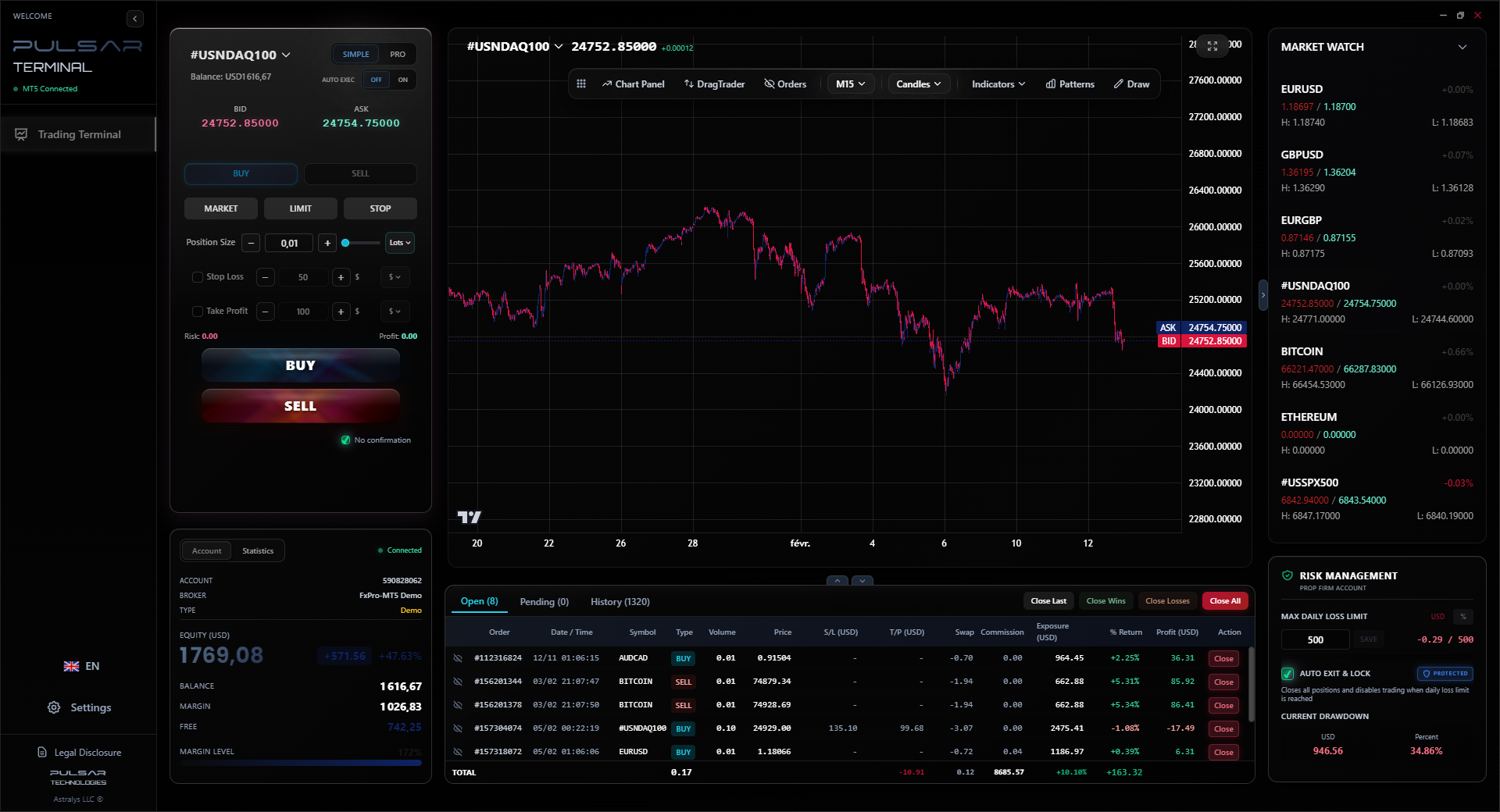
When you're developing and testing your own edge, having the right tools to manage risk and execute your plan precisely is non-negotiable.
Pulsar Terminal
MT5オールインワンツール:ドラッグ&ドロップ注文、マルチTP/SL、トレーリングストップ、グリッドトレード、出来高プロファイル、プロップファーム保護。毎日1,000人以上のトレーダーが利用。
The forex space, sadly, is full of charlatans. Protecting yourself starts with recognizing the warning signs.
Guaranteed Returns: This is the biggest one. No one can guarantee profits in a zero-sum game like forex. If they say they can, they're lying.
Pressure to Deposit More: A legitimate educator focuses on your learning, not your deposit size with their 'partner broker.' If the main push is to fund an account, especially a large one, your alarm bells should be deafening.
Overly Complex 'Secrets': Systems that rely on 15 indicators with custom colors and mystical names are usually designed to confuse you into thinking they're valuable. Price action is often beautifully simple.
No Discussion of Risk: If every screenshot is a winner, they're cherry-picking. Real trading involves loss. A credible mentor will show you a losing trade and explain why they took it and how they managed the risk.
My own worst experience was with a signal service that promised '95% accuracy.' I followed three signals. Two hit stop-losses, and the third barely scraped a breakeven. I was down 4% of my account in 48 hours. They then told me I needed to upgrade to the 'VIP' service for the 'really good' signals. Lesson learned the hard way.
“Risk management isn't optional software, it's your survival tool. A good entry makes a trade profitable; good risk management keeps you in the game.”
So, where do you start? Let's build a practical, step-by-step plan that ignores the hype.
- Regulation First: Decide you will only use an FSCA-regulated broker. Full stop. Research a few like IC Markets or XM and open a demo account.
- Education on a Budget: Before spending thousands on an academy, consume the vast amount of free, quality information. Learn the glossary terms, understand margin, and paper trade on your demo.
- Evaluate Paid Education: If you consider a paid course like Yahweh Forex Academy, apply the checklist from earlier. Demand transparency on strategy performance (drawdown, win rate) and verify any claimed licenses.
- Trade Tiny: When you go live, start with the smallest possible amount. For many brokers, that's $10-$50. Your goal for the first six months is not to make money, but to not lose money while executing your plan.
- Journal Relentlessly: Write down every trade. The entry reason, the exit reason, your emotional state. This log is more valuable than any indicator. It turns your mistakes into data.
The South African forex market is a real opportunity, but it's a marathon, not a sprint. The right education should feel like putting on a weighted vest for training - it makes you stronger and more disciplined, not just excited. Do the boring work first, and the profits become a possible byproduct of your skill, not a desperate hope.
FAQ
Q1Is Yahweh Forex Academy regulated by the FSCA?
Based on available public information, there is no clear evidence that Yahweh Forex Academy holds an FSCA license as a financial services provider (FSP). Academies providing general education typically don't need one, but if they cross into giving specific trading advice, signals, or managing accounts, they absolutely do. Always verify any FSP number provided directly on the FSCA's official website.
Q2What is a realistic monthly return for a beginner forex trader in South Africa?
Realistic? Aim for 0% initially. Your first-year goal should be to preserve capital while learning. After a year of consistent, disciplined practice, a skilled retail trader might target 2-5% per month, but that's with significant risk management. Anyone promising consistent returns above 10% per month is selling a fantasy, not education.
Q3Can I trade forex in South Africa with just R 500?
Technically, yes. Some brokers allow deposits this small. But practically, it's very difficult. With R 500 and 30:1 use, your buying power is R 15,000. The minimum trade size (a micro lot) is usually 1,000 units. Even a small 50-pip loss could wipe out a large percentage of your capital. It's better to save up to at least R 2,000-R 5,000 to allow for proper position sizing and withstand normal market volatility.
Q4What's the most important skill for a forex trader?
Risk management, full stop. It's not finding the perfect entry. It's knowing exactly how much you can lose on a trade (usually 1-2% of your account) and having the discipline to stick to that exit no matter what. A good entry makes a trade profitable; good risk management keeps you in the game.
Q5Do I have to pay tax on my forex trading profits?
Yes. In South Africa, profits from forex trading are considered taxable income by SARS. You are responsible for declaring this income and paying the applicable tax. Keep a detailed record of all your trades, including dates, amounts, profits, and losses, from the very beginning.
Q6Is MetaTrader 4 or MetaTrader 5 better for beginners?
For pure forex trading, MT4 is simpler and has more than enough features for a beginner. It's also more widely supported. MT5 is more powerful and can handle stocks and futures, but its interface is slightly more complex. Start with MT4. You can always switch to MT5 later if you need its advanced features.
ウィンストン教授のレッスン
重要ポイント:
- ✓Verify FSCA license for any broker or advisory service.
- ✓Start with a demo account for at least 2-3 months.
- ✓Never risk more than 1-2% of your capital on a single trade.
- ✓Specialize in 1-2 currency pairs, like USD/ZAR or EUR/USD.
この記事はどれくらい役に立ちましたか?
星をクリックして評価
週刊トレーディングインサイト
無料の週刊分析&戦略。スパムなし。
著者について
David van der Merwe
新興市場トレーダー
ヨハネスブルグ拠点で新興市場通貨11年のトレーダー。ZARペア、FSCA規制下の取引、南アフリカ市場分析を専門とする。
コメント
リスク警告
金融商品の取引には大きなリスクが伴い、すべての投資家に適しているわけではありません。過去の実績は将来の結果を保証するものではありません。本コンテンツは教育目的のみであり、投資助言として解釈すべきではありません。取引前に必ずご自身で調査を行ってください。
こちらもおすすめ

Cara Trading Forex Sukses: 7 Prinsip dari Trader Profesional
Cara trading forex sukses dengan 7 prinsip trader pro: manajemen modal, disiplin, journal trading, backtest. Data nyata, bukan janji profit palsu.
Jam Trading Forex Terbaik untuk Trader Indonesia: Panduan Lengkap dengan Tabel Waktu
Panduan jam trading forex untuk trader Indonesia. Tabel 4 sesi dunia, jam emas 20:00-00:00, sesi mana yang harus dihindari. Data akurat + tips dari trader berpengalaman.
Top 5 Sàn Forex Uy Tín Nhất 2026: Review Jujur dari Trader Indonesia
Top 5 sàn forex uy tín 2026 untuk trader Indonesia. Review jujur: spread, deposit, withdraw, dukungan lokal. Exness, XM, IC Markets & lebih.
