


It was March 2020, and the ZAR was in freefall.

David van der Merwe
신흥시장 트레이더 ·  South Africa
☕ 9 분 소요
배울 내용:
- 1Regulation Isn't a Suggestion, It's Your First Line of Defence
- 2The Real Costs of Trading: It's More Than the Spread
- 3Deposits, Withdrawals, and The Tools You Actually Need
- 4The use & Margin Trap: Why 30:1 is a Gift
- 5Your Broker Comparison Checklist (The Non-Negotiables)
- 6Final Verdict: Local vs. International Brokers
It was March 2020, and the ZAR was in freefall. My screen showed USD/ZAR at 19.35, a level I'd been waiting for. I clicked buy. Nothing happened. The platform froze, then came back with my order filled 150 pips higher. That 'technical glitch' from an offshore bucket shop broker cost me R12,000 in one click. That's the moment I learned your broker isn't just a platform, it's your business partner. And in South Africa, picking the wrong one isn't just expensive, it can wipe you out. Here's how to get it right.
Let's be blunt: if your broker isn't regulated by the Financial Sector Conduct Authority (FSCA), you're basically handing your money to a stranger in a dark alley. The FSCA isn't perfect, but it's the sheriff in town. Since 2021, they've capped use for retail traders at 30:1. That's not to spoil your fun, it's to stop you from turning a R10,000 account into a R300,000 debt overnight.
A real FSCA license means the broker must segregate client funds. Your money sits in a separate bank account, not mixed with their operational cash. If they go bust (it happens), your capital is theoretically protected from their creditors. An unregulated broker? Your money is just part of their working capital. Poof.

Warning: The FSCA issued over one hundred public warnings in the first half of 2025 alone. They're targeting 'signal' sellers on WhatsApp and Instagram, and cloned websites of legit brokers. If a 'guru' is pushing a broker you've never heard of, run.
I made the offshore broker mistake early on. The spreads were tiny, the use was 500:1, and the account manager called me 'brah'. It felt great until I tried to withdraw R5,000 in profits. Suddenly, I needed to verify my address with a utility bill... from three years ago. It took six weeks of emails to get my own money back. Never again.
The ODP (Over-the-Counter Derivatives Provider) license is the new gold standard. It signals the broker is moving from the informal to the institutional tier. When you're checking a broker's status, don't just look for an FSP number. Look for their specific authorization to act as an ODP. This is the detail that separates the serious players from the rest.

💡 윈스턴의 팁
A broker's customer service is best tested at 3 AM. If they answer, they're serious. If not, you're on your own when it matters most.
“Your broker isn't just a platform, it's your business partner. And in South Africa, picking the wrong one isn't just expensive, it can wipe you out.”
Brokers love to advertise 'spreads from 0.0 pips!'. It's a marketing hook. The real cost of trading is a combination of spreads, commissions, and hidden fees that eat into your profits like a silent tax.
The Spread & Commission Combo
For major pairs like EUR/USD, you'll typically choose between a 'standard' account with a wider, all-in spread, or a 'raw' account with a tiny spread plus a commission. Let's do the math with real 2024 numbers:
| Account Type | Avg. EUR/USD Spread | Commission (per lot, round-turn) | Total Effective Cost |
|---|---|---|---|
| Standard | 1.2 pips | R0 | 1.2 pips (R12 per mini lot) |
| Raw/ECN | 0.1 pips | $6 (≈R110) | 0.1 pips + R110 |
See the trap? If you're a high-volume scalper doing 20 trades a day, the raw account is cheaper. If you're a swing trader holding for days, the standard account's wider spread hurts less than that fixed commission. You need to match the account type to your strategy. Our position size calculator can help you model these costs before you trade.
The Silent Killers: Overnight Fees & Conversion
Holding a position past 10 PM SAST? You'll pay or receive a swap fee. Going long EUR/ZAR (buying EUR, selling ZAR) usually means you pay a fee, as South African interest rates are higher. This isn't a broker charge, it's the cost of the interest rate differential. But brokers can mark it up.
The biggest hidden cost for South Africans is currency conversion. If you fund a USD account with rand via your bank, you'll get killed on the exchange rate, often paying 2-3% above the interbank rate. That's R300 gone on a R10,000 deposit before you even place a trade.

Pro Tip: Use a broker that offers a ZAR-denominated account, like Khwezi Trade or others. Fund it via EFT in rand. This avoids conversion fees entirely. For international brokers, use Wise (formerly TransferWise) to convert your rand to USD/EUR at the real mid-market rate before sending it.
“The FSCA's 30:1 use cap didn't limit your potential profits. It limited your potential debt.”
Your broker's funding policy tells you everything about their customer service. A local EFT should clear in 24 hours, maybe 48. If it takes a week, that's a red flag. Popular methods here are EFT, Visa/Mastercard, and increasingly, e-wallets like Ozow or PayPal.
I once waited 14 business days for a withdrawal from an 'international' broker. Their excuse was 'international processing times'. Meanwhile, my local FSCA broker processes EFTs by 3 PM for next-day clearance. The difference is night and day.
The Platform War: MT4, MT5, and Beyond
MetaTrader 4 is the king in South Africa. It's familiar, stable, and supports countless Expert Advisors (EAs) for automated trading. MT5 is the newer version with more timeframes and built-in economic calendars. The truth? For most retail forex traders, MT4 is perfectly fine. The fancier tools in MT5 are often geared towards stocks and futures.
The real question isn't MT4 vs. MT5. It's what you do with it. Most traders drown their charts in 15 indicators. I did. My early charts looked like a rainbow vomited on my screen. I used RSI, MACD, Bollinger Bands, and three moving averages, all giving conflicting signals. I lost consistently with perfect hindsight.
Now? I might use one or two tools, like the RSI indicator for divergence or a simple volume profile. The platform is just the vehicle. Your strategy and discipline are the driver. Don't get sucked into believing a new platform will make you profitable. It won't.
Some brokers, like IC Markets or Pepperstone, offer cTrader or TradingView integration, which are excellent for pure charting. But if you rely on specific EAs, check they're compatible first.
💡 윈스턴의 팁
The 'minimum deposit' is a marketing tool. The real minimum is the amount you can lose 10 times in a row without changing your lifestyle. Start there.
“If you can't get a clear answer from support about spreads, imagine trying to resolve a withdrawal issue.”
I get it. use feels like free money. Turn R1,000 into R30,000 of buying power? What could go wrong? Everything. The FSCA's 30:1 cap for retail clients saved countless traders from themselves. I've seen offshore brokers offer 2000:1. At that level, a 0.05% move against you triggers a margin call. It's not trading, it's gambling with a guaranteed loss.
Let's break down a 30:1 trade on USD/ZAR:
- Account Balance: R10,000
- use: 30:1
- Usable Margin: R10,000 * 30 = R300,000 notional exposure
- For 1 standard lot of USD/ZAR (100,000 units), at a rate of 18.50, the margin required is roughly R3,333.
So with R10,000, you could theoretically open three lots. But should you? Absolutely not. That's using 100% of your margin. One bad move and you're done.
Here's what blew up my first account: I used 50:1 use on GBP/JPY, a volatile pair. I put on a position that used 80% of my margin. The trade went 20 pips my way, then reversed 50 pips against me in 15 minutes. The margin call email arrived before I could even react. I lost 65% of my account in one trade. The use didn't magnify my genius, it magnified my poor risk management.

Example: A sensible risk for that R10,000 account is 1% per trade, or R100. With a 50-pip stop loss on USD/ZAR (where each pip is ≈R5.40 on a mini lot), your position size should be about 0.18 lots. That uses a tiny fraction of your available use. use is for reducing margin tie-up, not for maxing out your buying power.
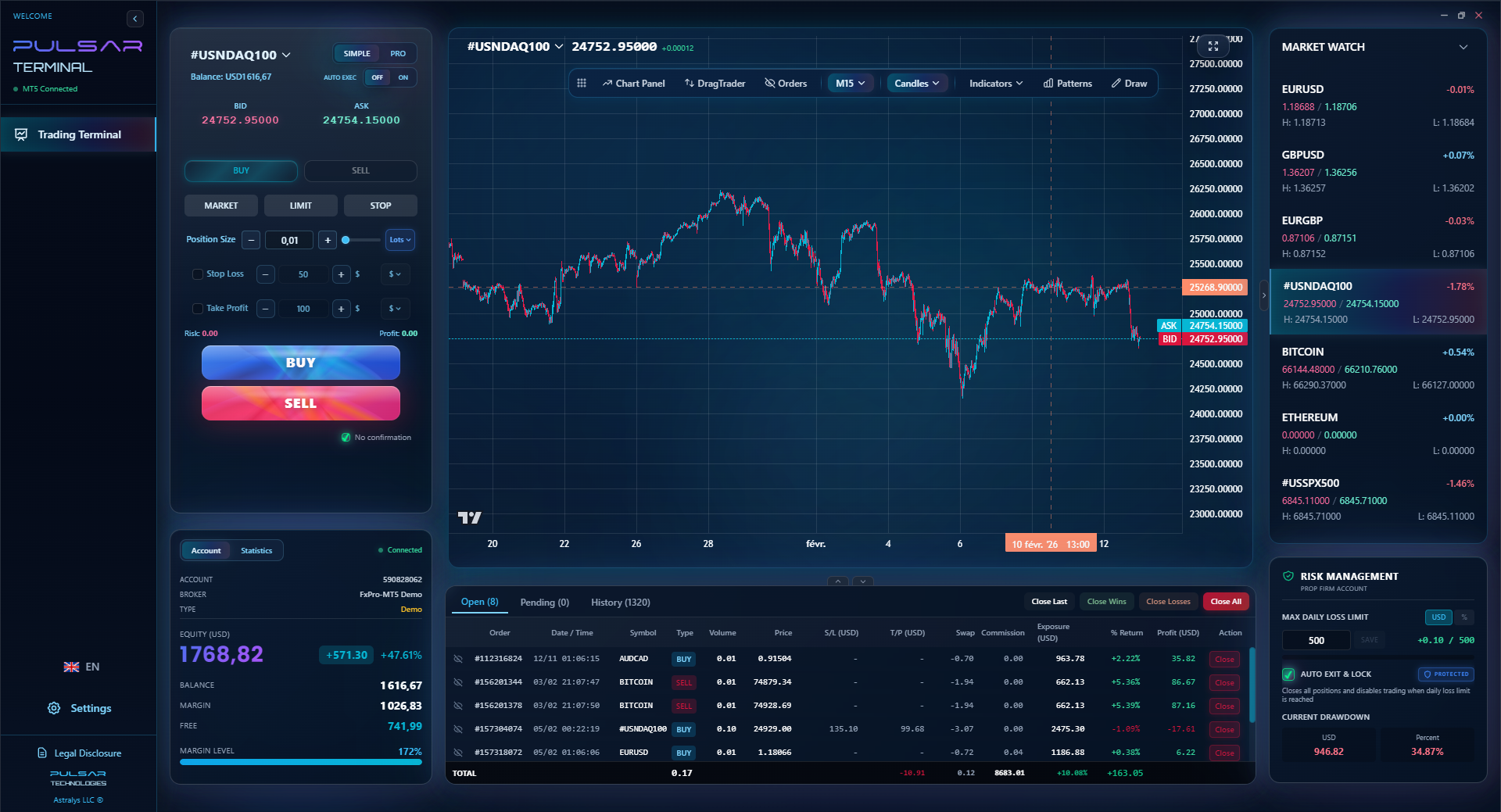
Managing risk with precise stop-loss and take-profit levels is critical, and Pulsar Terminal lets you set multi-level TP/SL and trailing stops directly on your MT5 charts with a simple drag-and-drop.
Pulsar Terminal
MT5 올인원 도구: 드래그앤드롭 주문, 다중 TP/SL, 트레일링 스톱, 그리드 트레이딩, 볼륨 프로파일, 프롭펌 보호. 매일 1,000명 이상의 트레이더가 사용.
“If you can't get a clear answer from support about spreads, imagine trying to resolve a withdrawal issue.”
Don't get distracted by flashy ads. Use this checklist before you deposit a single cent.
- Regulation: Primary FSCA ODP license. Verify the FSP number on the FSCA's website.
- Account Currency: Does it offer a ZAR account? If not, what are the conversion fees?
- Minimum Deposit: Is it realistic for you? R500 is common locally. $100 (≈R1,850) is common internationally.
- Cost Structure: For your style (e.g., scalping strategy vs. swing trading), which is cheaper: raw+commission or standard?
- Ask for the typical spread on the ZAR pairs you'll trade (USD/ZAR, EUR/ZAR). These are often wider than EUR/USD.
- Platform & Tools: MT4/MT5 provided? Stable? Does it allow EAs? What are the server locations? (You want a local server for faster execution).
- Funding/Withdrawal: Methods? Local EFT? Fees? Processing time in business days?
- Customer Service: Call them. Ask a technical question about spread definition or margin. If you can't get a clear answer from support, imagine trying to resolve a withdrawal issue.
A note on 'demo accounts': They're great for testing the platform, but they lie about execution. Slippage and requotes are often minimized in the demo environment. The real test is a small live account.
I opened a $100 account with XM years ago just to test execution on news events. The spread on EUR/USD widened to 15 pips during the NFP report, and my limit order didn't get filled. That $100 test taught me more about their execution than a year on a demo. Consider doing the same.
💡 윈스턴의 팁
Withdrawal speed is the purest measure of a broker's integrity. If they're slow to give you your money, they're not your partner.
“use doesn't magnify your genius. It magnifies your poor risk management.”
This is the big question for South African traders. There's no perfect answer, only trade-offs.
Local FSCA Brokers (e.g., Khwezi Trade, IFX Brokers)
- Pros: ZAR accounts, instant EFTs, local support, understand SA tax context.
- Cons: Often smaller selection of instruments, platforms might be less advanced, spreads on exotic pairs can be higher.
International FSCA Brokers (e.g., Exness SA, Tickmill, FP Markets)
- Pros: Usually tighter spreads on majors, vast range of instruments (CFDs on global indices, crypto), advanced platform features.
- Cons: Funding/withdrawals can be slower and involve forex conversion, support might not be SA-timezone focused.
My setup? I use an international broker for most of my trading in majors like EUR/USD and XAU/USD because the raw spreads are unbeatable. But I keep a small account with a local broker for quick access to rand liquidity and trading ZAR crosses.
The bottom line: Your broker is a critical piece of infrastructure. You wouldn't build a house on sand. Don't build a trading career on a shady, unregulated, or poorly suited platform. Do the homework, check the numbers twice, and start small. The right partner won't make you profitable, but the wrong one will definitely make you poor.
FAQ
Q1Is forex trading legal and taxable in South Africa?
Yes, it's completely legal when done through an FSCA-licensed provider. And yes, it's taxable. Your profits are considered income and are subject to income tax. You must declare them to SARS. Keep detailed records of all your trades, statements, and deposits/withdrawals. The Single Discretionary Allowance (R1 million per year) and Foreign Investment Allowance (R10 million per year with a SARS TCS pin) are for moving money offshore, not for avoiding tax on profits.
Q2What's the minimum deposit I need to start?
It varies wildly. Local brokers like Khwezi Trade offer accounts from R500. Many international brokers targeting South Africans have minimums around $100 (roughly R1,850). Some, like JustMarkets, advertise accounts from $1. My advice? Start with the minimum you can to test the platform and execution. Never deposit 'trading capital' you can't afford to lose just to meet a high minimum.
Q3Can I use international brokers like IG or Pepperstone?
You can, but you must ensure they are licensed to operate here. Many global brands have a dedicated South African entity regulated by the FSCA (e.g., IG South Africa, Pepperstone ZA). Always access their website via their official South African domain (.co.za) and confirm the FSP number. Don't just sign up on their .com site, as you may fall under a different, less protective regulator.
Q4Why is my use limited to 30:1? Can I get more?
The 30:1 cap is an FSCA rule for retail clients to protect you from catastrophic losses. It's a hard rule for brokers under their jurisdiction. The only way to get higher use is to be classified as a professional client, which requires meeting strict criteria like having a large portfolio (over R8.5 million) and significant trading experience. For 99% of traders, 30:1 is more than enough.
Q5What happens if my forex broker goes bankrupt?
This is where FSCA regulation is crucial. Licensed brokers are required to keep client funds in segregated accounts at reputable banks. This means your money is separate from the broker's company funds. If they go under, your capital should be safe from their creditors and, in theory, returned to you. With an unregulated broker, your money has no such protection and is likely lost.
Q6Are there any good South African forex trading communities?
Be extremely careful. While there are forums and Telegram groups, they are often filled with signal sellers, affiliate marketers pushing specific brokers, and 'gurus' selling courses. The FSCA warnings target these exact spaces. Real trading is solitary, analytical work. Use communities for general market discussion, but never follow trade calls blindly or trust broker recommendations without your own due diligence.
윈스턴 교수의 수업
핵심 요약:
- ✓Verify the FSCA ODP license, not just an FSP number.
- ✓Choose a ZAR account to avoid 2-3% conversion fees.
- ✓Model total cost: spread + commission + swap.
- ✓Use 30:1 use to reduce margin, not max exposure.
- ✓Test withdrawal with a small profit first.
이 기사가 얼마나 유용했나요?
별을 클릭하여 평가
주간 트레이딩 인사이트
무료 주간 분석 & 전략. 스팸 없음.
저자 소개
David van der Merwe
신흥시장 트레이더
요하네스버그 기반 트레이더로 신흥시장 통화 11년 경력. ZAR 통화쌍, FSCA 규제 거래, 남아공 시장 분석 전문.
댓글
위험 고지
금융 상품 거래에는 상당한 위험이 수반되며 모든 투자자에게 적합하지 않을 수 있습니다. 과거 성과가 미래 수익을 보장하지 않습니다. 이 콘텐츠는 교육 목적으로만 제공되며 투자 조언으로 간주되어서는 안 됩니다. 거래 전에 항상 직접 조사를 수행하십시오.
이 기사도 읽어보세요

Cara Trading Forex Sukses: 7 Prinsip dari Trader Profesional
Cara trading forex sukses dengan 7 prinsip trader pro: manajemen modal, disiplin, journal trading, backtest. Data nyata, bukan janji profit palsu.
Jam Trading Forex Terbaik untuk Trader Indonesia: Panduan Lengkap dengan Tabel Waktu
Panduan jam trading forex untuk trader Indonesia. Tabel 4 sesi dunia, jam emas 20:00-00:00, sesi mana yang harus dihindari. Data akurat + tips dari trader berpengalaman.
Top 5 Sàn Forex Uy Tín Nhất 2026: Review Jujur dari Trader Indonesia
Top 5 sàn forex uy tín 2026 untuk trader Indonesia. Review jujur: spread, deposit, withdraw, dukungan lokal. Exness, XM, IC Markets & lebih.
