


Thinking about buying a forex robot that promises to make money while you sleep? I get it.

David van der Merwe
신흥시장 트레이더 ·  South Africa
☕ 10 분 소요
배울 내용:
- 1What Exactly Is a Forex Trading Robot?
- 2The Legal Lowdown: FSCA Rules and Scams to Avoid
- 3The Real Costs (And They're Not Just Money)
- 4How to Properly Test a Robot (Before You Risk a Cent)
- 5Should You Build Your Own Robot?
- 6The Smart Way to Use Robots: As a Tool, Not a Savior
- 7Your First Steps if You're Still Interested
Thinking about buying a forex robot that promises to make money while you sleep? I get it. The idea of automated trading is incredibly seductive, especially when you're juggling a job and life here in SA. But before you hand over your hard-earned Rand, let's have a real chat. I've been trading for over 12 years, and I've seen more robots fail than succeed. This guide isn't about selling you a dream. It's about giving you the cold, hard facts about automated forex trading robots in South Africa, so you can make a decision that won't leave you broke and bitter.
Let's strip away the marketing jargon. An automated forex trading robot, also called an Expert Advisor (EA), is just a piece of software. You install it on a trading platform like MetaTrader 4 or 5, and it's programmed to follow a set of rules to open and close trades for you. No emotions, no second-guessing, just cold, hard logic (or at least, that's the theory).
Think of it like setting your car on cruise control. You still need to be in the driver's seat, watching the road, but the system handles the accelerator. The robot's rules are based on technical indicators - things like moving averages, the RSI indicator, or the MACD indicator. When certain conditions line up (e.g., RSI is oversold AND price touches a moving average), the robot pulls the trigger.
Here's the critical part most sellers won't tell you: a robot is only as good as the strategy it's built on and the market conditions it was designed for. A robot that made a killing during a strong trending market in 2022 could get slaughtered in the choppy, range-bound markets we often see now. I learned this the hard way early on. I bought a 'grid trading' EA for about R4,000 back in 2015. It worked beautifully in a sideways market, picking up small profits. Then EUR/USD decided to trend hard for a week. The robot kept placing orders against the trend, and I watched my account bleed out R12,000 before I manually shut it off. That was a brutal, but necessary, lesson.
This is where you need to pay close attention. In South Africa, our financial watchdog is the Financial Sector Conduct Authority (FSCA). They don't have a specific law called the 'Forex Robot Act,' but their general rules for financial services apply.
The FSCA's Stance
Any company or person offering you financial advice or managing your money - and yes, that includes selling you a robot that trades for you - should be licensed as a Financial Service Provider (FSP). If they're not, you have zero protection. The FSCA website has a register where you can check this. I check it religiously before trying any new service.
The FSCA is constantly putting out warnings about unregulated offshore brokers and 'get-rich-quick' schemes, many of which are fronted by flashy robot sales pages. If a website is all Lamborghinis, luxury watches, and promises of 20% monthly returns, run. Don't walk. I've had friends lose R50,000+ to these operations. There's no ombudsman to call when your money vanishes to some offshore company.
Using Robots with Local Brokers
Your safest bet is to use a robot with an FSCA-regulated broker that supports MetaTrader. Brokers like Exness (FSCA licensed) or IC Markets are popular choices because they have low spreads and solid MT4/MT5 support. You fund your account in ZAR via EFT, the robot runs on their servers, and your capital is held with a regulated entity. It's the difference between keeping your money in a proper bank versus stuffing it under a mattress.

Warning: If a robot seller says you must open an account with a specific, obscure offshore broker they recommend, that's a massive red flag. It's often a setup where they get a kickback, and you get scammed.

💡 윈스턴의 팁
A robot's greatest weakness is its inability to adapt. It will execute its flawed logic with perfect discipline until it destroys your account. Your job is to be the adaptive override.
“A robot is only as good as the strategy it's built on and the market conditions it was designed for.”
Let's talk numbers, because the price tag on the website is just the beginning.
The Upfront Hit:
- Cheap/Rookie Robots: R500 - R3,000. These are often basic, repackaged EAs you can find for free online, or they're wildly over-optimized for past data.
- 'Professional' Systems: R5,000 - R30,000+. This is where the serious promises live. Some might be legitimate custom code, but many are just expensive fantasies.
- Subscriptions: R200 - R1,500 per month. This locks you into a ongoing cost, which hurts if the robot stops working.
The Hidden Costs That Bite:
- The Learning Curve: You still need to understand trading basics. You need to know what a pip is, what spread your broker charges, and how to set proper risk. A robot won't save you from a margin call if you don't understand position sizing. I strongly recommend using a position size calculator for every robot you run.
- Broker Costs: Even with low spreads, commissions and swaps (overnight financing fees) add up, especially for a robot that trades frequently. A scalping strategy robot needs razor-thin spreads to be viable.
- The Opportunity Cost: This is the big one. The R10,000 and 100 hours you spend testing a bad robot could have been used to develop your own swing trading skills. I wasted almost a year and about R15,000 on various robots before I admitted I was better off refining my own manual strategy.

Example: Let's say you buy a robot for R8,000. You run it on a R20,000 account with XM. If it uses a risky strategy and hits a bad streak, losing 20% of your account, that's a R4,000 loss. Your total cost is now R12,000 (robot + loss), and you're down 60% of your starting capital. That's a deep hole to climb out of.
Never, ever run a robot on your live account based on a sales page or a pretty backtest. Here's my step-by-step process.
1. The Demo Account Gauntlet: Run the robot on a demo account for at least 2-3 months. Not a week. Market conditions change. Watch it like a hawk. Does it trade during major news events (a big no-no for most strategies)? Does it handle losses gracefully, or does it revenge trade?
2. Forward Testing is King: Backtests are useless if they're overfitted. You need to see how it performs on new, unseen data. Most platforms let you run a visual backtest on the most recent 3-6 months of data. This 'forward test' on past data is more telling than a 10-year optimized backtest.
3. Start Absurdly Small: If it passes the demo test, start on a live account with the absolute minimum capital. I'm talking R2,000-R5,000 on a Pepperstone cent account or a micro lot account. Use tiny position sizes. The goal here isn't to make money; it's to confirm the robot behaves the same way with real liquidity and execution as it did on demo.
4. Monitor the Drawdown: This is the peak-to-trough decline in your equity. If the sales page says 'max drawdown 15%' but you're seeing 25% on your test, shut it off immediately. The strategy is not strong.
My personal rule? I don't allocate more than 10-20% of my total trading capital to any single automated system. The rest stays under my manual control. This way, one bad algorithm can't sink me.
💡 윈스턴의 팁
The cost of a robot isn't its price. It's the drawdown you didn't plan for. Always budget for losses that are twice what the vendor claims.
“The R10,000 and 100 hours you spend testing a bad robot could have been used to develop your own trading skills.”
This is the million-Rand question. If you're technically inclined, building your own EA can be the ultimate solution. You code the exact strategy you trust, with your own risk parameters.
The Pros:
- Total Control: You understand every line of logic. No black box.
- Cost: Once you know how, the only cost is your time. No more buying robots.
- Adaptability: You can tweak it when you see market behavior changing.
The Cons:
- The Time Sink: Learning MQL4/5 (MetaTrader's coding language) is like learning a new trade. It takes months to get proficient.
- The Strategy Problem: A robot can't fix a bad strategy. Garbage in, garbage out. You need a proven, logical edge to automate first.
I started dabbling in MQL5 about 5 years ago. My first self-coded robot automated a simple support/resistance breakout strategy I was using manually on XAU/USD. It took me 6 weekends to get it right. The result? It performed almost identically to my manual trades, but without the occasional emotional hesitation. That was a win. But the 10 attempts before that were failures. It's a long road.
For most people, hiring a vetted coder on a freelance site to build your specific strategy is a smarter middle ground than buying a generic 'off-the-shelf' robot.
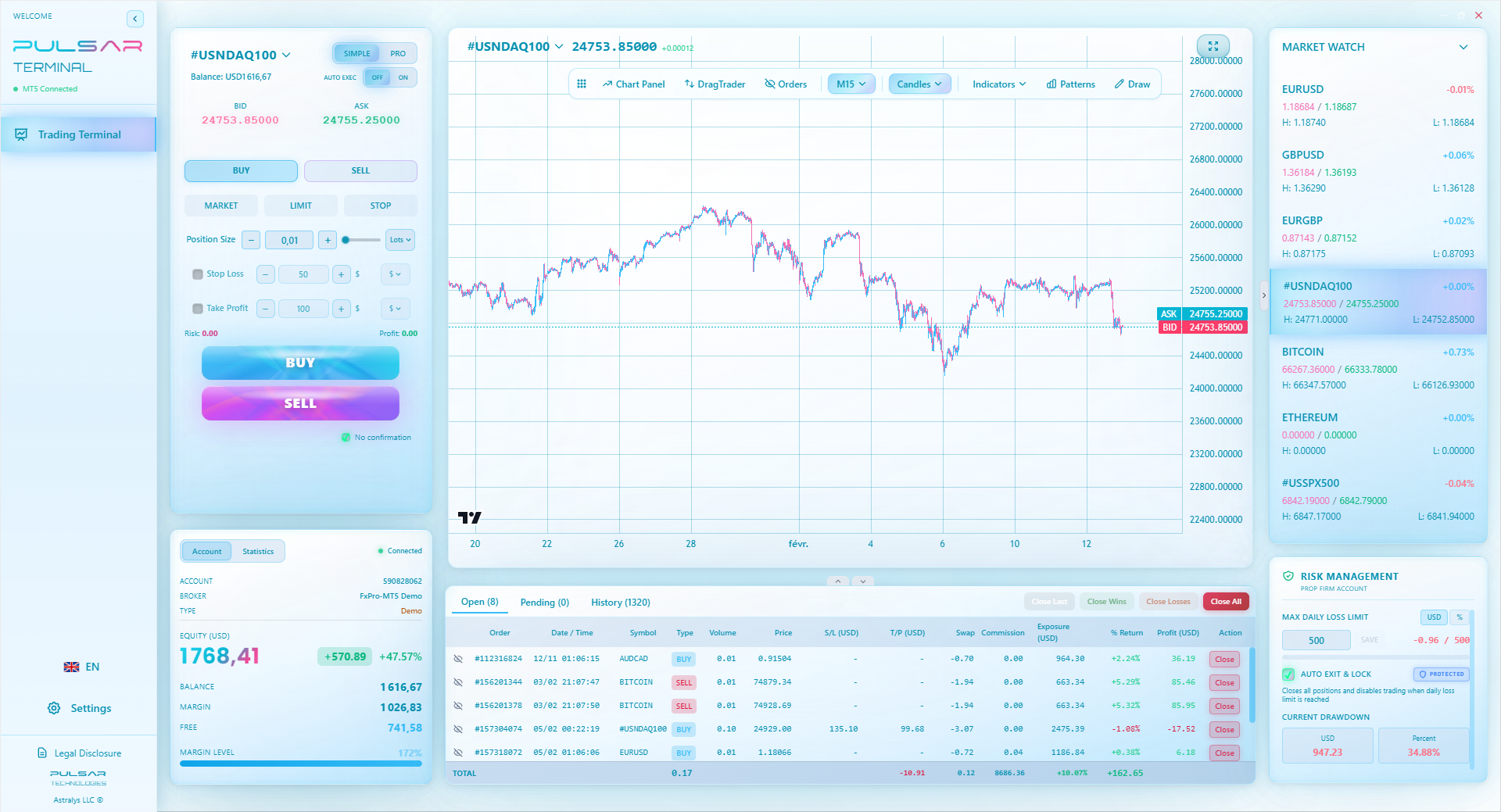
If you're building or managing a robot, precise trade management is non-negotiable, and Pulsar Terminal brings tools like multi-TP/SL and trailing stops directly into your MT5 workflow.
Pulsar Terminal
MT5 올인원 도구: 드래그앤드롭 주문, 다중 TP/SL, 트레일링 스톱, 그리드 트레이딩, 볼륨 프로파일, 프롭펌 보호. 매일 1,000명 이상의 트레이더가 사용.
After all these years, here's my honest opinion on where automated forex trading robots actually add value.
They're fantastic for handling the boring, repetitive tasks. Got a strategy that identifies a setup perfectly, but requires you to sit and watch for the exact candle close? Code that logic into an EA. It will execute the entry and initial stop-loss flawlessly, every time. You can then manage the trade manually, moving to breakeven or taking partial profits.
They're useful for trading multiple timeframes or pairs you can't watch. Maybe you have a solid strategy for EUR/USD on the 4-hour chart, but you also see opportunities on AUD/NZD daily charts. A robot can monitor both and alert you or take the trade, so you're not glued to 10 screens.
They enforce discipline (if they're good). They remove the temptation to move your stop-loss further away or to take profit too early out of fear. The rule is the rule.
The worst use case? Buying a robot with the hope that it will 'figure out' the markets and make you rich without any effort. That robot doesn't exist. The most successful automated traders I know are programmers or quants who treat it like a scientific experiment - constant testing, small deployments, rigorous risk management. They aren't buying 'Forex Megadroid Pro' from a Facebook ad.
“Automation can be a powerful ally, but it's a terrible master.”
Alright, if you've read this far and you're still keen to explore, here's a safe path forward. Forget about spending money for now.
- Open a Demo Account: Do this with a reputable, FSCA-regulated broker that offers MT4/MT5.
- Download Free EAs: There are thousands of free EAs on forums like MQL5.com. Download a few simple ones (e.g., a moving average crossover EA). Don't go for the complex ones yet.
- Learn to Attach and Configure: Your first mission is just learning how to put the robot on a chart, input settings like lot size, and hit 'run'. This is 80% of the battle for beginners.
- Observe and Journal: Run the free robot on demo for a month. Write down what it does. When does it win? When does it lose? This observation period is more valuable than any course.
- Paper Trade Your Own Strategy: Before you automate anything, have a clear, written, manual trading strategy that works for you on demo. An automated forex trading robot should be the last step in a process, not the first.
The dream of passive income is powerful. But in the forex market, there's no such thing as free money. Automation can be a powerful ally, but it's a terrible master. Start small, stay skeptical, and never risk money you can't afford to lose on a promise from a sales page. Your future self will thank you for the patience.
FAQ
Q1Are forex trading robots legal in South Africa?
Yes, using automated trading software is legal. The critical legal aspect is who you do business with. You must use an FSCA-licensed broker for your trading account. Companies selling robots that also manage your funds must be FSPs. Always check the FSCA's public register before depositing money.
Q2What is the most common mistake South Africans make with forex robots?
Funding an account with an unregulated offshore broker recommended by the robot seller. This bypasses all South African consumer protections. Another huge mistake is using real money before extensive demo testing. They see a flashy backtest and risk their rent money on day one.
Q3Can I use a forex robot with a prop firm challenge account?
Many prop firms do allow EAs, but you must check their specific rules. The challenge is that most prop firms have strict daily and overall loss limits. A robot that has a large drawdown can blow your challenge in hours. You need a robot with incredibly tight risk controls, something tools like specialized trading terminals can help manage automatically.
Q4How much money do I need to start with a robot?
Technically, some brokers let you start with R1,000 or less. Practically, I wouldn't recommend it. With such a small account, proper position sizing becomes almost impossible, and a few losses will wipe you out. A more realistic starting point for testing a robot live is R10,000-R20,000, using only a tiny fraction (0.5-1%) per trade.
Q5Do any robots work on the USD/ZAR pair?
Some do, but it's trickier. USD/ZAR is less liquid than majors like EUR/USD, meaning spreads are wider and price movements can be more erratic. A robot designed for the steady flow of EUR/USD might struggle with ZAR's volatility. You'd need a robot specifically tested and tuned for emerging market currency pairs.
Q6Is it better to buy a robot or a trading signal service?
They have similar problems. With a signal service, you're still manually executing, which introduces emotion and delay. With a robot, you have the 'black box' risk. Neither is a shortcut to skill. If forced to choose, a transparent robot you can test on demo is better than signals you have to follow blindly.
윈스턴 교수의 수업
핵심 요약:
- ✓Test every robot for 3 months on demo first.
- ✓Only use FSCA-regulated brokers, no exceptions.
- ✓Allocate less than 20% of capital to any single EA.
- ✓A robot cannot create an edge, it can only execute one.
이 기사가 얼마나 유용했나요?
별을 클릭하여 평가
주간 트레이딩 인사이트
무료 주간 분석 & 전략. 스팸 없음.
저자 소개
David van der Merwe
신흥시장 트레이더
요하네스버그 기반 트레이더로 신흥시장 통화 11년 경력. ZAR 통화쌍, FSCA 규제 거래, 남아공 시장 분석 전문.
댓글
위험 고지
금융 상품 거래에는 상당한 위험이 수반되며 모든 투자자에게 적합하지 않을 수 있습니다. 과거 성과가 미래 수익을 보장하지 않습니다. 이 콘텐츠는 교육 목적으로만 제공되며 투자 조언으로 간주되어서는 안 됩니다. 거래 전에 항상 직접 조사를 수행하십시오.
이 기사도 읽어보세요

Cara Trading Forex Sukses: 7 Prinsip dari Trader Profesional
Cara trading forex sukses dengan 7 prinsip trader pro: manajemen modal, disiplin, journal trading, backtest. Data nyata, bukan janji profit palsu.
Jam Trading Forex Terbaik untuk Trader Indonesia: Panduan Lengkap dengan Tabel Waktu
Panduan jam trading forex untuk trader Indonesia. Tabel 4 sesi dunia, jam emas 20:00-00:00, sesi mana yang harus dihindari. Data akurat + tips dari trader berpengalaman.
Top 5 Sàn Forex Uy Tín Nhất 2026: Review Jujur dari Trader Indonesia
Top 5 sàn forex uy tín 2026 untuk trader Indonesia. Review jujur: spread, deposit, withdraw, dukungan lokal. Exness, XM, IC Markets & lebih.
