


Here's a fact that cost me thousands to learn: 87% of retail traders who rely on a single 'best' indicator blow their accounts within two years.
James Mitchell
수석 트레이딩 애널리스트
☕ 9 분 소요
배울 내용:
- 1The Indicator Trap (And How I Fell In)
- 2It's a Framework, Not a Silver Bullet
- 3My Personal Combination (With Real Trade Examples)
- 4Why Context Beats Complexity Every Time
- 5The 3 Most Common (and Costly) Mistakes I See
- 6Building Your Own System: A Practical Start
- 7The Final Word: Your Mind is the Ultimate Indicator
Here's a fact that cost me thousands to learn: 87% of retail traders who rely on a single 'best' indicator blow their accounts within two years. I was almost one of them. The search for a holy grail is a trap, especially under strict US regulations with 50:1 use caps and the FIFO rule. This isn't about finding a magic line on a chart. It's about building a system that survives.
My first major loss came in 2018. I'd read all the books, mastered the RSI indicator, and was convinced I could spot every overbought turn. I shorted EUR/USD at 1.2350 because the RSI was pegged at 82. 'It has to reverse,' I thought. The market didn't care. It rallied another 140 pips, and I watched, frozen, as my $2,500 position evaporated. I was using the indicator correctly, but I was asking it the wrong question. An indicator doesn't predict the future. It describes the recent past, and in the US market, where spreads on standard accounts can be 1.4 pips or more, that lag can be expensive.

Warning: No indicator, no matter how complex, accounts for the spread you pay your broker. A 1.5-pip spread on EUR/USD at a place like FOREX.com means the market has to move that far just for you to break even. Your indicator signal needs to be stronger than that cost.
The real trap is believing one tool gives you an edge. It's like a carpenter trying to build a house with only a hammer. You need the right tool for the specific job: identifying a trend, gauging momentum, or measuring noise. My mistake was using a momentum tool (RSI) to call a trend reversal without any trend context. It was a classic misapplication, and my account statement was the receipt.
“87% of retail traders who rely on a single 'best' indicator blow their accounts within two years.”
Forget 'best.' Think 'purpose.' Every indicator falls into one of three buckets, and your job is to mix them like a recipe.
1. The Trend Confirmers (The 'What Is It?') These tell you if you're in a market that has a direction. In the US, with our 50:1 use on majors, catching a trend is where you make real money while keeping risk small. My go-to is a simple 20-period and 50-period Exponential Moving Average (EMA) combo. When the 20 EMA is above the 50 and both are sloping up, the trend is your friend. The MACD indicator histogram is also brilliant for this - it shows the acceleration of a trend, not just its existence.
2. The Momentum Gauges (The 'How Strong Is It?') This is where my old nemesis, the RSI, actually shines. Not for picking tops, but for confirming strength within a trend. In a strong uptrend, the RSI will often hover between 40 and 80, not 30 and 70. Seeing it dip to 55 and bounce? That's a potential continuation signal, not a reversal. I use this now for swing trading entries, not exits.
3. The Volatility Measurers (The 'Where's the Noise?') This is the unsung hero of risk management. The Average True Range (ATR) tells you the market's average daily movement. If EUR/USD has an ATR of 70 pips, setting a 20-pip stop-loss is statistically suicidal. I use the ATR to set all my stops and to size my positions. A volatile pair needs a smaller position. It's non-negotiable. I always run my trades through a position size calculator that uses ATR.

Pro Tip: Try this simple filter. Only take buy signals from your momentum indicator when price is above your key moving average (the trend filter). It instantly eliminates half the losing trades - the ones that go against the dominant flow.

💡 윈스턴의 팁
An indicator is a flashlight, not a compass. It illuminates what's right in front of you (recent price action), but it doesn't tell you which direction to walk. You need a map for that - your trading plan.
“An indicator doesn't predict the future. It describes the recent past, and that lag can be expensive.”
After years of tweaking, I settled on a three-indicator dashboard. It's boring, but it works.
The Setup:
- Chart 1: 200-period Simple Moving Average (SMA). Sole purpose: am I above or below the long-term benchmark? I don't trade against it.
- Chart 2: 20-period & 50-period EMAs. My primary trend filter.
- Subchart: RSI (14 period). My momentum gauge.
- Subchart: ATR (14 period). My risk ruler.
A Winning Trade (XAU/USD): In March of last year, gold (XAU/USD) was consolidating. Price was above the 200 SMA and the 20 EMA crossed above the 50 EMA. Trend filter: CHECK. I waited. Price pulled back to the 20 EMA, and the RSI dipped to 48. Momentum gauge: CHECK (healthy pullback, not broken). The ATR was $25. I placed a buy order at $1,980 with a stop-loss at $1,955 (1 x ATR below entry). Target was $2,030. It ran perfectly, hitting my target in 8 days. The system worked because all three components agreed: trend up, momentum pausing, risk defined.
A Losing Trade (EUR/USD): I broke my own rules in January. EUR/USD was in a messy range, chopping around those EMAs. No clear trend. But the RSI showed oversold at 28. I thought, 'It's so low, it must bounce!' I bought at 1.0850. No trend confirmation. The market chopped and took out my stop at 1.0820 for a 30-pip loss. The lesson? The RSI signal was correct (it was oversold), but without the trend filter, it was meaningless noise. The market can stay oversold far longer than you can stay solvent.
“An indicator doesn't predict the future. It describes the recent past, and that lag can be expensive.”
You can have the most elaborate Ichimoku Cloud or Fibonacci grid on your screen. If you don't understand the market context, it's just pretty lines. Here’s what matters more:
The US Session Overlap: The most volatile, liquid moves often happen between 8 AM and 12 PM EST when London is still open and New York is getting started. Your indicators will be most responsive here. Trying to trade a slow, ranging Asian session with the same settings? Good luck.
News Events: No indicator in the world can price in a surprise Fed announcement or a CPI print. I learned this the hard way holding a trade through NFP. The MACD indicator was beautiful… until the number hit and it became a chaotic scribble. Now, I just don't trade 15 minutes before or after major news. Period. The indicator noise is unbearable.
Broker Data Quality: This is a silent killer. Not all price feeds are equal. A slight difference in how your broker calculates the bid/ask can make your indicator give a slightly different signal. It’s one reason I stick with well-regulated US brokers like the ones reviewed on our site (FOREX.com, OANDA). Their data tends to be clean and reliable, which is critical when a single pip matters.
Indicators are rear-view mirrors. Context is the road ahead. You need both to drive.
💡 윈스턴의 팁
If you can't explain your indicator's signal to a 10-year-old in 10 seconds, you don't understand it well enough to risk money on it. Complexity is the enemy of execution.
“The real trap is believing one tool gives you an edge. It's like a carpenter trying to build a house with only a hammer.”
1. Over-optimizing on Historical Data
You can always find a setting that made you a millionaire… on last year's chart. I wasted months making a moving average 'perfect' for 2021 data. It failed instantly in 2022. Keep settings standard (9, 14, 20, 50, 200 are common for a reason). If it works for everyone, it works because it's strong.
2. Ignoring the Spread and Slippage
That perfect RSI bounce entry at 1.1050? Your market buy order might fill at 1.1052. Your stop-loss at 1.1030 might get taken out at 1.1028. That's 4 extra pips of cost on a 20-pip trade - a 20% hit to your potential profit. For scalping strategy especially, this is fatal. You need razor-thin spreads, which is why many look at commission-based RAW accounts.
3. Stacking Indicators of the Same Type
Three oscillators (RSI, Stochastic, Williams %R) at the bottom of your chart isn't confirmation. It's redundancy. They all measure the same thing (momentum) and will all give you the same false signal at the same time. Pick one from each category: one trend, one momentum, one volatility. That's it.

Example: Let's say you trade a $10,000 account. You risk 1% ($100) per trade. On EUR/USD with a 1.5-pip spread, you lose $1.50 the moment you enter. If your profit target is only 15 pips ($150), the spread just ate 10% of your potential profit before the market even moved. This math forces you to be selective.
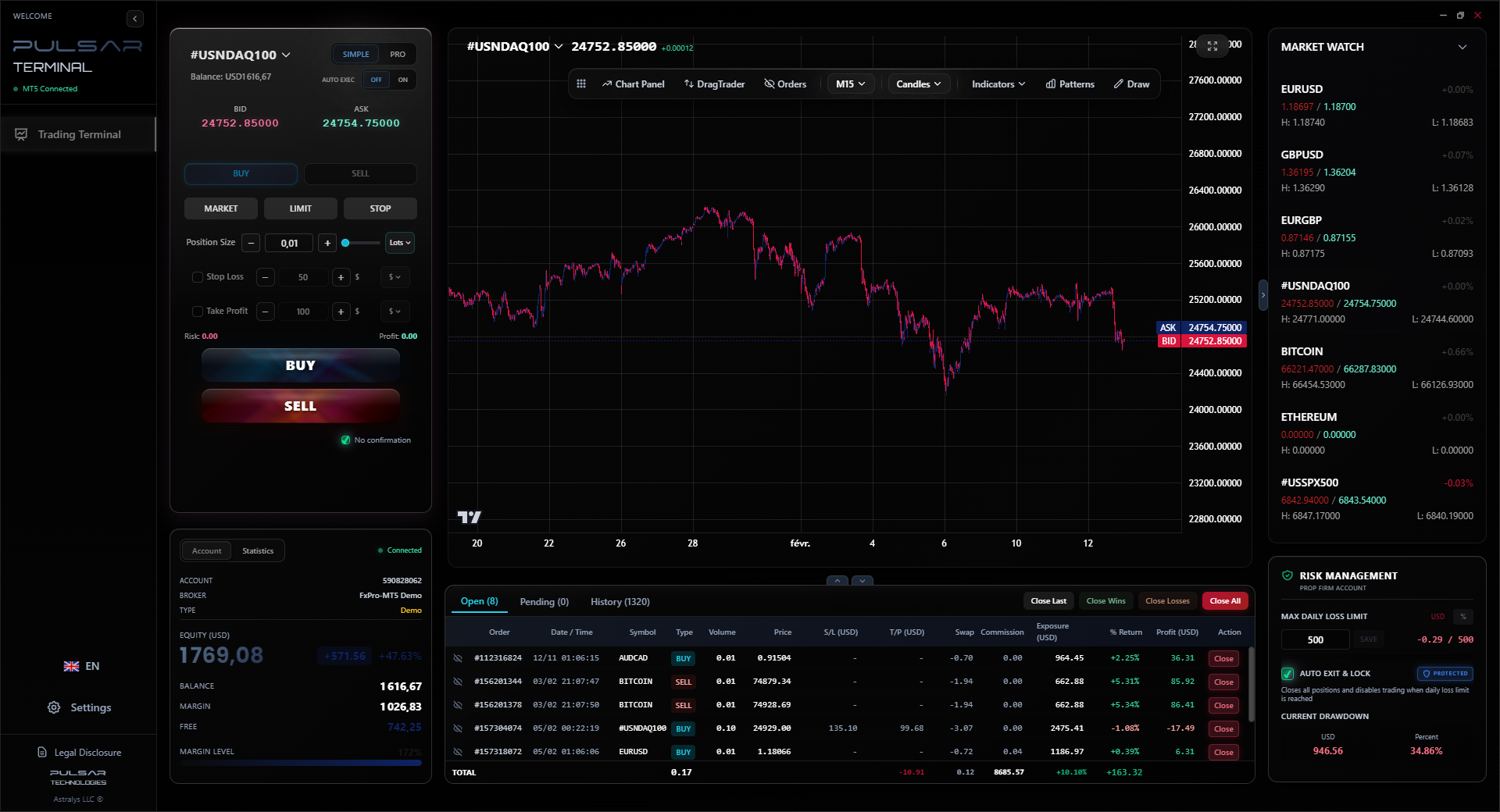
When your trading system gives a clear signal, you need fast, precise execution without emotional interference—Pulsar Terminal's drag-and-drop orders and automated multi-TP/SL management on MT5 turn your plan into action instantly.
Pulsar Terminal
MT5 올인원 도구: 드래그앤드롭 주문, 다중 TP/SL, 트레일링 스톱, 그리드 트레이딩, 볼륨 프로파일, 프롭펌 보호. 매일 1,000명 이상의 트레이더가 사용.
“The real trap is believing one tool gives you an edge. It's like a carpenter trying to build a house with only a hammer.”
Ready to move beyond the 'best indicator' search? Here's a Monday morning plan.
Step 1: Pick Your Core. Choose ONE indicator from each family. I suggest:
- Trend: 20 & 50 EMA
- Momentum: RSI (14)
- Volatility: ATR (14) Add them to your chart. Remove everything else. Clarity is power.
Step 2: Define the Rules. Write this down. For example: "I will only consider a BUY if: Price > 20 EMA > 50 EMA (trend up). I will then wait for RSI to pull back to between 40-50 (momentum pause). My stop-loss will be placed 1.5 x the current ATR value below my entry price."
Step 3: Backtest Visually, Not with Robots. Go back on the chart for 3 months. Don't automate it. Manually scroll, bar by bar. How often did your setup appear? Did it work in a trending market? Did it fail in a range? This gut-feel learning is irreplaceable.
Step 4: Demo Trade for a Month. Execute only those signals. No hunches, no news trades. Just the rules. Your goal isn't profit; it's to see if you have the discipline to follow the system when a tempting 'sure thing' appears outside it.
This process turns indicators from crystal balls into components of a mechanical edge. It's how you stop guessing and start trading.
💡 윈스턴의 팁
The most important setting on any indicator is the 'off' switch. Knowing when market conditions make your tool useless (like during major news) is a higher form of skill than knowing how to use it.
“Stop looking for the best forex indicator. Start building the best version of yourself as a trader.”
After 12 years, I can tell you the most reliable indicator isn't on any chart. It's your own psychology. Greed makes you ignore overbought readings. Fear makes you cut winners short before your target. Impatience makes you force trades when your system says 'wait.'
The best technical setup in the world will fail if you don't have the discipline to execute it and the emotional resilience to take the losses, which are inevitable. I've had 5 losing trades in a row following my plan perfectly. It feels awful. But the 6th was a winner that covered all the losses and more. You have to trust the math, not the feeling.
So, stop looking for the best forex indicator. Start building the best version of yourself as a trader. Get your rules, manage your risk with a position size calculator, and understand that tools are only as good as the craftsman using them. The market doesn't reward those with the fanciest charts. It rewards those who are the most consistent, disciplined, and honest about their own limitations. That's the only edge that lasts.
FAQ
Q1What is the most profitable forex indicator?
There isn't one. Profitability comes from a system, not an indicator. A simple combination like EMAs for trend and RSI for momentum, paired with strict risk management using ATR, can be highly effective if applied consistently over hundreds of trades. The indicator itself doesn't make money; your discipline does.
Q2How many indicators should I use on one chart?
Rarely more than three or four. You need one from each key category: trend, momentum, and volatility. Stacking multiple indicators that do the same thing (like three different oscillators) creates confusion and false confidence, not clarity.
Q3Why do my indicators work in demo but fail with real money?
Two reasons: psychology and execution. With real money, fear and greed distort your judgment, causing you to exit early or ignore signals. Also, real accounts suffer from slippage and the emotional impact of the spread that demo accounts often gloss over. The indicator is the same; you are different.
Q4Are lagging indicators useless?
Not at all. All indicators are lagging - they're based on past price. Their value isn't prediction, but description and confirmation. A moving average confirms a trend is in place. An RSI confirms momentum is weakening. Using them to confirm your thesis is powerful; using them to predict turns is risky.
Q5What's the best indicator for beginners in the US?
Start with two: the 20-period Exponential Moving Average (EMA) to see the short-term trend, and the Average True Range (ATR) to learn about volatility and set sane stop-losses. Master understanding what these two tell you before adding anything else. It teaches you trend and risk first, which is everything.
Q6How do US regulations like FIFO affect my indicator strategy?
FIFO (First-In, First-Out) forces you to manage trades sequentially, not by individual lot. This makes complex scaling-in strategies harder. It pushes you towards cleaner, single-entry trades based on a clear indicator signal, rather than layering in multiple positions. It simplifies your approach, which is often a good thing.
Q7Should I buy expensive indicator software?
Almost certainly not. The default, free indicators in platforms like MT5 or TradingView are all you need. Expensive 'black box' systems often over-optimize and fail in live markets. The secret isn't a secret indicator; it's in how you combine and apply the classic, free ones.
윈스턴 교수의 수업
핵심 요약:
- ✓Combine 3 indicator types: trend, momentum, volatility.
- ✓The spread eats 10% of a 15-pip target instantly.
- ✓ATR sets your stop-loss; never use a fixed pip amount.
- ✓No trading 15 mins before/after major news.
- ✓FIFO rules force cleaner, single-entry trades.
이 기사가 얼마나 유용했나요?
별을 클릭하여 평가
주간 트레이딩 인사이트
무료 주간 분석 & 전략. 스팸 없음.
저자 소개
James Mitchell
수석 트레이딩 애널리스트
뉴욕 기반으로 9년 이상의 트레이딩 경력 보유. 주요 USD 통화쌍, 프롭 펌 챌린지, 미국 규제 환경에 집중.
댓글
위험 고지
금융 상품 거래에는 상당한 위험이 수반되며 모든 투자자에게 적합하지 않을 수 있습니다. 과거 성과가 미래 수익을 보장하지 않습니다. 이 콘텐츠는 교육 목적으로만 제공되며 투자 조언으로 간주되어서는 안 됩니다. 거래 전에 항상 직접 조사를 수행하십시오.
이 기사도 읽어보세요

Cara Trading Forex Sukses: 7 Prinsip dari Trader Profesional
Cara trading forex sukses dengan 7 prinsip trader pro: manajemen modal, disiplin, journal trading, backtest. Data nyata, bukan janji profit palsu.
Jam Trading Forex Terbaik untuk Trader Indonesia: Panduan Lengkap dengan Tabel Waktu
Panduan jam trading forex untuk trader Indonesia. Tabel 4 sesi dunia, jam emas 20:00-00:00, sesi mana yang harus dihindari. Data akurat + tips dari trader berpengalaman.
Top 5 Sàn Forex Uy Tín Nhất 2026: Review Jujur dari Trader Indonesia
Top 5 sàn forex uy tín 2026 untuk trader Indonesia. Review jujur: spread, deposit, withdraw, dukungan lokal. Exness, XM, IC Markets & lebih.
