


My screen was a sea of red.

David van der Merwe
신흥시장 트레이더 ·  South Africa
☕ 12 분 소요
배울 내용:
- 1What Even Is a Forex Robot? Cutting Through the Hype
- 2The South African Rules You Can't Ignore
- 3The Real Costs (Beyond the Price Tag)
- 4How to Test, Not Just Trust
- 5Brokers That Actually Work With EAs in SA
- 6My Personal Experience: What Actually Worked (And What Didn't)
- 7Final Verdict: Should You Use One?
My screen was a sea of red. It was March 2020, the week everything broke. I’d just paid $2,500 for a ‘revolutionary’ forex robot that promised to ‘navigate volatility.’ Instead, it went berserk, opening 47 micro-lot positions on GBP/JPY as the pair dropped 800 pips in a day. I watched, frozen, as it hit every stop-loss in a cascading failure that wiped out 40% of that account. That wasn’t a robot. It was a very expensive lesson. Since then, I’ve tested, tweaked, and blown up more EAs than I care to admit. Let’s talk about the real search for the best forex robot in the world, right here from SA.
Forget the sci-fi imagery. A forex robot, or Expert Advisor (EA), is just a piece of software that runs on MetaTrader 4 or 5. You attach it to a chart, and it follows a set of programmed rules to open and close trades. No magic, no sentient AI (despite what the sales pages claim). It's a tool, like a hammer. You can use it to build something or smash your thumb to pieces.
The core promise is emotional detachment. It removes fear and greed from the equation. In theory, that's powerful. In practice, most robots are just selling you someone else's trading strategy, wrapped in a black box. You have no idea if it was built to trade ranging markets but is now facing a strong trend, or if it was only ever tested on perfect historical data.
Here in SA, the hype is particularly toxic. Social media is flooded with ‘gurus’ showing off Lamborghinis supposedly bought with robot profits. The FSCA has had to issue specific warnings about outfits like Trabot and Blueway Trades for promising ‘20-50% monthly profits’ – a guarantee of a scam. If someone promises you the best forex robot in the world with those returns, they're either lying or about to lose your money.

Warning: Selling trading signals or robots to the public without an FSP license from the FSCA is a criminal offense in South Africa. Always check the provider's regulatory status first.
A real, functional robot isn't a ‘set and forget’ retirement plan. It's a system that requires monitoring, understanding, and adaptation. The market changes. A robot that worked in 2022's ranging markets might get slaughtered in 2024's trending environment. Your job isn't to find a robot and relax. Your job is to find a strong system you can manage.

💡 윈스턴의 팁
The only 'best' robot is the one you've tested for three months on a demo during both calm and volatile markets. If you haven't done that, you're just gambling with extra steps.
“A robot that needs high use to work isn't a good robot, it's a dangerous one.”
Trading with a robot doesn't put you above the law. In fact, it might draw more scrutiny. Here’s the regulatory landscape every ZA trader must know.
The FSCA is Not Joking
The Financial Sector Conduct Authority is our watchdog, and they've been busy. They don't regulate the robots themselves, but they regulate who can sell you financial advice or automated systems. That guy on Instagram selling his ‘AI Goldmine EA’? If he doesn't have an FSP number, he's operating illegally. The FSCA has publicly named and shamed several, and you should check their website for warnings before you even click a ‘buy now’ button.
The 30:1 use Cap
This is a big one for robot traders. Since 2021, retail traders like you and me are capped at 30:1 use on major forex pairs. Some robot sellers, especially international ones, will show backtests using 100:1 or 500:1 use. Those results are fantasy in our market. When you test or run a robot, you must configure it for our reality: 30:1 max. This drastically changes the risk profile and potential returns. A robot that needs high use to work isn't a good robot, it's a dangerous one.
The Rand Speculation Rule
This trips up many newcomers. South African residents are prohibited from speculating directly against the ZAR. You can't just buy USD/ZAR hoping the rand will weaken. Our forex trading is done via CFDs on currency derivatives. This is a crucial distinction your broker handles, but it's worth knowing why you won't find a robot specifically trading ZAR pairs for speculative gain.
Tax Man Cometh
SARS doesn't care if a human or a robot made the profit. It's taxable income. Keep careful records of all your automated trades. Profits from your ‘best forex robot in the world’ are added to your other income and taxed at your marginal rate. Losses can be carried forward to offset future profits. Don't learn this lesson during an audit.
“The most profitable ‘robot’ I ever used wasn't for entering trades. It was a risk management EA.”
Let's talk numbers, because this is where the dream meets the budget. The advertised price of the robot is just the entry fee.
The Initial Outlay: They range from ‘free’ (usually a very basic or a scammy trial) to over R80,000 ($5,000+). I’ve found the sweet spot for decent, transparent EAs is between R1,500 and R15,000. Anything cheaper is often junk code; anything more expensive is usually selling you a dream, not superior technology.
The Essential: VPS Hosting. If you want your robot to trade 24/5, you can't run it from your laptop. Loadshedding? Internet downtime? Your laptop sleeps? The trade misses its exit. You need a Virtual Private Server. This is a remote computer that runs MT4/5 and your EA non-stop. Cost: ZAR 150 to ZAR 500+ per month. It's non-negotiable for serious automated trading. I use a local SA VPS provider for lower latency to my broker's servers.
Brokerage Costs: Your robot amplifies brokerage costs. A 1-pip spread might not seem like much on a manual trade, but a high-frequency scalping robot making 100 trades a week turns that into a major expense. You need a broker with tight, consistent spreads and EA-friendly policies. I’ve had good experiences with IC Markets and Pepperstone for their raw spreads and stability. Exness can be good too, but do your own due diligence.

Example: Let's say your robot risks 1% per trade on a R10,000 account. That's R100 risk capital. If your broker's spread on EUR/USD is 1.5 pips, and a pip is worth R7.50 on a mini lot, you're paying R11.25 in spread cost before the trade even moves. That's over 11% of your risk capital gone immediately. Now you see why low spreads are critical.
The Hidden Time Cost: This is the big one. You will spend hours configuring, backtesting, forward-testing on a demo, and monitoring live performance. You'll need to understand basic position size calculations to input correctly. This isn't passive income. It's active system management.
“The most profitable ‘robot’ I ever used wasn't for entering trades. It was a risk management EA.”
Never, ever run a robot live based on a sales page or a pretty backtest. Here’s my brutal testing protocol.
Step 1: The Backtest (But Be Skeptical). Run it in MT4/5's Strategy Tester. Use every available tick of data (the most accurate setting). Look at the equity curve. Is it a smooth(ish) climb, or does it have massive, heart-stopping drawdowns? A 60% drawdown means the robot can lose over half your account before recovering. Could you stomach that? I ignore any robot with a max drawdown over 25% in backtests – real trading will be worse.
Step 2: The Forward Test (Demo). This is mandatory. Run the robot on a demo account for at least 2-3 months, across different market conditions. Compare its live demo performance to the backtest. If they're wildly different, the backtest was likely over-optimized (‘curve-fitted’) to past data and is useless. I once bought a robot that had a 90% win rate in backtests. On a 3-month demo, it had a 45% win rate and barely broke even after spreads. I dodged a bullet.
Step 3: The Micro-Lot Live Test. Only now do you go live. Start with the smallest possible position size. For a R10,000 account, that might mean trading 0.01 lots. The goal isn't to make money. The goal is to confirm the robot behaves exactly as it did on the demo. Let it run for a full month. Monitor its adherence to your rules, like stop-loss placement. Does it respect the margin call levels of your account?
What to Look For in Results:
- Profit Factor: (Gross Profit / Gross Loss). Aim for above 1.3. Below 1.1 is noise.
- Maximum Drawdown: The largest peak-to-trough drop. Keep it under 20% for your sanity.
- Recovery Factor: (Total Net Profit / Max Drawdown). A good system has a high recovery factor, meaning it makes a lot relative to the pain it puts you through.
- Average Win vs. Average Loss: A good scalping strategy might have many small wins and few big losses. A swing trading robot might have few wins, but they're much larger than the losses. Know which one you have.
💡 윈스턴의 팁
Spend your first R5,000 on trading education and a VPS, not on a robot. Understanding why a trade works will save you ten times that amount in the long run.
“The market is dynamic, and any robot claiming universal supremacy is selling you a lie.”
Not all FSCA-regulated brokers are created equal for automation. Some have restrictions, requotes, or slow execution that will kill a robot. Based on my experience and community chatter, here are the key players that generally play nice with EAs.
| Broker | Why It's EA-Friendly | Watch Out For |
|---|---|---|
| IC Markets | Raw spreads from 0.0 pips, fast execution, dedicated VPS offers. | Their commission-based Raw Spread account is best for scalping EAs. |
| Pepperstone | cTrader & MT4/5, Razor account has tight spreads + commission. | Great for high-frequency bots. |
| Exness | Zero Spread accounts available, supports many EAs. | Be mindful of trading conditions during high volatility. |
| XM | Low minimum deposit ($5), good for starting small with a bot. | Spreads can be wider than the pure ECN brokers. |
| Tickmill | Professional-grade ECN model, very stable. | Excellent for slower, swing-style EAs. |
| HFM (HotForex) | Offers a Zero Spread account, FSCA regulated. | A solid all-rounder for EA trading. |
The golden rule: Open a demo account with your shortlisted broker and run your forward test on their server. Execution speed and spread behavior in the demo will mirror the live environment. Pay attention to slippage, especially around news events. A good robot should have a news filter to avoid trading during major announcements like US Non-Farm Payrolls.
“The market is dynamic, and any robot claiming universal supremacy is selling you a lie.”
Enough theory. Let's get personal. I’ve made and lost money with robots. Here are two concrete examples.
The Failure: In 2019, I bought a ‘grid trading’ EA for R12,000. It placed buy and sell orders at set intervals above and below the price, aiming to profit from volatility. It worked beautifully in a ranging market on EUR/USD, making a steady R2,000-R3,000 per month on a R50k account. Then, in early 2021, EUR/USD went on a sustained, one-way bullish trend. The robot kept selling short at each grid level, trying to ‘catch the pullback.’ It didn't come. I watched in horror as it accumulated a massive, unhedged short position. The drawdown hit 65%. I finally pulled the plug, taking a R32,500 loss. The lesson? A strategy that doesn't account for strong trends is a time bomb. Grid trading is risky business.
The Modest Success: Frustrated, I shifted focus. Instead of buying a ‘black box,’ I learned to code simple EAs in MQL4 myself. My only successful, consistent robot isn't clever. It's a basic trend-following system using a slow MACD indicator crossover and the RSI indicator for overbought/oversold filters. It only trades the daily chart on XAU/USD and EUR/USD. It averages about 4-6 trades per month. It's boring. But since 2022, on a R100,000 live account, it has returned roughly 11-15% per annum, with a maximum drawdown of 18%. It works because it's simple, trades higher timeframes (less noise), and I understand every line of code. It’s not the best forex robot in the world, but it’s mine, and it’s predictable.

Pro Tip: The most profitable ‘robot’ I ever used wasn't for entering trades. It was a risk management EA. It automatically moved my stop-loss to breakeven when a trade was up a certain number of pips, and trailed stops to lock in profits. This single tool saved me more money than any entry-signal robot ever made. Managing the trade is often more important than finding the perfect entry.
💡 윈스턴의 팁
Configure your robot to risk a maximum of 1-2% of your account per trade, no matter what the seller's default settings are. Over-leveraging is how robots blow up accounts.
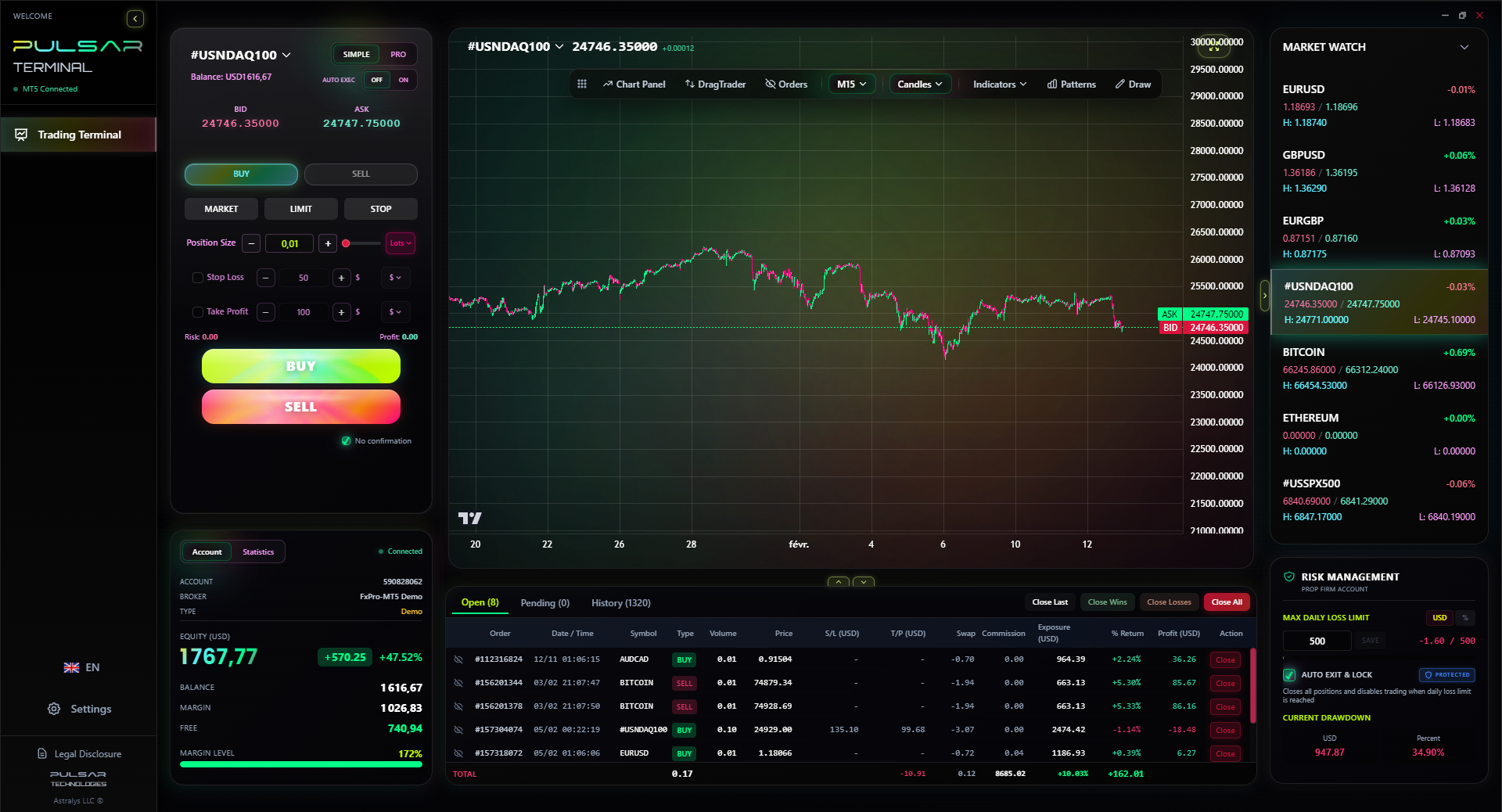
Managing the trades a robot opens is critical, and Pulsar Terminal automates advanced risk management like trailing stops and breakeven orders directly on your MT5 platform.
Pulsar Terminal
MT5 올인원 도구: 드래그앤드롭 주문, 다중 TP/SL, 트레일링 스톱, 그리드 트레이딩, 볼륨 프로파일, 프롭펌 보호. 매일 1,000명 이상의 트레이더가 사용.
“Your job isn't to find a robot and relax. Your job is to find a strong system you can manage.”
So, is there a single best forex robot in the world? No. Absolutely not. The market is dynamic, and any robot claiming universal supremacy is selling you a lie.
Should you use one? It depends.
Consider a robot if: You have a proven, rule-based manual strategy that you want to automate without emotion. You are technically inclined and willing to monitor and maintain a system. You have the capital to absorb drawdowns and cover VPS costs. You treat it as a business tool, not a lottery ticket.
Avoid robots if: You're looking for a ‘passive income’ button. You don't understand basic trading concepts like pips, spreads, and risk management. You can't afford to lose the money you invest. You believe the hype on social media.
The real path isn't about finding a magical robot. It's about developing or finding a strong trading system, and then considering automation to execute it precisely. Start by mastering trading manually. Learn what makes a good strategy. Then, and only then, explore automation as a way to enhance your discipline.
For the South African trader, the rules add an extra layer of safety (30:1 use) and an extra layer of caution (beware unlicensed sellers). Do your homework, test relentlessly, and never risk money you can't afford to lose on a promise from a stranger online. The best robot, in the end, might just be the one you build in your own head through experience and discipline.
FAQ
Q1Are forex robots legal in South Africa?
Yes, using forex robots (Expert Advisors) on your own account is legal. However, selling robots or trading signals to the public without a Financial Service Provider (FSP) license from the FSCA is illegal. Always verify a seller's FSP number before purchasing.
Q2What is the best forex trading platform for robots in SA?
MetaTrader 4 (MT4) and MetaTrader 5 (MT5) are the dominant platforms and support most Expert Advisors. They are widely offered by FSCA-regulated brokers like IC Markets, Pepperstone, and Exness. cTrader is also a strong, modern alternative for automated trading.
Q3How much money do I need to start trading with a forex robot?
You need enough to cover the robot cost, a VPS (ZAR 150-500/month), and a live trading account. While some brokers like XM allow deposits from $5, starting with at least R10,000-R20,000 is more realistic to properly test a robot and withstand normal drawdowns without being over-leveraged.
Q4Can a forex robot make me rich quickly?
No. Any robot or seller promising high, guaranteed monthly returns (like 20-50%) is almost certainly a scam, as warned by the FSCA. Legitimate automated trading is about consistent, risk-managed returns over time. Think in terms of annual percentages, not monthly get-rich-quick schemes.
Q5Do I need to know how to code to use a forex robot?
Not to use a pre-made one. You need to know how to install it on MT4/5, configure its settings (like lot size, stop-loss), and understand its strategy. However, basic coding knowledge (MQL4/MQL5) is incredibly valuable for tweaking settings, creating simple scripts, or truly understanding how your robot works.
Q6How do I avoid forex robot scams in South Africa?
- Check the FSCA's public warning list. 2. Never buy from a seller without a verifiable FSP license. 3. Ignore unrealistic profit promises. 4. Demand a verified multi-month track record, not just a backtest. 5. Always forward-test on a demo account for months before going live. 6. Be deeply skeptical of social media hype.
Q7Are there any free forex robots that actually work?
There are free EAs, but they are usually very basic, unmaintained, or designed as ‘loss-leaders’ to upsell you to a paid version. Some simple, classic strategies (like moving average crossovers) can be found for free. However, a strong, well-coded, and supported robot almost always has a cost, as development takes time and skill.
윈스턴 교수의 수업
핵심 요약:
- ✓Test every robot for 3 months on demo first.
- ✓Maximum 30:1 use is SA law for retail traders.
- ✓Factor in VPS costs (ZAR 150-500/month).
- ✓Risk only 1-2% of your account per trade.
- ✓Profit claims over 5% monthly are major red flags.
이 기사가 얼마나 유용했나요?
별을 클릭하여 평가
주간 트레이딩 인사이트
무료 주간 분석 & 전략. 스팸 없음.
저자 소개
David van der Merwe
신흥시장 트레이더
요하네스버그 기반 트레이더로 신흥시장 통화 11년 경력. ZAR 통화쌍, FSCA 규제 거래, 남아공 시장 분석 전문.
댓글
위험 고지
금융 상품 거래에는 상당한 위험이 수반되며 모든 투자자에게 적합하지 않을 수 있습니다. 과거 성과가 미래 수익을 보장하지 않습니다. 이 콘텐츠는 교육 목적으로만 제공되며 투자 조언으로 간주되어서는 안 됩니다. 거래 전에 항상 직접 조사를 수행하십시오.
이 기사도 읽어보세요

Cara Trading Forex Sukses: 7 Prinsip dari Trader Profesional
Cara trading forex sukses dengan 7 prinsip trader pro: manajemen modal, disiplin, journal trading, backtest. Data nyata, bukan janji profit palsu.
Jam Trading Forex Terbaik untuk Trader Indonesia: Panduan Lengkap dengan Tabel Waktu
Panduan jam trading forex untuk trader Indonesia. Tabel 4 sesi dunia, jam emas 20:00-00:00, sesi mana yang harus dihindari. Data akurat + tips dari trader berpengalaman.
Top 5 Sàn Forex Uy Tín Nhất 2026: Review Jujur dari Trader Indonesia
Top 5 sàn forex uy tín 2026 untuk trader Indonesia. Review jujur: spread, deposit, withdraw, dukungan lokal. Exness, XM, IC Markets & lebih.
