


Let's cut through the hype: most 'best prop firms' lists are just affiliate marketing garbage written by people who've never traded a funded account.
James Mitchell
수석 트레이딩 애널리스트
☕ 11 분 소요
배울 내용:
- 1What You're Actually Buying (It's Not Capital)
- 2The 2026 Regulatory Hammer & Which Firms Will Survive
- 3The Hidden Tax: Real Costs & Payout Math
- 4Platforms, use, and the Tools You Actually Need
- 5A Pragmatic Look at 2026's Contenders
- 6A Veteran's Blueprint for the Challenge & Beyond
- 7What's Next: AI, Multi-Asset, and Your Edge

Let's cut through the hype: most 'best prop firms' lists are just affiliate marketing garbage written by people who've never traded a funded account. The truth is, 90% of these companies will be gone in two years, and your challenge fee is just a donation to their marketing budget. I've traded with over a dozen of them, blown a few accounts, and actually gotten paid by a handful. This isn't a ranking. It's a survival guide. I'll show you which models are built to last, which are legal time bombs, and how to actually keep the money you make.
You think you're buying access to a firm's capital. You're not. You're buying a very expensive, one-sided insurance policy with terrible odds.
Here's the raw math they don't show in the slick ads: the average pass rate for these challenges is between 5% and 10%. Let that sink in. For every 100 people who pony up a challenge fee, maybe 5 get a funded account. And of those funded accounts, only about 7% ever see a payout. The entire business model is built on collecting those non-refundable evaluation fees. The funded accounts are just the cost of doing business to keep the dream alive for the next batch of hopefuls.
When you pass, you're not getting a $100,000 wire into your personal brokerage. You're getting a simulated account with a promise. The firm uses its own capital to back your trades, but you have zero ownership. They control the platform, the rules, and can pull the plug anytime. Your profit split? That's just a royalty on performance. It's a performance fee structure, not an ownership stake. Understanding this fundamental truth changes everything about how you approach it. You're not a partner. You're a contractor with a terrible deal who pays for the audition.

Warning: The 'account size' is a marketing number, not real money you control. A $100,000 'account' means you're trading 100k lots, but your actual risk is defined by the firm's profit target and daily loss limits. Your real capital at risk is 100% of your challenge fee.
“You're not buying access to capital. You're buying a one-sided insurance policy with 5% odds.”
The party's over. The wild west days of prop trading are collapsing under new rules. If you pick a firm without understanding this, you'll be left with a worthless funded account when they get shut down.
The SEC Backs Down (For Now)
In early 2024, the SEC tried to label prop firms as 'dealers,' which would have buried them in paperwork and capital requirements. By February 2025, they withdrew that appeal. Don't celebrate. This just means the immediate execution was stayed, not the intent. The regulatory glare is fixed on this industry.
The Real Threat: The CFTC in 2026
This is the one that matters. The CFTC is expected to formally classify evaluation-based prop firms as Commodity Trading Advisors (CTAs) in 2026. This isn't a maybe; it's the direction of travel. CTA registration means:
- Mandatory disclosure documents.
- Formal capital requirements.
- Audited financials.
- Specific risk warnings to 'clients' (that's you).
The small, offshore-only firms running on a shoestring budget? They can't afford this. They'll vanish. The survivors will be firms that are already acting like regulated entities.
What a Survivable Firm Looks Like
Look for firms that are already transparent. Do they have clear KYC/AML procedures? Are their terms unambiguous? Are they based in jurisdictions with a real financial regulator, not just a post office box? Firms that partnered with actual regulated brokers (like DNA Funded with DNA Markets, or ThinkCapital with ThinkMarkets) have a huge head start. Their infrastructure is already built for scrutiny. The fly-by-night operations offering 1:500 use from an island you can't find on a map are finished. When choosing from any list of the best prop firms, regulatory durability is your #1 filter now.
I learned this the hard way in 2023. I was 60% through a profit target with a small, trendy firm when they emailed all traders: 'Ceasing US operations immediately due to regulatory advice.' No payout. No refund. Just gone. My $489 challenge fee and two weeks of work evaporated. That's a $2,500 lesson in regulatory risk.

💡 윈스턴의 팁
The best prop firm is the one you don't need. Use their capital to build your own. Your first three payouts? Reinvest them into a personal account. That's your real freedom.

“The 2026 CFTC rules aren't a threat to good firms; they're a death sentence for the bad ones.”
They hook you with the challenge fee. The real costs come later, silently eating your profits. Let's break down where your money actually goes.
The average trader spends about $4,300 on challenge fees across multiple attempts. That's not an investment; it's a gambling loss for most people. Let's say you beat the odds. You get a $100,000 funded account.
The Profit Split Illusion: '90% profit split!' sounds amazing. But it's 90% of their defined profit. You hit your target, make $10,000. You get $9,000, right? Not so fast.
| Item | Typical Cost | Your $10K Profit Example |
|---|---|---|
| Profit Split (90%) | 10% to firm | Firm takes $1,000 |
| Platform/Data Fees | $50 - $200/month | Say $100 for the period |
| Payout Fee | $0 - $50 per withdrawal | $25 wire fee |
| Inactivity Fee | $25 - $100/month | $0 (you're active) |
| Currency Conversion | 1-3% if not USD | $0 (USD account) |
| TOTAL LEAKAGE | $1,125 |
Your $9,000 is now $7,875. That's a 21.25% effective fee, not 10%. And that's if you avoid all the trap fees.

Example: On a $50,000 account with an 8% profit target, you need to make $4,000. If your split is 80%, you expect $3,200. After a $150 platform fee and a $30 payout fee, you net $3,020. Your effective profit share is 75.5%, not 80%. This leakage makes hitting consistent, small gains nearly impossible. It pushes you towards riskier, home-run trades.
Some firms are better than others. Apex Trader Funding, for instance, lets you keep 100% of the first $25,000. That's a real advantage. TopStep does something similar with the first $10K. These structures acknowledge the fee problem. Always, always read the fee schedule. Then read it again. Your position size calculator needs to factor in this tax on success.

“The 2026 CFTC rules aren't a threat to good firms; they're a death sentence for the bad ones.”
Forget the account size. The trading conditions are what let you execute your strategy or strangle it. This is where the rubber meets the road.
use is a Double-Edged Sword: Yes, some firms still offer 1:100. Don't use it. The expected 2025/2026 regulatory changes will slash use anyway. Firms that already operate with sensible use (1:30, 1:50) are more sustainable. High use just helps you blow your daily loss limit faster. It's a trap for inexperienced traders, not a benefit.
The Platform War: You need the platform that fits your style. Period.
- MT4/MT5: The classics. Huge community, endless indicators. But some firms restrict MT5 for US traders. Check first.
- cTrader/TradeLocker: Clean, modern, great for order execution. Lower latency can be a big deal for scalping strategy.
- Rithmic/Tradovate/NinjaTrader: The futures trading environment. If you're trading the ES or NQ, this is your world. Firms like Apex and TopStep live here.
- TradingView Integration: A godsend for analysis. Some firms (like Funded Next) have direct trading from TradingView charts.
My mistake? I signed with a firm because of their cheap challenge, only to find they only offered a proprietary web platform with 300ms of lag. My scalping strategy was dead on arrival. I lost the $199 fee trying to adapt. Always, always do a demo test on their actual platform before paying a cent.
Spreads & Slippage: 'Raw spread' accounts are common. But who is the liquidity provider? Firms backed by real brokers (e.g., Moneta Funded by Moneta Markets) often have better, more consistent execution because they're plugged into real markets. Slippage during news is your silent enemy. A firm with poor liquidity will cost you more in bad fills than they ever take in fees.
💡 윈스턴의 팁
If you can't explain the firm's profit source beyond 'challenge fees,' neither can the regulator. That firm is on borrowed time.
“Your '90% split' is really a 75% split after the hidden taxes of doing business.”
I won't give you a static 'top 5.' The landscape is shifting weekly. Instead, here's how to categorize firms based on their likelihood of existing - and paying you - in 2027.
The Likely Survivors (Built for Regulation): These firms have broker partnerships, clear corporate structures, and are already adapting their rules. They're not always the cheapest or easiest to pass.
- Apex Trader Funding: A giant in the futures space. Their payer reputation is solid, and their model (100% of first $25K) is trader-friendly. They use Rithmic/Tradovate, a serious platform stack. They're preparing for CTA rules.
- TopStep: The original. They've been through multiple regulatory cycles. Their 'Trading Combine' is tough but transparent. They're a safe bet for futures traders who want stability over flashy offers.
- Firms with Broker Backing: DNA Funded (DNA Markets), ThinkCapital (ThinkMarkets). Their execution is via a regulated broker's infrastructure, which is a huge compliance advantage. This model is the future.
The High-Risk, High-Reward (Might Not Be Here): These are the firms with insane challenges (1-step, 5% profit target), crazy use, and low fees. The pass rate is higher because the model needs more funded traders to look legitimate. But where are they based? What's their capital source? If the CFTC letter comes, they'll be the first to freeze payouts and close. Tread carefully.
The Walking Dead (Avoid): Any firm that:
- Suspended US operations 'temporarily' (like FTMO did). They're not coming back.
- Has no clear KYC process.
- Offers deals that seem too good to be true (e.g., 'No daily drawdown!').
- Uses social media hype over substance.
Your research should include broker reviews. If a prop firm uses IC Markets or Pepperstone as their liquidity backbone, that's a positive signal about execution quality. Check our Exness review and XM review to understand the broker landscape they operate in.

“Your '90% split' is really a 75% split after the hidden taxes of doing business.”
Passing the challenge is a specific game with specific rules. It's not about maximizing profits. It's about not losing. Here's the only strategy that works consistently.
Phase 1: The Evaluation (Be a Robot) Your goal is to hit the profit target without touching the daily or max drawdown. Forget flair.
- Trade Tiny: Use 0.5% risk per trade, max. Your position size calculator is your bible. A 10% drawdown limit means 20 losing trades in a row will blow you up. Don't get close.
- Grind, Don't Hunt: Aim for 1:1.5 risk-reward trades. Take 10-15 pips on the EUR/USD guide, not 100. Consistency is key. Use the RSI indicator or MACD indicator to find these small, high-probability setups.
- Respect the Daily Loss: This is the killer. If you hit 80% of your daily loss, STOP TRADING. Log off. The challenge resets tomorrow. The number one reason people fail is revenge trading after a small loss.
I passed a $50k challenge with Apex by making an average of $87 per day for 23 days. Boring? Yes. Funded? Yes.
Phase 2: The Funded Account (Change the Game) Once funded, the psychology shifts. Now you have to make money and not lose the account. The rules are usually slightly looser.
- Withdraw Early, Withdraw Often: Get your profit split out of their environment ASAP. Build your own bankroll. This is your real capital.
- Scale Slowly: Don't immediately jump to 2% risk because you're 'funded.' Keep the same disciplined approach for the first few payout cycles.
- Automate Your Safety: This is where tech saves you. Use tools that enforce your rules. A trailing stop or a hard daily loss cut-off is better automated than left to your emotional discretion.

Pro Tip: Your first withdrawal is the most important. It proves the firm pays. Aim for a small, achievable target just to trigger that first payout. The psychological boost of seeing real money in your bank account is worth more than waiting for a bigger sum.
💡 윈스턴의 팁
Your edge isn't a secret indicator. It's the discipline to follow your plan when the chart screams at you to do the opposite. No firm can give you that.

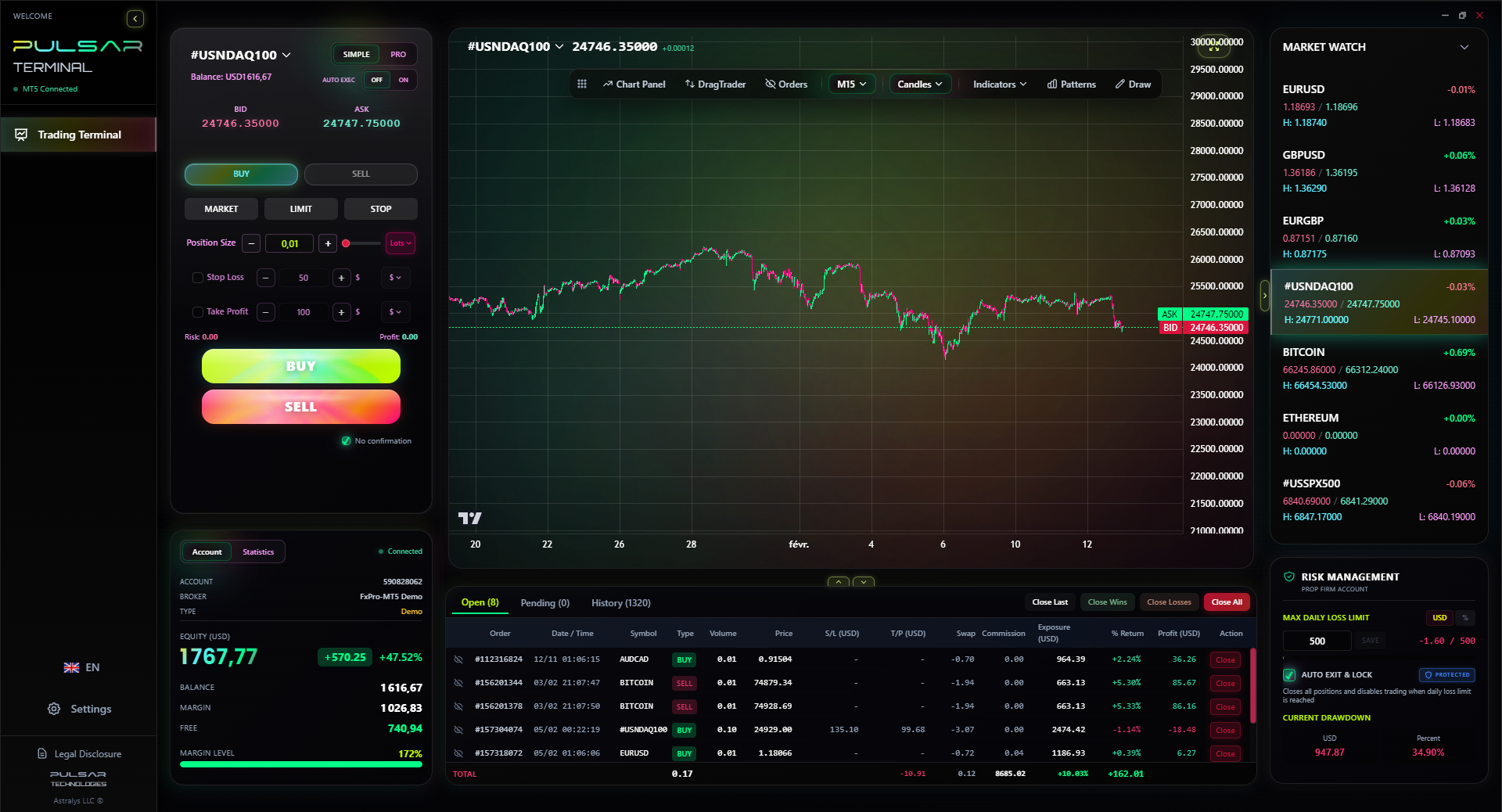
Managing a prop firm's strict daily loss and drawdown rules is a constant mental battle, which is why automating those protections directly on your MT5 chart with a tool like Pulsar Terminal is a game-saver.
Pulsar Terminal
MT5 올인원 도구: 드래그앤드롭 주문, 다중 TP/SL, 트레일링 스톱, 그리드 트레이딩, 볼륨 프로파일, 프롭펌 보호. 매일 1,000명 이상의 트레이더가 사용.
“Passing the challenge is about not losing. Keeping the account is about making money. They are different games.”
The prop firm of 2027 won't look like today's model. If you want to stay relevant, you need to see where the puck is going.
AI is Watching You (Seriously): Firms are already using machine learning to monitor trading behavior. They're not just checking drawdowns. They're analyzing for latency arbitrage, correlated asset manipulation, and pattern recognition that indicates you're just lucky, not skilled. Your edge needs to be strong, not a loophole. The 'copy a signal service' trick? AI will detect and boot you faster than any human manager.
The Multi-Asset Mandate: Forex-only firms are a dying breed. The survivors let you trade futures, indices, commodities, and crypto. Why? Diversification of the firm's risk and appeal to professional traders. You should want this too. Being able to trade XAU/USD guide during forex quiet times, or the ES during the US session, is a massive advantage. It lets you trade the best setup, not the only one available.
Your Lasting Edge: In a world of AI monitors and multi-asset platforms, your edge remains the same: discipline. The technology just gives you better tools to enforce it. The firms that will thrive are those providing those tools - reliable platforms, clean data, and fair rules. Your job is to provide the un-automatable part: the judgment to press the button or walk away. Focus on swing trading or strategies that don't rely on millisecond advantages you'll never have. Build a track record of consistent, manageable returns. That's the only thing that will matter to the serious firms left standing.

FAQ
Q1What is the #1 thing that makes a prop firm one of the 'best prop firms'?
Long-term payer reliability. A firm can have great rules and low fees, but if they don't consistently send money to traders' banks for years, they're worthless. Look for a long, public history of payouts (not just testimonials) and a structure built for upcoming 2026 CFTC regulation.
Q2Is the prop firm model a scam?
The business model itself isn't inherently a scam, but it's stacked heavily against the average trader. It's a probabilistic business where most traders lose their challenge fee. The scam risk comes from fraudulent firms that have no intention of paying out, or those that will vanish when regulations hit. Due diligence is non-negotiable.
Q3What's a realistic profit target for a funded account?
Aim for 3-5% per month, consistently. The firms' targets are often 8-10% to get funded, but that's a sprint. Once funded, treat it like a marathon. Trying to hit 20% monthly will almost certainly lead to a margin call or breach of drawdown rules. Consistency beats heroics every time.
Q4Can I trade news events with a prop firm?
Check the rules! Many firms restrict trading during major news releases (like NFP) due to the extreme volatility and slippage risk. They may widen spread definition dramatically or temporarily halt trading. Violating these rules is an instant account termination. Always know the event calendar and your firm's specific policy.
Q5What happens if I hit the daily loss limit?
Your trading is usually halted for that calendar day. Your account remains active, and you can trade again the next day, starting from your last equity balance. It's not a total failure unless you also breach the maximum trailing drawdown. The key is to stop immediately when you're near the limit to avoid a full breach.
Q6Are there prop firms for stock traders in the US?
Yes, but they are less common than forex/futures firms due to stricter SEC regulations on equity trading. Firms like TradeDay (futures-focused) and some multi-asset firms offer stock/ETF trading, but use is much lower (often 1:4 or 1:6), reflecting Reg T requirements. The evaluation process is similar.
Q7How do taxes work on prop firm payouts?
In the US, your profit share is considered ordinary income (likely reported on a 1099-MISC or 1099-NEC). You are responsible for self-employment taxes (Social Security & Medicare) on this income. Keep detailed records of all payouts and any related fees you pay. Consult a tax professional familiar with trading income.
윈스턴 교수의 수업
핵심 요약:
- ✓Filter for regulatory durability first, not lowest fee.
- ✓Assume a 21% effective fee on profits, not the advertised split.
- ✓The daily loss limit is your real enemy, not the profit target.
- ✓Your first withdrawal proves the model; make it small and early.
이 기사가 얼마나 유용했나요?
별을 클릭하여 평가
주간 트레이딩 인사이트
무료 주간 분석 & 전략. 스팸 없음.
저자 소개
James Mitchell
수석 트레이딩 애널리스트
뉴욕 기반으로 9년 이상의 트레이딩 경력 보유. 주요 USD 통화쌍, 프롭 펌 챌린지, 미국 규제 환경에 집중.
댓글
위험 고지
금융 상품 거래에는 상당한 위험이 수반되며 모든 투자자에게 적합하지 않을 수 있습니다. 과거 성과가 미래 수익을 보장하지 않습니다. 이 콘텐츠는 교육 목적으로만 제공되며 투자 조언으로 간주되어서는 안 됩니다. 거래 전에 항상 직접 조사를 수행하십시오.
이 기사도 읽어보세요

Cara Trading Forex Sukses: 7 Prinsip dari Trader Profesional
Cara trading forex sukses dengan 7 prinsip trader pro: manajemen modal, disiplin, journal trading, backtest. Data nyata, bukan janji profit palsu.
Jam Trading Forex Terbaik untuk Trader Indonesia: Panduan Lengkap dengan Tabel Waktu
Panduan jam trading forex untuk trader Indonesia. Tabel 4 sesi dunia, jam emas 20:00-00:00, sesi mana yang harus dihindari. Data akurat + tips dari trader berpengalaman.
Top 5 Sàn Forex Uy Tín Nhất 2026: Review Jujur dari Trader Indonesia
Top 5 sàn forex uy tín 2026 untuk trader Indonesia. Review jujur: spread, deposit, withdraw, dukungan lokal. Exness, XM, IC Markets & lebih.
