


I remember watching Bitcoin hit 1.2 million ZAR on VALR in late 2025 while the USD price was consolidating.

David van der Merwe
신흥시장 트레이더 ·  South Africa
☕ 11 분 소요
배울 내용:
- 1What 'Bitcoin Forex Trading' Actually Means in South Africa
- 2South African Regulations You Can't Ignore
- 3Where and How to Trade Bitcoin with ZAR
- 4Trading Strategies That Work in the SA Market
- 5Costs, Fees, and the Hidden Charges
- 6Common Pitfalls and How to Avoid Them
- 7The Future of Bitcoin Trading in South Africa
I remember watching Bitcoin hit 1.2 million ZAR on VALR in late 2025 while the USD price was consolidating. That 5% premium on the ZAR/BTC pair wasn't just noise - it was pure South African market dynamics at work. Most traders here don't realize we're playing a different game than our international counterparts. What we call 'bitcoin forex trading' isn't about traditional currency pairs with Bitcoin. It's about navigating ZAR-based crypto markets, CFDs through FSCA-regulated brokers, and understanding how our unique regulatory landscape creates opportunities (and pitfalls) you won't find anywhere else.
Let's clear this up right away. When South Africans talk about bitcoin forex trading, we're usually talking about three different things, and confusing them will cost you money.
First, there's trading actual Bitcoin against the Rand on local exchanges like VALR or Luno. This is spot trading - you're buying the actual asset. The ZAR/BTC pair behaves differently than USD/BTC. I've seen spreads widen to 2% during load-shedding hours when liquidity dries up. That's not a typo. Two percent.
Second, there's trading crypto CFDs through FSCA-regulated forex brokers. This is where most traditional forex traders dip their toes in. You're not buying Bitcoin; you're speculating on its price movement through contracts. Brokers like AvaTrade and Plus500 offer these with use, which brings its own set of risks. I learned this the hard way in 2023 when I got a margin call on a BTC CFD position during a weekend flash crash.
Third, there's trading Bitcoin against other cryptocurrencies (like BTC/ETH), which functions similarly to forex pairs in terms of analysis. The volume on these pairs on South African platforms is growing, but it's still thinner than international exchanges.

Warning: Don't assume international Bitcoin prices directly translate to ZAR prices. Local demand, banking delays, and exchange liquidity create consistent premiums or discounts. I've arbitraged this gap for months, sometimes netting 3-4% on simple transfers between platforms.
The key takeaway? Know which market you're actually in. Your strategy for spot ZAR/BTC on VALR should be completely different from your approach to BTC/USD CFDs on an international broker, even though both are 'bitcoin trading.'

💡 윈스턴의 팁
The ZAR/BTC spread is your silent partner. Watch it like a hawk. A wide spread means the market doesn't want your business right now. Wait for it to tighten.
“What we call 'bitcoin forex trading' isn't about traditional currency pairs with Bitcoin. It's about navigating ZAR-based crypto markets and our unique regulatory landscape.”
Our regulatory landscape changed completely in October 2022. The FSCA declared crypto assets 'financial products.' That wasn't just paperwork - it changed how every serious trader operates here.
The CASP License is Everything
If you're using a platform to trade, it must be a licensed Crypto Asset Service Provider (CASP). As of early 2026, 300 out of 512 applicants got their license. The FSCA is actively shutting down unlicensed operators. I made the mistake early on using an international platform without checking its SA status. My withdrawal was held for three weeks during compliance checks. Not fun.
Every legitimate platform now performs strict KYC. You'll need your ID, proof of address, and sometimes a selfie. This isn't optional anymore. The FIC monitors all transactions above ZAR 25,000 through the Travel Rule implemented in April 2025.
Tax Implications Are Real
SARS treats crypto as an asset of a revenue nature. Every trade is a taxable event. I keep a detailed log because in 2024, I had to account for 87 separate trades. Use a tracker or spreadsheet from day one. The proposed OECD CARF rules starting March 2026 mean automatic information sharing with other countries. There's no hiding.
What This Means for Your Trading
Regulation increased safety but also costs. Compliance means slightly higher fees, and sometimes slower withdrawals. The benefit? You're far less likely to get 'Mt. Gox'd' - South African client funds are now segregated, and platforms undergo regular audits. That peace of mind is worth the extra 0.1% in fees, trust me.

Pro Tip: Always check the FSCA's website for a provider's license status before depositing. I bookmark the page. It takes two minutes and saved me from a scammy 'broker' last year.
“I've seen spreads on ZAR/BTC widen to 2% during load-shedding hours. That's not a typo.”
You've got options, each with different pros, cons, and fee structures. Let's break down the real numbers.
Local Exchanges (For Spot Trading)
This is for buying and holding actual Bitcoin with your Rands.
| Platform | Key Feature | Typical Fee (ZAR/BTC) | Best For |
|---|---|---|---|
| VALR | Largest local volume | -0.01% to 0.05% | Active traders, low fees |
| Luno | User-friendly, great for beginners | -0.02% to 0.60% | First-time buyers, recurring buys |
| AltCoinTrader | Wide altcoin selection | 0.1% to 0.75% | Altcoin traders |
| Binance (with ZAR) | Global liquidity | 0% to 0.1% | Traders wanting global access |
I use VALR for most of my spot trading because the maker fee can be negative (they pay you for adding liquidity). On a ZAR 100,000 trade, that's a ZAR 10 rebate instead of a cost. It adds up.
Forex Brokers (For Crypto CFDs)
This is for speculation with use. You never own the Bitcoin.
- Plus500: FSCA-regulated, clean interface. Minimum deposit $100. Their spreads on BTC can widen significantly during high volatility.
- AvaTrade: Also locally licensed. Offers a wider range of crypto CFDs beyond just Bitcoin. Good for swing trading setups.
- CMTrading & IFX Brokers: Local presence, lower minimum deposits (as low as $10 at IFX).
I keep a small account with AvaTrade specifically for short-term CFD scalping on Bitcoin when I see a clear technical setup, but I never treat it like my spot holdings. The psychology is different.
Payment Methods That Actually Work
Bank transfers (EFT) are king. They're slow (often 12-48 hours) but cheap. Instant EFT services like Ozow or SiD are faster but can fail during loadshedding. I avoid card deposits - the 3-5% fees murder your edge before you even start.

Example: Buying ZAR 10,000 of BTC. On VALR via EFT: ~ZAR 10 fee. On Luno via debit card: ~ZAR 300 to ZAR 500 fee. That's an entire trade's potential profit gone.
💡 윈스턴의 팁
Your biggest edge in SA isn't a secret indicator. It's understanding the daily and weekly rhythms of local liquidity. Trade when the banks are open.
“I've seen spreads on ZAR/BTC widen to 2% during load-shedding hours. That's not a typo.”
Trading Bitcoin with ZAR isn't just copying US strategies. Our market has unique rhythms.
Exploiting the ZAR Premium/Discount
When global Bitcoin news hits, our local price often overreacts or underreacts due to banking hour mismatches and liquidity gaps. If BTC/USD pumps 10% at 2 AM SA time, our local exchanges might only reflect a 6% move by 9 AM. That's a potential 4% gap you can trade.
I set alerts for major support/resistance breaks on international charts. If BTC/USD breaks $70,000, I immediately check the ZAR price on VALR. More than once, I've bought the local lag and sold into the catch-up rally a few hours later.
Time Your Trades Around Liquidity
Liquidity is highest between 9 AM and 4 PM SA time when banks are open and deposits clear. After hours and on weekends, the spread on ZAR/BTC can balloon. I avoid placing large market orders on Sunday night. A limit order might not fill, but it'll save you from a terrible price.
Use Technical Analysis, But Contextualize It
The RSI indicator or MACD indicator on a BTC/USD chart still works, but your profit targets should be in ZAR, accounting for potential Rand volatility. If you're swing trading and the USD/ZAR rate moves 3% against you, it can wipe out your Bitcoin gains.
I overlay a simple USD/ZAR chart on my trading screen. If I'm long Bitcoin and the Rand is strengthening dramatically, I might take profit earlier. It's a two-currency game.
Risk Management is Non-Negotiable
Our market can be illiquid. If you need to exit a large position quickly, you might take a worse price. I never risk more than 1-2% of my capital on a single ZAR/BTC trade. Use a position size calculator religiously. The volatility here will test your stops, so give your trades room to breathe.
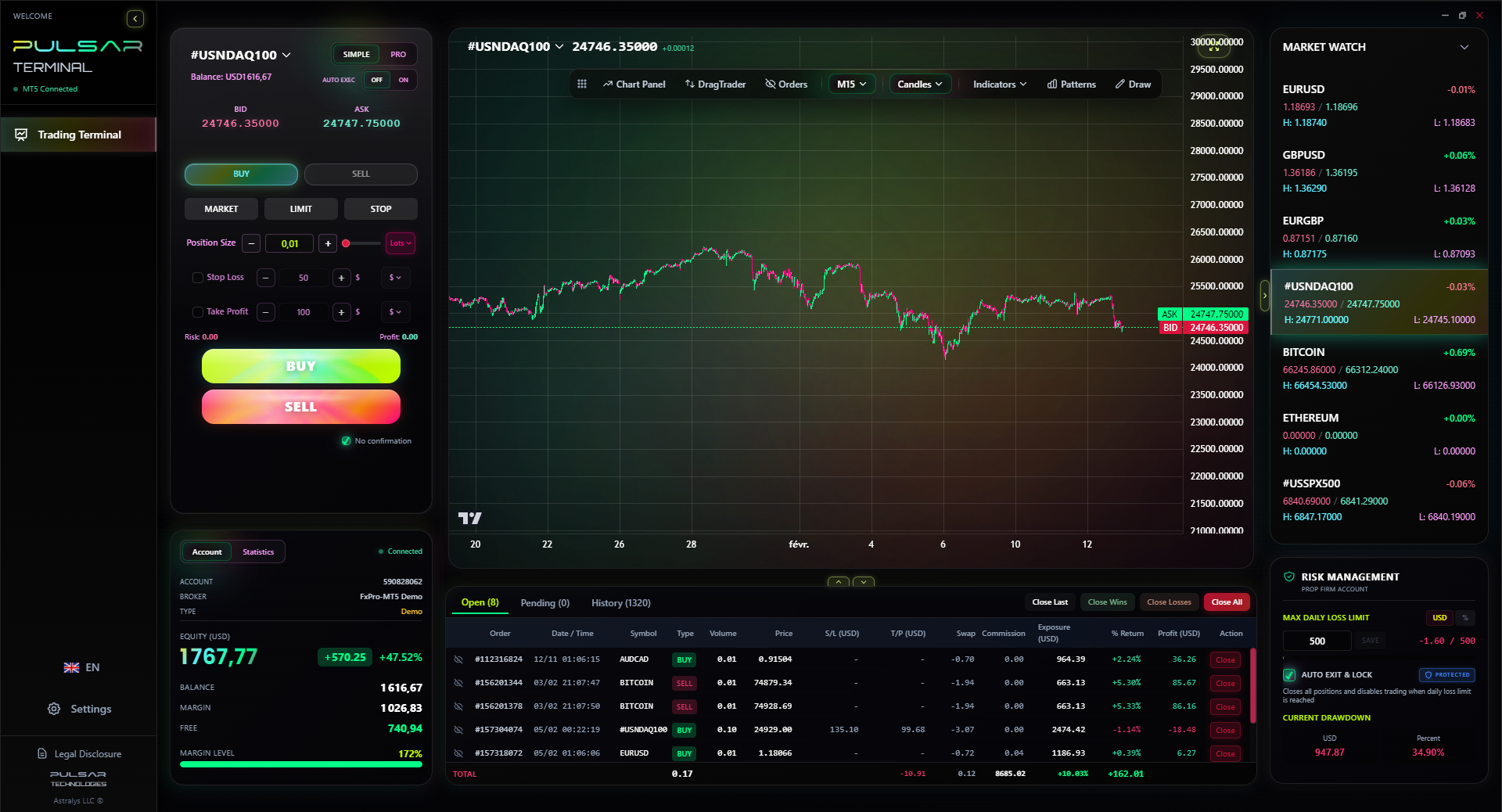
Managing multiple Bitcoin trades with different targets is complex, but Pulsar Terminal's multi-TP/SL and partial closure tools let you automate your entire exit strategy on MT5.
Pulsar Terminal
MT5 올인원 도구: 드래그앤드롭 주문, 다중 TP/SL, 트레일링 스톱, 그리드 트레이딩, 볼륨 프로파일, 프롭펌 보호. 매일 1,000명 이상의 트레이더가 사용.
“Regulation increased safety but also costs. The benefit? You're far less likely to get 'Mt. Gox'd'.”
This is where many new traders get burned. The advertised 'trading fee' is just one part of the story.
Trading Fees: These are usually tiered. On VALR Pro, if you trade under ZAR 100,000 in 30 days, you pay 0.10% as a taker. Trade over ZAR 10 million, and it drops to 0.025%. Plan your volume.
Deposit/Withdrawal Fees:
- EFT In: Usually free on local exchanges.
- EFT Out: R8 to R50 per withdrawal.
- Crypto Withdrawal: This is the big one. Moving Bitcoin off an exchange to your own wallet costs a network fee. During congestion, I've paid over R500 ($30) for a single transaction. Time your withdrawals when the mempool is clear.
Spread Costs: This is the hidden killer, especially on CFD brokers. The spread on BTC/USD might be $50 at a broker, which on one Bitcoin is fine, but as a percentage, it's huge for small moves. For a scalping strategy aiming for $100 profits, that $50 spread eats half your edge immediately.
The Real Cost of a Trade: Let's say you buy ZAR 50,000 of BTC on Luno as a taker (0.60% fee) and sell it a week later as a maker (-0.02% fee).
- Buy Fee: R300
- Sell Fee: -R10 (rebate)
- Net Fee: R290
You need the price to move over 0.58% just to break even on fees alone. That doesn't include the bid/ask spread. This is why active trading on high-fee platforms is a loser's game. Choose your platform based on your strategy.
💡 윈스턴의 팁
If you can't instantly explain the tax implication of your next trade, don't place it. The taxman is a more consistent winner than any trader.
“Regulation increased safety but also costs. The benefit? You're far less likely to get 'Mt. Gox'd'.”
I've made most of these mistakes so you don't have to.
Pitfall 1: Ignoring USD/ZAR volatility. In January 2024, I was up 15% on a Bitcoin trade in Dollar terms, but the Rand had strengthened so much I was only up 8% when cashing out to ZAR. Now I always check the forex pair.
Pitfall 2: Using the wrong platform for your goal. Want to hold Bitcoin long-term? Use a low-fee spot exchange like VALR. Want to day-trade with use? Use a regulated CFD broker like Pepperstone or IC Markets. Don't try to scalp on a spot exchange with high fees, and don't try to 'hold' a CFD long-term (you pay swap fees).
Pitfall 3: Not understanding tax liability. Every trade, even between crypto pairs (e.g., BTC to ETH), is a taxable event in SA. I got a nasty surprise tax bill in my second year of trading. Now I use crypto tax software specific to South Africa.
Pitfall 4: Chasing 'get-rich-quick' schemes on Telegram. If someone promises you guaranteed returns on Bitcoin forex trading, they're lying. The only people getting rich are the ones running the scheme. Stick to regulated platforms.
Pitfall 5: Poor security. Enable 2FA on every exchange and broker account. Use a hardware wallet for significant Bitcoin holdings. I learned after a friend lost R80,000 from a SIM-swap attack on his Luno account.
Pro Tip: Do a dry run. Withdraw a small amount of ZAR from your chosen platform back to your bank account before depositing large sums. Confirm the speed, fee, and process. It's the best way to test the plumbing.
“If you're long Bitcoin and the Rand is strengthening dramatically, you might take profit earlier. It's a two-currency game.”
The trend is clear: more regulation, more institutional involvement, and more integration with traditional finance.
The ZARU stablecoin that emerged in March 2026 is a sign of things to come. A Rand-pegged digital currency could make moving between ZAR and crypto seamless, reducing friction and potentially lowering costs.
The FSCA's three-year plan through to 2027 means even tighter oversight. This is good for consumer protection but may limit some of the wilder speculative products available internationally.
For traders, I think we'll see:
- More sophisticated trading tools on local platforms (better charts, more order types).
- Tighter spreads as competition and volume increase.
- Potential for Bitcoin ETFs listed on the JSE, giving another avenue for exposure.
The key for us as traders is to stay adaptable. The rules will change, the platforms will evolve, but the core principles of risk management and disciplined strategy won't. Keep learning, keep your records clean, and always know which version of 'bitcoin forex trading' you're actually engaged in.
The opportunity here is massive. With over 5.8 million South Africans already holding crypto, we're not early adopters anymore. We're building a mature market. Trade accordingly.
FAQ
Q1Is Bitcoin forex trading legal in South Africa?
Yes, but it's regulated. Trading Bitcoin itself is legal. Providing services as a broker or exchange requires an FSCA CASP license. Always use licensed platforms like VALR, Luno, or FSCA-regulated forex brokers offering crypto CFDs.
Q2What's the difference between buying Bitcoin on VALR and trading a Bitcoin CFD on Plus500?
On VALR, you own the actual Bitcoin. On Plus500, you own a contract that tracks the price. With CFDs, you can use use (increasing risk) and go short easily, but you pay financing charges and never own the asset. For long-term holding, use VALR. For short-term speculation, CFDs might suit you.
Q3How are Bitcoin trading profits taxed in South Africa?
SARS treats crypto trading as income (if you trade frequently) or capital gains. Every disposal (selling for ZAR, trading for another crypto) is a taxable event. You must declare profits in your annual tax return. Keep detailed records of every transaction, including dates, amounts in ZAR, and fees.
Q4Why is the Bitcoin price in ZAR sometimes different from the USD price converted?
Local supply and demand. If many South Africans are buying at once (FOMO), local exchanges can trade at a premium. Banking delays, load-shedding affecting arbitrage bots, and limited ZAR liquidity also cause price differences. This gap creates trading opportunities.
Q5What's the safest way to store Bitcoin in South Africa?
For large amounts, a hardware wallet (like Ledger or Trezor) you control is safest. For active trading amounts, keep it on a licensed, reputable exchange like VALR that uses cold storage for most client funds. Never leave large sums on unregulated platforms or in broker CFD accounts meant for trading, not storage.
Q6Can I use my normal forex trading strategy for Bitcoin?
You can apply similar technical analysis principles, but adjust for Bitcoin's extreme volatility (wider stops are needed) and 24/7 market. Also, factor in ZAR volatility if trading locally. A strategy that works on EUR/USD might blow up on Bitcoin if you don't account for the larger daily ranges.
Q7What's the minimum amount needed to start Bitcoin trading in SA?
You can start with very little. Some brokers like IFX Brokers have a $10 minimum for CFDs. On spot exchanges, you can buy fractions of a Bitcoin for R100. However, consider fees - trading very small amounts means fees eat a larger percentage of your capital. A more practical starting point is R1,000 to R2,000.
윈스턴 교수의 수업
핵심 요약:
- ✓ZAR/BTC trades at a persistent premium or discount vs. USD price.
- ✓Always verify FSCA CASP license before depositing any funds.
- ✓Every crypto-to-crypto trade is a taxable event for SARS.
- ✓Local market liquidity peaks between 9 AM and 4 PM SA time.
- ✓The spread is often your largest cost, not the commission.
이 기사가 얼마나 유용했나요?
별을 클릭하여 평가
주간 트레이딩 인사이트
무료 주간 분석 & 전략. 스팸 없음.
저자 소개
David van der Merwe
신흥시장 트레이더
요하네스버그 기반 트레이더로 신흥시장 통화 11년 경력. ZAR 통화쌍, FSCA 규제 거래, 남아공 시장 분석 전문.
댓글
위험 고지
금융 상품 거래에는 상당한 위험이 수반되며 모든 투자자에게 적합하지 않을 수 있습니다. 과거 성과가 미래 수익을 보장하지 않습니다. 이 콘텐츠는 교육 목적으로만 제공되며 투자 조언으로 간주되어서는 안 됩니다. 거래 전에 항상 직접 조사를 수행하십시오.
이 기사도 읽어보세요

Cara Trading Forex Sukses: 7 Prinsip dari Trader Profesional
Cara trading forex sukses dengan 7 prinsip trader pro: manajemen modal, disiplin, journal trading, backtest. Data nyata, bukan janji profit palsu.
Jam Trading Forex Terbaik untuk Trader Indonesia: Panduan Lengkap dengan Tabel Waktu
Panduan jam trading forex untuk trader Indonesia. Tabel 4 sesi dunia, jam emas 20:00-00:00, sesi mana yang harus dihindari. Data akurat + tips dari trader berpengalaman.
Top 5 Sàn Forex Uy Tín Nhất 2026: Review Jujur dari Trader Indonesia
Top 5 sàn forex uy tín 2026 untuk trader Indonesia. Review jujur: spread, deposit, withdraw, dukungan lokal. Exness, XM, IC Markets & lebih.
