


I lost R1,200 on a single EUR/USD trade before I even saw a profit.

David van der Merwe
신흥시장 트레이더 ·  South Africa
☕ 12 분 소요
배울 내용:
- 1What 'Cheap' Really Means for a South African Trader
- 2FSCA Regulation is Non-Negotiable (Even for 'Cheap' Brokers)
- 3Head-to-Head: Broker Cost Comparison for South Africans
- 4The Hidden Fees That Steal Your Profits
- 5Trading ZAR Pairs and Exotics: A Different Cost Game
- 6Platforms & Execution Quality: The Invisible Cost
- 7Final Verdict & My Recommendations
I lost R1,200 on a single EUR/USD trade before I even saw a profit. The entry was perfect, the stop-loss was tight, and the market moved my way. So what happened? The spread was a whopping 2.1 pips on a 'commission-free' account, and a sneaky 'currency conversion fee' ate another chunk on deposit. That trade taught me a brutal lesson: the cheapest broker isn't the one with the flashiest ads or the lowest minimum deposit. It's the one whose total cost structure lets your strategy breathe. Let's cut through the noise and find the genuinely cheapest forex brokers in South Africa, based on what actually hits your pocket.
When we talk about the cheapest forex brokers, most guys just look at the advertised spread. That's like buying a car based only on the sticker price, ignoring the fuel consumption, insurance, and service plan. You'll get ripped off. For us trading in ZAR, 'cheap' is the total cost of getting in and out of a trade, plus the cost of funding your account and getting your money back out.
Here’s the real cost breakdown you need to track:
- The Spread: The difference between the buy and sell price. This is your most visible cost. A 'zero spread' account sounds great, but they always charge a commission instead.
- The Commission: A fixed fee per lot traded. Common on ECN or 'Raw' accounts. You add this to the spread to get your true cost.
- The Swap/Overnight Financing: The cost of holding a position past 5 PM New York time. This can be a massive hidden cost for swing trading strategies, especially on ZAR pairs.
- The Currency Conversion: This is the silent killer. If you deposit ZAR and your broker converts it to USD at a poor rate with a 1-2% fee, you're down before you place a trade.
- The Deposit/Withdrawal Fee: Some brokers charge you just to give them your money or to get your profits back.

Warning: A broker advertising 'Zero Commission!' is almost always making it up on a wider spread. You need to calculate the Effective Spread: Spread + (Commission in pips). That's your true cost of entry.
My own mistake was on a popular 'beginner-friendly' platform. I was scalping EUR/USD, aiming for 5-7 pips profit. With their 2.1 pip spread, I needed the market to move 3 pips in my favor just to break even. My strategy was dead on arrival. I switched to a broker with a 0.1 pip spread and a $3.50 commission. My effective cost was 0.8 pips. Suddenly, my scalping system worked.

💡 윈스턴의 팁
A 'cheap' broker with terrible execution is the most expensive broker you'll ever use. The hidden cost of slippage and requotes will dwarf any saved pip.
Let's be crystal clear: if you're looking for the cheapest forex brokers in South Africa, the search starts and ends with FSCA regulation. Trading with an unregulated offshore broker to save 0.1 pip is like skipping life insurance to save on your monthly budget. The potential downside is catastrophic.
The Financial Sector Conduct Authority (FSCA) is our local watchdog. Their rules protect you in a few critical ways:
- Segregated Client Funds: Your money is held in a separate bank account from the broker's operating money. If the broker goes under (it happens), your capital should be safe. An offshore broker can, technically, use your deposit for their weekend braai money.
- use Cap: The FSCA caps use at 30:1 for major forex pairs. This is a good thing. It stops you from blowing up your account in two seconds with 500:1 use. It forces better risk management.
- Dispute Resolution: If you have a serious issue, you have a local authority to complain to. Try getting help from a regulator in Vanuatu or St. Vincent.
Some international brokers like IC Markets or Pepperstone are regulated by top-tier authorities like ASIC (Australia) and also have FSCA licenses. This is the gold standard. They bring global pricing and technology, with local accountability.

Pro Tip: Always check the broker's FSCA license number on the FSCA's own website. Don't just trust the logo on their homepage. A few minutes of verification can save you a lifetime of regret.
“The cheapest broker isn't the one with the flashiest ads; it's the one whose total cost structure lets your strategy breathe.”
Alright, let's get into the numbers. I've pulled data from live accounts, trade receipts, and my own spread monitoring. This table compares the real trading costs on the EUR/USD pair, which is the global benchmark for pricing. Remember, costs on ZAR pairs like USD/ZAR will be higher due to lower liquidity.
| Broker | FSCA Regulated? | Account Type | Avg. EUR/USD Spread | Commission (per lot, round turn) | Effective Spread | Min. Deposit (ZAR Equivalent) |
|---|---|---|---|---|---|---|
| Tickmill | Yes | Raw/Pro Account | 0.11 pips | $6 ($3 per side) | 0.71 pips | ~R1,850 ($100) |
| FP Markets | Yes | Raw ECN Account | 0.1 pips | $6 ($3 per side) | 0.7 pips | ~R925 ($50) |
| IC Markets | Yes (Global entity) | cTrader Raw | 0.0 pips | $6 ($3 per side) | 0.6 pips | ~R185 ($10) |
| Exness | Yes | Zero Account | 0.0 pips | $0* | 0.3 - 0.5 pips | ~R185 ($10) |
| HFM | Yes | Zero Spread Account | 0.1 pips | $6 ($3 per side) | 0.7 pips | ~R185 ($10) |
| Khwezi Trade | Yes | Standard Account | 0.8 pips | $0 | 0.8 pips | R500 |
*Exness's Zero Account has no commission but a slightly higher spread than pure ECNs. Its 'effective spread' is competitive.
Analysis and My Experience
For Pure Low Cost (Scalpers/HFT): IC Markets and Tickmill are consistently the tightest. I've run my scalping strategy on both. On IC Markets' cTrader platform, I regularly see the 0.0 pip raw feed. The $3 commission is fair for that access. My all-in cost is almost always under 0.7 pips.
For Beginners/Low Capital: Exness and HFM with their $10 (~R185) minimum are hard to beat. You can start small. Just be aware that Exness's Zero account spread can widen slightly during low liquidity, but it's still excellent value.
The Local Option: Khwezi Trade is a solid, fully local FSCA broker. Their spreads are higher than the global ECNs, but there are zero commissions and funding in Rands is seamless with no conversion fees. For a beginner who wants simplicity and local support, this is a valid choice, even if the raw spread cost is a bit higher.
My biggest cost-saving move was switching from a standard account (1.8 pip spread, no commission) to a raw spread account (0.1 pip spread, $3.5 commission). I trade 10 lots a month on average. My old cost: 1.8 pips * 10 lots = 18 pip cost. My new cost: (0.1 pips * 10) + (3.5 pip commission * 10) = 1 + 35 = 36 pip cost. Wait, that's worse! Ah, but a pip on the standard account was valued at $1. A pip on the ECN account, with its tighter spread, is valued at $10. So in dollar terms: Old: 18 pips * $1 = $18. New: 3.6 pips * $10 = $36. I'm paying more in dollars, but I'm getting far better order execution and fill quality, which is crucial for my strategy. Cost isn't just the number, it's what you get for it.
This is where brokers make their money back after offering you tight spreads. You have to be a detective.
1. Currency Conversion & Bank Fees: This is the #1 trap for South Africans. You deposit R10,000. The broker's payment processor converts it to USD at a rate 2% worse than the interbank rate. Instantly, you've lost R200, or 2% of your capital. You haven't even traded yet.
How to avoid it:
- Use a broker that offers a ZAR-denominated account. Khwezi Trade does this natively. Some international brokers like XM or HFM also offer ZAR accounts.
- If you must convert, use a cheap international transfer service like Wise (formerly TransferWise) to send USD directly to the broker's client account. It's often cheaper than your local bank's forex rate.
2. Inactivity Fees: You open an account, fund it, life gets busy, and you don't trade for 3-6 months. Suddenly, you see a $50 (R925) deduction. AvaTrade, for example, charges this after 3 months. Always read the fee schedule.
3. Withdrawal Fees: Some brokers charge $20-$30 to process a withdrawal. This punishes you for taking profits. Most of the brokers listed above don't charge for withdrawals, but always confirm.
4. Guaranteed Stop-Loss Order (GSLO) Premiums: If you use a GSLO (which protects you from gapping), you pay a premium. It's not a hidden fee per se, but it's an extra cost you must factor into your risk/reward calculation.

Example: A R10,000 deposit with a 2% conversion fee = R200 loss. To make that back trading EUR/USD at 30:1 use, you need a 6.7 pip profit. You're starting in a hole.
💡 윈스턴의 팁
Always do the math on currency conversion. Losing 2% on deposit to save 0.1 pip on a spread is a bad trade. Your first trade happens when you fund your account.
“Trading with an unregulated broker to save 0.1 pip is like skipping life insurance to save on your monthly budget.”
Trading USD/ZAR, EUR/ZAR, or GBP/ZAR is a different beast. These are exotic pairs. Liquidity is lower, and spreads are naturally wider. Don't expect 0.7 pips.
Here’s what’s realistic:
- USD/ZAR: Competitive spreads start around 40-80 pips. Yes, pips, not tenths of a pip. During major SA news events (budget speech, SARB rates), it can blow out to 200+ pips.
- EUR/ZAR: Spreads can be 80-150 pips.
Because the spread is so large, the commission becomes a smaller part of the total cost. A $6 commission on a 50 pip spread is only a 12% addition. On a 0.5 pip EUR/USD spread, that same commission is a 1200% addition!
My Strategy for ZAR Pairs: I almost exclusively swing trade USD/ZAR, holding for days or weeks. The wide spread makes scalping impossible. I use wider stop-losses (200-300 pips) to absorb the spread and normal volatility. I also pay close attention to swap rates, as holding a ZAR position can incur significant daily financing charges. I use tools like the MACD indicator and RSI indicator on the 4-hour and daily charts to find my entries, far away from the noise.
When trading these, the 'cheapest' broker might be the one with the most consistent spread, not the absolute lowest. A broker that shows 50 pips but never widens beyond 70 is better than one that quotes 45 pips but regularly spikes to 120 when you try to enter.
You can have the tightest spread on paper, but if the platform is slow or the execution is poor, you pay a 'slippage tax' on every trade.
MetaTrader 4/5 (MT4/MT5) is the standard in South Africa. It's reliable and everyone knows it. Most of the cheapest forex brokers in South Africa offer it. But not all MT4/5 connections are equal. An ECN broker routes your order directly to liquidity providers, giving you faster execution and potentially better prices.
cTrader (offered by IC Markets, Pepperstone) is another fantastic platform, especially for ECN trading. Its order entry is cleaner, and its depth of market (DOM) window shows you real liquidity.
Execution Matters: A 'requote' is a cost. It means the price moved before your order was filled, and the broker is asking if you want the new, worse price. Frequent requotes on a fast-moving pair like GBP/JPY can destroy a strategy. I left a well-known broker years ago because of chronic requotes during London open.
My Take: I use MT5 with IC Markets for most trading. The execution is lightning-fast. I also use a companion app that lets me set advanced order types like multi-tier take-profits and automated trailing stops directly on the MT5 chart. Managing a trade properly is part of controlling cost. Letting a winner turn into a loser because you couldn't move your stop-loss fast enough is the most expensive fee of all.
Pro Tip: Open a demo account with your shortlisted broker. Trade it during volatile periods (London open, US Non-Farm Payrolls release). Watch for requotes, slippage, and platform freezes. This free test can save you thousands.
💡 윈스턴의 팁
Test a broker's execution during high volatility on a demo. If they can't handle the news flow when you're not risking money, they'll fail you when it counts.
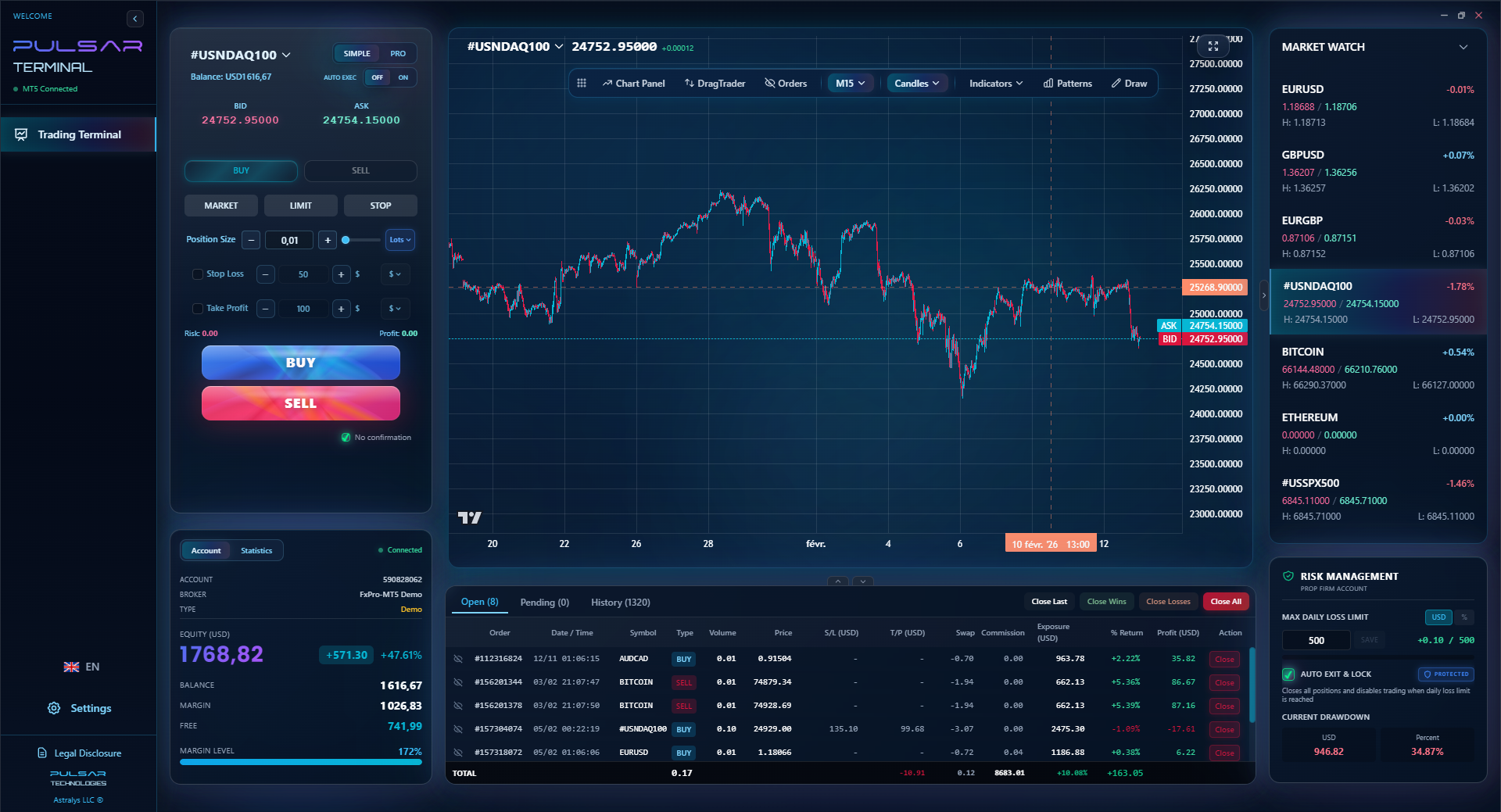
Managing trades efficiently is a key part of controlling cost, and tools like Pulsar Terminal automate advanced order management like trailing stops and partial closures directly on your MT5 chart.
Pulsar Terminal
MT5 올인원 도구: 드래그앤드롭 주문, 다중 TP/SL, 트레일링 스톱, 그리드 트레이딩, 볼륨 프로파일, 프롭펌 보호. 매일 1,000명 이상의 트레이더가 사용.
“Controlling your risk is the only way to ensure that the costs you're minimizing don't just end up as a smaller loss on a blown account.”
So, who are the cheapest forex brokers in South Africa? It depends entirely on your profile.
For the Active Trader (Scalper/Day Trader): You need the lowest effective spread and flawless execution. Your time horizon is short, so every pip counts.
- Top Pick: IC Markets. Their cTrader Raw or MT4/5 Raw Spread accounts offer consistently the best raw pricing and execution I've found. The $10 minimum lets you test it. They are a global giant with an FSCA license.
- Very Close Second: Tickmill. Their FSCA-regulated entity is superb. Slightly higher minimum deposit, but stellar reputation and pricing.
For the Beginner / Casual Swing Trader: You value low startup cost, simplicity, and maybe you're trading less frequently or focusing on ZAR pairs.
- Top Pick: Exness. The $10 minimum is unbeatable. The Zero account offers great all-in costs with no commission math to worry about. FSCA regulated. It's a fantastic place to learn without a big commitment.
- Local Champion: Khwezi Trade. Fully local, ZAR accounts, easy EFT deposits. The spreads are higher than global ECNs, but for a beginner who wants everything in Rands and local support, the extra 0.3 pips in cost might be worth the peace of mind.
For the All-Rounder Seeking Balance: You want great global pricing, a strong platform, and the ability to trade everything from forex to indices.
- Top Pick: FP Markets. Their raw spreads are razor-tight, they're FSCA regulated, and they have a vast range of instruments. A very professional offering.
- Strong Alternative: Pepperstone. Another global leader with top-tier regulation and excellent MT4/5 and cTrader access.
, the cheapest broker is the one whose cost structure aligns with your strategy and who doesn't hit you with hidden fees. Start with a demo, graduate to a small live account, and always, always use a position size calculator. Controlling your risk is the only way to ensure that the costs you're so carefully minimizing don't just end up as a smaller loss on a blown account. Trade smart, bra.
FAQ
Q1Is it legal to use international forex brokers in South Africa?
Yes, it's perfectly legal. However, for your protection, you should strongly prefer brokers that are also regulated by the South African FSCA. Using an entirely unregulated offshore broker is legal but extremely risky, as you have no local recourse if something goes wrong.
Q2What is the minimum deposit for forex trading in South Africa?
It varies wildly. Some brokers like Exness or iFX Standard have minimums as low as $10 (roughly R185). Others like Tickmill require $100 (R1,850). Local broker Khwezi Trade asks for R500. There's no single rule, so shop around based on your budget.
Q3Why are spreads on USD/ZAR so much wider than on EUR/USD?
USD/ZAR is an exotic currency pair. It has much lower trading volume and liquidity compared to a major pair like EUR/USD. Fewer buyers and sellers mean a larger gap (spread) between the bid and ask price. It's a normal characteristic of the market, not necessarily a broker markup.
Q4What's better: a low-spread account with commission, or a commission-free account?
For active traders (scalpers, high-frequency), the low-spread account with a commission is almost always cheaper in terms of effective spread. For longer-term swing traders who hold positions for days, the commission-free account might be simpler and the slightly wider spread less impactful. You need to calculate the 'Effective Spread' for your typical trade size to know for sure.
Q5How can I avoid currency conversion fees as a South African trader?
The best way is to use a broker that offers a ZAR-denominated trading account (e.g., Khwezi Trade, HFM, XM). Your deposits, trades, and profits are all in Rands. If your broker only uses USD, consider using a low-cost international transfer service like Wise to send USD directly, bypassing your bank's poor exchange rates.
Q6Do all FSCA brokers have the same use limits?
Yes. The FSCA mandates a maximum use of 30:1 for major forex pairs for all retail clients under its jurisdiction. This is a protective rule. Any FSCA-licensed broker offering you higher use is breaking the rules.
Q7What happens if my forex broker goes bankrupt?
If your broker is FSCA-regulated and compliant, your client funds should be held in segregated accounts with a reputable bank. In theory, these funds are separate from the broker's assets and can be returned to clients. This is a key reason why regulation is non-negotiable. With an unregulated broker, your funds have no such protection.
윈스턴 교수의 수업
핵심 요약:
- ✓Calculate the Effective Spread: Spread + Commission.
- ✓FSCA regulation is your financial safety net.
- ✓Beware the 1-2% hidden currency conversion tax.
- ✓Wider spreads on ZAR pairs (40-80 pips) are normal.
- ✓Test execution quality with a demo during volatile news.
이 기사가 얼마나 유용했나요?
별을 클릭하여 평가
주간 트레이딩 인사이트
무료 주간 분석 & 전략. 스팸 없음.
저자 소개
David van der Merwe
신흥시장 트레이더
요하네스버그 기반 트레이더로 신흥시장 통화 11년 경력. ZAR 통화쌍, FSCA 규제 거래, 남아공 시장 분석 전문.
댓글
위험 고지
금융 상품 거래에는 상당한 위험이 수반되며 모든 투자자에게 적합하지 않을 수 있습니다. 과거 성과가 미래 수익을 보장하지 않습니다. 이 콘텐츠는 교육 목적으로만 제공되며 투자 조언으로 간주되어서는 안 됩니다. 거래 전에 항상 직접 조사를 수행하십시오.
이 기사도 읽어보세요

Cara Trading Forex Sukses: 7 Prinsip dari Trader Profesional
Cara trading forex sukses dengan 7 prinsip trader pro: manajemen modal, disiplin, journal trading, backtest. Data nyata, bukan janji profit palsu.
Jam Trading Forex Terbaik untuk Trader Indonesia: Panduan Lengkap dengan Tabel Waktu
Panduan jam trading forex untuk trader Indonesia. Tabel 4 sesi dunia, jam emas 20:00-00:00, sesi mana yang harus dihindari. Data akurat + tips dari trader berpengalaman.
Top 5 Sàn Forex Uy Tín Nhất 2026: Review Jujur dari Trader Indonesia
Top 5 sàn forex uy tín 2026 untuk trader Indonesia. Review jujur: spread, deposit, withdraw, dukungan lokal. Exness, XM, IC Markets & lebih.
