


Thinking about handing your hard-earned Rand to a company that trades forex for you? You're not alone.

David van der Merwe
신흥시장 트레이더 ·  South Africa
☕ 10 분 소요
배울 내용:
- 1What Are These "Companies" Anyway?
- 2FSCA Rules and What They Actually Mean For You
- 3The Real Costs and Fees (They Add Up Fast)
- 4Copy Trading & Signal Services: The Retail Casino
- 5Prop Firms vs. Managed Accounts: Don't Confuse Them
- 6How to Vet a Company (The Due Diligence Checklist)
- 7The Alternative: Why Learning Yourself (Slowly) Wins
- 8Final Verdict for South African Traders
Thinking about handing your hard-earned Rand to a company that trades forex for you? You're not alone. With over 200,000 active traders in South Africa, the promise of passive income from forex is a powerful lure. But before you let someone else manage your money, you need to understand what you're really buying. Is it a legitimate investment service or a fast track to losing your capital? Let's cut through the marketing and look at the reality of these services under the FSCA's watch.
When you hear about companies that trade forex for you, they're usually one of three things: a licensed asset manager, a broker offering a managed account program, or a tech platform facilitating copy trading. The key difference is who's actually pulling the trigger on the trades.
A Discretionary FSP (Financial Services Provider) licensed by the FSCA can legally manage your money directly. They make all the trading decisions. This is the most traditional form of investment management.
Then you have broker-managed programs, often called PAMM (Percentage Allocation Management Module) or MAM (Multi-Account Manager) accounts. Here, you allocate funds within your brokerage account to a chosen trader or strategy. The broker's system automatically replicates their trades in your account, proportional to your allocation. Brokers like AvaTrade and FP Markets offer these.
Finally, there's social or copy trading. Platforms like eToro or built-in features on MT4/MT5 let you automatically copy the trades of other individuals. This isn't a company managing your funds; it's you choosing to mirror another retail trader. It's crucial to know the difference, as the regulatory protection varies wildly.

Warning: Many "forex fund managers" advertising on social media operate without an FSCA license. If they're taking discretionary control of your funds without a Category I or II FSP license, they are breaking the law. Full stop.

💡 윈스턴의 팁
A manager's past performance is less important than their worst drawdown. Ask them: 'What was your maximum peak-to-trough loss, and how long did it take to recover?' If they hesitate, you have your answer.
The Financial Sector Conduct Authority is the sheriff in town. Their job is market conduct, not to guarantee your profits. For a company to legally trade forex on your behalf in South Africa, they need a specific license.
The License You Must Check For
A company needs a Discretionary FSP license (Category I or II). This isn't the same license your broker has. You can verify any FSP number on the FSCA's website in two minutes. If they can't provide one, walk away. This license means they've met capital requirements, have a physical presence in SA, and their key individuals have passed regulatory exams.
The 30:1 use Cap
This is a big one. Since 2021, the FSCA capped use at 30:1 for retail clients. Any legitimate FSCA-regulated manager or broker must adhere to this. If a "managed service" is offering you 100:1 or 500:1 use, they are either breaking local rules or you're being routed through an offshore entity, stripping you of FSCA protection. That higher use isn't a feature; it's a giant red flag for risk.
Segregation of Funds
FSCA-licensed providers must keep client funds in segregated accounts, separate from the company's operating money. This protects you if the company goes bankrupt. Your money isn't theirs to use for payroll. This is a non-negotiable for any real investment firm.
“Copy trading doesn't teach you to fish; it just gives you someone else's rod until they drop it.”
Nothing is free. When a company trades forex for you, they get paid, and the broker gets paid. You need to add up all the layers.
First, the brokerage costs. Even in a managed account, you still pay spreads or commissions. On a major pair like EUR/USD, a good ECN broker might charge a 0.1 pip spread plus a $7 commission per lot. On an exotic like USD/ZAR, the spread alone can be 50-100 pips. Your manager's trades incur these costs on your account.
Then, the management fee. This is typically a percentage of your assets under management (AUM), say 1-2% per year. On a R100,000 account, that's R1,000-R2,000 a year, whether they make you money or not.
The killer is the performance fee. This is often 20% of the profits. Here's the rub: they usually calculate this on a "high-water mark" basis. If they make you 10% one year (R10,000), they take R2,000. If they lose 10% the next year, you're back to start. They don't owe you anything. But to earn their fee again, they must get you back above that previous high point. This structure incentivizes them to swing for the fences after a loss.
Let me give you a personal example. I once tested a popular MAM service on a XM account with a $5,000 allocation. The manager was aggressive. In six months, they generated a 15% return ($750). Sounds good? After the 20% performance fee ($150) and the broker's commissions/spreads (approx. $120), my net gain was $480. Then the manager hit a losing streak and gave back all the gains plus 5% in two weeks. I was down, but they had already banked their $150 fee. I closed the account.

Example: Initial Capital: R100,000 Year 1 Profit: 12% (R12,000) Performance Fee (20%): -R2,400 Management Fee (1.5%): -R1,500 Estimated Broker Costs: -R800 Net Gain to You: R7,300 That's a 7.3% net return, not 12%. You need to understand the net figure.
This is where most newcomers get burned. Copy trading and signal services market themselves as a shortcut to expertise. They're not.
When you copy a trader on eToro or use a signal service, you are delegating your decisions to another retail trader, often with zero formal qualifications. You're paying for their luck, not their skill. The stats are brutal: over 70% of retail traders lose money. By copying one, you're just automating your way into that majority.
Signal services are a subscription model. You pay R500-R600 per month for SMS or Telegram alerts. I subscribed to a well-known one for three months back in 2020, costing me about $110 total. Their "VIP signals" had a hit rate of about 55%. The problem? The risk/reward was terrible. They'd call a trade targeting 15 pips with a 50-pip stop loss. You'd need an 80% win rate just to break even on that math. I lost 2% of my test stake following them blindly.
The psychological trap is the worst part. When a copied trade wins, you feel like a genius. When it loses, you blame the signal provider. You learn nothing. You develop no sense of market rhythm, no ability to read a MACD divergence or understand why a scalping strategy works in London but not Tokyo. You remain a permanent passenger.

Pro Tip: If you insist on trying copy trading, use a demo account for at least three months. Track every copied trade. Calculate the net profit after spreads. You'll quickly see that the star trader's 40% monthly gain on the leaderboard doesn't account for slippage and doesn't last.
💡 윈스턴의 팁
Add up all the fees - management, performance, spreads. If the total annual cost is over 3% of your capital, the manager needs to generate consistent returns well above that just for you to break even with a savings account. The math is rarely in your favor.
“The FSCA's 30:1 use cap isn't a limitation; it's a life jacket most retail traders don't know they need.”
This is a critical distinction. A proprietary trading firm (prop firm) like FTMO or The5%ers is NOT a company that trades forex for you. It's the opposite.
You give them a small fee (for a "challenge"), and they give you simulated capital to trade. If you pass their rules, you get to trade their capital and keep a large share of the profits (e.g., 80-90%). They are evaluating your skill. They have zero interest in managing your personal money.
These firms are largely unregulated. Their business model is based on most traders failing the challenges. The rules are intentionally strict: a maximum daily loss, a maximum overall loss, minimum trading days. They force a discipline most lack. I've passed a few challenges and blown a few more. The one I passed required a 10% profit target with a 5% max loss. I used a conservative swing trading approach on XAU/USD and just barely made it, highlighting how tough it is.
Some scam artists blur this line. They might claim to be a "prop firm" but ask for a large "investment" from you to manage. That's not a prop firm; that's an unlicensed, likely fraudulent, managed account scheme. A real prop firm takes risk on you, not the other way around.
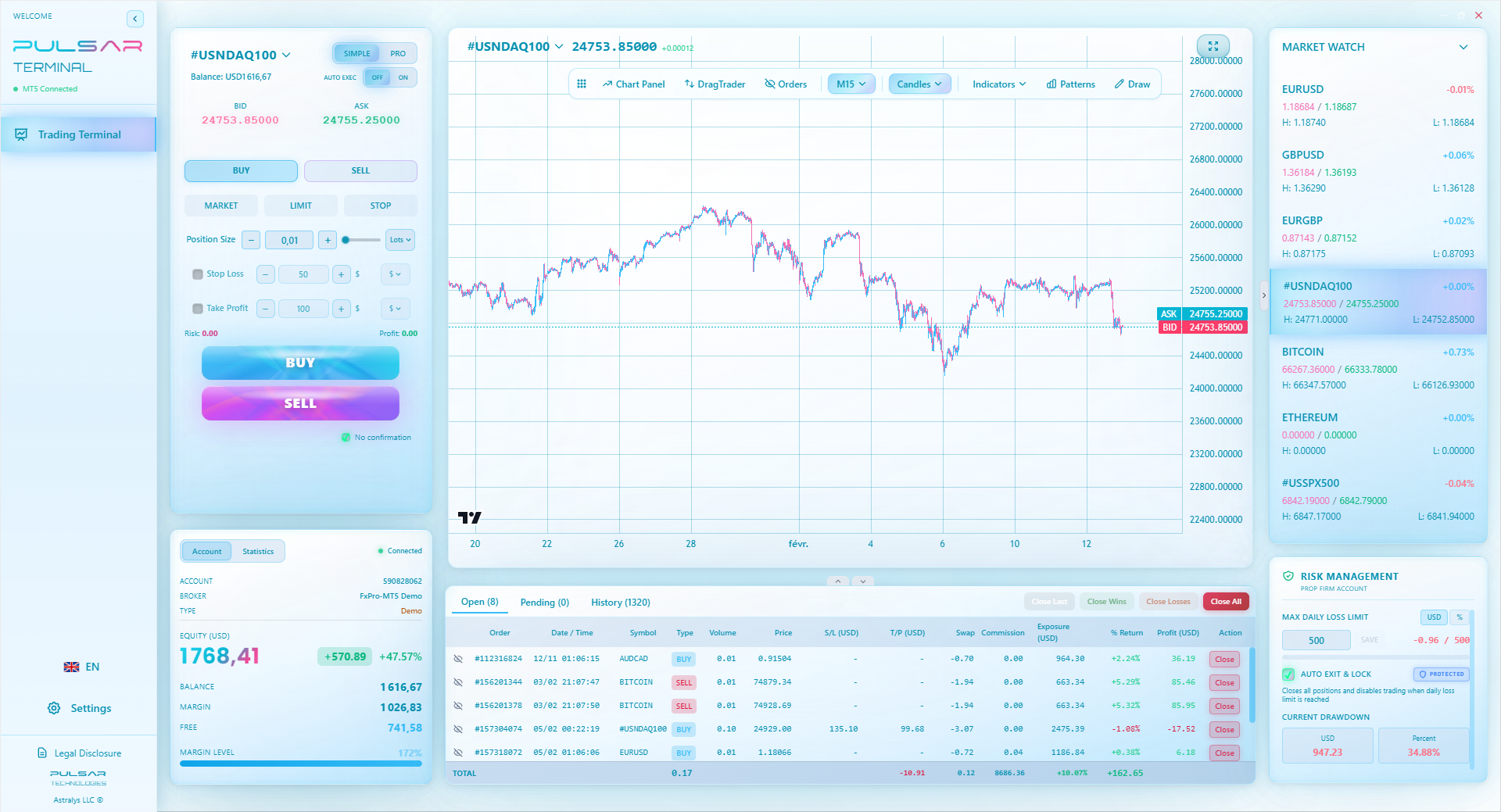
If you're serious about developing your own trading skill, precise order management is non-negotiable, which is where a tool like Pulsar Terminal for MT5 excels.
Pulsar Terminal
MT5 올인원 도구: 드래그앤드롭 주문, 다중 TP/SL, 트레일링 스톱, 그리드 트레이딩, 볼륨 프로파일, 프롭펌 보호. 매일 1,000명 이상의 트레이더가 사용.
If you're still considering a managed route, do this homework. Skipping a step is financial suicide.
- FSCA License Check: Get their FSP number. Go to the FSCA website. Verify the license is active and includes "Discretionary" services. Check the named Key Individuals.
- Audited Track Record: Demand a multi-year, audited performance statement. Not a MyFxBook link (those can be manipulated), but a PDF from an independent auditor. Anyone can have a good six months. You want to see how they performed in 2020's COVID crash or during EUR/USD volatility.
- Fee Structure in Writing: Get the full fee schedule. Management fee, performance fee calculation (high-water mark?), brokerage costs. What's the total expense ratio (TER)?
- Risk Disclosure: How do they define risk? What's their maximum expected drawdown? If they say "we aim for 5% monthly with minimal risk," hang up. That's a fantasy.
- Interview Them: Ask: "What is your edge?" "How does your strategy change in a low-volatility vs. high-volatility environment?" "Can you show me a specific trade from last year and explain the thesis?" If they can't answer clearly, they're guessing.
- Withdrawal Process: How do you get your money out? What's the notice period? If it sounds complicated, it's a trap.
💡 윈스턴의 팁
Before copying a trader, look at their average loss vs. average win. A trader with a 70% win rate but a risk-reward ratio of 1:3 (risking R300 to make R100) will lose money over time. The ratio matters more than the win rate.
“A good six-month track record is luck. A good five-year track record that includes a market crisis is worth examining.”
I know, you're busy. You want results. But hear me out. Paying a company to trade for you is like paying a personal trainer to lift weights for you. The muscle, the resilience, the knowledge - it never becomes yours.
Starting small with your own education is cheaper in the long run. That R20,000 you might give to a manager? Put R5,000 in a live account with a micro lot size at a broker like IC Markets or Pepperstone. Use the other R15,000 as "tuition" you are prepared to lose. Your goal for the first year isn't profit. It's survival. It's learning what a pip really costs, how emotion affects you, how to use a position size calculator before every trade.
Focus on one thing. Don't jump from RSI scalping to news trading. Pick a single currency pair and a single time frame. Study it. Keep a journal. I started with only GBP/USD on the 4-hour chart. For a year, that was my entire world. It was boring, but it built a foundation.
The brutal truth is this: the financial incentive for companies that trade forex for you is to gather assets and collect fees. Their incentive is not necessarily to make you rich. Your incentive, when you trade for yourself, is purely to protect and grow your capital. Those two motives are rarely perfectly aligned. When you control the trade, you control the risk. You might fail, but you'll fail on your own terms and learn why. That lesson is worth more than any temporary profit from a copied trade.
So, should you use companies that trade forex for you? For the vast majority of South Africans, the answer is no.
The legitimate, FSCA-licensed discretionary managers are typically targeting high-net-worth individuals (think portfolios well into the millions). They aren't chasing your R50,000 on Instagram. The accessible options - copy trading and unlicensed "managers" - are statistically likely to lose your money while teaching you nothing.
If you are determined to go the managed route, treat it as a serious investment. Allocate only capital you can truly afford to lose. Do the exhaustive due diligence. Understand that even with the best manager, you are still exposed to the inherent risks of the forex market.
For everyone else, the path is slower but far more empowering. Embrace the grind of learning. Use the FSCA's use cap as a built-in risk manager. Start small, journal everything, and focus on capital preservation above all else. The market isn't going anywhere. It's better to arrive late with your capital intact than to rush in and have to start over from zero.
FAQ
Q1Is it legal for a company to trade forex for me in South Africa?
Yes, but only if the company holds a valid Discretionary FSP (Financial Services Provider) license from the FSCA (Financial Sector Conduct Authority). This is a specific license category (I or II). Many individuals and firms offering management services on social media do not have this license and are operating illegally.
Q2What's the difference between a PAMM account and copy trading?
A PAMM (Percentage Allocation Management Module) account is a formal arrangement through a broker where a designated manager trades a pooled fund. You own a share. Copy trading is a social feature where you automatically replicate another retail trader's individual trades in your own separate account. PAMMs are typically offered by professional managers, while copy trading involves following other amateurs.
Q3What fees should I expect with a managed forex account?
Expect multiple layers: 1) Brokerage costs (spreads/commissions), 2) A management fee (often 1-2% of your assets per year), and 3) A performance fee (often 20% of profits, usually calculated with a "high-water mark"). These fees significantly eat into your net returns.
Q4Are proprietary trading firms (prop firms) a type of managed account?
No, they are the opposite. Prop firms provide you with simulated capital to trade under their rules. You are the trader. They are not managing your personal money. Be wary of any "prop firm" that asks for a large investment from you - that's likely a scam.
Q5Can I use an international broker for a managed account?
You can, but you lose FSCA protection. More importantly, any legitimate South African-based discretionary manager must be FSCA-licensed, regardless of the broker they use. If they're routing you to an offshore broker to avoid the 30:1 use cap, it's a major red flag.
Q6What's the single most important thing to check before giving a company my money?
Their FSCA Discretionary FSP license number. Verify it yourself on the FSCA's official website. Check that the license is active and the named Key Individuals are listed. No license, no deal.
Q7Is copy trading a good way to learn forex?
It's one of the worst ways. You become a passive follower. You don't learn the reasoning behind trades, risk management, or how to handle emotions. You might make money short-term, but you build zero lasting skill. It creates dependency, not competence.
윈스턴 교수의 수업
핵심 요약:
- ✓Verify the FSCA Discretionary FSP license. No exceptions.
- ✓Total fees over 3% per year make profitability a steep climb.
- ✓Copy trading teaches dependency, not market skill.
- ✓Prop firms test your skill; they don't manage your money.
- ✓Always calculate net return after ALL costs.
이 기사가 얼마나 유용했나요?
별을 클릭하여 평가
주간 트레이딩 인사이트
무료 주간 분석 & 전략. 스팸 없음.
저자 소개
David van der Merwe
신흥시장 트레이더
요하네스버그 기반 트레이더로 신흥시장 통화 11년 경력. ZAR 통화쌍, FSCA 규제 거래, 남아공 시장 분석 전문.
댓글
위험 고지
금융 상품 거래에는 상당한 위험이 수반되며 모든 투자자에게 적합하지 않을 수 있습니다. 과거 성과가 미래 수익을 보장하지 않습니다. 이 콘텐츠는 교육 목적으로만 제공되며 투자 조언으로 간주되어서는 안 됩니다. 거래 전에 항상 직접 조사를 수행하십시오.
이 기사도 읽어보세요

Cara Trading Forex Sukses: 7 Prinsip dari Trader Profesional
Cara trading forex sukses dengan 7 prinsip trader pro: manajemen modal, disiplin, journal trading, backtest. Data nyata, bukan janji profit palsu.
Jam Trading Forex Terbaik untuk Trader Indonesia: Panduan Lengkap dengan Tabel Waktu
Panduan jam trading forex untuk trader Indonesia. Tabel 4 sesi dunia, jam emas 20:00-00:00, sesi mana yang harus dihindari. Data akurat + tips dari trader berpengalaman.
Top 5 Sàn Forex Uy Tín Nhất 2026: Review Jujur dari Trader Indonesia
Top 5 sàn forex uy tín 2026 untuk trader Indonesia. Review jujur: spread, deposit, withdraw, dukungan lokal. Exness, XM, IC Markets & lebih.
